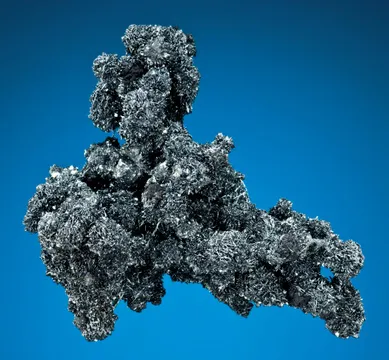
Huanuni Ludlamite — Bolivia: premier locality yielding lustrous green architectural crystals on matrix, with vivianite and pyrite, prized by collectors.
Key facts
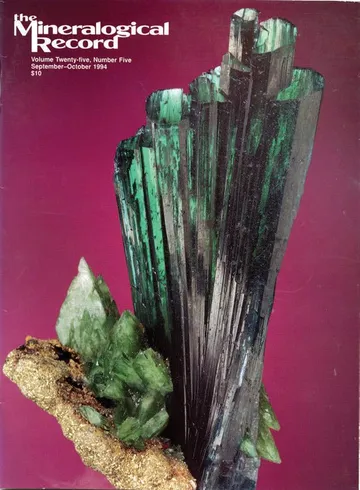
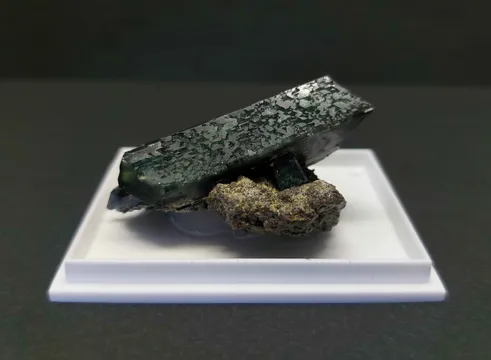
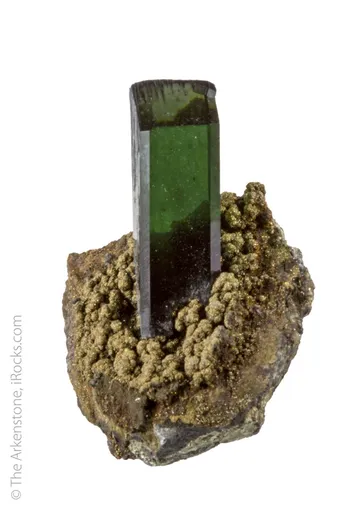
Huanuni is one of the great modern names for ludlamite. The finest specimens show what collectors hope the species can be: transparent to translucent, bottle-green crystal groups with a wet vitreous luster, fanning outward in layered sprays, bowties, butterflies, and wheat-sheaf clusters. On the best pieces the green phosphate sits in sharp contrast against brassy pyrite, brown limonite, tan siderite, dark sphalerite, or deep blue-green vivianite, giving Huanuni material a far more dramatic matrix presence than most ludlamite from pegmatite environments.

Photo: Wikimedia Commons
The locality is not a phosphate pegmatite but a major Andean tin-polymetallic system. Ludlamite here belongs to the late, low-temperature phosphate story of an intensely mineralized tin mine: a rare hydrated ferrous phosphate, Fe2+3(PO4)2·4H2O, found with pyrite, siderite, vivianite, quartz, limonite, sphalerite, cassiterite, and fluorapatite in a deposit famous above all for cassiterite. That setting is part of the appeal. Huanuni ludlamite is not a detached curiosity; it is a colorful secondary accent born within one of Bolivia’s most important tin deposits.

Photo: Wikimedia Commons
For collectors, Huanuni’s importance rests on both quality and continuity. Several classic ludlamite localities have produced admired specimens, but Huanuni is repeatedly singled out in dealer, museum, and database records as the source of some of the finest crystallized examples: lustrous green sprays on matrix, miniature to cabinet pieces with well-isolated crystal groups, and rare combinations with vivianite. The most desirable specimens are not simply green; they are architectural. A good Huanuni piece has crisp terminations, visible transparency, a balanced cluster rather than a rubbed mass, and a matrix that tells the Bolivian tin-mine story at a glance.

Photo: Wikimedia Commons
Search for specimens: View all ludlamite specimens from Huanuni Mine, Bolivia
Huanuni Mine is at Huanuni in Pantaleón Dalence Province, Oruro Department, Bolivia, near 18°17'03"S, 66°49'59"W. It is an active mine locality on and around Pozokoni Hill, in the central part of the Eastern Cordillera of the Bolivian Andes. In mineral-collector geography it belongs to the Bolivian Tin Belt, a chain of exceptionally productive tin-polymetallic deposits that has shaped both Bolivia’s economy and its specimen culture.
The deposit is a hydrothermal Sn-W-Pb-Ag-Zn system hosted mainly by Paleozoic sedimentary rocks: quartzites, shales, and siltstones of the Llallagua, Uncía, and Cancañiri formations, with lesser mineralization in Miocene volcanic rocks of the Morococala Formation. The ore structures are fissure-filling veins, many of them less than a meter thick, crudely banded and mineralogically complex. The early assemblage includes quartz and tourmaline, followed by cassiterite and successive sulfide, sulfosalt, carbonate, clay, and phosphate stages. Fluid-inclusion work has recorded hot saline brines, with homogenization temperatures reported as high as 425 °C, placing Huanuni firmly in the high-energy hydrothermal tradition of the central Andes.
Huanuni is also a historical mine in the fullest sense. In the nineteenth century it was exploited for silver minerals. By the second decade of the twentieth century, cassiterite had become the principal ore. Since 1952, after Bolivia’s mining nationalization, the mine has belonged to COMIBOL, the Corporación Minera de Bolivia. Modern mineralogical work describes it as Bolivia’s largest tin producer, and one of the key tin deposits of the world.
The mine’s commercial life has never been separate from its social history. Huanuni has remained an active industrial operation rather than a casual collecting ground. Collecting access should be regarded as restricted and mine-controlled; specimen material reaches the market through miners, local networks, and established dealers rather than through open recreational collecting. That matters for provenance. A sound Huanuni ludlamite specimen should carry a credible old label, dealer history, or mine-to-dealer chain whenever possible, because the mine has produced multiple green phosphate minerals and collectors often prize locality-specific associations.
Notable finds include classic ludlamite sprays and bowties from late twentieth-century and early twenty-first-century production, vivianite-ludlamite combinations on pyrite, ludlamite on siderite, and pieces large enough to enter museum and high-end dealer inventories. Huanuni is also the type locality for aheylite and nikischerite, underscoring how phosphate and sulfate mineralogy continued to develop in the late stages of a deposit better known to industry for tin.
Huanuni ludlamite is most recognizable as sharp, lustrous green crystals arranged in layered aggregates. Common descriptive forms include sprays, sheaves, bowties, butterflies, rosettes, and flattened fan-like groups. Older classic specimens are often described as flatter and more fan-like, with spiky terminations; a later rediscovery produced thicker, tighter, wheat-sheaf-like groups on siderite. Individual crystal groups documented in specimen records commonly measure around 8 mm to 2 cm, while exceptional groups reach several centimeters across. A few high-end cabinet pieces show large, well-positioned sprays, including examples with a ludlamite spray reported at 4.5 cm across.
The color range is one of the locality’s great strengths. Huanuni crystals may be pale green, bottle green, yellow-green, smoky green, or deep forest green. The best pieces combine saturated green color with transparency or strong translucency, so that individual blades appear alive under light rather than merely painted onto matrix. Luster is typically vitreous to slick, especially on fresh faces; dulled or chalky surfaces lower desirability sharply.
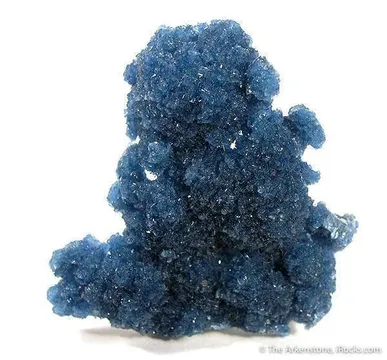
Matrix associations are a key part of identification and value. Mindat photo data for Huanuni ludlamite most commonly records pyrite and siderite, with vivianite also a significant association. Quartz, limonite, sphalerite, cassiterite, and fluorapatite are recorded less often but are important when present. Pyrite gives the classic metallic contrast: green ludlamite on brassy cubes or drusy pyrite. Siderite gives a warmer, tan to brown base. Vivianite combinations are especially prized when the two phosphates remain visibly distinct: ludlamite in green sprays and vivianite as blue to blue-green crystals.
Huanuni quality is judged by crystal integrity, isolation, composition, and matrix aesthetics. The best specimens have complete terminations, little bruising, minimal iron staining on crystal faces, and a clear central spray or bowtie that is not swallowed by limonite. Miniatures can be more desirable than larger pieces if the crystal group is sharp, glassy, and well-centered. Large cabinet specimens become truly important only when the ludlamite remains visually dominant and not merely scattered as small green patches.
Huanuni ludlamite is a serious collector species, not a bulk-market mineral. Fine crystallized material appears intermittently from old collections, specialist dealers, and occasional rediscoveries, but it is not abundant in the way common Bolivian pyrite, siderite, or quartz specimens can be. Dealer records show a wide range: modest small specimens, strong miniatures, expensive small-cabinet pieces, and rare top-end examples priced as major species representatives.
The main authenticity concern is attribution rather than treatment. Ludlamite itself is not a typical dyed, heated, or stabilized mineral in the specimen trade, but Huanuni pieces should be checked against the known locality style: green monoclinic crystal groups on pyrite, siderite, limonite, sphalerite, quartz, cassiterite, or with vivianite. Be cautious with vague labels such as “Bolivia” or “Oruro” when the price depends on Huanuni provenance. Morococala and other Bolivian localities are also cited for ludlamite, and a precise Huanuni label should not be assumed without supporting evidence.
Condition is critical. Ludlamite has perfect cleavage and is not a hard mineral, so Huanuni sprays are vulnerable to edge bruising, broken terminations, pressure marks, and old glue repairs. Inspect the central “hinge” of bowtie and sheaf aggregates, where damage can be hidden by iron oxides or matrix. On specimens with vivianite, protect the piece from strong light and heat; vivianite is famously light-sensitive, and even when the ludlamite is the main species, the associated vivianite can darken or shift in appearance.
Storage should be conservative: dry, stable, and away from direct sunlight. Avoid ultrasonic cleaning and aggressive chemical cleaning. Iron oxides and limonite are part of the natural Huanuni matrix on many pieces; trying to “improve” them can strip context, dull the ludlamite, or destabilize the specimen.
The story of Huanuni begins as a shift in metal and destiny. In the nineteenth century, the mine was worked for silver minerals. By the second decade of the twentieth century, cassiterite had become the chief prize, and the mine’s identity moved decisively from silver to tin. The specimen collector sees only the green crystal sprays; the miner sees Pozokoni Hill, veins, galleries, recovery, and ore. That dual identity is what gives Huanuni ludlamite its particular weight: a delicate phosphate from a working tin giant.
One of the most vivid chapters in the mine’s modern history unfolded on October 5 and 6, 2006, when violence broke out between salaried COMIBOL miners and cooperative miners over access to rich parts of the Huanuni deposit. Contemporary reports describe fighting with dynamite, knives, sticks, stones, and guns. One account reported sixteen dead and 115 injured; another reported the official death toll rising to twenty-one, with more than fifty seriously wounded. The numbers are stark, but so is the image of the mine itself: one of Bolivia’s most valuable tin deposits becoming a battlefield over underground access.
At the time, reports described about 1,200 government-employed miners and 4,000 independent miners working at Huanuni, with the mine producing about 10,000 tons of tin per year, slightly more than half of Bolivia’s total tin production. In collector language, “Huanuni” can sound like a tidy locality label. In Bolivian mining history, it is a place where ore, labor, politics, and survival have repeatedly collided.
A quieter but important collector story came later with the reappearance of fine ludlamite from the old producing ground. A notable dealer description characterized the material as a recent rediscovery in the same mine that had produced the great examples of earlier decades. The rediscovery was small, producing only a few significant specimens, and the habit differed from the older material: thicker, tighter, wheat-sheaf-like crystals rather than the flatter fan-like sprays that had defined many classic pieces. For collectors, that distinction matters. It means Huanuni is not one uniform “look,” but a locality with generations of style.