






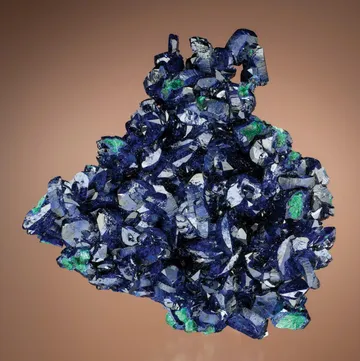
Milpillas, Mexico — defining modern copper locality famed for electric-blue azurite and green malachite, with lustrous crystals and distinctive pseudomorphs.
Key facts
Milpillas is one of the defining mineral localities of the twenty-first century: a modern underground copper mine in northern Sonora that, within only a few years of opening, gave collectors a new benchmark for azurite and malachite. The mine lies in the Cananea district, within the great Laramide porphyry-copper province that continues northward into Arizona and New Mexico. Economically, Milpillas is a deeply weathered and supergene-enriched porphyry copper system; aesthetically, it is a locality where that weathering profile created extraordinary cavities, seams, replacement zones, and pocketed breccias lined with secondary copper minerals.
What made Milpillas famous was not merely that it produced blue azurite and green malachite, but that it produced them in a style immediately recognizable across a room: intensely lustrous, sharply faced, electric-blue azurite crystals; silky green malachite replacing earlier azurite while preserving crystal form; and, in the finest specimens, a dramatic blue-green dialogue between fresh azurite and its malachite successor. Early Milpillas pieces were first treated with some mystery in the trade because they did not look quite like Bisbee, Morenci, Tsumeb, Touissit, or Chessy. Once the source became known, the mine moved quickly from “new discovery” to modern classic.
Regional View
Country View
Milpillas specimens owe their character to a long, repeatedly reworked supergene profile. Copper was leached downward from oxidized rock and reprecipitated in enriched zones; later fluctuations in groundwater and structural permeability overprinted older assemblages with newer ones. That sequence helps explain the locality’s signature pseudomorphs and layered crystal histories: azurite giving way to malachite, malachite partly recoated by azurite, copper oxides and sulfates appearing along the oxidation-reduction boundary, and uncommon silicates and vanadates turning up in small but highly prized pockets.

Photo: Wikimedia Commons
At its best, Milpillas azurite has an almost lacquered brilliance, with royal-blue to inky surfaces flashing vivid cobalt at edges and along growth lines. The most coveted pieces are not just blue; they are sharp, sculptural, undamaged, and alive with reflectivity. The finest malachites are equally distinctive: dark forest-green to lighter silky green pseudomorphs after azurite, commonly with velvety or chatoyant surfaces, sometimes still carrying blue azurite tips or later blue overgrowths. Unlike many prolific localities, Milpillas did not produce endless large, pristine plates. The big, undamaged, well-composed cabinet pieces are genuinely important modern classics.

Photo: Wikimedia Commons
Search for specimens: View all specimens from Milpillas, Mexico
The Milpillas Mine, also known historically as La Parreña, is in Santa Cruz Municipality, Sonora, near the village of Milpillas and north-northeast of Cuitaca. It is part of the Cananea district, one of the great copper districts of northern Mexico. In specimen labels the locality is commonly written as “Milpillas Mine, Cuitaca, Municipio Santa Cruz, Sonora, Mexico,” though older or trade labels may mention Cananea because of the broader district association.
Geologically, Milpillas is a partially oxidized, supergene-enriched porphyry copper deposit in the Sonora-Arizona-New Mexico metallogenic province. The primary porphyry system is Laramide in age; published geochronology on zircon and molybdenite places the quartz monzonite porphyry and mineralization near 64–63 Ma. The primary mineralization is relatively low grade and includes chalcopyrite with lesser bornite and pyrite, but supergene processes upgraded parts of the system into high-grade copper blankets dominated by chalcocite and minor covellite. These enriched zones were protected beneath Tertiary-Quaternary alluvial cover and within the Cuitaca Norte semigraben, a Basin and Range extensional structure.
The vertical weathering profile is central to understanding Milpillas specimens. A leached hematitic cap with kaolinite and limonitic iron oxides overlies oxide and mixed oxide-sulfide zones; beneath that, reducing conditions allowed copper to be redeposited as chalcocite-rich blankets. Published work describes a postmineral column plus leached cap totaling roughly 150 to 700 meters of vertical extent, and alluvial cover commonly tens to hundreds of meters thick. In the mine, alternating copper carbonate-oxide zones and chalcocite enrichment blankets created the environments that yielded azurite, malachite, brochantite, antlerite, cuprite, native copper, plancheite, dioptase, shattuckite, volborthite, vésigniéite, and other secondary species.
The mine’s specimen history begins almost as soon as its industrial life. Exploration of the deposit began decades before mining, with Peñoles reporting exploration roots in the 1980s and a major drilling program completed in 2001. That work supported construction of the underground operation, which began production in 2006. Peñoles describes the mine as its only copper mine, using underground cut-and-fill with yielding pillars and long-hole drilling; crushed ore is heap leached, then processed through solvent extraction and electrowinning to produce copper cathodes.
The first azurites and malachite pseudomorphs reached the mineral market in 2006–2007. Early material was good enough to attract immediate attention, but the great specimen years were defined by a succession of pockets and levels rather than by a single discovery. The 1100 level produced celebrated azurite and malachite material, including the Rosette Pocket and Tolvas Duales Pocket; the Rosette Pocket yielded superb azurite groups in 2011, including specimens around 10 to 12.7 cm and the famous 11.5 cm “Cannonball.” The Watercourse Pocket on the 1280 level produced fine azurites in 2013–2014. The 1160 level is documented for malachite pseudomorphs after azurite on velvet plancheite in 2008. Later, the 992 level became important for rarer assemblages, including dioptase with chrysocolla, darker malachite, shattuckite, and later quartz-bearing pieces collected in 2019.
By late 2011 many of the principal copper oxide bodies had already been mined, and carbonate-rich specimen zones became progressively less dependable. Industrially, the mine did not simply vanish: Peñoles suspended the unit in July 2020 because of losses tied to low copper prices and high operating costs, then resumed extraction, crushing, and ore placement in the second quarter of 2022. Peñoles lists the unit as operating in 2006–2020 and 2022 to the present, with underground workings, leach pads, and an electrowinning plant. For collectors, however, the important distinction is that the accessible specimen-rich oxidized zones that made Milpillas famous have been largely mined through, and organized specimen collecting is not a public activity. Miner collecting and dealer tours have been discouraged, and any modern material on the market should be treated as commercial mine-production material with provenance dependent on labels, dealer records, and prior collections—not as something a visitor can legally collect.
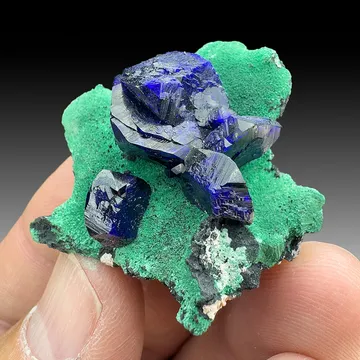
Milpillas azurite is prized for sharp, lustrous, intensely saturated crystals ranging from thumbnails and miniatures to serious cabinet pieces, with documented elite specimens around 10–13 cm and individual crystals reported even larger in early finds. The classic habit is flattened to thick lenticular or tabular, often doubly terminated, with striated faces, beveled edges, and a deep blue that can appear nearly black until strong light ignites electric-blue reflections; rosette-like groups, blocky single crystals, and aerial crystal clusters all occur. Associations include malachite coatings, malachite pseudomorphs after azurite, dickite, plancheite, brochantite, volborthite, and locally dioptase- or shattuckite-bearing assemblages. The 1100-level pockets, especially Rosette and Tolvas Duales, are among the most famous azurite sources in the mine, while later level-specific finds added distinctive habits and associations. Ordinary Milpillas azurites are still attractive, but top pieces separate themselves by pristine terminations, sculptural isolation, high luster, true electric-blue edge transparency, balanced matrix, and freedom from repaired contacts or bruised crystal tips.
Milpillas malachite is most famous as pseudomorphs after azurite: green replacements that preserve the earlier azurite’s sharp bladed, lenticular, tabular, or rosette-like form. The best examples are deep forest-green to silky bright green, with velvety or chatoyant faces, crisp inherited edges, and enough three-dimensional architecture to read immediately as former azurite rather than shapeless malachite; many are thumbnails to small cabinets, while fine cabinet plates are much scarcer than the quantity of small pseudomorphs might suggest. Important material appeared with the earliest Milpillas production around 2007–2009, including malachite-after-azurite groups from the 1100 and 1160 levels, some on plancheite or with residual or later azurite. Collectors particularly prize pieces that retain a blue azurite tip, a later azurite overgrowth, or a clean blue-green contrast; ordinary examples tend to be massive, fuzzy, incomplete, too heavily altered, or rubbed on the high points.
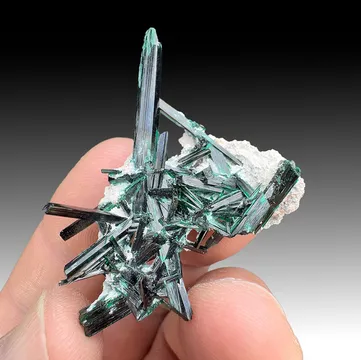
Beyond azurite and malachite, Milpillas has built a surprisingly broad secondary-copper mineral suite. Brochantite can occur as fine green needles and sprays, and the mine has yielded noteworthy antlerite, cuprite, native copper, dioptase, chrysocolla, plancheite, shattuckite, tenorite, delafossite, atacamite, clinoatacamite, clinoclase, conichalcite, olivenite, spangolite, mimetite, natrojarosite, hydroniumjarosite, chalcanthite, chenevixite, and rare vanadates including volborthite and vésigniéite. Milpillas is not the type locality for these famous species, but it has set or challenged modern quality standards for some of them: especially volborthite, which occurs in sharp yellow-green crystals and associations with malachite, azurite, and dickite; and plancheite, which provides velvety blue to blue-green mats beneath malachite pseudomorphs. The locality also produced deceptive-looking chalcocite-coated pyrite once mistaken for bornite or covellite, an instructive example of why analytical confirmation matters for the mine’s metallic-looking sulfide specimens.
Milpillas specimens deserve close condition inspection. Azurite is soft enough to bruise on exposed edges, and Milpillas crystals are often flattened, perched, or doubly terminated in ways that leave tips vulnerable. Look carefully for tiny nicks on the brightest edges, missing terminations, repaired matrix junctions, and unnatural resin shine in contact areas. A good Milpillas azurite should have crisp geometry and high natural luster, but not every reflective blue surface is pristine; some pieces show old pocket wear, mining impact, or preparation marks.
The best malachite pseudomorphs after azurite should preserve crystal morphology cleanly. A fuzzy green surface is not automatically a defect—many genuine pseudomorphs are silky or velvety—but the underlying form should still be coherent. High points on malachite pseudomorphs are easily rubbed, and large plates are often contacted or incomplete. On blue-green pieces, learn the difference between natural replacement and later azurite coating versus glued composites or cosmetically filled breaks. Documented assembled fakes from Milpillas have included pieces joined with glue colored by ground malachite; suspicious teal filler in seams, green-staining solvent swabs, and mismatched geometry across a joint are warning signs.
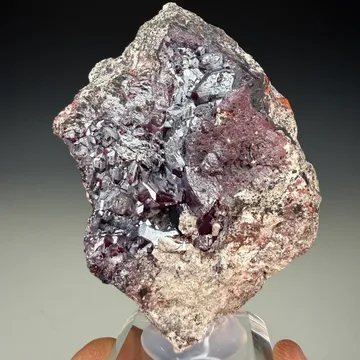
One locality-specific identification trap concerns metallic pyrite specimens coated by a very thin layer of chalcocite. Some were formerly described or sold as bornite- or covellite-coated pyrite, but analysis showed chalcocite coatings only about 13–19 µm thick on pyrite. This is not a fake in the sense of being artificial, but it is a classic Milpillas mislabeling issue. If paying a premium for unusual sulfides, rare vanadates, or arsenates from the mine, analytical support is valuable.
Milpillas material remains available on the market because many specimens entered collections and dealer inventories between 2007 and 2020, and additional pieces continue to circulate from collections. The spread in price is wide: damaged small pseudomorphs and lesser miniatures can remain accessible, while sharp electric-blue azurites, large pristine malachite-after-azurite groups, Rosette Pocket pieces, blue-green combination specimens, and analyzed rarities are strongly competed for. Provenance to a specific level, pocket, collection, photograph, or publication adds real value.
Azurite and malachite require ordinary but disciplined handling. Keep specimens dry, avoid acids and aggressive cleaning, do not soak pieces with clay-rich or porous matrix, and avoid prolonged direct sun or hot display lights. Some Milpillas pieces include delicate fibrous malachite, powdery secondary sulfates, or friable matrix that should not be touched repeatedly. Fluorescence is not a collecting feature for the main azurite-malachite suite; the appeal here is color, luster, morphology, association, and geological story.
The first Milpillas specimens arrived like contraband from an unnamed blue country. Within a year of the mine opening, itinerant Mexican mineral dealers were crossing into Arizona with azurite crystals and malachite pseudomorphs after azurite. The pieces were good—some only mediocre, some better—but they were strange enough to start arguments. They did not quite match the look of Bisbee or Morenci, and they were not Tsumeb or Touissit. The dealers kept the source quiet, and the mystery itself became part of the excitement. Then the secret broke: the specimens were from the newly opened Milpillas Mine.
One early azurite became a signal flare. In 2007, collector Jimmy Vacek acquired a single crystal described in print as 4 inches long, large enough and good enough to make seasoned observers raise their eyebrows. Gene Schlepp was also marketing fine early examples. Those pieces were only the beginning, but they announced that this was not a passing oddity from a small pocket; Milpillas was capable of world-class azurite.
The 2008 Tucson shows brought Milpillas into the broader gem and mineral world. Large quantities of well-crystallized azurite and malachite pseudomorphs after azurite appeared from the new Sonora source, along with massive azurite-malachite material suitable for lapidary work. Bill Larson of Pala International obtained about 5 kg of that massive material, and lapidarist Bud Standley cut roughly half of it into several hundred carats of cabochons and free-form carvings, with some carvings reaching 20 cm in maximum dimension. Raman work later confirmed azurite and malachite in examined cabochons, where granular blue domains were intergrown with felty light- and dark-green malachite.
The named pockets read like chapters in a short but spectacular book. In 2010, the Tolvas Duales Pocket on the 1100 level yielded azurite on malachite specimens including cabinet pieces in the 7.5 to 13.3 cm range. In 2011, the Rosette Pocket on the same level produced some of the mine’s iconic azurites: a 10 cm specimen, a 12.7 cm specimen, and an 11.5 cm rounded blue sculptural piece nicknamed “the Cannonball.” In 2013–2014, the Watercourse Pocket on the 1280 level added another suite, with fine azurites documented around 4.2, 5, and 11 cm. Later, in 2019, the 992 level surprised collectors with a different voice: dioptase with chrysocolla and darker malachite, pale blue shattuckite, quartz druses, and small quartz clusters riding on dioptase and shattuckite.
Milpillas also produced rumors with nearly the same regularity as specimens. Collectors heard, again and again, that the mine was finished for specimens—then another area would be found. Then it was done again; then another zone rich in azurite, malachite, or cuprite appeared. One forum post from 2014 captured the mood perfectly: “But wait!” The market cycled through urgency and surprise, with buyers warned repeatedly that no more would come out, only for new material to appear weeks or months later. In hindsight, both sides were partly right. The oxidized specimen zones were finite, but Milpillas was large enough, complex enough, and active enough to keep revealing new pockets long after the first wave of collectors thought the story had ended.
Evan A. Jones and Peter K. M. Megaw, “The Milpillas Mine, Cuitaca, Sonora, Mexico,” The Mineralogical Record, Vol. 52, No. 5, 2021, pp. 493–626 — The major monographic treatment of the locality, with pocket histories, level data, specimen photographs, and coverage of the broader Milpillas mineral suite.
The Mineralogical Record, Mexico IX: The Milpillas Mine, Vol. 52, No. 5, September–October 2021 — Publisher page for the special Milpillas issue, including article pagination.
Sample pages from The Mineralogical Record, Vol. 52, No. 5, “The Milpillas Mine” — Public sample pages showing the introduction and selected figure captions for azurite, brochantite, native copper, cuprite, dioptase, volborthite, malachite pseudomorphs, pyrite, quartz, and hematite specimens.
Thomas P. Moore and Marcus J. Origlieri, “Famous mineral localities: The Milpillas mine, Cananea district, Sonora, Mexico,” The Mineralogical Record, Vol. 39, No. 6, 2008, pp. 25–34 — The early modern-classic article documenting the first major appearance of Milpillas azurite and malachite on the market.
The Mineralogical Record, Mexico V, Vol. 39, No. 6, November–December 2008 — Publisher page for the 2008 Mexico issue containing the Moore and Origlieri Milpillas article.
Benito Noguez-Alcántara, Martín Valencia-Moreno, Jaime Roldán-Quintana, and Thierry Calmus, “Supergene enrichment and mass balance analysis in the Milpillas porphyry copper deposit, Cananea District, Sonora, Mexico,” Revista Mexicana de Ciencias Geológicas, Vol. 24, No. 3, 2007, pp. 368–388 — Essential geological paper on Milpillas supergene enrichment, leached caps, chalcocite blankets, alteration, and copper mass balance.
Victor A. Valencia, Benito Noguez-Alcántara, Fernando Barra, Joaquín Ruiz, George Gehrels, Francisco Quintanar, and Martín Valencia-Moreno, “Re-Os molybdenite and LA-ICPMS-MC U-Pb zircon geochronology for the Milpillas porphyry copper deposit: insights for the timing of mineralization in the Cananea District, Sonora, Mexico,” Revista Mexicana de Ciencias Geológicas, Vol. 23, No. 1, 2006, pp. 39–53 — Geochronological study establishing the late Laramide age of the Milpillas porphyry system.
Spring 2009 Gems & Gemology, Gem News International: azurite/malachite from Sonora, Mexico — GIA note on Milpillas azurite-malachite cabochon and carving material, including Raman confirmation of azurite and malachite.
Evan A. Jones and Peter K. M. Megaw, “Connoisseur’s Choice: Malachite Pseudomorphs after Azurite—Part 2: Milpillas, Mexico and Other Worldwide Localities,” Rocks & Minerals, Vol. 97, No. 6, 2022 — Focused treatment of malachite-after-azurite pseudomorphs, including Milpillas.
Mindat minID E11-1F8: Chalcocite, Pyrite from Milpillas — Documented example of pyrite coated by a very thin chalcocite layer, relevant to the locality’s bornite/covellite misidentification history.
Smithsonian National Museum of Natural History: Azurite from Milpillas — Museum record highlighting Milpillas azurite in the National Mineral Collection.
“Prep Work: Azurite crystals and Malachite, Milpillas Mine, Sonora, Mexico - Part 1 of 3” — Mine Rat Minerals — Mark Kielbaso demonstrates preparation work on an azurite and malachite specimen from Milpillas.
“Azurite from Milpillas Mine, Sonora, Mexico” — Fabre Minerals — Video of a 2020 level-1100 azurite floater with flattened, sharply defined crystals.
“Azurite with Malachite from Milpillas Mine, Sonora, Mexico” — Fabre Minerals — Video of a 2015 azurite with malachite specimen showing elongated, flattened, doubly terminated crystals.
“Azurite with Malachite from Milpillas Mine, Cuitaca, Mexico” — Fabre Minerals — Video of a 2013 azurite with fibrous malachite coatings and classic Milpillas electric-blue color.
Museo de Minería “Ing. Porfirio Padilla Lara”: Azurita con malaquita — Museum exhibit page noting the international reputation of Milpillas azurite crystals from Sonora.
Mindat: Milpillas Mine, Milpillas, Santa Cruz Municipality, Sonora, Mexico — Core locality database entry with coordinates, mineral list, references, and collecting-access cautions.
Wikimedia Commons: Category Milpillas Mine — Open image archive containing numerous Milpillas azurite, malachite, cuprite, and associated mineral photographs.
Industrias Peñoles: Milpillas — Operator page with current mine description, ownership, production method, operating periods, and copper cathode production data.
Revista Mexicana de Ciencias Geológicas: Supergene enrichment and mass balance analysis in the Milpillas porphyry copper deposit — Best open geological source for the deposit’s supergene profile and enrichment model.
Revista Mexicana de Ciencias Geológicas: Re-Os molybdenite and U-Pb zircon geochronology for Milpillas — Open source for the age and timing of the Milpillas porphyry copper mineralization.
The Mineralogical Record: Mexico IX, The Milpillas Mine — Publisher page for the 2021 special issue devoted to Milpillas.
The Mineralogical Record sample PDF: The Milpillas Mine — Public sample pages with selected pocket and specimen captions from the definitive article.
ResearchGate: Moore and Origlieri, 2008 Milpillas article — Abstract and bibliographic details for the early famous-locality article.
GIA Gems & Gemology, Spring 2009 PDF — Includes a Gem News International note on Milpillas azurite-malachite lapidary material.
Mindat discussion: Bornite-coated pyrite, Milpillas Mine — Useful thread on the chalcocite-coated pyrite identification issue.
Friends of Minerals Forum: Milpillas azurite fake specimen — Locality-specific discussion of assembled Milpillas azurite fakes using green-colored glue.
Fabre Minerals reference specimens: Milpillas azurite — Dealer archive with detailed descriptions of Milpillas azurite habits, colors, levels, and publication records.
Fabre Minerals search: Malachite after azurite from Milpillas — Useful archive of Milpillas malachite pseudomorph habits, sizes, and dates.

_Milpillas,_Sonora,_Mexico_(8459815326).jpg)