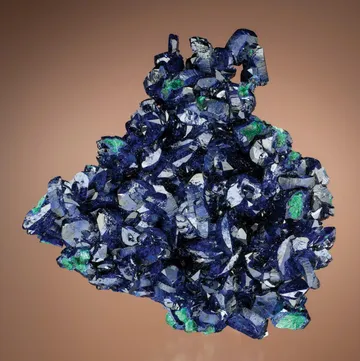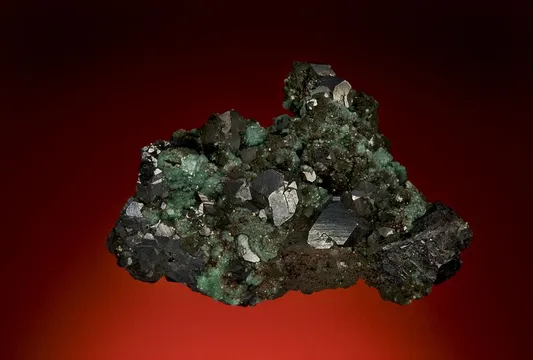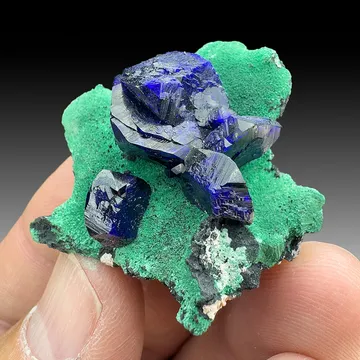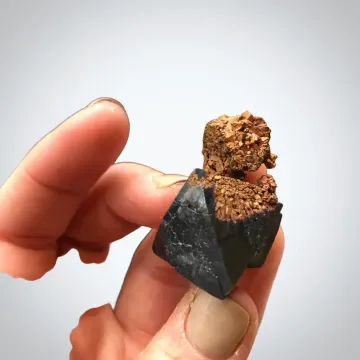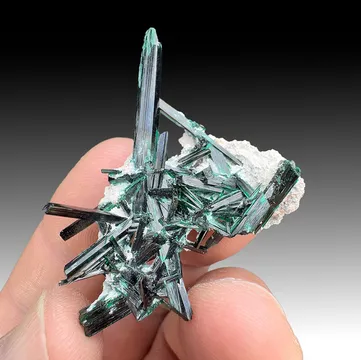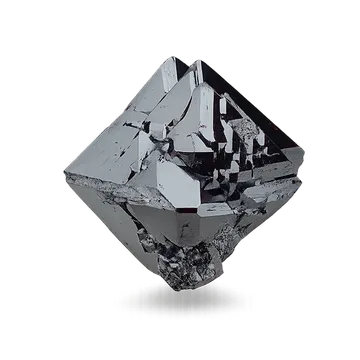
Cuprite from Milpillas Mine, Mexico — sharp octahedral crystals, deep red translucency with metallic luster, contrasting pale matrix, prized by collectors.
Key facts
Cuprite from the Milpillas Mine is a modern Mexican classic: not abundant like the mine’s famous azurite and malachite, but instantly recognizable when good. The best pieces carry sharp, lustrous, deep red to silvery-red Cu2O crystals on pale dickite, rock, massive cuprite, or copper-rich matrix. Under ordinary light many crystals look metallic, even gunmetal or silvered; under strong light or backlighting the better ones reveal the blood-red, cherry-red translucency that makes Milpillas cuprite so compelling.
Milpillas belongs to the great Arizona–Sonora porphyry-copper province, but it entered the collecting world in a very 21st-century way. Its orebody was not an obvious surface gossan waiting for old-time prospectors. It was a buried, secondarily enriched copper system, dropped and preserved beneath post-mineral cover, then mined underground for copper cathode production. The same oxidized and supergene copper zones that made the mine an industrial target also created one of the richest modern suites of secondary copper minerals: azurite, malachite, brochantite, chrysocolla, native copper, chalcocite, volborthite, dioptase, shattuckite, plancheite, and cuprite among them.
For collectors, Milpillas cuprite occupies an interesting niche. It is not simply “another cuprite locality.” Fine specimens are valued for a combination of metallic brilliance, red internal fire, well-defined isometric forms, and the unmistakable association with Milpillas’ pale clay-rich matrix and secondary copper assemblage. The most sought-after examples show isolated crystals rather than featureless masses, crisp octahedral geometry with modifications, lively red transparency at edges or through thinner areas, and attractive contrast against white to buff matrix.
The mine’s broader reputation was made first by azurite and malachite, then by brochantite and volborthite, but cuprite became part of the later Milpillas story as the oxide assemblages shifted. Specimens from finds around 2012–2016 are especially important in the collector market. The January 2016 material is repeatedly singled out in dealer and specimen records for unusually attractive isolated crystals on contrasting matrix, while other pockets produced rich “paved” surfaces or maze-like coatings of skeletal to subhedral cuprite.
Search for specimens: View all cuprite specimens from Milpillas Mine, Mexico
The Milpillas Mine, also known by its operator as La Parreña, is in Santa Cruz Municipality, Sonora, Mexico, in the Cananea district region near the Arizona border. It is a porphyry copper deposit with a major supergene enrichment profile. The hypogene system is Laramide in age and is associated with quartz monzonite porphyry; published geochronology places zircon crystallization at about 63.9 ± 1.3 Ma and molybdenite mineralization at about 63.1 ± 0.4 Ma, making Milpillas an important early Laramide porphyry system within the Cananea district.
The collecting significance of Milpillas comes from its preserved oxidized and supergene zones. Post-Laramide extension and Basin-and-Range-style deformation helped expose, leach, enrich, drop, and preserve the deposit. The supergene ore zone developed beneath post-mineral cover and a hematitic leached cap, with chalcocite and minor covellite in the enriched blanket and copper oxides, sulfates, carbonates, silicates, and arsenates/vanadates in the oxidized portions. For collectors, this is the engine that produced the mine’s spectacular suite of secondary copper minerals.
Peñoles describes Milpillas as its only copper mine. Exploration began in the 1980s; by 2001 enough work had been done to justify construction, based on an estimate of about 35 million tonnes of copper ore averaging 1.95% copper. The mine began production in 2006. It is worked underground, with cut-and-fill mining, vanishing pillars, and long-hole drilling. The ore is crushed, placed on leach pads, processed by solvent extraction, and finished as cathode copper in electrolytic cells.
Operations were suspended indefinitely in July 2020 because of high operating costs and low copper prices, then restarted in the second quarter of 2022. Peñoles lists the unit as operating from 2006–2020 and again from 2022 onward, with underground workings, leach yards, and an electrolytic plant. The company lists installed capacity at 45,000 tonnes per year of cathode copper and reported 12,866 tonnes of cathodic copper production in 2024.
Collecting access is not a normal field-collecting matter. Milpillas is an active industrial underground mine, not a public collecting site. Fine specimens reached the market because miners encountered pockets and mineralized cavities during ore extraction, and some material was recovered before it was crushed or leached. Serious collectors should treat all Milpillas specimens as market specimens requiring provenance, dealer credibility, and careful documentation rather than as material that can be self-collected.
The mine’s specimen-producing history is unusually concentrated. Important azurite, malachite, brochantite, and associated copper-mineral pockets appeared soon after production began and continued through roughly the first decade of mining. By the mid-2010s, many accounts describe the richest oxidized specimen zones as depleted or greatly diminished, with the mine moving increasingly into chalcocite-dominant sulfide ore. Cuprite was never the most common Milpillas show mineral, but good examples from the 2012–2016 period became memorable because they added a red, metallic, high-luster chapter to a locality better known for electric blue azurite and deep green malachite, brochantite, and volborthite.
Milpillas cuprite is most admired in sharp isometric crystals. The dominant habit is octahedral, commonly modified by dodecahedral and cubic faces. Some specimens show individual crystals perched or partly embedded on contrasting matrix; others present polycrystalline “paved” surfaces of intergrown octahedra. A number of examples also show skeletal, maze-like coatings or complex, irregular crystal growth on massive cuprite and copper-rich matrix.
Color is one of the great quality indicators. Many Milpillas cuprites appear dark red, silvery red, gray-red, or nearly metallic in ordinary incident light. The finest crystals reveal red translucency when light penetrates them, especially at thin edges, broken margins, or under strong backlighting. Collectors often describe the effect as cherry red, blood red, or deep wine red. Pieces that combine mirrorlike metallic luster with genuine internal red fire are the most desirable.
Crystal size varies widely. Many attractive specimens have crystals in the few-millimeter range, especially on larger matrix pieces. Good cabinet specimens may show crystals around 5–10 mm. Better individual crystals around 1 cm are notable, and published and dealer accounts indicate that Milpillas produced some sharp cuprite crystals approaching or reaching roughly 2 cm. In practice, the most important question is not only size but isolation, geometry, luster, and visibility. A 6 mm crystal standing proud on pale matrix can be more desirable than larger, crowded, damaged masses.
Matrix and associations are important to identification and appeal. White to cream dickite is a classic Milpillas association and gives the red cuprite excellent contrast. Massive cuprite, native copper, plancheite, neotocite, shattuckite, calcite, spangolite, hematite, atacamite, marshite, tenorite, volborthite, brochantite, and other secondary copper minerals are recorded with Milpillas cuprite in specimen data. Native copper combinations are especially interesting because visible copper is not common on many Milpillas cuprite pieces.
The best specimens have several features at once: sharp crystallography, bright metallic or submetallic luster, red translucency, clean presentation, and little damage. Milpillas cuprite can be visually deceptive in photographs because the strongest red response may require bright light or backlighting; a dull-looking silver-red crystal in one photo may glow red at the edges in person. Conversely, an overly dramatic backlit photo should not be mistaken for the way the specimen will look in a cabinet under normal lighting.
A typical high-grade Milpillas cuprite specimen shows one of two aesthetics. The first is the isolated-crystal style: discrete octahedra, often modified, on pale clay or rock matrix. The second is the rich-surface style: a carpet, vein, or sculptural face of bright metallic cuprite crystals, sometimes with massive cuprite beneath. Both are legitimate, but isolated crystals on contrasting matrix are generally rarer and easier to appreciate without magnification.
Milpillas cuprite is much less common than Milpillas azurite and malachite, and fine, undamaged examples are not abundant. The market still sees specimens, but much of the material is recycled from earlier finds rather than newly recovered in quantity. Small, dark, massive, or rough pieces remain obtainable; sharp, aesthetic specimens with red translucency, good luster, and matrix contrast are substantially harder to replace.
Condition is a major issue. Cuprite is brittle, relatively soft for a display mineral, and vulnerable to chipping along exposed crystal edges. Milpillas specimens are often extracted from tight, hard ore or clay-rich matrix, so contact marks, broken crystal tips, bruised edges, and sawed backs are common. When evaluating a piece, inspect the high points of octahedra, crystal terminations, edges where crystals enter matrix, and any bright chips that show fresh red interior. A sawed back is not automatically a problem if disclosed and if the display face is natural and undamaged.
Lighting matters more for cuprite than for many collector minerals. A specimen should be evaluated under normal display light and also under a strong focused light. The strongest pieces do not merely look red when backlit; they retain attractive luster, form, and contrast in ordinary viewing. Be wary of paying solely for a photographic glow that may disappear in a case.
The most locality-specific authenticity concern is not a known epidemic of fake Milpillas cuprite clusters, but surface alteration and identity confusion. A Mindat discussion in 2014 specifically addressed the idea of changing silvery-gray Milpillas cuprite back to gemmy red. Experienced contributors rejected the notion of a simple legitimate restoration; Alfredo Petrov noted that altering the crystal faces would destroy the original surface and would make such a specimen a fake in the meaningful collector sense. In other words, any claimed chemical “re-redening” of Milpillas cuprite should be treated as a serious red flag unless fully disclosed and scientifically documented.
Milpillas also has a documented labeling caution involving other copper minerals: some specimens marketed as “bornite-coated pyrite” were later shown through reflected-light work and discussion to involve very thin chalcocite or djurleite coatings on pyrite rather than bornite. This is not a cuprite fake, but it is directly relevant to Milpillas collectors because it shows how thin coatings, complex copper-sulfide chemistry, and overconfident labels can mislead even experienced market participants. For expensive Milpillas specimens with unusual associations, analytical backup or a conservative label is valuable.
Repairs and stabilization should be considered. Clay-rich matrices can be friable, and some specimens may have been trimmed, stabilized, or cleaned. Cuprite itself can be damaged by aggressive cleaning, and acid treatment can attack associated carbonates or etch surfaces. A natural metallic surface with growth features is preferable to an unnaturally bright, etched, or “burned” surface. Ask whether the specimen has been repaired, glued, stabilized, trimmed, acid-cleaned, or oiled.
Provenance adds real value. Labels from established dealers, collection histories, find dates such as 2012–2013, 2015, or January 2016, and references to known Milpillas styles help separate serious pieces from generic red copper-oxide material. Because Milpillas is a modern locality, many specimens should have relatively traceable histories. A vague label reading only “Mexico cuprite” is less desirable than one naming Milpillas Mine, Cuitaca or Santa Cruz Municipality, Sonora, and ideally a dealer, collector, or find period.
Milpillas is one of those localities that collectors talk about as if it arrived late to a party everyone thought was over. The old copper camps of Arizona and northern Mexico had already written their legends: Bisbee, Morenci, Ajo, Cananea. Then Milpillas appeared from beneath cover, a buried porphyry copper system that had no obvious surface expression and still managed to produce one of the most colorful mineral bonanzas of the modern era.
One published telling puts the discovery in almost accidental terms. Rocks suggestive of a porphyry copper system were found in gravels above the hidden deposit, and drilling followed. Copper was hit quickly, but the altered cobbles that inspired the search apparently had come from somewhere else. The misleading clues still led to the right concealed orebody. The secret was buried under hundreds of meters of alluvium, loose rock, sand, and water-bearing cover in a down-dropped trough. The engineering problem was formidable: get through that cover and into ore. High grade made it worthwhile.
The mine needed three years of development before ore production began in 2006. Almost immediately, a few azurites appeared, then more. By 2007, larger finds had caught the collecting world’s attention. The first “electric” blue crystals reached the market, along with rosettes of coarse azurite on velvet malachite. The Milpillas aesthetic was not subtle: saturated blue, vivid green, pale matrix, and crystals with a level of definition that invited comparisons to Bisbee and Tsumeb.
Then came the pockets, one after another. Over roughly five years, Milpillas produced an extraordinary range of azurite habits and colors, including malachite pseudomorphs after azurite that quickly became a specialty of the locality. The 2013–2014 Watercourse Pocket is part of the lore: thousands of specimens, sharp slightly curved crystals averaging around 1.5 cm, and a volume of material large enough to affect the market yet fine enough to be remembered specimen by specimen.
As the blue bonanza waned, the chemistry of the finds shifted. Brochantite emerged in remarkable quality, including emerald green needles reported to 10 cm and stout deep green crystals to 3 cm with chisel-like terminations. In 2014, a single pocket produced pistachio-green volborthite rosettes around 3 cm across, perched on elongate azurite crystals. That episode helped secure Milpillas as more than an azurite locality; it was a living laboratory of secondary copper mineralogy, producing one headline species after another.
Cuprite entered the later story as the sulfates gave way to oxides. Accounts describe sharp, skeletal, gemmy blood-red cuprite forming maze-like coatings and single crystals up to about 2 cm. That phrase — maze-like coatings — captures much of the Milpillas cuprite personality. The crystals are not always clean textbook individuals floating on matrix; many seem to grow in dense red metallic networks, with geometry flashing from complicated surfaces.
The January 2016 cuprite find became especially memorable among collectors. One described specimen from that find weighed 714 grams, or about 1.6 pounds, with mirrorlike silver-metallic cuprite crystals to 8 mm across part of a sculptural matrix and both native copper and cuprite visible on the back. Another documented January 2016 specimen, 70 × 60 × 30 mm, was singled out as one of the few from that pocket with actual isolated crystals on contrasting matrix — the kind of piece collectors remember because it translates a rich ore occurrence into a clear display specimen.
The market stories have their own Milpillas flavor. In early 2014, collectors were already arguing online about whether Milpillas was finished. One participant joked that every time someone announced the end, another pocket appeared. Another described about 20 flats of impressive Milpillas azurites at a Denver show, including a two-inch-tall crystal bought for $100 and a hand-sized vug filled with half-inch azurites offered at $200. The refrain was familiar: buy while you can, because no one knows whether a locality is truly over until time has already made the decision.
For cuprite, the equivalent warning is quieter but sharper. Fine examples were never as plentiful as the azurites. When one appears with crisp crystals, red fire, and a real Milpillas matrix, it is not just a red copper oxide; it is a fragment of the short interval when the mine’s oxidized zones were still generous enough to let specimen quality survive industrial copper mining.