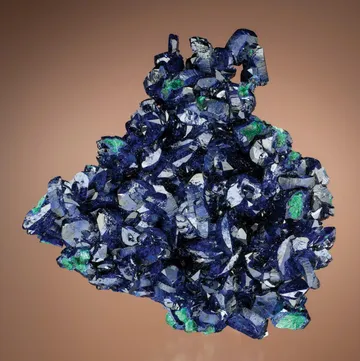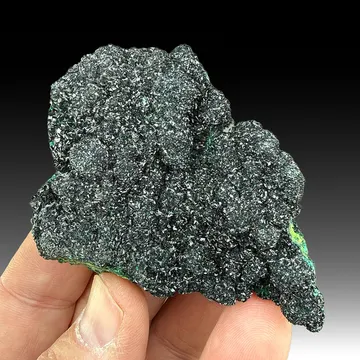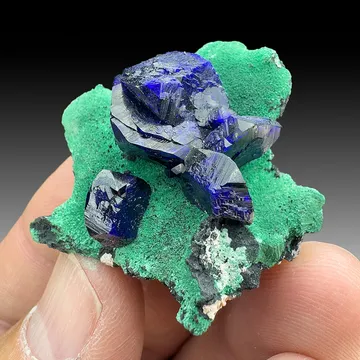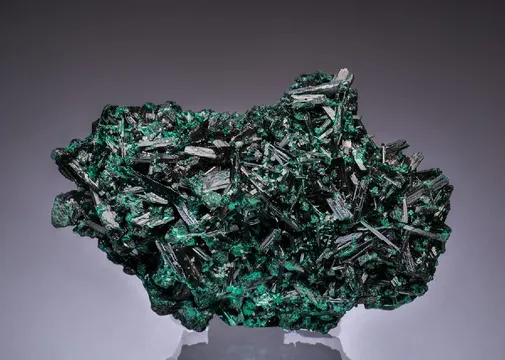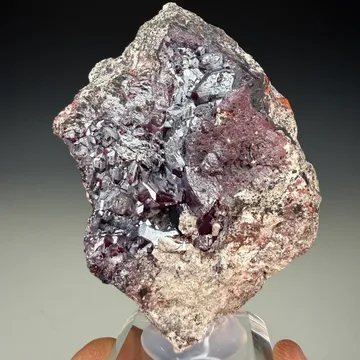
Brochantite - Milpillas Mine, Mexico: emerald-green crystals with chisel terminations; superb display quality, high luster, premier provenance for collectors.
Key facts
Brochantite from the Milpillas Mine is one of the great modern surprises in copper-mineral collecting: a species long appreciated as green sprays and crusts, suddenly appearing from Sonora in sharp, lustrous, display-quality crystals of exceptional color and scale. Milpillas is better known to many collectors for its azurite and malachite, but the mine also produced brochantite that serious species collectors routinely compare with the finest known examples for the mineral.
The appeal is immediate. The best specimens show deep forest-green to vivid emerald-green crystals with a glassy, almost wet luster; in transmitted or raking light, some crystals flash brighter internal green along their length. Earlier material was commonly delicate and hair-like, while a notable later style from the 2014 finds produced thicker, chisel-terminated crystals that could stand proud of the matrix rather than lying flat in drusy mats. That combination—rich color, high luster, robust crystal form, and a clean modern provenance—made Milpillas brochantite much more than a side note to the mine’s famous azurites.

Photo: Mindat.org
Geologically, Milpillas is a deeply oxidized and secondarily enriched porphyry copper deposit in northern Sonora. Its specimen story is inseparable from that supergene environment: copper-bearing solutions moved through fractures, watercourses, blankets, and cavities, producing a remarkable secondary assemblage in the oxidized zone. Brochantite, Cu4(SO4)(OH)6, belongs to that sulfate-rich copper suite and was found with the visual freshness collectors associate with the best Milpillas material—sharp, saturated, and often on pale matrix that intensifies the green.
For collectors, the prize is not merely “brochantite from Mexico,” but the right Milpillas brochantite: isolated or well-spaced crystals, undamaged chisel terminations, strong luster, saturated emerald to deep bottle-green color, and a composition that shows naturally rather than as a dark mat. Miniatures and thumbnails can be outstanding; small-cabinet and cabinet pieces are far rarer in excellent condition. The most desirable examples feel architectural: green blades and prisms rising from pale matrix, sometimes accompanied by finer acicular growth that gives the specimen both structure and sparkle.
Search for specimens: View all brochantite specimens from Milpillas Mine, Mexico
The Milpillas Mine, also known as the La Parreña Mine, is in the Santa Cruz Municipality of Sonora, Mexico, in the broader Cananea copper district. It is an underground copper operation owned by Industrias Peñoles and developed to produce Grade A cathodic copper from soluble copper minerals through crushing, heap leaching, solvent extraction, and electrowinning.
Exploration of the deposit began in the 1980s. By 2001, work had defined enough ore to justify construction, including an estimate cited by Peñoles of up to 35 million tons of copper ore averaging 1.95% copper. Commercial operation began in 2006. Peñoles suspended operations in July 2020 because of high costs and low copper prices, then resumed mining, crushing, and ore-deposit activities in the second quarter of 2022. For specimen collectors, however, the crucial point is that the great oxidized specimen-producing zones were largely mined through much earlier; the resumption of copper production does not mean that fine collector pockets are again available.
Milpillas sits within the northwest-southeast Laramide metallogenic copper belt that continues from Sonora into Arizona and New Mexico. The deposit lies in the Cuitaca Graben and is a partially oxidized porphyry copper system, with alternating copper carbonate-oxide and chalcocite enrichment blankets above lower-grade primary chalcopyrite-bornite mineralization. The mineralization is buried beneath roughly 250 meters of gravel cover and extends to about 720 meters depth. Most of the copper carbonate-oxide ores occurred in the upper 200 meters of the deposit, and those oxidized levels were the heart of the great specimen production.
The host rocks include Jurassic volcaniclastic rocks of the Henrietta Formation and rocks of the Laramide Mesa Formation intruded by monzonitic to quartz-monzonitic stocks. Sericitic alteration in the stocks and surrounding volcaniclastic rocks hosted the principal copper mineralization. The supergene profile included a leached cap rich in goethite, hematite, and jarosite; an oxide zone with copper oxides, carbonates, and sulfates; and deeper enriched sulfide zones. Repeated supergene enrichment cycles, driven by uplift and changing water levels, helped create the overlapping suite that made Milpillas such an unusually productive specimen locality.
Production of fine collector specimens was never official public collecting. Specimens reached the market largely through recovery by miners and through commercial specimen networks, while the mine owner actively discouraged collecting and dealer tours. This is one reason provenance matters. Good Milpillas labels should ideally preserve the mine name, Sonora location, dealer or collection history, and, when known, a find period or level. Some notable Milpillas finds are tied to specific levels and named pockets in the mineral literature, especially for azurite and malachite; brochantite is better documented by find period and specimen style, particularly the important 2014 material that introduced thicker, chisel-shaped crystals.
The mine’s first great market impact came within a year of opening, when Mexican dealers began bringing azurite and malachite specimens across the border into Arizona while keeping the source quiet. The mystery did not last: the distinct look and quality of the material led collectors back to the newly opened Milpillas Mine. Over the following years, the locality produced not only world-class azurite and malachite but also superb brochantite, olivenite, tenorite, vésigniéite, volborthite, cuprite, native copper, dioptase, shattuckite, plancheite, and related copper species.
Milpillas brochantite occurs in two broad collector-recognized styles. The first is the more delicate acicular to fibrous habit: fine green needles, sprays, tufts, and drusy coatings, sometimes forming dense surfaces of sparkling crystals. These pieces can be beautiful, but they are fragile; the best require careful handling and close inspection because broken needle tips and bruised crystal ends are common.
The second, more celebrated style consists of thicker prismatic to chisel-shaped crystals. These are the pieces that elevated Milpillas to world-rank status for the species. In the best examples, the crystals are sharp, lustrous, and well terminated, with individual crystals commonly in the several-millimeter to 1 cm range and exceptional crystals reaching around 2 cm. The crystals may be stout blades, elongated prisms, or clustered sheaves; the finest examples show enough separation that the crystal form can be read clearly rather than disappearing into a green mat.
Color ranges from dark bottle green and deep forest green to vivid emerald green. Many crystals look nearly black-green in ordinary room light, then flash brighter green along edges, terminations, and internal fractures under strong illumination. Highly saturated, vivid green crystals with glassy luster command the strongest collector interest. Dull, overly dark, or flattened mats are less desirable unless they have exceptional coverage, size, or provenance.
Matrix is an important part of the Milpillas look. Brochantite may occur on pale to near-white matrix, on thin wafers, or with light clay-mineral associations such as dickite, creating strong contrast against the dark green crystals. Some specimens have smaller acicular brochantite accompanying larger prismatic crystals, an attractive combination because it gives both sculptural form and fine sparkle. Documented associated minerals in the broader Milpillas secondary suite include azurite, malachite, chrysocolla, cuprite, dioptase, volborthite, vésigniéite, olivenite, plancheite, shattuckite, quartz, dickite, calcite, barite, chalcocite, native copper, hematite, goethite, and jarosite; not all are direct brochantite associations on a given specimen, so labels and photographs should be read carefully.
Quality is judged first by crystal definition. A single, isolated, undamaged chisel-terminated crystal can be more important than a larger but muddier aggregate. Next comes luster: the finest Milpillas pieces are bright, not waxy or chalky. Color follows closely, with vivid emerald or deep saturated green preferred. Matrix contrast and display balance matter greatly. The best thumbnails and miniatures are often more desirable than larger plates because the crystal size, separation, and condition remain strong in proportion to the specimen.
Size ranges vary by style. Thumbnail and miniature specimens are commonest on the market. Dealer records document thumbnails around 2 to 4 cm across with individual crystals to about 1 cm, miniatures and small cabinets with crystals to 2 cm, and occasional cabinet pieces with broader clusters. Published Milpillas brochantite specimens include examples around 9 cm and 13.1 cm, showing that the locality did produce larger display pieces, though clean, aesthetic, well-crystallized large specimens are much scarcer than small pieces.
Milpillas brochantite is still available, but the market is now mostly recycled inventory, older dealer stock, collection pieces, and auction appearances rather than a steady flow of new production. Prices vary widely with habit and condition. Small, dense, fibrous or drusy examples can remain relatively accessible, while isolated, lustrous, chisel-terminated crystals on contrasting matrix are premium specimens. Recent dealer and auction records show thumbnails and miniatures ranging from low hundreds of dollars into four figures, with exceptional cabinet-quality examples priced higher.
Condition is the central buying issue. Brochantite is not especially soft for a secondary copper mineral, but Milpillas examples are often physically delicate because of their acicular or elongated habit. Inspect terminations under a loupe. Look for bruised tips, scraped crystal ridges, missing crystals on the display face, and flattened areas where sprays contacted the pocket wall. Minor peripheral contacts are normal and acceptable on many pieces, but damage to the primary crystal or central spray should be priced accordingly.
The thick 2014-style crystals are much more robust than the hair-like material, but they are not immune to chipping. Chisel terminations should be crisp. A flat termination is not automatically damage—many brochantite crystals naturally terminate that way—but irregular white scars, dull broken ends, or mismatched luster at the tip are warning signs. On thin matrix wafers, check the back for repairs or glued supports.
Documented fake or treatment issues specifically involving Milpillas brochantite are not prominent in the literature or dealer record. The more realistic authenticity concern is misidentification or overconfident labeling. Fine green copper minerals can be visually confusing: fibrous malachite, atacamite-group minerals, antlerite, and brochantite can overlap in habit and color. For expensive pieces, especially unusual associations or very fine isolated crystals, a reputable dealer, old label, Raman/XRD confirmation, or well-documented provenance is valuable.
There are documented Milpillas labeling problems in the broader copper-sulfide suite. Specimens once marketed as “bornite-coated pyrite” from Milpillas were later shown through microscopy and analysis to involve very thin chalcocite or related copper-sulfide coatings on pyrite rather than bornite. That episode is not a brochantite fake, but it is a useful caution: Milpillas produced complex supergene assemblages, and attractive labels are not a substitute for evidence.
Another locality-authenticity caution concerns material that reached the market as Milpillas but was later traced to a separate copper property near Rancho Jacalito, west of Cuitaca. That case involved quartz-shattuckite-chrysocolla-style specimens rather than classic brochantite, but it reinforces the same lesson: “near Cuitaca” is not automatically “Milpillas Mine.” For high-value purchases, ask for the chain of provenance and compare the matrix and associations with well-documented Milpillas examples.
Avoid cleaning Milpillas brochantite aggressively. Do not use acids, ultrasonic cleaners, steam, or stiff brushing. Dust with an air bulb or very soft brush only. Keep specimens in stable, dry storage, isolated from harder minerals that can abrade the crystal faces. Because many pieces are built of needles, blades, and thin matrix, custom acrylic bases or well-fitted boxes are wise for transport and long-term display.
The Milpillas story began like a good mineral-market mystery. Within a year of the mine opening in 2006, Mexican dealers were crossing into Arizona with azurite crystals and malachite pseudomorphs after azurite. The specimens were good enough to draw attention, and odd enough to create speculation: they did not look quite like Bisbee, Morenci, Chessy, Touissit, or any familiar Mexican source. The dealers initially kept the source to themselves. Then the name came out—Milpillas—and the newly opened underground copper mine became one of the defining specimen localities of the early twenty-first century.
The first wave hinted at what was coming. A four-inch single azurite crystal acquired by Jimmy Vacek in 2007 was already enough to make collectors take notice, and Gene Schlepp was marketing fine early examples. By the time the full Milpillas story was written in the Mineralogical Record, the locality had moved far beyond azurite and malachite. It had produced world-class examples of several less expected copper species, including brochantite.
Brochantite’s own turning point came with the material found in July and August 2014 and shown as a Tucson 2015 novelty. Before that, fibrous brochantite was already well known from the mine, but the 2014 material changed the conversation. Instead of only fragile, hair-like growths, collectors saw aggregates of elongated idiomorphic crystals with clear faces and chisel-like terminations. One documented specimen measured 9.5 × 6.3 × 3.3 cm, with a main crystal 1 × 0.4 cm, and was described by Jordi Fabre as having one clearly isolated, doubly terminated crystal. For a species often collected as sprays or druses, that degree of definition was exceptional.
Another specimen from the same 2014 find, filmed by Fabre Minerals, distilled the appeal even further: two complete brochantite crystals, isolated and sharply defined, standing on matrix with white dickite. The specimen measured 4.6 × 4.2 × 3.2 cm, and the main crystal reached 2 × 0.9 cm. That is the sort of measurement that matters to brochantite collectors. A two-centimeter crystal of brochantite is not just “large”; when it is complete, lustrous, and aesthetically placed, it becomes a species-level specimen.
Milpillas also produced cautionary stories, the sort that teach collectors how complicated a modern copper mine can be. One involved attractive pyrite specimens labeled as bornite-coated pyrite. Under reflected light, the coating proved to be only a few microns thick, and the evidence pointed instead to chalcocite or related copper sulfides. The issue was not deception so much as the difficulty of identifying ultra-thin supergene coatings by quick visual or incomplete analytical methods. The lesson carries across the Milpillas suite: the mine produced beautiful minerals, but beauty and a confident label are not the same as proof.
A later market episode involved specimens said to be from Milpillas that resembled some of the mine’s quartz-shattuckite material. Careful comparison showed that they came from a small copper property near Rancho Jacalito, several kilometers west of Cuitaca and well southwest of the Milpillas Mine. The differences were mineralogical and textural: abundant shattuckite, thicker quartz encrustations, fibrous ajoite largely pseudomorphed by chrysocolla, and a lack of dioptase. For collectors, that episode sharpened the meaning of locality. “Cuitaca area” may be geographically close, but the Milpillas Mine is a specific locality with a specific specimen history.