Cananea, Mexico — historic copper district known for two collector favorites: pyrite-on-quartz crystals and turquoise nodules, especially Maria Mine pieces.
Key facts
Cananea is one of the great copper names of North America: a Sonoran mining district at the southern continuation of the Arizona–New Mexico porphyry-copper province, where Laramide intrusions, volcanic cover rocks, breccia pipes, skarn bodies, and later supergene enrichment made a deposit of global scale. For collectors, the name is not just an orebody. It is a label that can mean several related but distinct specimen sources: the giant Buenavista del Cobre open pit, the historic Cananea mine workings and La Colorada breccia system, the specimen-producing Maria Mine, and the Cananea Municipality turquoise occurrences such as La Mariquita at Cuitaca.
The best-known collector pieces from the broader Cananea area divide into two visual families. One is the sulfide-quartz suite: sharp, lustrous pyrite cubes, brassy chalcopyrite, milky to clear quartz, molybdenite, sericite, tourmaline, and locally rhodochrosite, fluorapatite, sphalerite, scheelite, and other accessories. The Maria Mine, in particular, is valued for large, brilliant pyrite and chalcopyrite crystals on quartz, a combination that can look far more like a fine cabinet specimen than a byproduct of an industrial copper district. The other family is turquoise: blue to blue-green masses and nuggets, often with dark iron-oxide or sulfide matrix and, in the most recognizable examples, bright metallic pyrite flecks that give the stone a hard Sonoran sparkle.
Cananea also has unusual historical weight. Copper was worked in the region in the eighteenth century; William C. Greene’s Cananea Consolidated Copper Company turned the district into an industrial mining camp at the end of the nineteenth century; and the 1906 Cananea strike became one of the emblematic labor episodes preceding the Mexican Revolution. Few mineral labels carry such a combination of large-scale economic geology, specimen interest, lapidary fame, and political history.
Regional View
Country View
Geologically, Cananea is a district-scale system rather than a single collector pocket. The principal Buenavista del Cobre deposit is a porphyry Cu-Mo system hosted by volcanic and intrusive rocks and complicated by breccia bodies, contact zones, replacement mineralization, skarns, and a strong supergene history. The district’s published age work places several Cananea-lineament porphyry systems in a tight Paleocene mineralizing interval, with Buenavista del Cobre and Mariquita around 59 Ma and Maria around 60 Ma. That timing helps explain why Cananea specimens often carry the same broad porphyry-copper language—quartz, pyrite, chalcopyrite, molybdenite, sericite, copper oxides—but show very different collector expression depending on whether the specimen came from a quartz-lined pocket, a breccia zone, a supergene oxidized setting, a skarn/replacement body, or a turquoise-bearing alteration zone.
Search for specimens: View all specimens from Cananea, Mexico
Cananea lies in north-central Sonora, Mexico, roughly southeast of Tucson, Arizona and northeast of Hermosillo. In modern mining usage the main operation is Buenavista del Cobre, historically the Cananea mine, an operating open-pit porphyry copper mine within the Cananea mining district. The wider district includes Buenavista, Maria, Mariquita, Milpillas, Lucy, El Alacrán, El Pilar, and other porphyry, breccia, skarn, replacement, and supergene systems along the Cananea lineament. Collector labels may therefore read simply “Cananea,” but a strong label should preserve the sublocality when known: Maria Mine, Buenavista del Cobre, La Mariquita Mine, Santa Rosa mine, Manzanal Mine, or another named working.
The regional rock package is complex. Published technical descriptions place the district in the eastern Sonora Basin and Range Province. Precambrian Cananea basement rocks are overlain by Paleozoic sedimentary rocks, including the Cambrian Capote Quartzite and thick upper Paleozoic carbonate sequences. Above these are Triassic to late Jurassic volcanic rocks of the Henrietta and Elenita formations, followed by the younger volcanic units of the Mesa Formation. Diorite, granodiorite, and quartz monzonite intrusions entered after emplacement of the Mesa Formation, and late diabase dikes exploited northwest-southeast fractures. Pipe-like breccias formed as late products of quartz-monzonite porphyry activity, and later erosion, exhumation, oxidation, and supergene enrichment transformed the upper parts of the system.
At Buenavista del Cobre, the deposit is divided in modern reporting into BVC and BVZ target zones. BVC is the main copper-molybdenum porphyry system; BVZ lies to the northwest and is described as a polymetallic Zn-Cu-Ag body, with skarn-type mineralization in Paleozoic carbonate units. The dominant alteration in the principal volcanic and porphyritic rocks is phyllic, with sericite, quartz, and pyrite. Propylitic alteration with chlorite and epidote surrounds the phyllic zones, while argillic alteration in upper ore zones includes kaolinite, halloysite, alunite, and minor pyrophyllite. Potassic alteration is less visible at surface but appears at depth and in important structures such as La Colorada.
Mineralization at Cananea is classic porphyry-copper mineralization in both economic and specimen terms. Much of the copper occurs as disseminations and veinlets in stockwork zones in volcanic and intrusive rocks. Higher-grade material is associated with breccia structures, contact zones, and replacement bodies. In the supergene zone, chalcocite, covellite, and digenite replace earlier pyrite and chalcopyrite; above that, oxidized caps carry goethite, hematite, and jarosite. Below the enrichment zone, primary hypogene mineralization is mainly chalcopyrite with minor bornite. Breccia bodies such as La Colorada, El Capote, Oversight Cananea-Duluth, La Demócrata, El Kirk, Henrietta, América Bonanza, and Veta 5 have been important in the mining history; their angular to subrounded fragments may be set in matrices of massive sulfides and quartz.
The mining story begins well before the modern open pit. Technical histories record eighteenth-century exploitation in the Cananea Mountains, including early work around the “Cobre Grande” mine. The district became an industrial copper camp after William C. Greene acquired rights and organized the Cananea Consolidated Copper Company in 1899. Anaconda acquired control in 1917 and remained tied to the operation until 1982. The high-grade La Colorada deposit was discovered in 1926 and was estimated at about 7 million tonnes of ore averaging 6.0% copper and 0.40% molybdenum, with significant gold and silver. A 12,000-tonne-per-day concentrator was completed in 1944, underground mining continued alongside open-pit operations until 1964, and Tajo Cananea open-pit exploitation began in 1960. The company was Mexicanized in 1971, became Compañía Minera de Cananea S.A., and later passed into the modern Southern Copper/Grupo México orbit as Buenavista del Cobre.
The mine is still a major industrial operation, not a public collecting locality. Buenavista is operated as an open-pit truck-and-shovel mine with concentrators, leach facilities, SX-EW plants, extensive pit infrastructure, tailings and water-management systems, and controlled access. Serious collectors should assume that field collecting at Buenavista, Maria, Mariquita, Milpillas, and other Cananea-area mines requires explicit permission from landowners, concession holders, and operators. Most specimen material reaches collectors through miners, old collections, dealer stocks, lapidary parcels, or specimens saved during earlier mining and exploration periods, not through casual public rockhounding.
The most important specimen-producing pocket information publicly available concerns the Maria Mine. Mindat’s Maria Mine locality description records quartz, tourmaline, sericite, and pyrite as gangue minerals, with chalcopyrite, sphalerite, molybdenite, and possibly scheelite among the ore minerals. Specimens reportedly began reaching the mineral trade through Top Gem Minerals in the late 1980s or early 1990s. The same locality notes that many pieces suffered heavy damage during recovery, which explains why sharp, undamaged Maria pyrite and chalcopyrite specimens on quartz are much less common than the scale of the mine might suggest.
Turquoise labeled Cananea belongs to a separate collecting stream from the sulfide-quartz pocket material. Mindat records turquoise at Cananea itself, with fluorapatite and pyrite as photo-associated minerals, and La Mariquita material from Cuitaca in Cananea Municipality is well documented as sculptural turquoise nuggets with bright pyrite microcrystals. Commercial lapidary literature also uses names such as Cananea, Sonoran Blue, Alpine Blue, and sometimes Campitos or other Sonoran trade names, so the locality discipline for turquoise is especially important. A specimen label that says “Cananea” may be accurate at district scale, but “La Mariquita Mine, Cuitaca, Cananea Municipality” or another precise sublocality is far more valuable to a mineral collector.
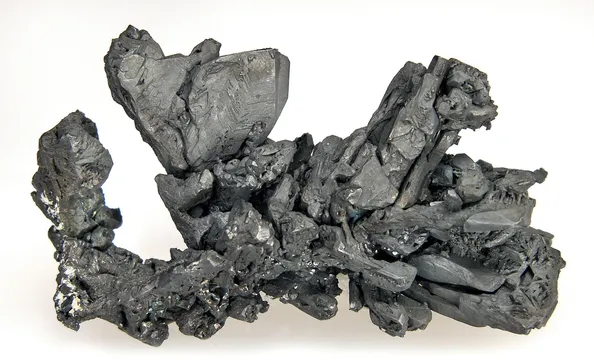
Cananea pyrite is best represented in collector hands by material from the Maria Mine, where it occurs with quartz, chalcopyrite, fluorapatite, molybdenite, and locally tetrahedrite-group minerals; the most desirable pieces show brilliant, sharp, metallic cubes on quartz rather than massive disseminated pyrite from the porphyry ore. The documented Maria Mine description records simple lustrous pyrite cubes up to 30 cm on an edge, commonly in groups and commonly associated with crystallized quartz, but also emphasizes that many specimens were badly damaged during recovery, making clean, complete faces and intact group architecture the real premium features. Ordinary Cananea pyrite may simply be part of phyllic alteration or stockwork ore; the specimens collectors pursue are sculptural cabinet pieces with sharp cubic geometry, bright faces, quartz contrast, and enough matrix or association to prove their origin in the Maria quartz-pocket suite.
Cananea turquoise is prized for blue to blue-green color with brown, black, iron-oxide, sulfide, or porphyry-related matrix, and its most recognizable visual signature is the presence of bright pyrite flecks or microcrystals in the stone. Mindat records turquoise at Cananea with fluorapatite and pyrite associations, while the well-known La Mariquita occurrence in Cananea Municipality has produced uncommon sculptural nuggets, including documented material with sky-blue polished interiors and scattered pyrite microcrystals. Fine collector turquoise from this area should be judged differently from anonymous cabbing rough: the best pieces have strong natural color, attractive metallic or dark matrix, visible geological context, and a trustworthy label separating Cananea or La Mariquita from look-alike Morenci, Kingman, Bisbee, Campitos, and other North American turquoise names.
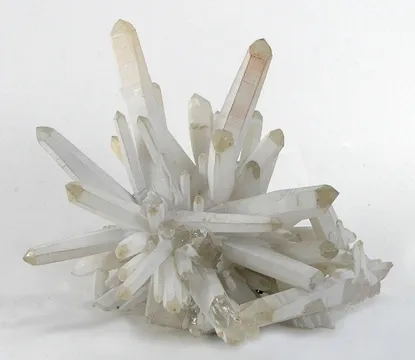
Cananea quartz is not merely background gangue: at the Maria Mine it is the stage on which the district’s best pyrite and chalcopyrite crystals display, and Mindat photo associations tie Cananea quartz especially to pyrite, rhodochrosite, molybdenite, fluorapatite, chalcopyrite, tourmaline, schorl, and rare native gold or gold-amalgam associations. The Maria Mine description records quartz from milky to clear, as crystals in groups and less commonly as singles, with crystals up to about 20 cm; some pockets were clean while others were filled with slightly brown clay. Good Cananea quartz specimens are those with undamaged terminations, attractive clarity or sculptural grouping, and meaningful sulfide or tourmaline inclusions or attachments; ordinary pieces are abundant-looking milky quartz without the sharp sulfide contrast or pocket freshness that distinguishes the Maria material.
Beyond pyrite, turquoise, and quartz, Cananea has a broad copper-district suite that includes chalcocite, digenite, bornite, covellite, chalcopyrite, molybdenite, sphalerite, galena, enargite, luzonite, tetrahedrite-group minerals, goethite, hematite, magnetite, alunite, kaolinite, sericite, fluorapatite, apatite, tourmaline, dravite, rutile, anatase, titanite, zircon, malachite, chrysocolla-related copper silicates in the region, and skarn minerals such as garnet, diopside, wollastonite, epidote, and actinolite in appropriate subsettings. The locality also has a tellurium footnote of real mineralogical interest: paratellurite, TeO2, is listed by Mindat with Santa Rosa mine, Cananea as a co-type locality, while the Handbook of Mineralogy notes that type material was stated to be from Cananea but was probably from the Moctezuma/Bambolla mine area. That makes Cananea-labeled paratellurite a label to handle with particular care rather than a casual rarity claim.
The biggest authenticity issue for Cananea specimens is label precision. “Cananea” may refer to the city, the municipality, the Buenavista/Cananea mine, the Maria Mine, La Mariquita, or simply a Sonoran turquoise trade parcel. For sulfide specimens, the strongest Cananea labels identify Maria Mine when the piece shows the characteristic quartz-pyrite-chalcopyrite-molybdenite-tourmaline-sericite assemblage. For turquoise, insist on a label trail if the specimen is sold as Cananea, La Mariquita, Campitos, Sonoran Blue, or Alpine Blue, because these names overlap in the lapidary trade more than mineral collectors would like.
Cananea turquoise deserves special scrutiny. Pyrite-flecked turquoise is attractive and widely sold, but pyrite is not proof of locality by itself. Trade sources document that some Cananea-area or “Alpine Blue” material has been sold misleadingly as “Morenci 2,” Morenci, Kingman, or even Bisbee. Stabilization is also common in commercial turquoise, especially for softer or chalkier material. Stabilized turquoise can still be attractive and legitimate if disclosed, but it should not be priced or described as untreated natural mineral specimen material. Buyers should look for disclosure of stabilization, dyeing, backing, resin impregnation, reconstitution, and composite construction, and should be wary of unusually uniform blue color, plastic-like luster, suspicious black “matrix,” or metallic pyrite that appears artificially arranged in cracks.
Condition matters greatly on Maria Mine pyrite and chalcopyrite. The best pieces are large, lustrous, and dramatic, but the documented history of recovery included an unusual amount of damage. Expect bruised cube corners, cleaved or contacted quartz, chipped chalcopyrite edges, and repairs on larger display specimens. Because pyrite cubes may reach large sizes, a few small bruises are not fatal, but broken cube corners, missing group members, and dull abraded faces reduce value quickly. Chalcopyrite from the district may have a natural patina; cleaning should be conservative, as harsh chemical treatment can change color, strip desirable surface character, or expose unstable tarnish.
Quartz specimens should be checked for pocket clay in crevices, iron staining, and repaired or reglued terminations. Molybdenite-bearing pieces can shed soft metallic flakes and should be handled gently. Sericite-rich pieces may contain delicate micaceous rosettes or yellowish alteration coatings that should not be scrubbed. If scheelite is present on Maria Mine quartz, shortwave ultraviolet testing may help reveal it, but the specimen should be evaluated mineralogically rather than marketed on fluorescence alone.
Market availability is uneven. Cananea turquoise remains available in lapidary channels, but well-documented natural specimen pieces from specific Cananea Municipality sublocalities are much scarcer than generic Sonoran turquoise. Maria Mine pyrite, chalcopyrite, and quartz specimens appear periodically from old stocks and collections, especially pieces tied to late-1980s and early-1990s recovery, but undamaged cabinet specimens are genuinely selective material. Buenavista itself is an active industrial operation, so do not expect regular fresh collector production from the main open pit.
On the morning of June 1, 1906, the Cananea story left the mine ledger and entered Mexican history. The strike began at the Oversight mine before dawn, when Mexican workers stopped work and moved through the company town under a demand that became a slogan: “Cinco pesos, ocho horas”—five pesos and an eight-hour day. The demand was not abstract. Contemporary and later accounts describe a camp divided by nationality, wage, and status: Mexican workers doing hard mine labor for less than American workers, with the Americans occupying many of the better-paid and supervisory positions in an enterprise controlled by William C. Greene’s Cananea Consolidated Copper Company.
The strike gathered mass quickly. Workers carried red flags, pressed their wage and hour demands, and confronted a company town built around copper, smelters, and American capital only about 40 to 45 miles south of the Arizona border. The episode turned violent when strikers moved toward company facilities and American employees resisted. Accounts differ in emphasis and casualty figures, but the violence was real and immediate: men were shot, the Metcalf brothers became notorious figures in the story, armed Americans crossed or approached the border from Arizona, and Sonora governor Rafael Izábal arrived with forces to suppress the uprising. NASA’s later Earth Observatory note, written for a satellite image of the mine, summarizes the human cost as 19 deaths and identifies the strike as a major catalyst of the Mexican Revolution and the beginning of Mexico’s labor movement.
The most striking thing for a collector is how close the specimen label sits to that history. A Cananea pyrite cube, turquoise nugget, or quartz-chalcopyrite specimen is not from an anonymous hill. It comes from a district where a mineralized breccia pipe could become a mine, a mine could become a company town, and a company town could become a symbol. When old labels read “Cananea, Sonora,” they carry not only geology but also the memory of a camp where copper, labor, nationality, and revolution met in the same streets.
There is another, quieter Cananea story in the Maria Mine specimens. When collector material began reaching the trade through Top Gem Minerals in the late 1980s or early 1990s, the mine revealed an unexpectedly elegant side: pyrite cubes that could reach astonishing size, chalcopyrite clusters with a handsome natural patina, quartz groups, dark sphalerite, molybdenite-specked sericite, fibrous tourmaline, and occasional scheelite. But the same account that praises the crystals also records the heartbreak—many were damaged, and relatively few survived as fine specimens. That is why an intact Maria Mine pyrite on quartz has the feel of a saved object, a survivor from an ore environment that was never designed to be gentle.