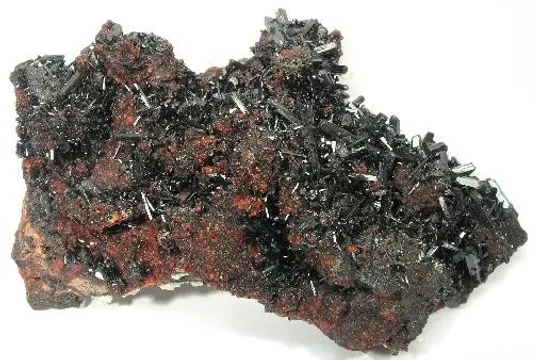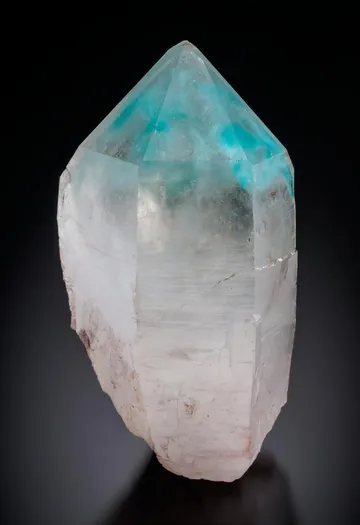
Limpopo, South Africa — a trio of collector worlds: Palabora blue brucite and baddeleyite, Murchison antimony and stibnite, and Bushveld Pt-group minerals.
Key facts
Limpopo is not a single-pocket locality so much as a province-sized mineralogical cross-section through some of southern Africa’s great ore provinces. For collectors, its name most often resolves into three very different specimen worlds: the Palabora carbonatite–foskorite complex at Phalaborwa, the Murchison Greenstone Belt antimony mines around Gravelotte, and the eastern Bushveld Complex platinum and chromium country. Palabora gives Limpopo its most distinctive cabinet identity: pale to intense blue brucite from carbonatite, black baddeleyite crystals that are among the finest known for the species, calcite, magnetite, iowaite, chondrodite, zeolites, phlogopite, and a suite of rare platinum-group minerals. The Murchison Range contributes native antimony and stibnite from the old Consolidated Murchison mines, while the Bushveld mines supply the microscopic but historically important platinum-group minerals that put names such as atokite and braggite into mineralogical literature.
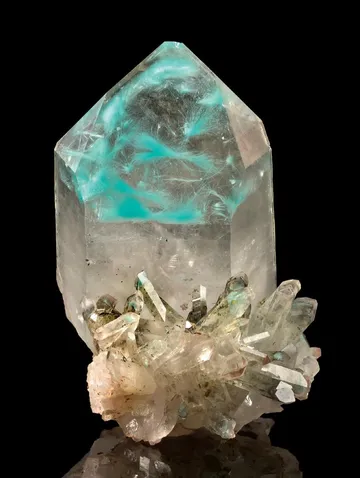
The best Limpopo specimens have an unmistakable look. Palabora brucite is typically blue rather than the lemon-yellow or white habit collectors may associate with other districts; good examples show translucent, foliated plates or tabular crystals rather than merely chalky masses. Palabora baddeleyite is the opposite visually: black, lustrous, strongly striated, commonly bladed to prismatic, and often set in foskorite or carbonatite with magnetite, calcite, apatite, or phlogopite. The antimony pieces from the Murchison mines are darker and more metallic, with bright native antimony cleavages and silvery stibnite sprays in quartz-carbonate gangue.
Regional View
Country View
Palabora, immediately west of Kruger National Park near Phalaborwa, is the anchor locality for many Limpopo collector specimens. Its open pit, now superseded by underground block-cave mining, was developed into a huge excavation in the Loolekop intrusion, the carbonatite–foskorite core of the Palabora Igneous Complex. During the open-pit era, especially where mining intersected cavities in carbonatite, foskorite xenolith zones, and dolerite-related fracture systems, the operation briefly became a specimen locality of world standing rather than simply a copper-phosphate-vermiculite mine.

Photo: Wikimedia Commons

Photo: Wikimedia Commons
Search for specimens: View all specimens from Limpopo, South Africa
The locality entry “Limpopo, South Africa” covers a province, so the geology behind specimens varies sharply from mine to mine. The most specimen-rich and best documented collector source is the Palabora Mine at Phalaborwa. Palabora is part of the Palabora Igneous Complex, an alkaline, concentrically zoned intrusive complex roughly 6.5 km by 2.5 km at surface. Its outer rocks include syenite and feldspathic pyroxenite, but the major rock by volume is micaceous pyroxenite composed largely of diopside, phlogopite, and apatite. The economically and mineralogically famous inner Loolekop intrusion is smaller, roughly 1.4 km by 0.8 km, and consists of a foskorite sheath around a carbonatite core. In collector language, that means the important specimens come from a silica-poor, calcite-magnetite-apatite-phlogopite system, not from normal quartz veins or pegmatites.
Palabora’s ore is a low-grade but very large copper sulfide body in carbonatite and foskorite, with associated apatite, magnetite, vermiculite, baddeleyite, uranothorianite, nickel, gold, silver, platinum, and palladium reported from the complex. The carbonatite is dominantly calcite-magnetite-apatite rock with accessory olivine and phlogopite, while foskorite is a magnetite-olivine-apatite rock. This unusual rock chemistry explains the locality’s signature species: baddeleyite rather than zircon as the major zirconium mineral, brucite in carbonatite, fluorapatite and magnetite as abundant associates, and a suite of low-silica accessory phases that can seem odd to collectors accustomed to granite pegmatites or skarns.
The best specimen intervals at Palabora were not uniformly distributed through the orebody. During open-pit mining in the 1980s, cavities were encountered either around foskorite xenoliths along the eastern margin of the carbonatite or adjacent to younger cross-cutting dolerite dikes. These produced limited but important quantities of specimen material. Named dike and fracture settings, including the Main Dike and Ramp Dike zones, yielded zeolite-suite minerals such as fluorapophyllite, prehnite, mesolite-natrolite intergrowths, pectolite, calcite, and scarce quartz; the carbonatite and foskorite yielded the brucite, baddeleyite, magnetite, calcite, chondrodite, barite, iowaite, and related assemblages most sought by systematic collectors.
Palabora has deep mining history. Long before modern industrial development, copper-rich outcrops around Loolekop were worked by African miners, with ancient shafts, adits, galleries, iron tools, and dolerite hammer-stones exposed during later open-pit development. Some workings followed mineralized veins to depths of tens of meters and through tunnels less than half a meter wide. In the modern period, Hans Merensky recognized the vermiculite and apatite potential of Loolekop, obtained rights in the 1930s, and helped launch the sequence of exploration that eventually outlined the great carbonatite. Palabora Mining Company was formed in 1956; extensive diamond drilling between 1957 and 1962 proved a huge, low-grade copper reserve; open-pit copper mining began in the mid-1960s; and the operation later transitioned to underground block-cave mining beneath the old pit.
Ownership and operating structure have changed over time. Rio Tinto and Newmont were central to the formation and development of the Palabora Mining Company, and Anglo American later held a significant share. In 2013, Rio Tinto and Anglo American divested their holdings to a consortium led by South Africa’s Industrial Development Corporation and China’s Hebei Iron & Steel Group. The modern operation, through Palabora Copper, includes an underground copper mine, concentrator, smelter and refinery, rod casting, vermiculite open cuts and processing, and magnetite recovery from tailings.
For field collectors, the practical point is simple: Palabora is an active industrial mining and processing complex, not an open collecting site. The best specimens are legacy pieces from the open-pit period, former mine staff collections, old South African collections, and international dealer stock. Modern underground block-caving is efficient for ore but poor for preserving open cavities and delicate specimens; the huge benches and accessible cavity zones that once yielded display pieces are largely historical. Provenance to old Palabora, Loolekop, Phalaborwa, or specific bench/dike labels is therefore valuable.
The Murchison Greenstone Belt localities near Gravelotte form Limpopo’s second great collector story. The Consolidated Murchison mines worked antimony-gold mineralization along the Antimony Line, a roughly east-northeast belt of quartz-carbonate rocks and talcose to chloritic schists within Archean greenstone terrain. Major mine names include Monarch, Alpha-Gravelotte, Athens-Weigel, Beta, United Jack, Free State, and Murchison. The ore is dominated by stibnite, with native antimony, berthierite, arsenopyrite, pyrite, quartz, carbonate minerals, talc, chlorite, fuchsite, and antimony oxides such as cervantite, senarmontite, valentinite, and stibiconite documented in the district. Specimen-grade pieces are normally sulfide-rich, metallic, and compact rather than open-vug display specimens.
The broader province adds still more mineralogical weight. In the eastern Bushveld Complex, the Atok Mine is the type locality for atokite, (Pd,Pt)3Sn, a platinum-group mineral described from Merensky Reef material. Braggite, now represented by the composition PdPt3S4 in modern nomenclature, has its type locality given as Mokopane in Limpopo. These species are not cabinet minerals in the usual sense; they are polished-section and ore-microscopy species, important to mineralogists and PGE specialists rather than to casual display collectors. Limpopo also includes emeralds from the Gravelotte area, copper minerals from the Musina/Messina district, chromium, platinum, and andalusite localities of the Bushveld region, and many lesser mine and prospect occurrences.
Brucite from Limpopo means, above all, Palabora brucite from the Loolekop carbonatite at Phalaborwa. It occurs in the carbonatite as foliated masses with poorly defined crystals, sometimes mixed with calcite, and more rarely as tabular pale-blue hexagonal crystals or terminated crystals lining small vugs. Historic Palabora pieces include blue masses and plates weighing several kilograms from the early open-pit period in the 1960s, as well as later specimen-quality crystals from carbonatite cavities; some examples show brucite as stacked parallel crystals with prehnite and minor fluorapophyllite. The best collector pieces are translucent blue rather than off-white, show clean crystal faces or tabular aggregates rather than crushed foliated masses, and preserve the soft pearly luster without heavy abrasion, calcite smearing, or edge bruising.
Native antimony from Limpopo is tied to the Consolidated Murchison antimony-gold district around Gravelotte, especially the Monarch Antimony mine and related workings on the Antimony Line in the Murchison Greenstone Belt. Specimens are typically bright silver-white to tin-white metallic cleavages, grains, and masses in quartz-carbonate matrix, commonly associated with stibnite and sometimes with pyrite, berthierite, antimony oxides, or carbonate gangue. Good pieces show fresh, lustrous native antimony in obvious contrast with radiating or crystalline stibnite, not just dull grey sulfide ore; the most desirable examples carry sharp stibnite sprays, rich metallic patches, and old labels to Monarch, Murchison, Alpha-Gravelotte, Athens-Weigel, or Consolidated Murchison rather than a vague “South Africa” attribution.
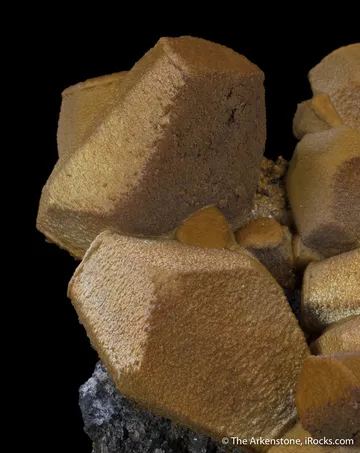
Baddeleyite from Limpopo is a Palabora specialty and one of the province’s truly world-class mineral-specimen contributions. In the Loolekop orebody it occurs mainly in foskorite and less commonly in carbonatite, typically as short black prismatic to bladed crystals flattened parallel to 100, with strong vertical striations from polysynthetic twinning; most crystals are microscopic to millimetric, but detached crystals to about 3 cm are well represented in collections, and exceptional Palabora crystals have reached far larger sizes. Good pieces are sharply crystallized, lustrous black, visibly striated, and preferably matrix-supported in foskorite or carbonatite with magnetite, calcite, apatite, clinochlore, or phlogopite; many crystals show healed fractures or natural breaks, so the collector’s eye should distinguish normal Palabora growth features from later damage.
Other Limpopo minerals of collector and scientific importance include calcite, magnetite, fluorapatite, fluorapophyllite-(K), chondrodite, iowaite, phlogopite, prehnite, pectolite, barite, valleriite, bornite, chalcopyrite, and rare PGE minerals from Palabora; stibnite, berthierite, cervantite, senarmontite, valentinite, stibiconite, aurostibite, ullmannite, and fuchsite-bearing quartz-carbonate rocks from the Murchison antimony mines; emerald from the Gravelotte emerald workings; and Bushveld platinum-group minerals such as atokite and braggite. The type-locality minerals are especially significant: atokite is tied to the Atok Mine in the eastern Bushveld Complex, while braggite has its type locality at Mokopane in Limpopo. These are mostly ore-microscopy species rather than hand-specimen showpieces, but they give the province unusual weight in systematic mineralogy.
Limpopo labels require scrutiny because “Limpopo, South Africa” is a broad provincial attribution. A Palabora brucite, a Monarch native antimony, a Gravelotte emerald, and an Atok PGE polished section are all legitimately Limpopo specimens, but they are not interchangeable localities. For serious cataloging, insist on the mine name when possible: Palabora Mine or Loolekop for brucite and baddeleyite; Monarch, Murchison, Alpha-Gravelotte, Athens-Weigel, Beta, or Consolidated Murchison for antimony-suite material; Atok or Mokopane for PGE type-locality material. Old labels reading “Phalaborwa,” “Palabora,” “Loolekop,” or “Eastern Transvaal” can all be historically reasonable, but a modern listing should clarify the current Limpopo provincial placement.
No famous large-scale fake industry is documented for Limpopo brucite, antimony, or baddeleyite, but mislabeling is a real collector issue. Palabora baddeleyite can be confused in poor photographs with black tourmaline, rutile, ilmenite, or even dark amphibole; it should be unusually dense for its size, strongly lustrous, and commonly striated or twinned. Palabora brucite is soft, sectile, and easily bruised; the blue material is distinctive, but broken surfaces, calcite mixtures, and foliated masses can look less crystalline than buyers expect. Some Palabora material in older collections has also carried outdated or incorrect identifications, and published work notes biotite formerly misidentified as pyroaurite and magnetite specimens mislabelled as other black oxides in collection contexts.
Condition matters greatly. Brucite has low hardness and perfect basal cleavage, so Palabora pieces often show edge contacts, bruised plate margins, crushed foliated areas, or a greasy abrasion polish from handling. The best pieces should be handled as soft cabinet minerals, not washed aggressively or stored loose against harder specimens. Baddeleyite is harder and denser but many Palabora crystals display natural healed fractures as part of their growth history; fresh chips, snapped terminations, and repaired detached crystals are more serious condition issues. Native antimony and stibnite are both vulnerable to bruising: stibnite blades bend, splinter, and dull easily, while native antimony cleavages can tarnish or become rubbed.
Fluorescence is not the main attraction for these featured species, though associated calcite and some secondary minerals from the province may respond variably. For handling, the antimony-suite specimens deserve respect: avoid inhaling dust, do not cut or grind sulfide-rich pieces without proper controls, wash hands after handling, and keep fragile stibnite away from vibration. Palabora brucite should also be kept dry and protected from acidic cleaning solutions; acid treatment would attack associated calcite and can ruin the visual texture of brucite-calcite mixtures.
Market availability is uneven. Palabora brucite appears periodically from older dealer stock and legacy collections, with attractive blue crystals far scarcer than massive or foliated material. Palabora baddeleyite is available more often than most world-class baddeleyite localities because the mine was so large and the species was recovered commercially as a byproduct, but large, well-formed, matrix specimens remain genuinely uncommon and command a premium. Native antimony with stibnite from the Murchison mines is far less abundant in the general market than Chinese stibnite or Mexican stibnite and is best bought when well-provenanced. The PGE type-locality minerals from Atok and Mokopane are generally research, polished-section, or micromount material rather than normal display specimens.
At Palabora, the earliest mining story is not a tale of European prospectors but of African miners working the copper-rich hill at Loolekop centuries before the open pit existed. When modern mining stripped into the hill, it exposed a maze of old galleries, shafts, and adits. Some ancient workings followed mineralized veins to depths of 20 to 35 meters, and some of the tunnels were less than 50 cm in diameter. Iron chisels, gads, and dolerite hammer-stones came out of those old workings, and more than fifty smelting sites were recorded around the nearby syenite hills. For a collector holding a Palabora azurite, malachite, or copper-bearing specimen, that history matters: the locality was already an ore district long before it became a modern carbonatite mine.
The Hans Merensky chapter has the quality of a late-career rediscovery. Merensky had mapped around Loolekop as early as 1904, but the decisive turn came in 1937, when he was told of large deposits of “hydrated mica,” the vermiculite that would become one of the district’s great industrial minerals. He obtained the prospecting rights and founded the Transvaal Ore Company. Then, in 1946, at about seventy-five years old, he remembered an apatite-bearing rock he had seen forty years earlier near the vermiculite occurrence. He sent his secretary, Jurgen von Bulow, to retrieve samples using specific directions. The material turned out to be apatite-bearing carbonatite. Merensky went to Loolekop himself, supervised exploration and drilling, and within three years the enormous Palabora carbonatite had been delineated.
The open-pit years produced the mineral specimens collectors now chase, but only in frustratingly brief windows. The Palabora operation was built for ore, not vugs, and the best cavities were localized. In the 1980s, mining intersected specimen-producing cavities near foskorite xenoliths on the eastern margin of the carbonatite and along younger dolerite-related fracture systems. Named bench and dike labels are more than collector romance here: Bench 31 produced an off-white pearly brucite-calcite specimen on massive magnetite collected by Jon Gliddon in June 1987, while Ramp Dike and Main Dike pockets yielded delicate zeolite-suite pieces. One published Palabora pectolite specimen was collected by Gliddon from the Ramp Dike on Bench 18 in 1981, where white needles bridged an apophyllite-lined vug in dolerite.
The baddeleyite story is even more dramatic because Palabora changed expectations for the species. Baddeleyite is typically a microscopic or millimetric mineral, yet Palabora produced crystals that made it a display species. Published descriptions record a 10 cm terminated baddeleyite crystal in foskorite matrix in the Desmond Sacco collection, described as the finest known from Palabora and a global benchmark for the species. Another illustrated Palabora crystal measured 2.7 cm and showed the flattened form, striations, polysynthetic twinning, and healed fracture typical of the locality. Mindat’s Palabora occurrence note records baddeleyite up to 15 cm from early-1980s finds, with small crystals to 1 cm quite common. That combination—industrial-scale orebody plus a normally obscure zirconium oxide—explains why Palabora baddeleyite still has a special status among systematic collectors.
The Murchison Range antimony mines have a different rhythm: narrow, old, structurally controlled, and historically tied to global antimony demand. During the First World War, antimony in the form of stibnite “cobs” was produced for export from the United Jack Mine, then activity faded after the war. Interest revived in 1928 when antimony as a byproduct of gold became worthwhile, and in 1934 Consolidated Murchison was formed to prospect and exploit the more extensive mineralization east of Leydsdorp. By the mid-1980s, Consolidated Murchison was described as South Africa’s only primary antimony producer and the biggest single antimony mine in the world, producing roughly 18 percent of world output. The mine fed its mill from several shafts, with Athens and Alpha active at that time and Monarch and Beta being deepened and equipped.