La Paz County, USA — famed for Red Cloud wulfenite and North Geronimo vanadinite, with fluorescent calcite and fluorite; a prize for collectors.
Key facts
La Paz County is one of the great western Arizona collector names: a desert county whose specimen reputation rests less on large-scale metal production than on a handful of oxidized, pockety lead-silver-zinc veins that happen to grow superb secondary minerals. The heart of that reputation is the Silver Mining District in the southern Trigo Mountains, especially the Red Cloud, North Geronimo/Pure Potential, Hamburg, Princess, Clip, Dives, Melissa, Silver King, and neighboring claims. These deposits are fissure and fault-zone veins cut through volcanic rocks and Laramide intrusive bodies, with brecciated, iron-stained wall rock, calcite, quartz, fluorite, and barite providing the cavities in which lead, zinc, molybdenum, vanadium, arsenic, and silver were remobilized into collector minerals.
For specimen collectors, the county’s two calling cards are unmistakable: Red Cloud wulfenite and North Geronimo/Pure Potential vanadinite. Red Cloud produced the benchmark Arizona look for wulfenite—upright to perched orange-red to deep red tabular crystals, commonly glassy and transparent, on drusy quartz, iron oxide, or calcite-rich matrix. North Geronimo/Pure Potential, about a short distance northwest of Red Cloud in the same structural belt, gave the county a different red: lustrous vanadinite in bright orange-red to blood-red hexagonal prisms, including the celebrated hoppered and skeletal crystals that make the locality instantly recognizable in thumbnail and miniature drawers. Fluorescent calcite, fluorite, and willemite add a second layer of interest, especially in specimens from the Red Cloud–Geronimo group, where daylight aesthetics and shortwave ultraviolet response can occur on the same piece.
Regional View
Country View
Historically, labels can be confusing. La Paz County was created in 1983 from the northern part of Yuma County, so older labels, older articles, and many classic collection records correctly used “Yuma County” for mines that are now in La Paz County. Serious collectors should treat old “Yuma Co.” labels from Red Cloud, North Geronimo, Hamburg, and the Silver District as a normal historical artifact, not an error, provided the district and mine name are otherwise consistent.

Photo: Wikimedia Commons / Ivar Leidus
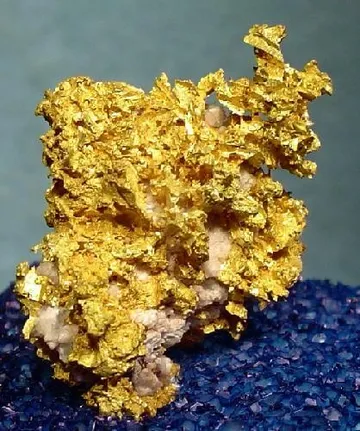
The county also has an older gold-mining identity. The La Paz placers in the Dome Rock Mountains were among the early western Arizona placer fields, worked from the 1860s and famous for coarse gold and large nuggets. To the specimen collector, however, the county’s enduring mineralogical personality is the oxidized lead-vanadate-molybdate assemblage of the Trigo Mountains: red vanadinite, red wulfenite, yellow to orange mimetite, cerussite, anglesite, fluorite, calcite, quartz, willemite, smithsonite, and uncommon lead-silver and lead-silicate species tucked into narrow fault-controlled veins in one of the harshest collecting climates in the American Southwest.
Search for specimens: View all specimens from La Paz County, USA
La Paz County occupies the lower Colorado River desert of western Arizona, with Parker as the county seat and the Colorado River forming much of the western boundary. For collectors, the county’s most important mineral ground is the Silver Mining District in the southern Trigo Mountains, north of Yuma and east of the Colorado River. The district is a Pb-Zn-Ag-Au-Cu-Ba-F-Mo-V camp in which the important specimen mines sit along steep to moderately dipping fault zones, fractures, and vein systems. The most famous part of the district is the Red Cloud–Geronimo area, where the mineralized structures cut volcanic units—andesite breccia, rhyolitic to dacitic tuffs, lapilli tuffs, and related flows—and lie close to granodiorite, quartz diorite, monzonite, and quartz monzonite intrusive rocks. This juxtaposition of reactive lead-zinc-silver ore, broken volcanic wall rock, fluorite-calcite-quartz-barite gangue, and arid-zone oxidation is the essential recipe behind the specimens.
The Red Cloud Mine is a former surface and underground lead-zinc-silver-gold-vanadium-molybdenum occurrence on patented private ground. Its vein occupies an irregular fault zone, recorded as striking roughly north-northwest and dipping east, with mineralization in irregular masses, vug linings, nodules, and breccia cavities. Primary galena and silver-bearing galena were partly altered to anglesite, cerussite, lead oxides, chlorargyrite and related silver halides, with secondary wulfenite, vanadinite, mimetite, fluorite, calcite, quartz, pyrolusite, goethite, malachite, smithsonite, willemite, and rarer species in the oxidized zone. The finest Red Cloud specimens are not ore specimens in the mining sense; they are mineralogical accidents of open space—small to medium pockets where the chemistry was right and the cavity remained uncrushed.
The North Geronimo Mine, widely marketed in modern specimen circles as the Pure Potential Mine, lies within the same Silver District system. It is a former underground Pb-Zn-Ag-Fe-Mo-V-F mine, historically worked from a shaft and short drifts and later claimed for specimen production. The deposit is described as irregular bunches and vugs in lensing veins along a north-trending fault zone, with argentiferous lead sulfate and carbonate, zinc carbonate, lead oxide, wulfenite, altered galena, manganiferous calcite, quartz, fluorite, and iron oxides. Its collector fame rests on vanadinite, especially the bright red, lustrous, hoppered to skeletal crystals that distinguish North Geronimo/Pure Potential from the more common massive or drusy vanadinite occurrences of the Southwest.
Other Silver District mines broaden the county picture. Hamburg produced vanadinite and wulfenite with the same general oxidized lead-silver vein chemistry, along with mimetite, cerussite, smithsonite, massicot, minium, litharge, fluorite, calcite, quartz, and amethyst. The Clip Mine is noted for lead-silver mineralization with barite, fluorite, calcite, manganese-rich calcite, celestine, cerussite, chlorargyrite, malachite, pyrolusite, and vanadinite. The Dives Mine adds silver minerals and rarities such as tocornalite, while nearby claims such as Princess, Silver King, Melissa, South Geronimo, Papago, Black Rock, and Silver Glance make the district an unusually dense cluster of classic small mines rather than a single isolated locality.
Mining history in the county begins earlier than the famous specimen era. The La Paz placers, west of Quartzsite and northeast of Ehrenberg, were discovered in 1862 and quickly drew prospectors to the Dome Rock Mountains and the Colorado River corridor. These were gold-bearing gravels derived from quartz veins in metamorphic rocks intruded by granitic bodies; the richest placer values were concentrated near bedrock in washes such as Ferrar Gulch and Arroyo La Paz. The placer ground produced coarse gold and large nuggets, but its specimen legacy is mainly historical rather than mineralogical.
The Silver District developed after prospectors recognized silver-bearing lead ores in the Trigo Mountains. By the early 1880s, the district supported mills, small smelting efforts, and settlements such as Silent, Clip, and river landings that served the mines. The Red Cloud passed through many owners and operators, including the Red Cloud Mining Company of New York, Horton & Knapp, Red Cloud Consolidated Mines Company, Neal Mining Company, Penn Metals, Riley & Holmes, and others. Production was intermittent: periods of activity in the 1880s were followed by decline when silver prices weakened, then later exploration, dump recovery, and specimen work during the twentieth century. Much of the district’s value to modern collectors was recovered after its metal-mining importance had faded.
Specimen production has been episodic and highly pocket-driven. Red Cloud’s great modern wulfenite fame was reinforced by important pockets in the 1970s, 1980s, 1990s, early 2000s, and later small finds. The celebrated April 1996 Red Cloud pocket is one of the landmark modern American wulfenite events, producing large numbers of top-tier red crystals and a few world-class specimens. North Geronimo/Pure Potential became a modern vanadinite classic in the 1990s and 2000s, yielding brilliant red matrix pieces, hoppered thumbnails, and fluorescent matrix specimens that circulated through Tucson dealers and private collections.
Collecting access must be treated mine by mine. Red Cloud has operated at times as a fee-collecting locality and specimen source, with surface collecting, dry camping, and specimen sales advertised seasonally by the mine operators; current access is by reservation or mine-owner terms, with no underground access. The approach is remote desert travel, and four-wheel drive is recommended. North Geronimo/Pure Potential is under claim and lease and is explicitly not open to casual entry. Much of La Paz County is a patchwork of BLM land, patented claims, active claims, private parcels, wildlife or military restrictions nearby, and hazardous historic workings. Serious collectors should verify current claim status and permission before visiting any mine or dump, and should assume that shafts, stopes, and adits are off-limits unless the owner or operator clearly states otherwise.
La Paz County vanadinite is a Silver District specialty, best known from the North Geronimo/Pure Potential Mine but also documented from Red Cloud, Hamburg, Princess, Silver King, Clip, Papago, South Geronimo, and other district workings. The classic look is bright orange-red to deep blood-red Pb5(VO4)3Cl as lustrous hexagonal prisms, commonly only a few millimeters but locally much larger, with the finest North Geronimo/Pure Potential crystals forming stepped, skeletal, or hoppered individuals on dark iron-stained breccia, quartz, calcite, fluorite, or mixed oxidized matrix. The strongest pieces have saturated red color, glassy luster, complete terminations, sharp hexagonal outlines, and enough contrast from the matrix to avoid becoming merely a red crust; ordinary pieces tend to be drusy, damaged, dull, brownish, or visually crowded. Calcite is a frequent companion, wulfenite appears on some specimens, and the district’s best vanadinite is especially prized because it offers a distinct American alternative to the more abundant Moroccan material: smaller on average, but sharper, redder, and often more architectural.
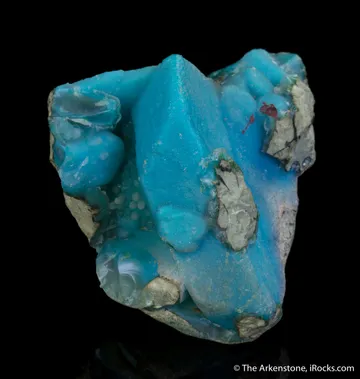
Beyond vanadinite, La Paz County’s collector roll call is led by Red Cloud wulfenite, one of the world standards for the species, with orange-red to deep red PbMoO4 tabular crystals that may be transparent, highly lustrous, and dramatically perched on quartz or calcite-rich matrix. Mimetite occurs in yellow to orange and reddish microcrystals in the Silver District, sometimes with wulfenite and vanadinite; cerussite, anglesite, smithsonite, fluorite, calcite, quartz, barite, and lead oxides are widespread in the oxidized Pb-Zn-Ag veins. Rarities documented from the district include wickenburgite, stetefeldtite, tocornalite from the Dives Mine, diaboleite, fornacite, descloizite, caledonite, leadhillite, linarite, chlorargyrite, minium, massicot, litharge, plattnerite, and willemite. Away from the Silver District, the Dome Rock Mountains add native gold from the La Paz placers and notable zunyite from the Big Bertha Mine, while the Buckskin Mountains and Planet-Swansea area contribute copper minerals such as chrysocolla, malachite, azurite, brochantite, chalcanthite, cuprite, and associated hematite, quartz, and sulfates.
The most common locality problem is mislabelling rather than outright fakery. Pre-1983 labels for Red Cloud, North Geronimo, Hamburg, and other Silver District material commonly read “Yuma County,” which can be historically correct even though the mines now lie in La Paz County. North Geronimo and Pure Potential are the same collector locality in normal market usage, but labels may emphasize one name or the other depending on the collecting period and dealer. Some Red Cloud labels have also been applied loosely to specimens from nearby claims, especially when red wulfenite or vanadinite came from the broader Red Cloud–Geronimo property area; mine-specific labels are preferable.
Vanadinite from La Paz County can be confused in the market with Moroccan vanadinite and with Arizona specimens from Apache, Old Yuma, Mammoth-St. Anthony, Rowley, Puzzler, and other southwestern localities. North Geronimo/Pure Potential pieces tend to show small but very bright red crystals, hoppered or stepped growth, dark brecciated matrix, calcite or fluorite associations, and a compact American miniature aesthetic. Large, thick Moroccan-looking vanadinite clusters with abundant tan barite should be questioned if sold as La Paz County without old labels or convincing provenance.
Condition is critical. Red Cloud wulfenite has perfect-looking edges that chip easily, and even small bruises on a main tabular crystal can halve the appeal of an otherwise fine specimen. Vanadinite is brittle, and the hoppered crystals that make North Geronimo pieces desirable are also vulnerable at the rims and corners. Calcite-rich matrix can be friable; iron oxide coatings may shed dust; and fluorite or willemite-bearing matrix pieces can have crumbly pocket surfaces. Avoid aggressive cleaning. Water, acids, and ultrasonic cleaning are poor choices for many oxidized lead-mineral matrices, especially where calcite, cerussite, or delicate microcrystals are present.
Handling should be sensible rather than theatrical. Vanadinite, wulfenite, cerussite, anglesite, mimetite, minium, massicot, and several associated species contain lead; vanadinite also contains vanadium and chlorine, and mimetite contains arsenic. These are stable display minerals when kept intact, but they should not be abraded, sawn, tumbled, powdered, licked, or handled before eating. Wash hands after handling, keep fragments away from children and pets, and store loose crumbs or trimmed debris responsibly.
Fluorescence is a real collecting bonus in La Paz County. North Geronimo/Pure Potential and Red Cloud matrix specimens may show calcite, fluorite, and willemite responses under ultraviolet light, including bright shortwave colors in some pieces. The best fluorescent specimens are not always the best daylight vanadinite or wulfenite specimens, so collectors should decide whether they are buying an aesthetic mineral specimen, a fluorescent specimen, or a rare combination of both.
Market availability varies by species. Small North Geronimo/Pure Potential vanadinites remain available from older dealer stocks and occasional releases, with attractive thumbnails and miniatures more common than cabinet specimens. Superb undamaged hoppered crystals, strong red matrix plates, and larger pieces with balanced aesthetics are much scarcer. Red Cloud wulfenite is always in demand and is priced heavily by color, transparency, isolation, crystal size, and lack of repairs. Ordinary microcrystalline or damaged Red Cloud material is obtainable; great perched red crystals, major 1996-pocket pieces, and old-provenance classics are high-end American minerals.
The La Paz story begins with gold, not vanadinite. In January 1862, Captain Pauline Weaver and companions were working the Colorado River country when they found gold in a gulch known as El Arroyo de la Tenaja, east of the river and near what became the La Paz placer district. The find helped ignite the Colorado River gold rush. Prospectors poured into the desert washes, dry-washing and panning gravels that were richest near bedrock, and La Paz grew almost overnight into a river mining town. One early account records that Jose Redondo recovered a nugget weighing more than two ounces less than a mile south of Weaver’s camp; later, Ferrar Gulch became famous for even coarser gold, including a nugget attributed to Juan Ferrar that weighed more than 47 ounces. For a county now beloved for red lead minerals, it is worth remembering that its name first entered Arizona mining history through heavy yellow metal in dry desert gravel.
The Silver District had its own rough romance. One old account says the Red Cloud was discovered after three miners reached Yuma with almost no capital and pawned a shotgun for supplies, then went into the district and found nuggets of native silver in the soil below the outcrops. Whether told as history or frontier legend, the story captures the appeal of the Trigo Mountains in the 1880s: a remote, hot, unforgiving camp where lead-silver veins could be rich enough to support mills, furnaces, river landings, and entire settlements that later vanished. Silent, Clip, Norton’s Landing, and other names now read like marginal notes on old maps, but in the early 1880s they were part of a working network of mines, wagon roads, mills, and Colorado River supply points.
For collectors, the most quoted Red Cloud romance belongs to Ed Over. In the 1970s, Over’s association with the mine entered mineral-collecting folklore, helped by the now-famous painted words “WULFENITE IS LOVE” on a mine-side tank or building captured in period photographs. It is a phrase that could have been silly anywhere else, but at Red Cloud it feels accurate. Few localities ask so much patience for such fragile rewards: hard desert access, oxidized broken ground, narrow pockets, and red plates of PbMoO4 so easily cleaved or bruised that a crystal can go from world-class to merely interesting in a second.
The April 1996 Red Cloud pocket is one of the great modern American specimen episodes. Wayne Thompson and James Horner had purchased the mine in 1994, and a group involving Thompson, Horner, Bill Larson, Les Presmyk, and Gene Meieran began open-cut work on the vein in 1995. On April 1, 1996, Bob Johnson opened the pocket that became the largest and most productive in Red Cloud history. The pocket changed the market almost immediately: specimens that would previously have been once-in-a-career finds appeared in real quantity, including red, transparent wulfenite crystals on matrix with a level of luster, color, and size that confirmed Red Cloud’s status as one of the world’s defining wulfenite localities. One 10 cm specimen from the find was later described as among the two or three finest recovered in the operation and passed through several major collections, a reminder that the best Red Cloud pieces have the provenance trails of paintings.
North Geronimo/Pure Potential tells a quieter but equally satisfying collector story. It was not the county’s great nineteenth-century headline mine, yet by the 1990s it was producing the kind of vanadinite that advanced collectors immediately recognize: red, lustrous, hoppered, compact, and distinctively American. Some specimens carry both names on their labels because “North Geronimo” is the older mine name and “Pure Potential” became common during modern specimen work. The finest pieces feel almost engineered—little red hexagonal towers and skeletal forms built on dark matrix, sometimes with calcite or fluorescent material—proof that a small oxidized fault vein can make specimens with as much personality as far larger ore bodies.