A collector's guide to Jos Plateau, Nigeria: its geology, mining history and notable minerals, illustrated with the 147 specimens documented from this locality on EarthWonders.
Key facts
The Jos Plateau is one of Africa’s great multi-generation gem and tin districts: a broad, high granitic upland in north-central Nigeria where Jurassic alkaline “Younger Granite” ring complexes cut older basement rocks and shed cassiterite-rich gravels into a web of streams, flats, and mine workings. To economic geologists it is a classic tin-columbite province; to collectors it is the Nigerian source whose name appears on colorless and pale-blue topaz from the old tin fields, sharp aquamarine and green beryl, unusual emerald-green beryl from miarolitic and greisen-related settings, etched glassy phenakite, and surprisingly fine elbaite tourmaline.
The specimens that made Jos famous have two very different looks. The older tin-field material is often alluvial or eluvial: waterworn topaz pebbles and crystals, cassiterite, columbite-group minerals, and heavy-mineral concentrates tied to granite weathering. The gem-crystal material is more pocket-like: beryl, aquamarine, emerald-green beryl, elbaite, and phenakite as isolated crystals, many showing etching, dissolution features, tapered or complex terminations, and the bright luster expected from late-stage granitic fluids. The best Jos pieces are not merely “from Nigeria”; they are distinctly Jos in style—pale blue to blue-green beryls with clean faces and color zoning, colorless phenakite floaters that look carved by solution, and small but highly gemmy tourmalines with green-to-pink zoning.
Regional View
Country View
“Jos Plateau” is also a name that has been used broadly in the specimen trade. It can mean the plateau as a collecting region, a parcel handled through Jos, or a more specific mine or pocket whose precise field name was lost between miners, buyers, cutters, and exporters. The best labels preserve sublocalities such as Ropp Tin Mines, Bukuru, Rafin Gabas Hills, Salistone Mine / Okuta-didan Mine, or named pockets around the Jos gem trade. When locality precision matters, especially for emerald-green beryl and phenakite, collectors should favor older labels, dealer notes, analysis, or a provenance chain over a bare country-and-plateau attribution.

Photo: Wikimedia Commons

Photo: Wikimedia Commons

Photo: Wikimedia Commons
Search for specimens: View all specimens from Jos Plateau, Nigeria
The mineralizing engine of the Jos Plateau is the Nigerian Younger Granite Province: Jurassic alkaline ring complexes emplaced into older basement gneisses, schists, migmatites, and Pan-African granites. In the Jos-Bukuru, Ropp, Sha-Kaleri, and neighboring complexes, late granite phases, greisenization, miarolitic cavities, veins, fissures, and roof-zone structures produced tin, niobium-tantalum, tungsten, fluorine-rich assemblages, and beryllium minerals. Weathering then did the rest. Cassiterite and associated heavy minerals were released from primary granite, greisen, quartz-vein, and pegmatitic sources into eluvial and alluvial deposits, while more delicate gem crystals survived only where pockets or decomposed rock could be worked carefully.
The classic ore story is cassiterite with columbite-group minerals. Tin mineralization is especially tied to biotite granite phases of the Younger Granites, with alluvial dispersion controlled by the radial drainage systems around the ring complexes. Ropp is one of the best-known subdistricts. Its Younger Granite complex lies southeast of Jos-Bukuru and includes tin-bearing biotite granite, greisenized zones, quartz veins, dykes, alluvial systems, and old workings around places such as Bukuru, Kassa valley, South Ropp, Dress, Tente, and the broader Barkin Ladi–Ropp mining belt. In specimen terms, this is why Jos topaz is so often linked with the tin mines: topaz, quartz, fluorite, cassiterite, and columbite all belong to the late fluorine-rich granitic system and to the durable heavy-mineral residue left by erosion.
Commercial tin mining began in the early twentieth century and transformed Jos from a highland settlement into Nigeria’s famous “Tin City.” Colonial-era production centered on Jos, Naraguta, Delimi, Rayfield, Bukuru, Barkin Ladi, Bisichi, Ropp, and related fields, with numerous British and Nigerian operators. Ropp Tin, Bisichi Tin Company, Naraguta concerns, Rayfield interests, Northern Nigeria ventures, Jos Tin Areas, Kaduna Syndicate, and later amalgamated companies all appear in the mining literature. By the mid twentieth century, hydraulic and mechanized mining had altered large tracts of land; by the late twentieth century, many formal operations had declined, while artisanal reworking of old dumps, channels, and abandoned pits continued.
Collectors should not imagine Jos as one tidy, fenced specimen mine. It is a region of old tin workings, gem pits, weathered granite pockets, and trade routes through the city of Jos. Some sublocalities are true mines or prospects; others are buying names attached to parcels assembled by miners and dealers. The Salistone Mine, also known as Shining Stone Mine or Okuta-didan Mine, is documented as an alluvial phenakite occurrence, and “Okuta-didan” is reported as meaning “shining stone” in Yoruba. Ropp Tin Mines at Bukuru are documented for topaz and cassiterite. Rafin Gabas Hills appear in gemological literature as a place where miners searched Younger Granite roof zones for miarolitic beryl pockets, even preparing drill holes to expose cavities.
Collecting access today is best treated as restricted and local-permission only. Many workings are active artisanal sites, privately controlled leases, abandoned industrial ground, or unsafe water-filled pits. The old tin landscape includes steep-sided excavations, unstable spoil, tailings, and radiometric anomalies associated with U- and Th-bearing accessory minerals in the granites and concentrates. Specimens on the market are normally obtained through Nigerian miners, local dealers, Jos-based gem merchants, international show dealers, or old collections rather than through recreational field collecting.
The notable gem finds are most memorable for their pocket character. In the late 1980s and early 1990s, Nigerian emerald and green beryl from central Nigeria entered the international market in enough quantity to trigger a serious gemological debate over whether the bluest green crystals should be called emerald or green beryl. Jos-area material includes strongly zoned bluish green beryls, pale to saturated aquamarines, and large, well-formed crystals from granitic roof-zone or pegmatitic pockets. Phenakite from the Jos Plateau appeared in collector channels as colorless to milky, etched, high-luster crystals—some large enough and clean enough that they were nearly lost to the cutting trade before mineral dealers recognized their specimen value.
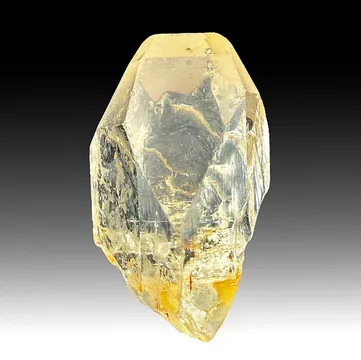
Jos beryl ranges from near-colorless and pale yellowish crystals through aquamarine-blue, blue-green, and emerald-green material, reflecting the district’s mix of pegmatitic, miarolitic, and greisen-related sources. The best non-varietal beryl specimens from the plateau are typically single crystals or crystal sections with strong luster, clean prism faces, etched zones, and visible color zoning rather than matrix plates. Fine pieces can be several centimeters long, and some green beryl / emerald crystals from central Nigerian material reached far larger sizes, but most collector specimens are thumbnails to miniatures. Ordinary Jos beryl may be abraded, cloudy, iron-stained, or only generically labeled; superior pieces show intact terminations, sharp hexagonal form, saturated blue-green or golden-green zoning, and enough transparency to reveal the late-stage growth history inside the crystal.
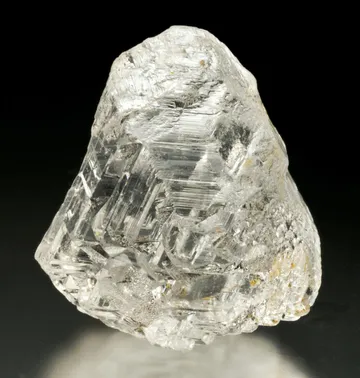
Jos phenakite is one of the locality’s modern collector signatures, especially material attributed to the Salistone Mine / Shining Stone Mine / Okuta-didan Mine. Specimens are usually colorless to milky, sometimes with faint golden tones, high vitreous luster, and complex etched surfaces that give the crystals a rounded, solution-sculpted look rather than a simple textbook prismatic habit. Most are small thumbnails or small miniatures, but documented crystals reach several centimeters, including notable floaters around 4 cm and larger, and at least one EarthWonders-recorded 4.7 cm crystal with a cavity containing sulfur crystals. Good Jos phenakite is distinguished by transparency, complete all-around form, bright faces, and crisp etching; ordinary examples are more included, frosted, broken, or so quartz-like that confirmation by density, optics, or analytical testing becomes important.
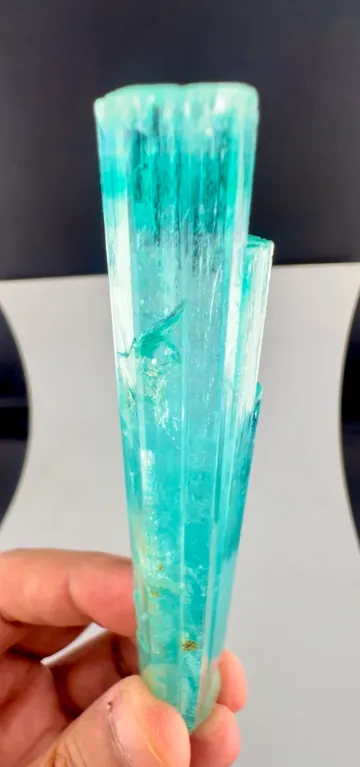
Aquamarine from the Jos Plateau is the blue member of the district’s beryl suite, occurring as single hexagonal crystals, etched crystals, and occasionally more complex terminations showing stepped or clustered growth. Color ranges from very pale blue to stronger sky blue and blue-green, with some crystals showing a darker, more opaque lower zone and a clearer, paler termination. Specimens around 2–5 cm are familiar in collections, while published and dealer-described pieces include larger crystals; one reported Jos aquamarine crystal was described as a 9.5 cm doubly terminated crystal. Associations documented from photo and specimen records include feldspar, quartz, muscovite, and schorl, though many crystals reached the market as loose pocket or alluvial pieces. The best Jos aquamarines combine clean blue color, transparency, intact termination, and original surface texture; lesser pieces are clouded, abraded, iron-stained, or simply labeled “Nigeria” without a secure Jos connection.
Topaz is the historic collector mineral of the Jos tin fields, especially from Ropp Tin Mines at Bukuru and related workings around the plateau. Nigerian topaz from this district is mostly colorless to faintly blue or greenish blue, occurring both as rolled alluvial pebbles and as short prismatic crystals with prominent dome faces that can create a chisel-like termination. Vertical striations, triangular or shield-like etch marks, pitted basal faces, and cleavage bases are all characteristic features noted in the literature, and while many pieces are singly terminated because they detached along the basal cleavage, doubly terminated crystals are known. Fine Jos topaz is glass-clear, lustrous, complete, and lightly colored rather than merely a rounded cutting pebble; the most desirable old specimens also carry Ropp, Bukuru, or tin-mine provenance rather than the broad and sometimes overused “Jos Plateau” label.
Jos elbaite is much scarcer in collections than the district’s beryl or topaz, but good crystals are surprisingly attractive: slim, gemmy prisms grading from pale or pinkish bases into green, grass-green, bottle-green, or darker terminations. Documented examples from the plateau include complete crystals around 4–6 cm, some doubly terminated, with color zoning visible through the length of the prism and only minor contacts or chips. These are not the large matrix tourmalines of Brazil or Afghanistan; their appeal is in clarity, zoning, and locality. A strong Jos elbaite should be transparent, lustrous, well terminated, and visibly polychrome, while ordinary pieces are fractured, abraded, too dark to read, or labeled only as “Nigerian tourmaline” without evidence for the plateau.
Emerald from the Jos Plateau belongs to the long-debated Nigerian emerald / green beryl suite: bluish green, green, and zoned beryl crystals whose color may reflect chromium, vanadium, iron, or a mixed chromophore signature. The finest Jos-attributed emerald specimens are well-formed miarolitic or granitic-pocket crystals, commonly elongated, hexagonal, and internally zoned, and some are large enough to be major cabinet-level display pieces rather than simple gem rough. Gemological studies of central Nigerian emerald and green beryl show abundant growth structures, fluid inclusions, and locality-distinctive solid inclusions such as albite, fluorides including fluorite and ralstonite-type phases, Fe-rich mica, ilmenite, monazite, and related greisen minerals. The best collector pieces have legitimate emerald-green body color, natural surfaces, and convincing provenance; borderline pale blue-green crystals should be sold and valued carefully as green beryl unless testing or expert documentation supports the emerald name.
Tourmaline from Jos is represented both by elbaite and by darker tourmaline-group material such as schorl in association with beryl-bearing pegmatites. The collector-grade material is generally slender, gemmy, and zoned, with green, dark green, pale green, and pink portions, while schorl appears more as an accessory association on aquamarine or in pegmatitic contexts. Fine pieces are judged on completeness, transparency, color separation, and undamaged terminations; because Nigeria produces tourmaline from multiple regions, the “Jos Plateau” locality is most convincing when attached to an old label, a documented photo record, or a collection history. Ordinary “Nigerian tourmaline” should not be upgraded to Jos without supporting evidence.
Beyond the main collector species, Jos Plateau records include the minerals expected from a fluorine-rich tin-granite province: cassiterite, columbite-group minerals, wolframite, fluorite, quartz, albite, microcline, muscovite, Fe-rich mica, monazite, ilmenite, zircon, pyrochlore-group minerals, and alkaline-granite silicates such as aegirine and arfvedsonite. The broader Mindat regional entry also includes a Kishesha lead-silver mine assemblage with argentopyrite and arsenopyrite, reminding collectors that “Jos Plateau” is a large regional umbrella, not a single paragenesis. Nigerian type-mineral fame is often associated with nearby or broader Nigerian pegmatite districts—especially nigerite / ferronigerite-series material from the Egbe district of Kogi State—rather than with Jos Plateau proper, so type-locality claims on Jos labels should be checked carefully.
Locality precision is the central issue with Jos Plateau specimens. The name is genuine and important, but it has been used broadly in the trade. A specimen labeled “Jos Plateau” may be from a named mine, a pocket within Plateau State, a neighboring central Nigerian beryl district, or simply a parcel exported through Jos. This matters most for emerald, green beryl, aquamarine, phenakite, and tourmaline, where Nigeria has multiple producing areas and where value can change significantly with a tighter locality.
Phenakite deserves special caution. Colorless, etched Jos phenakite can resemble quartz, topaz, beryl, danburite, or even worked glass to the untrained eye, and inexpensive “phenacite” in the metaphysical market is sometimes sold with weak or unverifiable locality information. For significant purchases, ask for a reliable dealer, a previous collection label, specific sublocality, density or refractive-index data, or laboratory confirmation. Phenakite is denser than quartz and has different optical properties, but visual identification alone is risky when pieces are small, colorless, and waterworn or etched.
Topaz from Jos is commonly alluvial or cleavage-broken. Basal cleavages, abraded edges, pitted faces, iron staining, and waterworn surfaces should be expected, but fresh chips on terminations and cleavage planes still affect value. Color is usually subtle; strongly saturated blue “topaz from Nigeria” should be treated skeptically unless supported, since irradiation and heat treatment are common in commercial blue topaz generally, even when not specifically tied to Jos specimen material. Natural Jos crystal specimens are usually prized for form, luster, age of provenance, and tin-field locality rather than dramatic color.
Emerald and green beryl require careful naming. Some central Nigerian beryls contain enough chromium and show absorption features that justify the emerald designation, while other pale or bluish green stones are more honestly described as green beryl, vanadium beryl, or aquamarine-green beryl depending on color and analytical data. This is not just semantics: “emerald” changes price. Fine Jos emerald specimens are best bought with documentation, especially if they are large, transparent, or offered at a premium. Bluish green color zoning, white cores, internal growth tubes, multiphase inclusions, and iron-related spectral features are part of the Nigerian signature, but they are not a substitute for provenance.
Condition varies sharply by species. Beryl and aquamarine often show etched or dissolved surfaces that are natural and desirable, but bruised terminations and cleaved bases are common. Elbaite crystals may be contacted at the base or chipped at the termination, and their slender form makes repairs worth checking under magnification. Phenakite floaters can be excellent all around, but small bruises disappear easily in bright luster and should be inspected with side lighting. Topaz cleavage is perfect and unforgiving; even a strong-looking crystal can have internal cleavage veils or edge bruises.
Handling considerations are straightforward but important. Topaz should be protected from shock because of its cleavage. Beryl and phenakite are durable enough for careful handling but should not be ultrasonically cleaned if included, fractured, or pocket-coated. Tin-field concentrates and old mine materials may include U- and Th-bearing accessory minerals such as monazite or pyrochlore-group phases; ordinary display specimens are not generally a problem, but heavy-mineral sands, radioactive-looking concentrates, or old ore lots should be stored and handled sensibly, with dust avoidance and basic radiation awareness where appropriate.
Market availability is irregular. Topaz and small phenakite appear with some frequency, often as thumbnails, loose crystals, or small parcels. Good aquamarine and green beryl are available but increasingly label-sensitive. Fine emerald-green crystals and high-end phenakite floaters are much scarcer, especially with strong provenance. Elbaite from Jos is a connoisseur locality item: not impossible, but far less common than Nigerian tourmaline labeled from broader or different districts.
One of the most memorable Jos stories belongs to the 2009 phenakite find that nearly vanished into the lapidary trade. A few kilos of colorless phenakite crystals reportedly reached cutting factories in Thailand in August 2009. To a cutter, the parcel was facetable rough; to a specimen dealer, it was something rarer: complete, etched crystals from a new Nigerian occurrence, some with enough form and brilliance to stand as mineral specimens rather than being sawn into gems. Bill Larson, in Thailand on gem business, recognized the significance of the material and saved a small number of good crystals from the cutter. One 4.0 x 2.1 x 1.7 cm crystal weighing 24 grams was later described as one of the finer crystallized pieces recovered, a complete floater selected from material that represented about half the find. The description is vivid because the crystal does not behave visually like most phenakite: it has a rounded, sculptural termination, complex surface patterning, and such pure colorlessness that it was compared at first glance to a completely colorless spessartine garnet.
Another Jos story is older and harsher: the birth of the tin city itself. Before roads and rail links changed the plateau, smelted tin from Naraguta was reportedly carried by porters on a journey of roughly 200 miles to Loko. Early twentieth-century photographs and historical accounts show a mining landscape where the ore, the labor, and the transport system were inseparable. By 1909, around 1,200 tons of black tin had been exported; by 1929, production had reached a reported peak of 15,129 tons. The rise drew companies, prospectors, migrant laborers, traders, and colonial administrators into Jos, but it also scarred the land. Dumps, ponds, and excavations became permanent features of the plateau, the same landscape in which later collectors and miners would recover topaz, cassiterite, columbite, and gem pockets.
The emerald story is quieter but just as consequential for collectors. When Nigerian emeralds and green beryls reached the market in the early 1990s, they were large enough, attractive enough, and ambiguous enough to restart an old gemological argument: where does green beryl end and emerald begin? The Nigerian crystals could be bluish green, iron-rich, zoned, and pale compared with the most saturated Colombian stones, yet analytical work showed chromium, vanadium, and iron features in varying combinations. Gemologists examined about 1,000 emerald and green beryl crystals and around 30 cut stones from Kaduna and Plateau material, documenting growth structures, fluid inclusions, Fe-rich mica, fluorides, and mixed absorption spectra. In collecting terms, this debate still lives on every time a dealer label says “Nigerian emerald,” “vanadium beryl,” “green beryl,” or “emerald-banded beryl” from Jos.