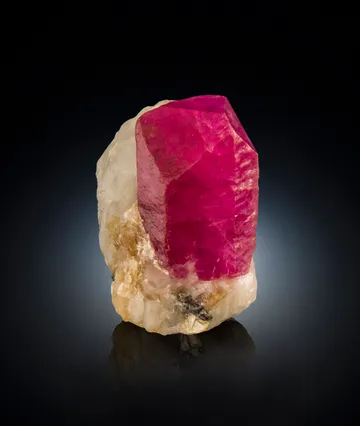
Jegdalek ruby deposit, Afghanistan - historic marble-hosted ruby locality yielding vivid red corundum; prized by collectors for sharp crystals and provenance.
Key facts
Jegdalek is the classic ruby locality of Afghanistan: a high, rugged marble-hosted corundum district in Surobi District, Kabul Province, east to east-southeast of Kabul on the road-and-track approach toward the Kabul–Jalalabad corridor. For collectors, its importance is twofold. It is a historic gem source that has supplied ruby, pink sapphire, violet-to-purple sapphire, and subordinate blue or bicolored corundum for centuries, and it is also a real specimen locality, capable of producing sharply formed red corundum crystals in pale calcite-dolomite marble rather than only gem rough.
Geologically, Jegdalek belongs to the great Asian family of marble-hosted ruby deposits associated with continental collision, regional metamorphism, and local intrusive activity. The ruby-bearing rocks are interstratified gneisses and marbles of the Nuristan series, cut by Oligocene granitic and pegmatitic rocks of the Laghman complex. In the field and in the cabinet, the setting announces itself immediately: vivid red to pinkish red corundum emerging from white to gray marble, sometimes accompanied by phlogopite or other mica, pyrite, graphite, spinel, titanite, tourmaline, chlorite-group minerals, and calc-silicate minerals.
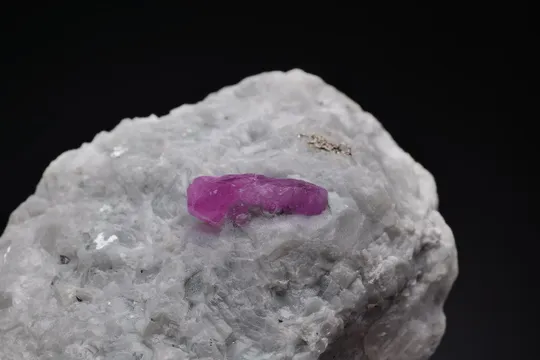
The best Jegdalek specimens have a particular look: hexagonal to pseudo-hexagonal, dipyramidal or prismatic ruby crystals with saturated raspberry-red to purplish red color, lustrous faces, visible growth features, and enough translucency to glow when backlit. They are not typically huge by specimen standards; attractive crystals around a centimeter are already desirable, and sharp crystals approaching or exceeding 2 cm are exceptional. Their appeal lies in contrast, color, locality history, and the unmistakable marble matrix that connects them to the geological style of Mogok, Luc Yen, Hunza, Nepal, and other great marble ruby districts.
Regional View
Country View
Collectors should understand Jegdalek as both a gem mine and a mineral locality. Much of the production has historically been semitransparent pink sapphire or ruby suitable for cabochons and carvings, while a much smaller portion is clean enough for faceting. The mineral-specimen portion is narrower still: well-formed, undamaged crystals on marble matrix are occasional products of the workings, and the finest examples are prized because they preserve the crystal in its natural geological context rather than sacrificing it to the lapidary wheel.

Photo: Wikimedia Commons

Photo: Wikimedia Commons
Search for specimens: View all specimens from Jegdalek ruby deposit, Afghanistan
The Jegdalek ruby deposit lies in the southern part of the Surobi region of Kabul Province, Afghanistan, around 34°26′N, 69°49′E, with historical coordinates and modern locality databases placing the deposit roughly 60 km east to east-southeast of Kabul. The locality is also commonly seen under the spellings Jagdalek, Jagdalak, Jagdalik, and Jigdalak, all of which occur on specimen labels and in older gem literature. Elevations reported from the actively worked belt in the 1990s range from about 1,550 to 2,000 m, low enough compared with many Afghan pegmatite and emerald workings that mining has historically been possible year-round.
The deposit is hosted in calcite to calcite-dolomite marble within a sequence of Proterozoic gneiss and marble. Published descriptions vary in scale: some describe the broader corundum-bearing marble package as hundreds to thousands of meters thick, while more detailed locality summaries describe the main Jegdalek gneiss-marble strata as extending about 1.5 km with a total thickness of roughly 100 to 350 m. The marbles are interlayered with kyanite-, amphibole-, pyroxene-, biotite-, and related gneisses, and the sequence is intruded by granites and desilicated pegmatites assigned to the Oligocene Laghman complex. In practical collector terms, Jegdalek is a marble ruby deposit with a local metasomatic overprint, not a basalt-related sapphire field.
Ruby and sapphire occur in mineralized marble zones rather than in open geodes or alpine-style clefts. The corundum is reported from two principal mineralized marble zones, north and south, separated by as much as 600–800 m and joined toward the west, with a vertical mineralized extent of more than 400 m. The ruby-bearing marble is characteristically coarse grained. Corundum occurs irregularly in thin conformable veins, lenses, and pocket-like concentrations within marble horizons; some descriptions place these lenses at only a few centimeters thick, and they are commonly discontinuous. This explains why attractive matrix specimens are much scarcer than the romantic image of a “ruby mine” suggests: the miner is usually breaking marble and sorting for useful corundum, not opening specimen pockets lined with perfect crystals.
The broader ore field includes skarns and muscovite-bearing pegmatites and is described as lying in the western part of the Surkh-Rod pegmatite field. The associated mineral assemblage records the mixed carbonate, metamorphic, and intrusive setting. Calcite and marble dominate the matrix; phlogopite, muscovite, margarite, graphite, pyrite and other iron sulfides, spinel, titanite, tourmaline, chlorite-group minerals, garnet-group minerals, plagioclase, orthoclase, pargasite, diopside, clinohumite, fuchsite, and white clay-like alteration products have all been reported in or around the ruby-bearing material.
Mining is old, difficult, and historically discontinuous. The mines have been described as worked for more than 700 years. In the 1200s, wealthy Muslim merchants reportedly sold red stones from the region into the Mongol world, including to Kublai Khan and other prominent figures; later historical writers wrestled with the old problem of Afghan “ruby” and spinel, because red corundum and red spinel moved through overlapping trade routes and were often grouped under traditional trade names. By 1886, C. L. Griesbach reported about 300 men extracting rubies in the Jegdalek region with hammers and chisels. More than a century later, field visits in the 1990s found strikingly similar small-scale methods still in use.
Modern descriptions record about 20 named mines and many small unnamed diggings. Mindat-listed sublocalities include Chak Mine, Chongay Mine, Karoon-Sapara Mine, Lal-Poor Mine, Loy-Khan Mine, Mirkalwat Mine, Njoni-Ghala-Spai Mine, Pahra-Dar-Khana Mine, Taghar Mine, and Warmankai Mine, among others. The deposit has also been described as worked from more than 2,000 open pits and trenches, a figure that captures the district’s artisanal character: many small cuts following mineralized marble rather than a single modern open pit. Workers historically used hammers, picks, pry bars, simple pulley systems, and, in places, pneumatic drills and dynamite. Broken marble was hoisted from pits, sorted nearby, and even stacked into rudimentary shelters around the workings.
Government and political control have shifted repeatedly. For much of the last century the mines were described as being owned and worked sporadically by the Afghan government. Shortly after the Soviet invasion of 1979, Soviet operators reportedly ran the mines for only five to six months. Later, local tribal miners worked the deposit in small groups, often five or six men for smaller diggings and larger groups for more substantial workings. A 2024 contract brought renewed formal attention: Ariana Highland Mining Extraction Company announced that it had secured a contract with the Afghan Ministry of Mines and Petroleum to operate the Jigdalak Ruby Mine, with investment figures reported around US$27.5 million and a large concession area measured in square kilometers. How that formal arrangement will affect specimen production, transparency, and export pathways remains a live question for collectors.
Historically reported production figures emphasize how much of Jegdalek’s output is not classic red facetable ruby. One detailed gemological study estimated approximately 75% pink sapphire, 15% ruby, 5% mixed blue and red-to-pink corundum, and 5% blue sapphire. Most material was semitransparent and suitable for cabochons or carvings, while only a small fraction was facetable. The same work noted good-quality faceted rubies up to 32 ct, but top-quality material rarely exceeding 5 ct; semitransparent rough commonly ranged up to 1.5–3.0 cm, and the largest crystal seen by the senior author weighed 174 ct. For the collector, those figures are a useful corrective: the locality can be magnificent, but fine crystal specimens and clean gems are the exceptional end of a much larger production stream.
Access for foreign collectors should be regarded as impractical and unsafe. Afghanistan remains a high-risk destination, and the Jegdalek area is an active mining district under local and governmental control, not a recreational collecting site. Serious collectors acquire Jegdalek material through established dealers, older collections, Afghan and Pakistani trading networks, and documented specimen sales. Older labels may read “Jagdalak,” “Kabul,” “Sorobi,” “Sarobi,” “Afghan ruby,” or simply “Afghanistan,” so provenance depends heavily on label history, matrix, crystal habit, inclusions, and, for valuable gemstones, laboratory documentation.
Jegdalek ruby is corundum colored red to purplish red by chromium, usually in calcite-dolomite marble and commonly with pink sapphire or violet-to-purple zones nearby. The most characteristic crystals are subhedral to euhedral, with dipyramidal habits, pseudo-hexagonal outlines, basal pinacoid faces, rhombohedral faces, and visible twinning or growth features; smaller crystals under about 2 ct tend to be sharper, while larger crystals are commonly more modified, fractured, or partly embedded. Good specimens show a saturated raspberry-red to deep red crystal standing proud of white or gray marble, ideally translucent enough to glow when backlit and clean enough that the color is not lost in fractures. Matrix pieces may include phlogopite, pyrite, graphite, spinel, or calc-silicate minerals, but the classic visual is ruby on pale marble. Ordinary Jegdalek pieces are opaque, broken, over-trimmed, or merely pink corundum in massive carbonate; better pieces retain a complete or nearly complete crystal, strong color, sharp edges, and a convincing old or well-documented Afghan provenance.
Corundum from Jegdalek covers the full locality range beyond the strict collector use of “ruby”: pink sapphire, purplish pink to violet sapphire, rare blue sapphire, bicolored red-blue material, and crystals too pale or too mixed in color to be comfortably called ruby. In production terms, pink sapphire has been far more abundant than true ruby, and blue sapphire is a minor component. The crystals share the same marble-hosted habits as the red material, with dipyramidal to prismatic forms, lamellar twinning, red/pink and blue growth zoning, and frequent healed fractures. The distinctive Jegdalek corundum look is a pink to purplish crystal in pale marble, sometimes with sharply defined blue lamellae or patches following rhombohedral and dipyramidal growth directions. Good collector pieces are not simply “Afghan corundum”; they show crystal form, locality-style marble matrix, visible zoning or translucency, and honest color terminology, because the ruby-versus-pink-sapphire boundary is especially important at this locality.
Other minerals documented from the Jegdalek ruby deposit give the locality its diagnostic matrix and paragenesis. Calcite and marble dominate; phlogopite, muscovite, margarite, graphite, pyrite, marcasite, pyrrhotite, apatite, zircon, rutile, and aluminum hydroxide phases such as boehmite appear as inclusions or alteration features in studied corundum. Locality and gem summaries also report spinel, titanite, tourmaline, chlorite-group minerals, garnet-group minerals, orthoclase, plagioclase, pargasite, diopside, clinohumite, fuchsite, and white clay-like alteration material. Of these, spinel is especially important to collectors because red spinel from Afghanistan can be confused or historically conflated with ruby; pyrite, graphite, mica, and calcite are important because they help support a marble-hosted Jegdalek attribution when seen in the right textural context.
Jegdalek specimens require careful buying because several different problems overlap: natural ruby versus pink sapphire, corundum versus spinel, Afghan origin versus similar marble-hosted ruby localities, and natural untreated stone versus treated or enhanced gem material. On matrix, the most common collector issue is not synthetic ruby but misdescription. Pale pink corundum may be sold as ruby because of the Jegdalek name, while a proper gemological description might place some pieces in pink sapphire. In mineral collecting, “ruby” is often used more generously for red to pinkish red corundum from classic ruby localities, but high-value pieces deserve stricter color language.
The corundum-spinel confusion is real and historically old. Afghan and Central Asian red stones moved through trade under names that did not always distinguish species, and even modern matrix specimens can have pseudo-octahedral ruby habits that make quick visual identification risky. Corundum has trigonal symmetry, high hardness, and characteristic growth striations and twinning; spinel is cubic and may show true octahedral forms. When value is significant, visual habit is not enough. Raman testing, refractive index, specific gravity, or professional gemological examination can settle the species.
Condition is a major price factor. Jegdalek corundum commonly contains healed and unhealed fracture planes, lamellar twin planes, carbonate inclusions, marble remnants, and alteration seams. These are part of the locality’s character, but they also make crystals vulnerable to bruising, chipping, and repairs. Many older specimens have been extracted from tough marble with hand tools, and exposed crystals may be dinged, cleaved along parting planes, glued, repaired, or stabilized. Large crystals should be inspected closely around the contact with matrix and along natural twin planes; a “too perfect” perched crystal on fresh white calcite-marble deserves skepticism until the attachment is examined under magnification.
Treatment concerns are more serious for faceted stones than for matrix specimens, but they matter to collectors who buy both. GIA’s studied samples collected directly from miners were unheated, and the presence of boehmite or other AlO(OH)-related infrared features can support an unheated condition. However, seams or veins of aluminum hydroxide on Jegdalek ruby may superficially resemble glassy residues seen in treated rubies, so a quick reflected-light impression can mislead. Conversely, modern rubies from many sources may be heated, flux-assisted, or glass-filled; any loose stone sold as fine Jegdalek ruby should be accompanied by a reputable laboratory report if price depends on natural origin, lack of treatment, or geographic origin.
Fluorescence is one of the pleasures of the locality. Red Jegdalek ruby commonly shows medium to strong red fluorescence under long-wave ultraviolet light and weaker red fluorescence under short-wave UV. Blue zones may be inert, and remnants of marble matrix can fluoresce chalky blue. UV response can help illustrate chromium-rich ruby in a display, but it is not a stand-alone proof of origin; many marble-hosted rubies fluoresce strongly. Still, a Jegdalek matrix specimen under long-wave UV often delivers the kind of glowing red response that makes the locality memorable.
Market availability is uneven. Small loose crystals, partial crystals in marble, and pink-to-red corundum matrix pieces appear regularly enough that Jegdalek is obtainable, but fine, sharp, lustrous, damage-free ruby crystals with strong color and attractive marble matrix are much scarcer. Older pieces from established collections often carry better collector confidence than anonymous recent imports. Current formal mining activity may increase gem rough, but that does not automatically translate into more fine specimens, because gem mining tends to prioritize recoverable corundum rather than careful specimen preservation.
The Jegdalek story begins in the old red-stone trade, where the words were often less precise than the gems were beautiful. Medieval accounts record wealthy Muslim merchants carrying red stones eastward, and by the 1200s such stones were reportedly being sold to Kublai Khan and other powerful figures. The detail that still catches the collector’s ear is not merely the age of the trade, but the claim that those merchants could distinguish ruby from spinel. That distinction mattered enormously. Afghanistan’s red-stone world included both true corundum and the “balas ruby” tradition of spinel, and even today a collector turning a red crystal in marble under a lamp is participating in the same old act of separation: ruby or spinel, name or mineral, legend or proof.
In 1886, Griesbach described a mining scene that would still have looked familiar more than a century later: about 300 men working the Jegdalek region with hammer and chisel. There is no image of modern mechanized abundance in that account. Instead, the locality reads as a human-scale mining landscape, men following red crystals through hard carbonate rock with hand tools, their reward measured in small flashes of color rather than in tonnage. When Gary Bowersox visited in the 1990s, the basic method had not changed much. Workers still used hammers, picks, pry bars, simple lifting systems, and only limited pneumatic drilling or dynamite. Broken marble came up from pits by pulley, and some of it was stacked into shelters where ruby and sapphire were sorted from the host rock.
The 1992 field visit has become one of the stark episodes in Jegdalek literature. Bowersox, long active in Afghan gem exploration, visited the ruby mining area during a period of conflict and experienced nightly rocket attacks. It is a jarring contrast: one of the world’s great ruby localities, known for stones that glow under ultraviolet light, being examined against the background of rockets over the mining district. The detail is important because it explains why even a famous deposit remained poorly understood for so long. Jegdalek was never simply remote; it was remote inside a country whose institutions, roads, archives, and field access had been repeatedly disrupted by war.
A later field image from 1996 is quieter but just as revealing. Miners had started new trenches on the western end of the deposit, following the veins in an east-to-west direction. That is the practical geology of Jegdalek in one scene: not a single cavern of rubies, but trench after trench tracking narrow, irregular mineralized marble. The ruby-bearing lenses were rarely more than a few centimeters wide, so the miners’ work depended on reading marble, following subtle horizons, and breaking enough rock to find where the corundum had concentrated. The most attractive crystal a collector sees on a stand may have survived an extraction process designed for gem recovery rather than aesthetic preservation.
The numbers from the late 1990s show the scale and uncertainty of the trade. In Peshawar in 1999, Bowersox saw more than 100,000 carats of rough rubies and sapphires reportedly from Jegdalek, with an estimated wholesale value approaching US$1 million. No one knew exactly how long that parcel had taken to mine. That uncertainty is pure Afghan gem trade: material moving through multiple channels, crossing into Pakistan, sorted, recut, relabeled, and dispersed to Karachi, New Delhi, Dubai, Europe, and beyond. For the mineral collector, it explains why Jegdalek specimens so often arrive with compressed labels and imperfect histories. The stones may be ancient in geological time, but their paper trails often vanish somewhere between the mine, Peshawar, and the international market.
The 2013 Al Jazeera documentary “Crystal Dreams” framed Jegdalek through the lives of miners in the Sappar/Jegdalek region, men working “with dynamite and pick axes” for red crystals while larger political forces looked toward the ruby trade as a source of revenue. The documentary’s power lies in the mismatch between the jewel and the circumstances: a stone that may end up in royal or high-end jewelry begins in a barren mountain district where control, legality, smuggling, and survival are inseparable. That is the modern Jegdalek tension. The same specimen that sits calmly in a collector’s case may have passed through one of the most politically complicated gemstone supply chains on earth.