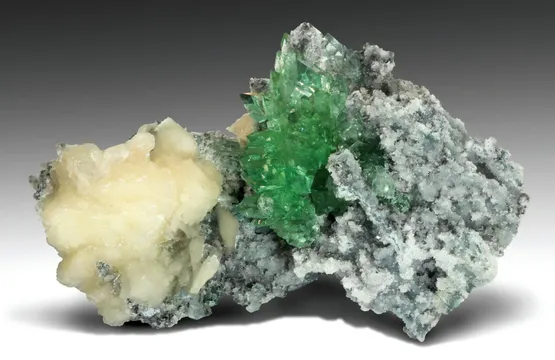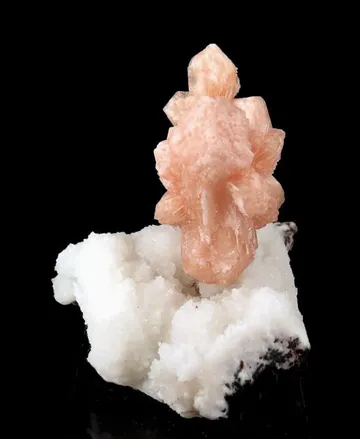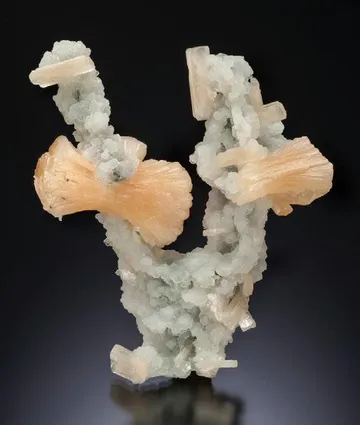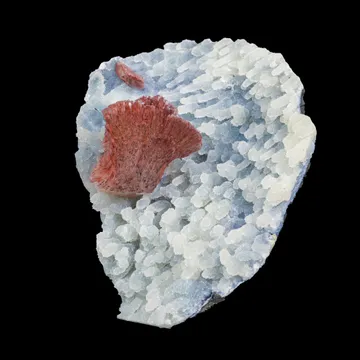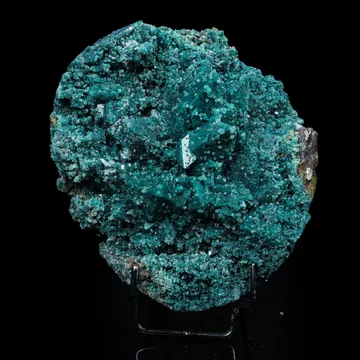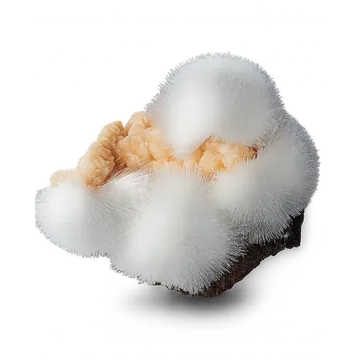
Scolecite from Jalgaon District, India: glassy colorless-to-white acicular crystals forming radiating sprays in basalt vesicles, prized for locality beauty.
Key facts
Jalgaon District sits in one of the great zeolite-producing belts of the Deccan Volcanic Province, where gas cavities and later open fractures in basalt became crystal-lined pockets of scolecite, stilbite, heulandite, fluorapophyllite-(K), calcite, powellite, quartz, chalcedony, and related secondary minerals. For collectors, Jalgaon scolecite is not just “Indian white needles.” The best pieces have a very particular presence: glassy, colorless-to-white lathes and acicular crystals radiating from a compact core, often with transparent terminations, pearly or snowy interiors, and small apophyllite crystals flashing over the spray like frost.

Photo: Wikimedia Commons
The district’s appeal lies in its range. Some Jalgaon pieces are delicate fans rising from peach stilbite-lined vugs; others are compact, sculptural “starbursts” that can be viewed from nearly every side; a smaller number are unusually robust sprays with stout, euhedral, translucent crystals rather than the hair-fine needles collectors associate with much Maharashtra scolecite. This variety reflects the broader district label: Jalgaon includes multiple producing areas and villages, with recorded scolecite occurrences at Chalisgaon, Shendurni in Jamner, and Savda near Sawade Pr Chandsar.

Photo: Mineral Auctions
Geologically, the Jalgaon material belongs to the classic basalt-cavity zeolite suite of western and central India. The Deccan flood basalts erupted near the end of the Cretaceous and produced thick stacks of lava flows. Later low-temperature alteration and hydrothermal fluids moved through vesicles, amygdales, and larger cavities, depositing silica, carbonates, zeolites, and apophyllite in complex sequences. In the Savda/Jalgaon quarry complex, scientific work has shown that even neighboring cavities could differ strongly from one another: one pocket might be lined thinly with chalcedony, stilbite, or apophyllite, while another could be filled much more completely by a single dominant secondary mineral.
Historically, Jalgaon became part of the great Indian zeolite story that transformed mineral shows from the late twentieth century onward. Older Jalgaon scolecite specimens in collections often trace to the 1980s, 1990s, and early 2000s, and some are now regarded as old-pocket material rather than routine current production. Collectors prize the locality for dramatic three-dimensional form, strong contrast with apophyllite or stilbite, intact terminations, and the unusual combination of delicacy and architectural strength.
Search for specimens: View all scolecite specimens from Jalgaon District, India
Jalgaon District is in the Nashik Division of Maharashtra, within the Deccan Volcanic Province. The productive mineral environment is basalt: vesicular and cavity-bearing lava flows that later received silica-rich, calcium-bearing, alkali-bearing, and aluminum-bearing fluids. Scolecite, CaAl2Si3O10·3H2O, formed as a secondary zeolite in these openings, generally as radiating sprays, acicular fans, and glassy lath-like clusters rather than as massive material.
The best-studied Jalgaon-area quarry complex is Savda, near Sawade Pr Chandsar, where large cavities in the flow-core zone have been examined in detail. Scientific sampling there documented multistage secondary mineralization involving clay minerals, chalcedony, calcite, heulandite, stilbite, mordenite, powellite, and apophyllite. The Savda work is especially important because it demonstrates how complicated these basalt cavities can be: the mineral suite is not uniform from pocket to pocket, and not every species known from the wider district appears in every analyzed Savda cavity.
Mindat records scolecite for Jalgaon District as a district-level occurrence and lists Chalisgaon, Shendurni, and Savda among regional scolecite localities. The district record also shows the associations collectors know well: fluorapophyllite-(K), heulandite subgroup minerals, stilbite subgroup minerals, powellite, calcite, laumontite, thomsonite subgroup minerals, prehnite, and epistilbite. Chalisgaon material is recorded with calcite, fluorapophyllite-(K), and stilbite subgroup minerals; Shendurni material is recorded with thomsonite subgroup minerals; Savda material is recorded as a quarry occurrence with photo-based associations including stilbite subgroup minerals, apophyllite group minerals, and powellite.
Mining is not conventional scolecite mining in the ore-deposit sense. The specimens are recovered from basalt quarries, construction-stone workings, road cuts, and related excavations where cavities are opened incidentally or during commercial quarrying. Access is therefore highly situational. Active quarries are industrial sites, not casual collecting grounds, and fine specimens generally enter the market through local miners, brokers, and dealers rather than through open public collecting.
The best-known production periods for Jalgaon scolecite on the collector market are the 1980s through early 2000s, with later finds continuing intermittently. Dealer and auction records describe important older pieces from 1980s–1990s purchases, early 1990s finds, a 1998 Jalgaon dig that produced powellite on scolecite, 1990s or early 2000s scolecite with apophyllite, and more recent Jalgaon starbursts. This pattern is typical of Deccan zeolite localities: production comes in pulses when quarries expose fresh cavities, followed by long periods when only scattered pieces or older collections supply the market.
Notable finds include robust euhedral sprays large enough to be considered exceptional for the species, transparent-to-white scolecite fans to about 5 cm in small-cabinet vugs, compact 360-degree starbursts with tiny apophyllite overgrowths, and rarer powellite-on-scolecite combinations. A famous style from the district is the clear or white spray sprinkled with minute apophyllite crystals, the contrast between satin-white scolecite and glassy apophyllite giving the specimen both delicacy and sparkle.
Jalgaon scolecite is usually white to colorless, commonly with a milky white core grading outward into clearer crystal tips. On better pieces, individual crystals show glassy prism faces and sharply defined terminations. The finest examples are not merely fuzzy white sprays; under good light the crystals resolve into distinct, straight, lustrous blades or needles.
The classic habits are radiating fans, tapered sprays, divergent sheaves, and compact starbursts. Some specimens are fragile acicular aggregates rising from stilbite-lined pockets; others are stout enough to look almost like miniature bundles of clear gypsum or natrolite, though the structure and associations reveal the zeolite setting. Jalgaon is especially appreciated for three-dimensional clusters that display well from several angles, rather than flat, one-sided plates.
Typical display specimens are thumbnails to small cabinets, with crystal sprays in the 3–6 cm range. Better cabinet examples can be considerably larger, and exceptional Jalgaon pieces have been documented as overall specimens around 14–21 cm, including robust sprays or large cabinet clusters. Size alone is not the measure of quality, however. A small Jalgaon spray with perfect terminations, glassy clarity, and a clean apophyllite or stilbite association will often outclass a larger but bruised or chalky mass.
Associated minerals are central to the district’s visual identity. Fluorapophyllite-(K) may appear as tiny water-clear plates dusting the scolecite or as larger greenish crystals nearby. Stilbite subgroup minerals add peach, salmon, cream, or white contrast, often lining the pocket in small blades or bow-tie forms. Heulandite provides tan to orange plates or tabular clusters on some Jalgaon zeolite specimens. Calcite, powellite, quartz, chalcedony, laumontite, thomsonite subgroup minerals, and occasional epistilbite broaden the paragenetic story.
Collectors judge Jalgaon scolecite by termination quality first. Broken tips are common, and even very small bruises can deaden the visual effect of a fan. The next factors are luster, transparency, and architecture: clear terminations over a luminous white core, an open radial form, and a composition that does not look crowded or collapsed. The most desirable pieces balance delicacy with strength: they look ethereal, but the crystals are distinct, upright, and visually complete.
The best Jalgaon pieces also show good mineral contrast. White scolecite on colorless apophyllite can be elegant but risks looking monochrome unless the luster is superb. White scolecite on peach stilbite or green apophyllite is more immediately dramatic. Powellite on scolecite is rarer and adds both color and scientific interest, particularly when the powellite crystals are sharp and fluorescent.
Jalgaon scolecite is available on the market, but fine pieces are much scarcer than the broad “Indian zeolite” label suggests. Entry-level sprays, partial clusters, and repaired or lightly contacted specimens can be found regularly. Top examples—complete all-around starbursts, old-pocket robust sprays, or elegant combinations with apophyllite, stilbite, or powellite—remain competitive and can move from hundreds into several thousands of dollars depending on size, preservation, association, and provenance.
Recent market records show the spread clearly. A 7.6 cm scolecite with apophyllite from Jalgaon sold at auction in January 2026 for $215. A small-cabinet Jalgaon scolecite and stilbite vug from the Dr. Stephen Smale collection sold in July 2025 for $811. A large-cabinet Jalgaon scolecite from the Mike Scott estate, described as an unusually large and robust old 1990s piece, sold in September 2025 for $4,058. Dealer offerings also show fine cabinet scolecite-on-apophyllite pieces presented as upper-tier material, often priced by inquiry rather than posted openly.
Authenticity concerns are mostly practical rather than exotic. Jalgaon scolecite does not have a well-established locality-specific treatment problem comparable to dyed agate or coated quartz. The main collector risks are misidentification, repair, assembly, and over-broad locality labeling. Scolecite can be confused with natrolite and mesolite, especially in fine white sprays, and many Deccan zeolite specimens have historically been labeled only “India,” “Poona,” “Nasik,” or “Maharashtra” when a more precise locality was unavailable. For high-value pieces, provenance matters: older labels, collection history, dealer records, and convincing locality-specific associations all add confidence.
Repairs are common enough to watch for. A broken scolecite spray reattached to matrix may still be collectible if disclosed, but undisclosed repairs materially affect value. Inspect the base of the spray for glossy glue, unnatural debris packed into contact points, suspiciously flat break surfaces, or apophyllite and stilbite fragments used to disguise joins. Starbursts should have a believable growth center; assembled pieces can look too evenly arranged or mechanically radial.
Condition is critical. Scolecite’s beauty comes from fine, exposed terminations, and Jalgaon sprays are easily damaged by handling, shipping, dusting, or display vibration. Tip bruising, compressed edges, missing radial sectors, and broken basal clusters are the most common issues. Pieces that look complete from one angle may have a hidden broken patch near the base or backside, so serious buyers should ask for multiple views.
Cleaning should be conservative. Avoid acids, heat, steam, and aggressive ultrasonic cleaning. Use a blower, very soft brush, and careful distilled-water rinsing only when necessary, and allow the specimen to dry thoroughly. Do not try to “brighten” a scolecite spray chemically; the improvement is rarely worth the risk. For display, support the matrix rather than the crystals, use stable mounts, and keep the spray away from direct handling.
The modern scientific story of Jalgaon’s zeolite cavities is unusually vivid because the Savda quarry complex was not merely described from old labels or isolated museum pieces. Researchers examined large, freshly opened basalt cavities, with sample numbers tied to exact Jalgaon/Savda coordinates. Their field material included calcite, stilbite, apophyllite, quartz, chalcedony, clay minerals, and filament-bearing hand specimens from the quarry complex near 20°59′ N and 75°27′ E.
The striking part is that these cavities were not simple crystal pockets. Some contained subsurface filamentous fabrics: threadlike cores later wrapped and preserved by chalcedony and other minerals. In one documented sample, a loose filament could move within a tubular space inside a chalcedony aggregate. Under the microscope, the structure resolved into a central fibrous zone and marginal cell-like textures. The researchers argued that the morphology, chemistry, and texture could not be explained adequately as ordinary stalactites or inorganic biomorphs, and that the Savda fabrics provided strong evidence of a biogenetic origin. For collectors accustomed to thinking of Jalgaon as “pretty zeolites,” the implication is memorable: some cavities also preserved a microscopic record of ancient subsurface microbial activity before later zeolites and apophyllite completed the mineral story.
The Savda study also gives a rare look at time inside a Deccan pocket. Apophyllite from the Savda/Jalgaon quarry complex produced two age clusters, one around 44–48 million years and another around 25–28 million years. That means the lava flows erupted near the end of the Cretaceous, but some later secondary minerals continued crystallizing long afterward, into the Paleogene and early Miocene. A collector holding a Jalgaon scolecite with apophyllite is not just holding the result of one cooling event. The specimen represents a long afterlife of basalt: cooling, burial, fluid movement, silica deposition, zeolite growth, carbonate pulses, and late apophyllite.
Auction records preserve a different kind of field note: the afterlife of specimens once they leave India. A Jalgaon powellite on scolecite was described as coming from a 1998 dig, with a 1.9 cm straw-yellow powellite crystal nestled into glassy elongated scolecite and showing bright whitish-yellow fluorescence. Another Jalgaon scolecite-and-stilbite specimen, long in the collection of mathematician and collector Dr. Stephen Smale, was treated so cautiously that the auction listing specified hand delivery only. Fragile Jalgaon scolecite can be dramatic on the shelf, but it is not a mineral that forgives rough logistics.
One of the more imposing recent public records was a large-cabinet Jalgaon scolecite from early 1990s finds, formerly in the Mike Scott collection. The specimen measured 21.0 x 6.8 x 3.8 cm and was described as a huge cluster of unusually robust crystals, not the thin, gracile sprays collectors normally expect from the species. It sold in September 2025 for $4,058. That price is useful not because every Jalgaon scolecite is expensive, but because it shows what the market does when size, old provenance, robustness, and rarity of habit converge.