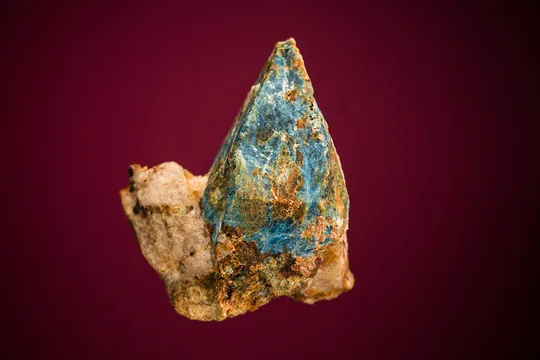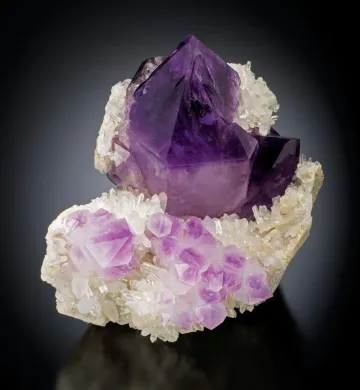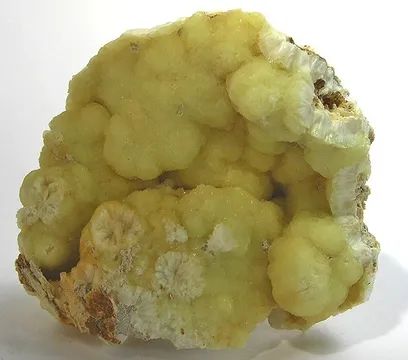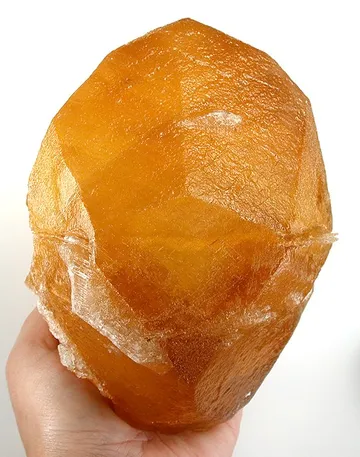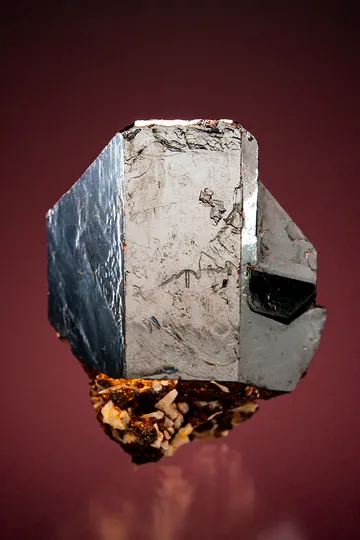
Graves Mountain, USA — a classic American locality known for large mirror-lustrous rutile, blue lazulite, and pale kyanite, prized by collectors.
Key facts
Graves Mountain is one of the classic American mineral localities: a mined, collector-worked monadnock in Lincoln County, Georgia, whose reputation rests on large, mirror-lustrous rutile, richly blue lazulite, stellate pyrophyllite, iridescent goethite-hematite, pale kyanite, and an unexpectedly sophisticated suite of secondary phosphates. The mountain is a resistant ridge of kyanite-bearing quartzose rock and sericite schist within the Georgia Piedmont, part of the Little River Series of metamorphosed volcanic and sedimentary rocks. In specimen terms, its identity is unmistakable: black to deep red-brown rutile twins with bevelled, reflecting faces; dusky to azure lazulite crystals locked in quartz-kyanite rock; quartz and iron-oxide surfaces washed in oil-slick color; and pale bladed kyanite and pyrophyllite recording a long sequence of metamorphism, fracturing, hydrothermal alteration, and oxidation.
The locality entered mineralogical literature in 1859, when Charles U. Shepard described its unusual assemblage. By the later nineteenth century, Graves Mountain specimens had crossed the Atlantic and become objects of serious crystallographic study by European mineralogists. George F. Kunz and Tiffany & Co. later helped place its rutile and lazulite in prominent private and museum collections. The later kyanite-mining era both revealed and destroyed specimens: blasting and milling opened fresh ground and exposed magnificent crystals, while many collectible pieces inevitably passed through the crusher.
Regional View
Country View
Before mining, Graves Mountain was a twin-peaked ridge with a saddle between the summits. The original collector lore centers on that saddle and its adjacent slopes, where rutile weathered from near-vertical veins and pockets into colluvium. Mining transformed the mountain into large pits, but it also exposed the zones collectors still discuss by name: the main pit for rutile, lazulite, kyanite, pyrite, quartz, and pyrophyllite; and the east pit for iridescent goethite-hematite, pyrophyllite, and phosphate-rich micromaterial.

Photo: Rob Lavinsky, iRocks.com / Wikimedia Commons

Search for specimens: View all specimens from Graves Mountain, USA
Graves Mountain lies south of U.S. Highway 378 between Lincolnton and Washington, Georgia. Geologically it is not a simple quartz vein locality, even though quartz veins are visually prominent throughout the workings. The mountain is built chiefly of quartz-sericite schist, sericite-kyanite-quartz rock, and quartz conglomerate. Hurst’s 1959 geological work emphasized that the rock formerly called “quartzite” is chemically and texturally more complex than a clean quartzite and is compatible with an origin as an acidic tuff within a metavolcanic-metasedimentary sequence. The resistant kyanite-quartz rock forms the spine of the ridge, while schistose rocks flank it.
The collecting minerals are concentrated in a narrow, structurally controlled zone trending roughly northeast-southwest across the mountain. Kyanite, rutile, lazulite, pyrite, barite, and later pyrophyllite are not evenly scattered through the hill; they are focused where fracture cleavage and later cross-fractures allowed recrystallization, veining, and alteration. Hurst described a coarse kyanite zone about 200 feet wide and 600 feet long, dipping steeply southeast and exposed through a vertical interval of nearly 200 feet. In that zone, kyanite commonly forms 15–25% of the rock, with local masses much richer. His estimate of at least half a million tons of kyanite down to the base of the mountain explains why a celebrated collector locality became a serious refractory-mineral mine.
Rutile is concentrated more erratically. Coarse crystals occur as isolated individuals and groups in the kyanite-quartz rock, especially where the host is pyrophyllitized, and in some pyrophyllite veins and quartz pods. Hurst outlined a rutile-bearing zone roughly 100 feet wide and 500 feet long, striking northeast-southwest and dipping 40–60 degrees southeast. Classic rutile also weathered loose into the saddle and the slopes north of it, where collectors historically found sharp small crystals after rain and larger, somewhat rounded crystals in colluvial material. The best old specimens show Graves Mountain’s diagnostic combination of size, deep red internal color under strong light, high adamantine to metallic luster, stubby prismatic form, and repeated twinning.
Lazulite occupies a related but more restricted part of the kyanite-quartz host. It is locally abundant in silica-rich bands rather than in the quartz veins themselves. Hurst recorded zones one to two feet thick on the southeast side of the mountain averaging as much as 15% lazulite, with blue crystals distributed across a broader northeast-southwest zone. Barwood later distinguished two practical specimen types: lazulite in hard gray kyanite-quartzite, and better-formed crystals from a whitish, friable kyanite-quartzite that is no longer exposed in the mine area. That distinction matters to collectors, because many Graves lazulites are embedded, altered, included, or broken from hard matrix, while the most desirable pieces show sharp pyramidal or tabular crystals, strong blue color, and minimal alteration to white or chalky phosphate products.
The early scientific history begins with Shepard’s 1859 paper and the rush of European crystallographic interest that followed. The locality was worked for specimens in the nineteenth century, and in the early twentieth century George F. Kunz acquired the upper part of the mountain and arranged for specimens to be collected. A 1935 Georgia Geological Survey report still described Graves Mountain primarily as a collector locality famous for rutile, lazulite, and pyrophyllite, while also recognizing kyanite as a potential resource. In 1940 an adit was driven on the southeast slope for flotation testing of unweathered kyanite-quartz rock; those tests showed that quartz, pyrophyllite, and kyanite could be separated to yield a high-grade kyanite concentrate.
Commercial kyanite mining began in the 1960s. Dr. Paul Bennett purchased the mountain in 1961, and commercial mining began in 1963. Combustion Engineering acquired and expanded the operation in 1965 through its mineral divisions; during that ownership, Graves Mountain supplied a major share of domestic U.S. kyanite consumption. The property was sold to Pasco Mining Company in 1984, mining continued until November 1, 1986, and after ownership reverted to Combustion Engineering, mining did not resume. The modern collecting landscape is therefore a post-mining one: extensive pits, dumps, high walls, moved material, and zones that may be covered, exhausted, or freshly exposed depending on slope failure and past digging.
Access today is controlled and should be treated as permission-only collecting. The Georgia Mineral Society’s Graves Mountain information page has long described access for colleges, universities, gem and mineral societies, and small collector groups by arrangement with the caretaker, along with public Rock Swap & Dig events in spring and fall. The posted code of conduct is not ceremonial: no collecting under high walls, no rappelling, no power tools, hand tools only, parking restrictions, caretaker authority over safe work areas, and dusk closure are all central to keeping the locality available. Graves is a real former mine with unstable walls, acid-stained water in places, loose boulders, and old blasted rock; the mountain gives good specimens only to collectors who take safety and landowner rules seriously.
The most discussed specimen-producing episodes fall into a few categories. The old saddle trenches and north-slope colluvium produced the iconic loose rutile crystals. The southeast lazulite zones yielded blue crystals in kyanite-quartz rock, including old material distributed internationally more than a century ago. The east pit and dump material have produced iridescent goethite-hematite and quartz, along with phosphate microminerals in angular cavities interpreted by collectors as casts after dissolved sulfate minerals. A 1969 organized trip preserved rare phosphosiderite-jarosite material from weathered lazulite-bearing rock before the rest was processed through the plant. In 1999, collectors recovered vuggy variscite- and crandallite-bearing rock from the east pit, including unusually large variscite crystals by the standards of the species.
Graves Mountain rutile is the locality’s signature mineral and one of the great American classics: dark red-brown to black, stubby prismatic crystals, commonly twinned or multiply intergrown, with mirror-bright faces that can flash red internally under strong light. Hurst recorded crystals up to 5 inches long and weighing as much as a pound, while later collector accounts describe larger masses and clusters recovered during the mining era. The best rutile occurs in kyanite-quartz rock, especially pyrophyllitized zones, pyrophyllite veins, and quartz pods; loose crystals weather into the saddle and north-slope colluvium. Ordinary Graves rutile is chipped, rounded, iron-coated, or only partly exposed in matrix; fine specimens show sharp terminations or crisp twin geometry, strong luster, recognizable red translucency at edges or fractures, and attractive association with pale pyrophyllite, kyanite, quartz, or iridescent iron oxides.
Lazulite from Graves Mountain is a true locality classic: blue pyramidal to tabular crystals, commonly twinned, embedded in sericite-kyanite-quartz rock rather than in open quartz veins. Hurst described fresh crystals as dusky blue and weathered crystals as azure blue, grayish blue, or mottled blue and white, generally averaging under three-quarters of an inch across and reaching about 1.5 inches; Barwood noted that although crystals of several inches are known, most collector crystals are under 2 cm. The best pieces historically came from a whitish friable kyanite-quartzite that is no longer exposed, while hard gray lazulite rock remains known both as specimen and lapidary material. Good Graves lazulite is judged by sharp crystal form, saturated blue color, limited chalky alteration, and attractive contrast against pale kyanite-quartz matrix; many otherwise promising pieces are compromised by quartz and rutile inclusions, fractured surfaces, or alteration to crandallite-group and other secondary phosphate products.
Goethite at Graves Mountain is inseparable in collector practice from hematite and from the famous iridescent “turgite” material, a traditional but mineralogically imprecise name for iridescent goethite-hematite mixtures. The iron oxides are secondary products of pyrite decomposition: they stain the weathered kyanite-quartz rock, line cubic voids after pyrite, form microveinlets, and produce botryoidal to reniform masses in float, especially around the saddle, east side of the high summit, old fields, and the east pit. The most desirable goethite-bearing specimens show strong, undamaged botryoidal surfaces with stable rainbow films in purple, blue, green, yellow, orange, or red, sometimes on quartz crystals or in vugs; lesser pieces are dull brown, friable, earthy, or confusingly labeled without confirming whether hematite or goethite is dominant.
Quartz at Graves Mountain is both a rock-forming component and a specimen species, occurring as massive quartz in the kyanite-bearing host, as white to translucent vitreous veins from less than an inch to many feet wide, as drusy crystals lining altered barite-shaped cavities, and as quartz crystals coated by iridescent goethite-hematite. It is the most abundant collector mineral on the mountain, but fine cabinet quartz is selective: many crystals are distorted, bent-looking, cracked, or coated unevenly. The best Graves quartz specimens are not prized for water clarity in the alpine sense; they are prized for locality character, especially terminated crystals with intense natural iridescent coatings, blue-tinted quartz overgrowths in the phosphate cavities, rutile or pyrite inclusions, and associations with kyanite, lazulite, pyrophyllite, or botryoidal iron oxides.
Kyanite is the economic backbone of Graves Mountain and one of the major visual signatures of its host rock. In the coarse-grained kyanite-quartz rock, blades are subhedral to euhedral and occur along foliation and fracture planes, marginal to quartz veins, and as disseminated single crystals or groups; Hurst estimated that the coarse rock averages around 10% kyanite overall, with wide zones at 20–40% and local masses near 50%. Fresh kyanite is pale blue, or colorless to pale green in lazulite-rich zones, while weathered blades become brown and are commonly altered along margins and cleavages to fine pyrophyllite. Fine specimens are those in which blades retain shape, color, and context—especially pale blue crystals crossing quartz, associated with lazulite or rutile, or showing the ribbed, honeycombed weathering texture of the Graves host—whereas much mined material is massive, altered, iron-stained, or too intergrown for display.
Hematite from Graves Mountain appears as secondary iron oxide after pyrite, as granular iron-rich material in weathered quartzite, as botryoidal or reniform masses, as coatings on quartz and goethite, and as part of the iridescent goethite-hematite material widely sold under the old field name “turgite.” Johnston described abundant botryoidal and reniform hematite on the north slope, while Hurst treated much of the brown staining, void-lining material, and botryoidal masses as goethite-hematite derived from decomposing pyrite. Collector-grade hematite is judged by iridescence, sculpture, and stability: vivid rainbow films on botryoidal forms or quartz are far more desirable than massive brown iron oxide, and specimens with intact color layers, no powdery breakdown, and a well-documented Graves Mountain provenance remain the most marketable.
Other documented minerals from Graves Mountain include pyrophyllite, pyrite, barite, alunite, andalusite, gibbsite, kaolinite, paragonite, muscovite, ilmenite, native sulphur, native gold, variscite, woodhouseite, crandallite, phosphosiderite, strengite, cacoxenite, dickite, jarosite, gorceixite, svanbergite, topaz, xenotime-(Y), and several iron sulfate species. The phosphate suite is especially important for micromounters: woodhouseite, variscite, crandallite, phosphosiderite, strengite, and cacoxenite occur in cavities, alteration zones, and pseudomorphs associated with lazulite-bearing kyanite-quartz rock. Collector lore sometimes describes Graves Mountain as a rutile type locality, but modern mineralogical usage treats it more safely as a world-class classic locality rather than the formal type locality for rutile.
The first authenticity issue with Graves Mountain is naming, not fakery. The iridescent material is very often sold as “turgite,” but turgite is not a valid mineral species; accurate labels should usually read iridescent hematite, iridescent goethite, or goethite-hematite, depending on identification. Streak can help separate hematite-dominant material from goethite-dominant material, but mixed surfaces are common, and visual naming alone is unreliable. Collectors should also be wary of vague labels such as “Georgia rutile” or “Georgia lazulite” when Graves Mountain is implied but not documented; the locality is famous enough that unlabeled southeastern material can be casually upgraded by assumption.
No systematic tradition of manufactured Graves Mountain fakes is central to the standard locality literature, but repaired, glued, or composite pieces deserve scrutiny, especially expensive rutile crystals on contrasting matrix. Rutile can be naturally loose, naturally embedded, or naturally perched in pyrophyllite-rich matrix; however, the same high contrast that makes these specimens beautiful also makes repairs visible under magnification. Check contact points for unnatural adhesive sheen, mismatched iron staining, and matrix that does not wrap or grow naturally around the crystal. On fine rutile twins, inspect beveled edges and terminations carefully, because the best faces are hard and lustrous but prominent corners chip easily during extraction from blasted rock.
Condition is a serious market divider. Graves Mountain rutile ranges from battered black lumps to superb mirror-faced twins; a small, sharp, lustrous, well-formed crystal may be more desirable than a much larger bruised one. Lazulite commonly shows alteration along fractures and margins, white chalky replacement, broken terminations, and inclusion-heavy interiors; clean blue form matters more than bulk. Pyrophyllite sprays are attractive but brittle. Kyanite blades are often altered, iron-stained, or locked in heavy matrix. The iridescent goethite-hematite material can be delicate: thin color films may abrade, botryoidal crusts can detach, and washing should be conservative. Avoid acids on iron-oxide iridescence and phosphate micros unless you know exactly what you are doing.
Fresh pyrite-bearing Graves Mountain material can be chemically active. Pyrite oxidation produced many of the locality’s iron oxides, sulfate minerals, sulphur, and acidic mine waters, and some specimens may continue to shed oxidation products if stored damp. Keep pyrite-rich material dry, separate fragile sulphates and phosphates from washable cabinet specimens, and do not soak mixed phosphate-bearing pieces casually. Some mine waters and muds at the locality are acidic enough to stain clothing and degrade footwear, and collected material should be cleaned with eye protection and gloves where sulphate crusts, pyrite decay, or acidic residues are present.
Market availability is uneven. Iridescent goethite-hematite, quartz with iridescent coatings, common kyanite, pyrophyllite, and small rutile are regularly available from old collections and modern collecting. Fine Graves Mountain rutile—the sharp, red-flashing, mirror-faced, well-twinned material that made the locality famous—is much scarcer and commands a premium, especially on matrix. Good lazulite is less common than casual listings suggest; much available material is massive, altered, or small, while crisp blue crystals from old collections are strongly preferred. Micromount phosphates can be rare and highly locality-specific, especially older 1969 material and the better 1999 variscite-crandallite pieces.
The Graves Mountain story begins like many great American mineral stories: with a short nineteenth-century paper that made the locality impossible to ignore. Shepard’s 1859 description announced hematite, quartz, pyrophyllite, kyanite, rutile, lazulite, barite, pyrite, and sulphur from a Georgia hill that, before heavy mining, was still a rugged double summit with a saddle between the peaks. German mineralogists soon became fascinated with the crystals. Haidinger studied the rutile in 1860, Rose wrote on circular rutile intergrowths in 1862, Lasaulx studied lazulite in 1883, and Mügge returned repeatedly to twinning and crystal-face problems in the 1880s and 1890s. The locality was not merely producing pretty specimens; it was supplying the raw material for crystallography.
A 1935 Georgia Archives photograph catches the old collecting era in one still image: H. C. Ull collecting lazulite from quartzite on the slopes of Graves Mountain on June 29, 1935. By then the locality was already an old classic. The picture matters because it freezes the pre-open-pit mountain, when collectors were still working slopes and outcrops for blue phosphate crystals rather than navigating the vast industrial benches familiar to later visitors.
The Kunz chapter gave Graves Mountain an international polish. George F. Kunz, the Tiffany & Co. gem expert whose name is attached to kunzite, acquired the upper part of the mountain in the early twentieth century and allowed selected collecting for specimens. By the time Hurst wrote the 1959 Geological Survey bulletin, the official transmittal letter could say that the finest rutile specimens in famous private and museum collections around the world had been collected at Graves Mountain and supplied by Kunz while he was president of Tiffany & Co. It is hard to imagine a stronger endorsement for a mineral locality: a rural Georgia ridge feeding both European crystallographers and Tiffany-era collecting circles.
Then came the machinery. The very report that served collectors by mapping the minerals also showed that the mountain contained a workable kyanite resource. Commercial mining followed, and the operation used the normal logic of industrial rock: blast, shovel, truck, crush, grind, concentrate. Collectors saw the paradox immediately. Mining exposed fresh rutile-bearing ground that hand collectors never could have reached, but it also fed countless rutile-bearing rocks into the mill. A later Georgia Mineral Society account captured the tragedy bluntly: many fine rutile specimens were recovered, and many more were destroyed.
The most repeated mining-era tale is the lunchbox story. When collecting was restricted, employees were not supposed to remove specimens, but a machine operator could spot a rock with a few shining rutile faces, climb down under some practical pretext, and make the piece disappear into a lunchbox. The story persists because it sounds exactly like Graves Mountain: a world-class crystal hidden in plain sight inside an industrial kyanite operation, too good to crush but too illicit to carry openly. Rumors circulated of clusters more than 3 inches across and over 15 pounds in weight, and the haunting possibility remains that some of the finest rutile ever found from the locality never entered the formal mineral market at all.
Henry Barwood’s 1999 field notes read like a micromounter’s rescue mission. On June 12, with the weather mercifully cloudy and only in the bearable 80s, his group examined the west pit and saw that the north wall had collapsed over much of the lazulite-woodhouseite zone. A small pit in the floor that had yielded excellent micros had been backfilled. The more productive rutile areas looked too unstable to risk. By midafternoon the group had little to show except barite crystals and a few promising specimens with possible woodhouseite.
Then, around 3 p.m., they gave the east pit one last try. Someone had dug for lapidary-grade lazulite and thrown aside vuggy rock. Barwood and his son realized the discarded pieces carried variscite and crandallite in angular cavities, the so-called “anhydrite” casts. They worked until nearly 7 p.m., stopping only when exhaustion and “the image of a small car with broken springs” made continuing unreasonable. Cleaned specimens revealed colorless, light green, dark green, blue, and red variscite; the blue came from lazulite inclusions, the red from rutile inclusions. The largest variscite crystals reached 10 x 10 x 12 mm, while the best were 4–6 mm crystals covering cavities several centimeters across. For variscite, those are not casual numbers.
Barwood returned on July 17, 1999, with seven micromounters despite forecasts of serious heat. Again the weather turned merciful, cloudy all day and barely reaching 80 degrees. The group concentrated on the east pit and recovered more material, though not quite as fine as the first discovery. The find included lapidary lazulite, barite, hematite, possible chrome-bearing pyrophyllite, massive and crystalline crandallite, massive woodhouseite, pyrite, blood-red rutile micros, and unknowns. The field note ends with the urgency every serious collector recognizes: go now, because a locality like this will not remain available forever.
The same 1999 report also gives the sharpest safety warning in the Graves Mountain literature. Barwood wrote that he had witnessed “a near death when a boulder collapsed” and feared that someone would eventually be crushed trying to dig rutile from the high wall. That sentence should be read beside every beautiful Graves rutile. The finest crystals came from hard, fractured, mined rock; the same geology that made pockets also made unstable walls and loose blocks.
A 2004 collecting account by Mike Streeter shows the post-mining locality at its best: social, exhausting, and specimen-rich. The group arrived around 9 a.m. after checking in with caretaker Junior Norman. Some headed to the lower pit to prospect the main wall for rutile, while others moved to the upper pit, where excellent iridescent goethite, hematite, quartz crystals, lazulite in quartzite, variscite, and pyrophyllite could be found. Streeter’s “poking around” quickly turned into major digging with a large pry bar as he and Ron recovered delicate goethite-hematite specimens with superb iridescence.
That same trip produced one of the collector moments that keeps people returning to Graves Mountain. After torrential downpours, excellent kyanite and lazulite rocks were uncovered at the bottom of the main pit, and one boulder yielded “fantastic euhedral and unweathered lazulite crystals in quartzite.” Later, Bill worked under an umbrella beside the high wall on a large boulder that had fallen months before under its own weight. Streeter first declined to take a few blows, then immediately gave in. He and Bill spent hours breaking down the boulder and recovered some of the finest iridescent goethite-hematite either had collected. By the end, the problem was not finding specimens but loading them: all the earlier rocks and tools had to be rearranged in the Dodge, with just enough space left for Opal to ride home comfortably.
Charles U. Shepard, “On Lazulite, Pyrophyllite, and Tetradymite in Georgia,” American Journal of Science, 2nd series, vol. 27, pp. 36–40, 1859 — The paper that first brought Graves Mountain’s unusual mineral assemblage to scientific attention; cited in later Georgia Geological Survey work.
M. W. Haidinger, “Die Rutilkrystalle von Graves Mount in Georgia U.S.N.A.,” Sitzungsberichte der Kaiserlichen Akademie der Wissenschaften Wien, vol. 39, pp. 5–9, 1860 — Early European crystallographic work on Graves Mountain rutile, listed in Hurst’s bibliography.
Gustav Rose, “Über eine neue kreisförmige Verwachsung des Rutils,” Annalen der Physik, vol. 115, pp. 643–649, 1862 — Classic nineteenth-century study of circular rutile intergrowths, cited in Johnston’s historical summary.
A. von Lasaulx, “Optisch-mikroskopische Untersuchung der Krystalle des Lazulith von Graves Mountain, Lincoln County, Georgia, U.S.A.,” Niederrheinische Gesellschaft, p. 274, 1883 — Early optical work on Graves Mountain lazulite.
Thomas L. Watson and J. W. Watson, “A Contribution to the Geology and Mineralogy of Graves Mountain, Georgia,” University of Virginia Philosophical Society Bulletin, Scientific Series, vol. 1, pp. 200–221, 1912 — Major pre-mining account cited repeatedly by later Georgia Geological Survey authors.
Thomas L. Watson, “The Rutile Deposits of the Eastern United States,” U.S. Geological Survey Bulletin 580, pp. 391–392, 1915 — Places Graves Mountain within the broader eastern U.S. rutile context.
Thomas L. Watson, “Lazulite of Graves Mountain, Georgia, with Notes on Other Occurrences in the United States,” Washington Academy of Sciences Journal, vol. 11, pp. 386–391, 1921 — Key lazulite reference cited in Johnston’s 1935 report.
W. D. Johnston, Jr., “Kyanite at Graves Mountain,” in Kyanite and Vermiculite Deposits of Georgia, Georgia Geological Survey Bulletin 46, pp. 26–30, 1935 — Concise pre-commercial-mining account of the locality, its kyanite, rutile, lazulite, quartz, pyrite, hematite, and origin interpretations.
Vernon J. Hurst, The Geology and Mineralogy of Graves Mountain, Georgia, Georgia Geological Survey Bulletin 68, 1959 — The essential geological and mineralogical reference, including maps, mineral descriptions, economic geology, and paragenetic interpretation.
Henry L. Barwood, “Phosphate Minerals at Graves Mountain, Georgia,” Rocks & Minerals, vol. 45, no. 1, p. 30, 1970 — Short but important account of the secondary phosphate and phosphosulfate suite, republished by the Georgia Mineral Society.
M. Eugene Hartley III and C-E Minerals, “Graves Mountain,” Georgia Geological Society Field Trip Guidebook, vol. 16, pp. 42–52, 1976 — Field-trip reference to the mine during the commercial kyanite era.
Robert B. Cook, “The Mineralogy of Graves Mountain, Lincoln County, Georgia,” The Mineralogical Record, vol. 16, no. 6, pp. 443–458, 1985 — Major collector-oriented mineralogical treatment of the locality, frequently cited by later authors and collectors.
Julian C. Gray and Paul A. Schroeder, “Mineralogy of Graves Mountain, Lincoln County, Georgia,” in W. C. Elliott, ed., Field Trip Guide for the 40th Annual Meeting of the Clay Minerals Society and Spring Meeting of the Mineralogical Society of America, pp. 57–67, 2003 — Modern field-trip treatment emphasizing mineralogy and clay/phosphate perspectives.
Jose Santamaria, “Mineral History of Graves Mountain,” Matrix: A Journal of the History of Minerals, vol. 11, no. 4, pp. 233–244, 2003–2004 — Detailed historical account of collecting and mining, made available through Focal Point Mineralogy.
Digital Library of Georgia, “Collecting lazulite from quartzite on slopes of Graves Mountain,” Georgia Geological Survey photograph, June 29, 1935 — Archival photograph documenting pre-open-pit collecting for lazulite.
Digging Graves Mountain for Hematite & Rutile! — On The Search OTS — First-visit style collecting video focused on rutile, hematite, tools, and expectations at a public dig.
Graves Mountain Georgia East Pit — The Dirty Rock Hounder — Walkthrough of the east pit collecting context, with emphasis on the broad mineral suite and the scale of the site.
Graves Mountain Field Trip Photos — Georgia Mineral Society — Photo-rich media page showing the main pit, high walls, rutile digging grounds, and collecting areas.
Mindat: Graves Mountain, Lincoln County, Georgia, USA — Best single online locality database entry, with coordinates, mineral list, photos, and collecting/mining summary.
Georgia Geological Survey Bulletin 68: The Geology and Mineralogy of Graves Mountain, Georgia — Foundational technical report for geology, paragenesis, economic zones, and classic mineral descriptions.
Georgia Geological Survey Bulletin 46: Kyanite and Vermiculite Deposits of Georgia — Includes W. D. Johnston’s 1935 pre-mining account of Graves Mountain.
Georgia Mineral Society: Graves Mountain collecting information — Access, directions, event information, caretaker contact details, and safety rules.
Georgia Mineral Society: Graves Mountain article by Michael Haege — Collector-focused narrative on rutile, lazulite, quartz, goethite-hematite, pyrophyllite, and mining-era lore.
Georgia Mineral Society: Henry Barwood, Phosphate Minerals at Graves Mountain, Georgia — Essential short guide to the phosphate micromineral suite and pseudomorphs.
Georgia Mineral Society: Henry Barwood 1999 field-trip report — Vivid account of east-pit variscite and phosphate collecting, with important safety warnings.
Focal Point Mineralogy: Mineral History of Graves Mountain — Entry point to Jose Santamaria’s historical article and broader Georgia mineral history context.
Digital Library of Georgia: 1935 lazulite collecting photograph — Archival image showing H. C. Ull collecting lazulite from Graves Mountain quartzite.
Wikimedia Commons: Minerals of Graves Mountain — Open image category with rutile, lazulite, goethite, quartz, pyrophyllite, and iridescent iron-oxide specimens.
Mike Streeter: A September Rockhounding Vacation — Graves Mountain — Collector field narrative with practical observations on pits, rutile, lazulite, and iridescent goethite-hematite.
Explore Georgia Graves Mountain brochure — Concise tourism-style summary of the locality’s rutile, lazulite, pyrophyllite, and collecting access.
GIA: Iridescence in Metamorphic “Rainbow” Hematite — Useful background for understanding why “turgite” is not a valid species name and how iridescent hematite-goethite materials are discussed.