A collector's guide to Jacksons Crossroads, USA: its geology, mining history and notable minerals, illustrated with the 84 specimens documented from this locality on EarthWonders.
Key facts
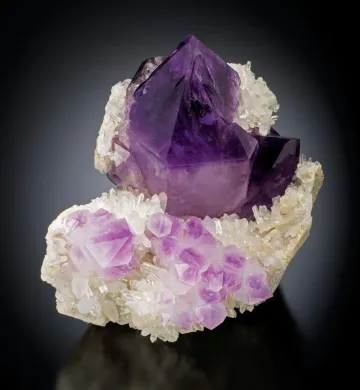
Jacksons Crossroads is the modern benchmark for American amethyst: a small Wilkes County, Georgia, occurrence whose best specimens look less like routine quartz-pocket material than a deliberate union of saturated purple glass and snow-white quartz. Collectors know the mine by its shorthand, JXR, and by the trade nickname “Wilkes County Jewels,” a name that is deserved when the material is at its best: lustrous, sharply terminated crystals in deep violet to royal purple, commonly set on contrasting drusy quartz matrix and bright enough under strong case lighting to seem almost lit from within.
Geologically, the deposit belongs to the Piedmont crystalline terrane of east-central Georgia, in the broad belt of Appalachian amethyst occurrences that also includes other Georgia and South Carolina quartz localities. The older state geological literature placed the amethyst in medium-grained granitic rock and granite saprolite north of Clifford Grove Church; later collector-field accounts and published locality discussions describe the working rock as deeply altered crystalline host, much of it kaolinized and weathered to saprolite, with quartz-lined cavities scattered through both soft decomposed material and harder blocks. For the collector, the important point is practical: JXR did not behave like a simple continuous vein mine. The amethyst occurred in pockets—some clay-filled, some in stubborn boulders—where the difference between a bucket of broken purple chips and a world-class cabinet specimen could be one careful pause of the excavator.
The historic importance of the locality rests on a concentrated burst of fine production in the early 2000s. Amethyst had long been known from Wilkes County, and the area had a pre-JXR gem history, including reported 1920s work by Tiffany & Company on a local Wilkes County amethyst deposit and later small-scale efforts in the region. But the Jacksons Crossroads material that changed the market appeared to collectors as a distinctly modern find: the mine was reported as discovered in 1988, then came into wide collector consciousness after exceptional pockets in the 2004–2005 period and a strong showing at the 2005 Tucson Gem & Mineral Show. From that point forward, JXR became one of the few United States amethyst localities that could be discussed seriously beside the better classic world sources for specimen aesthetics, not merely for patriotic or regional appeal.
Regional View
Country View
The best pieces are instantly recognizable: amethyst crystals of several centimeters, sometimes singly, sometimes in sculptural clusters, with color concentrated in terminations or outer zones and a glassy to mirror-bright luster. Many specimens show pale or colorless quartz cores, white quartz matrix, or small drusy quartz that heightens the purple by contrast. The finest examples are not just dark; they are alive—transparent enough to read zoning and internal light, saturated enough to hold color across a crystal face, and balanced enough that the white quartz is not dead weight but part of the composition.

Photo: Wikimedia Commons

Photo: Wikimedia Commons
Search for specimens: View all specimens from Jacksons Crossroads, USA
Jackson Crossroads Amethyst Mine lies in Wilkes County, Georgia, about 0.7 mile west-southwest of the hamlet of Jacksons Crossroads and a few hundred yards north of Clifford Grove Church. The best-known mine coordinates are near 33.88694, -82.85722. Collectors will see the locality labeled variously as Jacksons Crossroads, Jackson Crossroads, JXR Amethyst Mine, Tignall, or Wilkes County, Georgia; the most precise specimen label should include Jackson Crossroads Amethyst Mine, Jacksons Crossroads, Wilkes County, Georgia, USA.
The deposit is a semiprecious gemstone occurrence, not an ore mine in the normal metallic sense. The “ore bodies” were amethyst-bearing quartz pockets and quartz-lined cavities in deeply weathered Piedmont crystalline rock. Older geological descriptions in the Central Savannah River Area literature recorded amethyst north of Clifford Grove Church in medium-grained granite, where exposures along a gullied woods road showed vein walls with projecting small amethyst crystals. Regional accounts of Wilkes County amethyst also describe crystals in granite saprolite, formed in open fractures and vugs and later freed or partly exposed by deep weathering. Field collectors at JXR repeatedly described the practical mining environment as a mixture of soil, saprolite, clay, and competent rock, with pockets hidden in both soft decomposed material and hard boulders.
The pocket mineralization is simple but visually powerful. Quartz is the dominant mineral; amethyst is the collector’s prize. Colorless quartz occurs as small drusy crystals and clusters, while amethyst appears as larger individual crystals and groups. Clay commonly filled the cavities, and careful washing or cleaning often revealed much more luster and transparency than a fresh mud-coated pocket suggested. Calcite, lokkaite-(Y), and a rare strand-like occurrence recorded as lepidocrocite are documented from the mine, but the locality’s reputation rests almost entirely on quartz aesthetics: deep purple amethyst against pale or white quartz.
Mining history in the Wilkes County amethyst district predates the famous JXR pockets. The county was already known for amethyst before the 2000s, with regional reports of gem-grade material and local workings during the twentieth century. The Jacksons Crossroads occurrence itself was reported as discovered in 1988. In the early 2000s, work by Rodney Moore and Terry Ledford brought the locality to national and international collector attention, culminating in exceptionally strong production around Christmas 2004 and the public debut of many fine pieces at Tucson in 2005. Later years brought additional named or described finds, including the Treasure Chest pockets discussed in Rocks & Minerals in 2008 and lilac-colored “flower” amethyst noted in 2015.
JXR collecting was sometimes a fee-dig and field-trip locality, but access has changed repeatedly. Public digs, club visits, and machine-assisted events are well documented from the 2000s and 2010s, including periods when collectors searched fresh spoil brought out of the pit rather than entering the active working area. Today, collectors should treat the mine as private property with no routine public collecting access unless the current owners or managers explicitly announce otherwise. No specimen is worth trespass, and the combination of steep pits, unstable clay, heavy equipment, and waterlogged red Georgia soil makes casual uninvited collecting both unsafe and legally indefensible.
The notable finds were pocket events rather than steady bench production. Accounts from January 2004 describe two trackhoes removing soil, saprolite, and bedrock, then stopping when clay-filled pockets appeared so that the crystals could be hand-extracted. Dealer and collector reports from 2005 emphasize the exceptional Christmas 2004 pockets, mirror-faced gemmy crystals, and large cabinet pieces with amethyst set into quartz matrix. Later pockets produced unusual habits and colors, including lilac-colored amethyst “flowers.” The best JXR specimens generally came from moments when machinery exposed a boulder or pocket and experienced collectors slowed the process enough to preserve crystal groups that would otherwise have been broken into attractive but ordinary fragments.
Jacksons Crossroads amethyst is prized for lustrous, glassy crystals ranging from small thumbnails to large miniatures and cabinet groups, with exceptional crystals and clusters several centimeters across and major matrix plates known from the best early-2000s pockets. The color runs from pale lilac and lavender through rich violet to deep royal purple, commonly zoned with the strongest saturation in terminations or outer growth zones; the most desirable pieces combine deep color, transparency, sharp terminations, and placement on contrasting white or colorless quartz. Good JXR amethyst is not merely dark: it has brilliance, sculptural balance, and a distinctive lively purple that can show red or blue flashes in favorable lighting. Ordinary pieces tend to be broken singles, pale crystals, contacted fragments, or matrix pieces with color but little form; exceptional pieces preserve undamaged terminations, gemmy interiors, bright luster, and enough white quartz matrix to give the amethyst visual lift.
Non-amethyst quartz from Jacksons Crossroads is an essential part of the locality’s look, especially as white to colorless drusy matrix beneath larger purple crystals. Field observations describe two contrasting quartz expressions at the mine: relatively large amethyst crystals and much smaller colorless quartz crystals, the latter commonly as druses or clusters seldom more than about a centimeter individually. Collectors value JXR quartz most when it is compositionally useful—sparkling, clean, and sharply crystallized enough to frame the amethyst—though colorless clusters and druses can also be collected in their own right. The best quartz-associated specimens are those in which the pale quartz is not massive dead matrix but a bright crystalline stage for the purple crystals; pieces with muddy, fractured, iron-stained, or visually heavy matrix are far less compelling unless the amethyst itself is outstanding.
Other documented minerals from the Jackson Crossroads Amethyst Mine are few but interesting. Calcite occurs as yellow scalenohedra to about 1 cm in cavities with amethyst, and rare lokkaite-(Y) has been recorded as white spherical aggregates to about 1 mm in cavities associated with calcite. Lepidocrocite is listed from a specimen formerly in the Terry Ledford collection as a single red strand-like inclusion. No valid type-locality mineral is established from Jacksons Crossroads, but lokkaite-(Y) is a notable rarity for a locality otherwise dominated by quartz, and calcite associations add appeal when they are undamaged and clearly documented.
The primary authenticity issue with Jacksons Crossroads material is not a famous wave of fakes but the usual problem of provenance. Good JXR amethyst is desirable and expensive enough that labels matter. A specimen should be labeled to Wilkes County, Georgia, not vaguely as “Jackson County” or simply “Georgia amethyst.” Nearby or regionally associated material from Diamond Hill, Purple Knight, other Wilkes County sites, or general Appalachian amethyst should not be upgraded to JXR without a reliable chain of custody.
Synthetic amethyst and treated quartz exist in the broader gem and mineral market, but locality-specific JXR fakery is not well documented in the collector literature. Still, loose facetable amethyst and single crystals deserve normal caution: ask for old labels, mine-run context, photographs from the find when available, or provenance through known JXR operators, collectors, or dealers. Matrix pieces are usually easier to assess because the white quartz druse, clay-pocket surfaces, crystal habit, and locality style provide context, but even there the label should carry more weight than wishful resemblance.
Condition is central to value. JXR crystals commonly show contacts, edge bruises, chipped tips, healed or etched faces, iron staining, clay residues, and internal fractures. Some natural etching has been mistaken for damage, while some real damage is softened by the brilliance of the material. Large matrix plates should be inspected carefully for repairs; at least one prominent published Wikimedia/iRocks example notes a clean repair through a large plate. A repaired JXR cabinet piece can still be important, but the repair should be disclosed and priced accordingly.
Cleaning is usually about removing Georgia clay and iron staining without dulling the quartz or damaging associated minerals. Quartz itself is robust, but calcite is not; any specimen with calcite or suspected lokkaite-(Y) should be treated as delicate and kept away from acids unless the owner is prepared to sacrifice associations. Many attractive JXR pieces were found mud-coated and only revealed their luster after careful washing. Conversely, overcleaning can strip the specimen of useful pocket context and expose fractures that were less visible when lightly clay-stained.
Market availability is better than for many closed American gem pockets because JXR produced enough material in the 2000s and 2010s to seed private collections, dealer inventories, and online auctions. However, fine undamaged matrix specimens remain genuinely scarce. Singles and small clusters appear with some regularity; top pieces with deep color, glassy luster, balanced composition, and documented early-pocket provenance are much less common and command strong premiums among collectors of American classics.
On January 16–17, 2004, Mike Streeter and a small invited group entered the northeast Georgia pine woods for the kind of machine dig that collectors still talk about because it captures exactly how JXR worked. The party included Mike Galvin, Dave Smith, Don Brockway, David Reville, Chrissy Streeter, and Streeter himself. Two trackhoes did the brute work: a 50,000-pound Kobelco with a 1.2-cubic-yard bucket and a reach to about 25 feet below grade, and a smaller 13,000-pound IHI 555J that could dig to about 13 feet. The machines stripped soil, saprolite, and hard rock until a pocket appeared; then everything stopped. From that moment, it was no longer earthmoving but surgery, with hand tools taking over so the crystals would not be smashed.
The most memorable find from those two days came from a monster boulder lifted from the hole. Inside was a pocket lined with needle-like quartz druse, and among the sparkling lining sat clusters of dark purple amethyst. Streeter’s group considered it the finest Georgia matrix amethyst any of them had seen. It was still dirty when photographed, which is one of the pleasures of the story: everyone present had to imagine what the piece would become once the clay was washed from the crystal faces. The weather imposed the ending. By late Saturday afternoon dark clouds were gathering, and heavy rain was forecast for the evening and next day. The great hole had to be filled and graded before nightfall. The find was divided, the trackhoe operator was paid in crystals as well as gratitude, and the crew left with “bulging buckets and big smiles.”
The 2005 public-dig notices from Dixie Euhedrals show another side of the same mine: the strange moment when a world-class specimen locality was also, briefly, a place where a persistent collector with $25 and a strong hammer might get lucky. The announcements describe meeting at the Dollar General on Highway 17 in Tignall at 9 a.m. and convoying to the site, fresh dirt being moved into the pay-to-dig area while machinery worked a restricted zone, and a promise of “gemmy mirror faced amethyst crystals with great gemmy internal clarity.” The language is pure field-collector exuberance—part sales notice, part campfire dare. It also records how quickly the locality’s reputation had accelerated: the same page mentions JXR material ranging from inexpensive pieces to specimens “into the thousands,” and collectors flying in from Wisconsin or driving down from Vermont for a chance at the purple pockets.
John S. White’s 2012 visit gives a quieter but equally revealing picture. He had wanted to see the locality for years and finally spent a full day there with Bob Cook. Terry Ledford was operating the mine, and White described the pit as altered granite in which feldspar had largely kaolinized to a pale, heat-reflecting rock. Mining, he noted, was limited to cooler months because the light-colored pit grew hot at the bottom. The amethyst was randomly disseminated: no obvious vein or seam told the miners where the next pocket would be. In White’s account, the scene is a blend of science and anticipation—Cook lecturing, Ledford and Mark Randle working a pocket, Terry and Travis cutting rock with a gas-powered circular saw while water was poured over the blade, and fresh amethyst coming out mud-covered before being washed at the cabin.
A more personal story comes from writer Tom Poland, who went looking for Jackson Crossroads Amethyst Mine the day after Christmas and found instead the wider “amethyst country” of Wilkes County. His grandfather, at fourteen, had been plowing a field when a mule reared and turned up an amethyst cluster. Poland drove through Tignall and the back roads, got imperfect directions from a one-legged man in an electric scooter, took the wrong turn, and eventually found himself facing a red-clay road full of potholes, gullies, ridges, and wallows. A mudhole “like an orange lake” turned him back before he reached the mine. What he salvaged was not a specimen but a landscape: old granite markers for Henry Hill and Sarah Cotten, a fall on rain-slick leaves that knocked the wind out of him, and Friendship Baptist Church, where a cottontail bolted from a broken tomb and sent his heart racing. It is a useful reminder that JXR is not just a label on a mineral card; it belongs to a rural Georgia landscape of red clay, old churches, pine woods, and long memories.