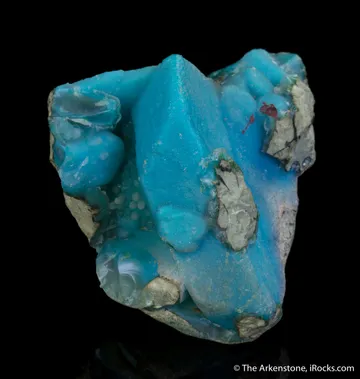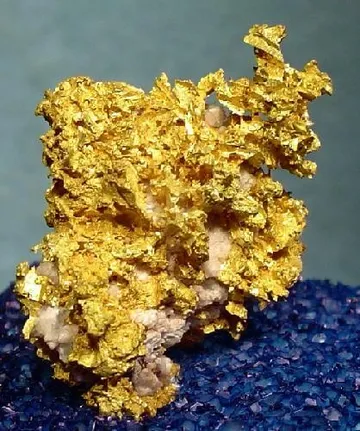
Grandview Mine, USA - a Grand Canyon locality famed for vivid blue cyanotrichite and green brochantite, rare copper sulfates, and historic collecting appeal.
Key facts
Grandview Mine is one of the great paradoxes of American mineral collecting: a remote, hard-won copper mine suspended inside the Grand Canyon, commercially awkward in its own day, but enduringly important because its oxidized ore zones produced some of the most vivid secondary copper-aluminum sulfate specimens ever seen from the United States. The mine lies on Horseshoe Mesa below the South Rim of Grand Canyon National Park, in the Grandview Mining District of Coconino County, Arizona. Its mineralization is hosted by a solution-collapse breccia pipe developed in and around the Mississippian Redwall Limestone, with copper, uranium, zinc, lead, arsenate, sulfate, and carbonate species concentrated in fractured, bleached, brecciated, and locally marbleized limestone and downdropped strata.
For collectors, Grandview’s identity is blue and green. The classic specimens are miniature to small-cabinet plates and vuggy fragments carrying electric blue cyanotrichite in hairlike radiating sprays, emerald to dark green brochantite in acicular or short-prismatic groups, and powder-blue to pale sky-blue chalcoalumite as crusts, spherules, and botryoidal coatings. Azurite and malachite add the more familiar carbonate palette, but the mine’s fame rests on the delicate copper sulfate assemblage: cyanotrichite, brochantite, chalcoalumite, langite, devilline, grandviewite, and associated rare arsenates and uranyl arsenates.
Historically, the deposit mattered before mineral collectors knew its name. Pete Berry and partners located the claims in 1890 and developed the mine from the early 1890s; ore from Grandview was rich enough to win recognition at the 1893 Columbian Exposition in Chicago, with one famous high-grade piece assayed at about 70 percent copper. Yet the geography that made the locality romantic also made it uneconomic: ore had to be hoisted and packed by animals up the Grandview Trail from deep in the canyon. Commercial work ended in the early twentieth century, but the specimens that left the mine—especially material collected and preserved from older work and mid-twentieth-century permitted or legacy collecting—became classic American rarities.
Regional View
Country View
The best Grandview pieces have a look unlike the larger, more massive copper classics from Bisbee, Morenci, or Ajo. They are intimate specimens: broken cavern surfaces and iron-stained limestone pockets dusted with tufts, puffballs, silky crusts, and needle bundles. A fine one is not judged by brute size but by preservation, color saturation, undamaged sprays, sharp contrast between blue cyanotrichite and green brochantite, and the presence of pale chalcoalumite or Grandview’s namesake species, grandviewite, in coherent layered relationships.
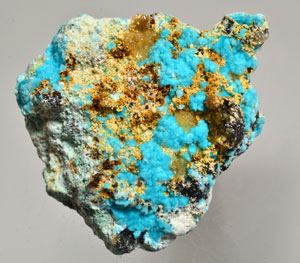
Photo: National Park Service
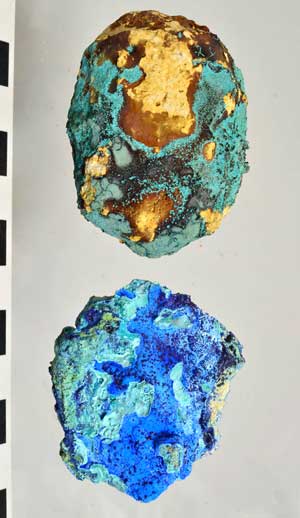
Photo: National Park Service
Search for specimens: View all specimens from Grandview Mine, USA
Grandview Mine, also known historically as the Last Chance Mine and the Canyon Copper Company Mine, is situated on Horseshoe Mesa below Grandview Point, on National Park Service land within Grand Canyon National Park. The locality is reached by the Grandview Trail, a steep historic route built to move ore and supplies between the canyon rim and the mine workings. Modern descriptions place the mine roughly 3,000 feet below the South Rim, while an early geological account described it as about 2,500 feet below the rim in the upper part of the Redwall Limestone at the southern end of Horseshoe Mesa.
Geologically, Grandview is a copper-uranium-bearing solution-collapse breccia pipe. Breccia pipes of the Grand Canyon region formed when solution caverns in the Redwall Limestone collapsed, producing vertical to pipe-like masses of fractured rock that could act as plumbing for metal-bearing fluids. At Grandview, the host and immediate wall rock are principally Redwall Limestone, with the orebody described in modern locality data as pipe-like and hosted in the upper Redwall Limestone and basal Supai Formation. The Redwall is characteristically bleached, brecciated, and marbleized around the mineralized zone, and the Grandview Monocline and associated Cremation Fault system were important structural controls.
The mine’s collector minerals are overwhelmingly products of oxidation, hydration, and supergene alteration rather than primary sulfide ore visible in large masses. Copper sulfates and copper-aluminum sulfates dominate the specimen story: cyanotrichite, brochantite, chalcoalumite, langite, devilline, chalcanthite, and grandviewite occur with azurite, malachite, aurichalcite, smithsonite, gypsum, baryte, kaolinite, and iron oxides. Uranium and arsenic add a rarer suite, including zeunerite, metazeunerite, olivenite, scorodite, pharmacosiderite, parnauite, philipsbornite, and related rare phases. The coexistence of kaolinite and fully hydrated zeunerite has been used as evidence for low-temperature formation, below about 70 degrees C.
Mining began with claims located by Pete Berry and partners around 1890. Berry, along with Ralph and Niles Cameron and other associates, developed the Last Chance copper claims and built the Grandview Trail in 1892–1893. The mine produced ore by 1893, and its high-grade copper ore was famous enough to be exhibited at the World’s Columbian Exposition in Chicago. Berry and partners sold the property to the Canyon Copper Company in 1901, and that company continued work until the mine was no longer profitable in the first decade of the twentieth century. William Randolph Hearst later acquired the property, and the National Park Service eventually obtained it in 1940.
The workings were small but ambitious for such a location. Early accounts describe two drifts driven into the Redwall Limestone, crosscuts from those drifts, a shaft connecting levels about 100 feet apart vertically, and small stopes extended from the crosscuts. Ore was raised to the top of Horseshoe Mesa by a mule-operated hoist, then packed up the Grandview Trail by mule and burro. Each pack animal reportedly carried about 200 pounds, and a train of eight to ten animals could average about a trip and a half per day. From the rim, the ore was hauled by wagon to a rail point and ultimately shipped for smelting.
Specimen-producing material came from the oxidized copper zones and vuggy breccia-pipe ore, especially areas where open cavities allowed late secondary minerals to grow as sprays, crusts, and delicate acicular aggregates. The exact pocket names familiar from some western mines are not part of Grandview collecting vocabulary; instead, specimens are usually described by assemblage and provenance. Many classic collector pieces are associated with older collections, with several known market specimens described as having been collected in the mid-1960s, including Bob Bartsch material later passing through prominent modern collections and dealers. Museum material is also important: in 2010, more than 1,200 Grandview Mine specimens were added to the Grand Canyon National Park Museum Collection, where a GeoCorps America project cataloged and identified specimens from the locality.
Collecting access today is closed. Grandview is inside Grand Canyon National Park, where collecting, removing, possessing, or commercially using rocks and minerals is prohibited except under formal scientific permit conditions. The mine openings themselves are hazardous historic workings, and in 2009 the National Park Service, working with partners, installed bat gates in three adits to protect visitors, preserve the resource, and allow Townsend’s big-eared bats to continue using the workings as roosting habitat. Collectors should regard all legitimate specimens as old material from historic, legacy, museum, or pre-closure sources—not as anything obtainable by field collecting today.
Cyanotrichite is the Grandview mineral most responsible for the mine’s prestige among collectors, occurring as bright to electric blue, hairlike, acicular crystals in radiating tufts, sprays, puffballs, and silky crusts on vuggy matrix. Documented Grandview examples include tiny clusters under 1 mm, sprays visible to the naked eye, and larger display specimens in which dozens of radiating aggregates cover miniature to small-cabinet pieces; some dealer-documented examples reach roughly 8–10 cm overall while the individual crystals remain extremely delicate. It is closely associated with brochantite, chalcoalumite, malachite, azurite, and locally gypsum or baryte, and classic pieces commonly show the strongest visual contrast where intense blue cyanotrichite sits on dark emerald-green brochantite or pale powder-blue chalcoalumite. Good Grandview cyanotrichite is judged by saturated blue color, undamaged needles, abundant separated sprays rather than crushed felt, and old, credible provenance from the now-inaccessible mine.
Brochantite from Grandview is the deep green counterpoint to the mine’s blue species, occurring both as acicular crystals in radiating groups and as shorter prismatic crystals, often directly associated with cyanotrichite. On collector specimens it may form dark green crusts, sprays, botryoidal-looking layers, or vug linings beneath and between tufts of cyanotrichite; in the best material, emerald to dark green brochantite supplies the matrix color that makes the cyanotrichite appear almost neon. Strong pieces show discrete green crystal groups rather than dull massive coating, visible sparkle or silky texture under magnification, and balanced association with blue cyanotrichite or pale chalcoalumite. Because many Grandview specimens are small and friable, brochantite-rich pieces with clean contrast, minimal dusting, and intact acicular texture are more desirable than larger but abraded fragments.
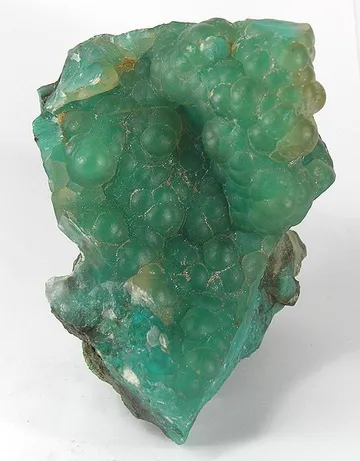
Chalcoalumite is a key Grandview associate and, on some pieces, the quiet mineralogical foundation of the whole blue-green assemblage: it occurs as light blue to sky-blue and blue-green crusts, spherulitic aggregates, spheroidal crystals, and botryoidal coatings in vuggy matrix, commonly with brochantite and cyanotrichite. Documented Grandview chalcoalumite includes light blue spheroidal crystals to about 0.75 mm in singles and clusters, as well as richer crusts that can underlie later sprays of grandviewite or cyanotrichite. The most attractive collector pieces show powder-blue chalcoalumite as a continuous but textured surface rather than a chalky smear, ideally with darker brochantite and brighter cyanotrichite creating layered color. Its significance is also mineralogical: grandviewite type material was described as greenish blue acicular sprays perched on chalcoalumite layers covering cyanotrichite and carbonatecyanotrichite, making chalcoalumite central to interpreting the mine’s late-stage sulfate sequence.
Beyond the three showcase species, Grandview is important for grandviewite, the mine’s type-locality mineral, now defined as Cu3Al2(SO4)(OH)10·H2O after later redefinition from the original Cu3Al9(SO4)2(OH)29 description. Grandviewite occurs as turquoise-blue to pale greenish-blue silky sprays of extremely fine acicular crystals, commonly on chalcoalumite and cyanotrichite/carbonatecyanotrichite mixtures. Carbonatecyanotrichite itself is documented from the mine and can be visually difficult to separate from cyanotrichite without analytical work. Rare and notable Grandview species include parnauite, philipsbornite, osarizawaite, pharmacosiderite, scorodite, olivenite, zeunerite, and metazeunerite; the uranyl arsenates occur in the radioactive gossan-style part of the assemblage and are a reminder that Grandview is not simply a copper-sulfate locality but a complex Colorado Plateau breccia-pipe system.
Grandview specimens are legitimate only as old material. The mine is within Grand Canyon National Park, where recreational mineral collecting is prohibited, and the mine openings are gated and protected. Any specimen represented as recently collected from the mine should be treated with serious skepticism unless it has a lawful research or museum context. For market material, the most desirable labels often cite older collections, historic dealer stock, or mid-twentieth-century collecting history; names such as Grandview Mine, Grand View Mine, Last Chance Mine, Canyon Copper Company Mine, Horseshoe Mesa, Grandview District, Grand Canyon, and Coconino County may all appear on labels for the same locality.
The chief identification trap is not artificial enhancement but species confusion. The old name “bisbeeite” was applied to material later shown to be cyanotrichite, so older labels may preserve obsolete terminology. Some material visually called cyanotrichite may include carbonatecyanotrichite, and the two can be difficult or impossible to separate by eye in mixed acicular aggregates. Grandviewite adds another layer of complexity: early literature and older labels may use the original formula, while current usage follows the redefined formula Cu3Al2(SO4)(OH)10·H2O. For important pieces, especially those represented as grandviewite or carbonatecyanotrichite rather than cyanotrichite, analytical confirmation is far more meaningful than visual assertion.
Condition is everything. Cyanotrichite and grandviewite sprays are hair-fine and easily flattened, rubbed, or dust-filled. Avoid repeated handling, air blasts, ultrasonic cleaning, wet cleaning, or aggressive brushing. Even a soft artist’s brush can permanently mash Grandview acicular sprays. Good storage means a covered perky box or sealed display case with the specimen immobilized and kept away from vibration, humidity swings, and casual touching. The copper sulfate assemblage is hydrated and delicate; stable indoor conditions are preferable to hot lights, damp basements, or direct sunlight.
Radioactivity is a locality-specific consideration for specimens containing zeunerite, metazeunerite, or uranium-rich gossan material. Most blue cyanotrichite-brochantite-chalcoalumite display pieces are collected and handled as delicate copper secondary specimens, but any Grandview specimen with visible green tabular uranyl arsenates, unusually radioactive labels, or provenance from uranium-rich zones should be stored and handled with normal radioactive-mineral precautions: keep dust contained, wash hands after handling, do not grind or trim without proper controls, and store away from prolonged close personal exposure.
Availability is limited. Grandview specimens appear sporadically in old collections, dealer inventories, and auctions, but no new legal collector supply exists from the locality. Miniatures with small cyanotrichite tufts are obtainable from time to time; rich, undamaged small-cabinet specimens with strong electric blue color and contrasting brochantite are genuinely scarce. Grandviewite-bearing specimens are rarer still, and specimens carrying several confirmed rare species from the mine are more likely to reside in museum or advanced systematic collections than in ordinary market stock.
Pete Berry’s mine was born from stubborn arithmetic: exceptionally rich ore in a place almost designed to defeat mining. By July 1892, Berry was building the Grandview Trail down from the rim to Horseshoe Mesa. The trail was not a scenic promenade at first, but an industrial lifeline cut into canyon walls so that ore could come out and food, tools, powder, and men could go in. National Park Service history notes that Berry and the Camerons used shortcuts such as cribbing—juniper logs and chains set against rock walls rather than blasting every foot of passage from the cliff. Hikers still cross portions of that old solution today, walking over the same practical engineering that served mule trains.
The ore route reads like something from a logistical puzzle. Ore was raised from underground workings to the top of Horseshoe Mesa with a mule-operated hoist, then loaded onto pack animals for the climb up the four-mile trail. Each mule carried about 200 pounds, and a train usually numbered eight to ten animals. A good animal could average a trip and a half per day. The trail itself cost Berry an estimated $12,000 to build and maintain—an enormous burden for a small copper operation whose product still had to be hauled by wagon to a railroad point and then shipped onward to the El Paso smelter.
The mine’s most famous ore specimen became part of Grand Canyon legend. One high-grade piece reportedly weighed more than 700 pounds and assayed at about 70 percent copper. It was sent to the 1893 World’s Columbian Exposition in Chicago, where Grandview ore won attention for its extraordinary copper content. That dazzling number, however, did not solve the canyon. By the early 1900s, the copper market and new methods for processing huge low-grade deposits elsewhere made the small, remote, high-grade Grandview orebody uneconomic. The problem was never just whether the rock contained copper; it was whether the canyon would let that copper leave at a profit.
The human geography of Grandview was as tangled as the mine workings. Berry’s canyon enterprise was tied to tourism almost from the beginning. In 1892 he erected a native-log building at Grandview that an early account described as 193 feet long, with a cistern built in connection with it. He later operated the Grandview Hotel, and for a few years the same trail served ore trains, miners, and visitors. Captain John Hance, one of the canyon’s legendary guides and storytellers, led tourists down the Grandview route. Berry’s last party down the trail was recorded in 1916, a Phoenix group that included Charley Schultz.
The mine camp itself gradually turned into ruins while remaining almost theatrically legible. The National Register nomination described low stone walls, retaining walls, rusting winches and machinery, collapsed wooden structures, and a stone building roughly 30 by 12 feet whose four adobe-laid walls still stood about 6 feet high when recorded in 1972. Earlier visitors saw bunkhouses, boarding houses, a burro corral, and small sleeping cottages for travelers. Today that ruined camp is part industrial archaeology, part mineral locality, and part warning: Grandview is beautiful, but it is not benign. Rotting timbers, collapsed openings, unstable rock, steep exposure, and protected resources define the modern site as much as the old copper colors.
The modern mineral story has its own quiet drama. In 1971, Wayne C. Leicht described the mine’s minerals and noted unidentified material. Decades later, specimens from Grandview led to the description of grandviewite, a new mineral named for the locality. Its crystals are not theatrical giants; they are tiny pale blue-green acicular sprays, the sort of thing easily overlooked without careful eyes and careful science. When more than 1,200 Grandview specimens entered the Grand Canyon National Park Museum Collection in 2010, Geologist-in-Park Janelle Rohweller cataloged them without destructive testing, relying on macroscopic observations and the literature. Her challenge was precisely the mine’s appeal to systematic collectors: some species are very rare, very small, visually similar, and difficult to identify without sacrificing material.
Wayne C. Leicht, “Minerals of the Grandview Mine [Arizona],” The Mineralogical Record, vol. 2, no. 5, pp. 214–221, 1971 — The foundational collector-mineralogy treatment of Grandview, repeatedly cited for species, habits, and unidentified phases later revisited by subsequent researchers.
Austin F. Rogers, “The optical properties and morphology of bisbeeite,” American Mineralogist, vol. 7, no. 9, pp. 153–154, 1922 — Early work tied to the material historically called “bisbeeite,” now important mainly because of its correction in the Grandview cyanotrichite story.
Samuel G. Gordon, “Recently described ‘bisbeeite’ from the Grand Canyon is cyanotrichite,” American Mineralogist, vol. 8, no. 5, pp. 92–93, 1923 — The key correction that moved the old “bisbeeite” material into cyanotrichite.
David M. Colchester, David R. Klish, Peter Leverett, and Peter A. Williams, “Grandviewite, Cu3Al9(SO4)2(OH)29, a new mineral from the Grandview Mine, Arizona, USA,” Australian Journal of Mineralogy, vol. 14, no. 2, pp. 51–54, 2008 — Original description of grandviewite as a new mineral from the Grandview Mine.
RRUFF-hosted PDF of Colchester et al. 2008, “Grandviewite, Cu3Al9(SO4)2(OH)29, a new mineral from the Grandview Mine, Arizona, USA” — Accessible copy of the grandviewite description, including habit, associations, and locality context.
Ritsuro Miyawaki, Frédéric Hatert, Marco Pasero, and Stuart J. Mills, “IMA Commission on New Minerals, Nomenclature and Classification (CNMNC) – Newsletter 65,” European Journal of Mineralogy, vol. 34, pp. 143–148, 2022 — Includes the accepted IMA redefinition of grandviewite as Cu3Al2(SO4)(OH)10·H2O.
Jiří Sejkora, Gwladys Steciuk, Maria Florencia Marquez-Zavalia, Jakub Plášil, and Zdeněk Dolníček, “Grandviewite redefinition, new formula Cu3Al2(SO4)(OH)10·H2O, and crystal-structure determination,” Mineralogical Magazine, vol. 86, no. 5, pp. 730–742, 2022 — The modern structural and formula revision for the type-locality species.
Malcolm Alter, Raymond Grant, Peter Williams, and David Sherratt, “Structural Geology and Hydrogeology of the Grandview Breccia Pipe, Grand Canyon National Park, Arizona,” Arizona Geological Survey Contributed Report CR-16-B, 2016 — A modern structural and hydrogeological study of the Grandview breccia pipe, cited by the Arizona Geological Survey.
H. H. Waesche, “The Grand View Copper Project,” Grand Canyon Nature Notes, vol. 8, no. 12, March 1934 — Rich early historical and geological account based largely on information from Pete Berry and a 1932 mine visit.
F. Ross Holland Jr., “National Register of Historic Places Inventory—Nomination Form: Grandview Mine / Last Chance Mine / Canyon Copper Company Mine,” 1972; listed July 9, 1974 — Primary historic-preservation record describing the mine ruins, structures, ore-hauling history, and significance.
Allyson Mathis, “Grand Canyon’s Museum Collection Curates Rare Minerals from Grandview Mine,” National Park Service Canyon Sketches, May 2012 — NPS account of Grandview minerals, museum curation, grandviewite, bat gates, and legal protection of park mineral resources.
“Grandview Mine,” William Ascarza, Arizona Memory Project — Five-minute historical video from the Coconino County Mining History collection, summarizing Grandview’s copper production, uranium byproducts, and Grand Canyon setting.
“What They Found in the Grandview Mine in the Grand Canyon — Why It Was Dynamited in 1901,” The Severed Timeline, YouTube — Popular history video that frames Grandview’s documented mining history while examining dramatic claims about a 1901 dynamiting story.
“Grand Canyon National Park - Grandview Tonto Loop Extreme Dayhike,” FoorTrek, YouTube — Hiking video showing the Grandview Trail context, with background on Pete Berry, the Last Chance Mine, Horseshoe Mesa, and the former Grandview Hotel.
Grandview Mine locality page, Mindat — Core mineral list, locality names, geological notes, and species references for the mine.
Grandviewite mineral page, Mindat — Current mineral data, type-locality status, redefined formula, associations, and references for grandviewite.
Grandviewite occurrence at Grandview Mine, Mindat — Occurrence-level data linking grandviewite directly to the Grandview Mine and associated species.
Brochantite from Grandview Mine, Mindat — Species occurrence page documenting Grandview brochantite habit and associations.
Carbonatecyanotrichite from Grandview Mine, Mindat — Useful for understanding why some Grandview blue acicular material may require analysis.
National Park Service: Grand Canyon’s Museum Collection Curates Rare Minerals from Grandview Mine — Best official overview of the mine’s mineralogical importance, grandviewite, museum specimens, and current protection.
National Park Service: Miners in Grand Canyon National Park — Context for Pete Berry, the Camerons, the Grandview Trail, and the Last Chance Mine in Grand Canyon mining history.
Grand Canyon Nature Notes, 1934: “The Grand View Copper Project” — Detailed early account of the mine’s history, geology, ore transport, and mining methods.
National Register nomination: Grandview Mine / Last Chance Mine — Historic-site documentation with descriptions of the ruins, structures, and significance.
Western Mining History: Grandview Mine — MRDS-derived mine record with commodities, coordinates, production notes, structure, alteration, and ownership context.
Arizona Geological Survey: Breccia Pipe in Grand Canyon — Context for Grand Canyon breccia pipes and a link to the Grandview breccia-pipe structural report.
National Park Service geology permits and rockhounding policy — Official statement that recreational collecting of rocks and minerals is generally prohibited in National Park System units.
Arizona Memory Project: Grandview Mine video — Public-history media item by William Ascarza from the Coconino County Mining History collection.