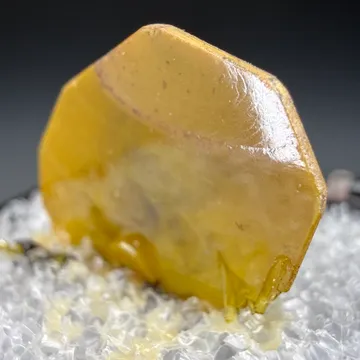
Glove Mine, Arizona: classic wulfenite locality with thick tabular blades in butterscotch to honey-yellow, architectural crystals, and strong collector appeal.
Key facts
The Glove Mine—also known in older specimen labels as the Sunrise Mine—is one of Arizona’s classic wulfenite localities: not a vast industrial mine, but a small, intensely oxidized lead-zinc-silver deposit whose caverns yielded some of the most distinctive tabular wulfenite in American collections. It sits east of Amado in Cottonwood Canyon, on Devil’s Cash Box Ridge in the Tyndall Mining District, along the southwestern flank of the Santa Rita Mountains of Santa Cruz County, Arizona. The ore was localized where faulting, bedding, and receptive Paleozoic carbonate strata combined to make unusually open pathways for mineralizing fluids, and later for deep oxidation. That oxidation is the key to the specimens. Primary galena, sphalerite, chalcopyrite, pyrite, and quartz gave way upward to cerussite, anglesite, smithsonite, wulfenite, vanadinite, mimetite, manganese oxides, calcite, and a suite of rarer lead, zinc, copper, vanadium, and manganese species.
To collectors, the Glove’s signature is wulfenite in thickly overlapping tabular blades: butterscotch, honey-yellow, pale orange, caramel-orange, and sometimes darkened to brown or glossy black by manganese oxides. The best pieces are architectural rather than delicate sprays—intergrown plates in vuggy, boxwork arrangements, sometimes almost matrixless, sometimes on gossan, limonite, calcite, quartz, or darker manganese-rich matrix. Exceptional crystals have been recorded to roughly 10 cm on an edge, but the finest cabinet and miniature specimens usually win by integrity: intact plate edges, bright waxy-to-subadamantine luster, translucent color, and the unmistakable “Glove” geometry of rounded to octagonal tabs packed like amber shingles.
Regional View
Country View
Historically the mine mattered both as an ore producer and as a specimen source. Its commercial life began after discovery in 1907, with significant production following in the early twentieth century and a major productive phase under the Sunrise Mining Company in the 1950s. Geologically it has been important enough to warrant a dedicated Economic Geology paper on oxidation of the sulfide body, and mineralogically it earned a full “Famous Mineral Localities” treatment in The Mineralogical Record. For collectors, however, the mine’s fame rests most securely on the great wulfenite pockets: cavern linings of caramel-orange plates that entered private collections, museum collections, and the Arizona mineral canon.
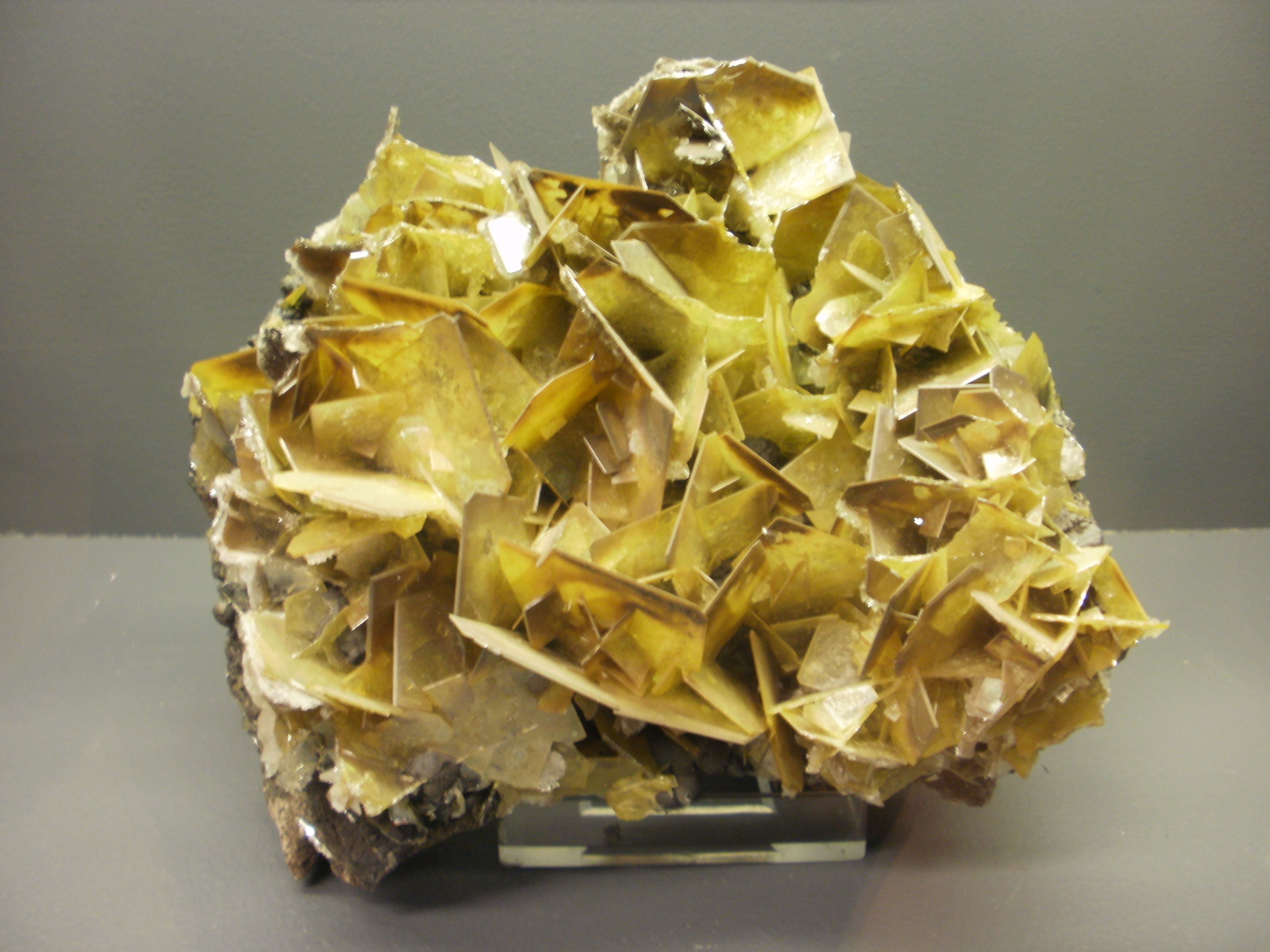
Photo: Wikimedia Commons

Photo: Wikimedia Commons
Search for specimens: View all specimens from Glove Mine, USA
The Glove Mine is a Pb-Zn-Ag-Cu-Au-Mo deposit in the Glove Mine group of the Cottonwood Canyon area, Tyndall Mining District, Santa Cruz County, Arizona. The main adit locality is recorded east of Amado at about 4,224 feet elevation, with the broader claim group including names such as the Zombie and Zeco claims, Festiago-Franklin, and the Blacksmith adit. Older labels may use “Sunrise Mine,” “Glove Mine near Amado,” or simply “Glove Mine, Santa Rita Mountains.” The locality lies on Devil’s Cash Box Ridge, a wonderfully apt old mining name that reflects the richness of the district rather than any relation to collector marketing.
The deposit is best understood as an oxidized carbonate-hosted replacement and fissure-controlled lead-zinc-silver system. Mineralization is associated with permeable zones produced by fault intersections and favorable beds in Permian Naco Group limestone, with igneous activity in the region represented by quartz monzonite and latite porphyry intrusions. Primary sulfide mineralization included argentiferous galena, sphalerite, pyrite, chalcopyrite, and quartz. In the mined oxidized zone, limestone solution created cavities and chimneys in which secondary lead, zinc, vanadium, molybdenum, manganese, and carbonate minerals were concentrated. This is why the Glove is so far more interesting to collectors than its modest tonnage might suggest: oxidation did not simply stain the ore; it opened and lined cavities, producing collectible crystal surfaces.
Published descriptions divide the ore body into oxidized and leached upper material, a silver-enriched intermediate zone, and deeper sulfide ore. The specimen-producing ground belongs chiefly to the oxidized and leached zone, where cerussite, anglesite, smithsonite, wulfenite, and other secondary minerals were concentrated in solution cavities. Mine workings included shafts and adits, with multiple levels; historical accounts describe an oxidized portion around the 250-foot level and lower workings extending to more than 480 feet at the massive sulfide zone. Ore was raised by hoist and skip, hand-trammed through tunnels, dumped into a surface ore bin, and shipped by rail for processing.
The original discovery is credited to 1907, with the Sheehy family and A. O’Donnell associated with the early claims. Fifteen original Glove claims were staked between 1911 and 1917, and early work included leasing by the Copper Queen Mining Company. Early shipments moved by mule team about eight miles west to the Amado rail station, then by the Tucson-Nogales line of the Southern Pacific Railroad to smelting. Significant twentieth-century operators and owners included Sheehy interests, Santa Cruz Silver-Lead Company, Sunrise Mining Company, Arivaca Mining Corporation, Colorado Fuel & Iron Steel Corporation, and later Sierrita Mining and Ranching Company.
The 1950s were the mine’s great economic and specimen-producing decade. Under the Dallas-based Sunrise Mining Company, with Edward A. Mack as general manager, the mine reportedly employed an average of about fifteen men, developed more than 5,000 feet of underground workings, and produced around 20 to 25 tons of lead-silver ore per day during its peak years. Olson’s 1966 Economic Geology paper reports total production of more than 21,000 tons of ore averaging 7.6 ounces silver per ton, 25.5% lead, 4.1% zinc, and 0.1% copper, valued slightly above one million dollars at the time of writing. Later summaries give a larger figure for the Glove group of about 29,260 tons averaging roughly 22% lead, 9% zinc, 7 ounces silver per ton, 0.3% copper, and minor gold.
Collector access today should be treated as closed unless explicit permission has been obtained from the claim holders. The mine has been under active claim, reinforced gates have been installed on adits and shafts, and a 2011 fire caused structural damage that made parts of the mine dangerous or impassable. Historical underground workings, unstable openings, bad air, deep shafts, and fragile remaining structures make casual entry inappropriate even aside from legal access. The Glove is now chiefly a specimen-market locality: material appears through old collections, dealer stocks, auctions, and the occasional older self-collected piece with reliable labels.
The notable specimen finds were cavity finds rather than broad ore-dump collecting. The famous wulfenite came from leached caverns and vugs in the oxidized zone, including a legendary 1950s cavern lined with caramel-orange tabular crystals. Later small finds and recovered specimens continued into the late twentieth and early twenty-first century, but no later discovery has displaced the classic 1950s Glove wulfenite in reputation. A documented 2007 North Fault 200-level find produced thin pale-yellow wulfenites to about 2.5 cm on chrysocolla-bearing matrix with black psilomelane, clear calcite, and traces of pale pink hematite on some calcites—beautiful, but so delicate that shipping was judged impractical for some pieces.
Wulfenite is the defining mineral of the Glove Mine, occurring as tabular to bladed tetragonal crystals in dense overlapping aggregates, boxwork clusters, and individual plates; the classic color is light yellow to pale orange, but the most desired old pieces often show a warmer butterscotch or caramel-orange tone, and some crystals are dark brown to jet black from manganese-oxide inclusions or coatings. Mindat and the older literature record crystals reaching four inches or more, about 10 cm, on an edge, although fine undamaged pieces more commonly show plates from the centimeter scale to several centimeters across; dealer and museum examples document attractive miniatures and cabinets with blades around 2 to 4 cm, and the best historic specimens show coherent masses of intact, lustrous, translucent to opaque plates. Calcite is the most visible associate in photographed Glove wulfenites, appearing as tiny off-white “sugary” crystals or later coatings on and between plates; other key associates include anglesite, cerussite, mimetite, mottramite, plattnerite, vanadinite, coronadite, descloizite, manganese oxides, quartz, smithsonite, and limonitic gossan. Good Glove wulfenite is separated from ordinary material by intact edges, strong luster, warm even color, recognizable locality habit, and sculptural coverage; dull brown broken plates, heavily damaged boxwork, or indistinct manganese-coated masses are commoner, while sharp blackened specimens with preserved wulfenite form and naturally attractive coronadite-style coating have their own specialist following.
Calcite at the Glove Mine is not the headline species, but it is one of the most important visual associates on the locality’s best-known specimens: small off-white, colorless, compressed, or “sugary” crystals scattered over wulfenite blades, lining pockets, or strengthening otherwise fragile wulfenite boxwork. In Glove specimens it commonly reads as a late carbonate accent—tiny cream-white sparkles against honey-yellow wulfenite, crusts on limonitic or manganese-rich matrix, or clear to pale calcite nestled among plates—rather than as large standalone calcite crystals. The most collectible calcite-bearing Glove pieces are those in which calcite enhances contrast without obscuring the wulfenite; a light frosting can emphasize the geometry of the blades, while heavy coatings can make the specimen look dull or confused. Calcite also appears with smithsonite, limonite, quartz, and other oxidized-zone minerals from the mine, but its main market importance here is compositional and aesthetic: it helps identify the pocket environment and gives classic Glove wulfenite its characteristic pale-on-gold texture.
Beyond wulfenite and calcite, the Glove Mine is notable for a broad oxidized Pb-Zn-Ag-Cu-V-Mo-Mn suite. Documented species include anglesite, cerussite, smithsonite, vanadinite, mimetite, mottramite, descloizite, plattnerite, coronadite, cryptomelane, pyrolusite, manganite, hausmannite, minium, hemimorphite, hydrozincite, rosasite, malachite, azurite, chrysocolla, caledonite, chenevixite, devilline, gypsum, quartz, chalcedony, goethite, hematite, rhodochrosite, siderite, galena, sphalerite, chalcopyrite, covellite, and pyrite. No verified type-locality mineral is central to the Glove’s fame; its importance lies instead in world-class wulfenite and in unusual replacement and coating relationships, especially cryptomelane pseudomorphous after wulfenite with calcite, descloizite and mottramite pseudomorphs or coatings after wulfenite, plattnerite reported on wulfenite, and smithsonite occurring as gray balls or attractive creamy-gray to colorless material on limonitic matrix.
Glove Mine specimens are often locality-recognizable, but they are not locality-proof. Arizona, Mexico, Morocco, and China all have produced tabular wulfenite, and unlabelled yellow-orange blades should not be assigned to Glove merely because they look “western.” Reliable old labels, known provenance, and the correct mineral association matter. A convincing Glove wulfenite commonly shows thick to moderately thin tabular plates in butterscotch to pale orange-yellow tones, often with calcite, limonite, manganese oxides, mottramite or descloizite coatings, or gossanous matrix. Black wulfenite from the Glove is a real and desirable substyle, but “black wulfenite” should be examined carefully: natural manganese-oxide inclusions or coatings preserve crystal form and may show uneven, intimate growth relationships, whereas artificial darkening, oiling, or generic black oxide staining would not carry the same value.
The most common condition issue is edge damage. Wulfenite is brittle, and Glove material is frequently intergrown in projecting plates; even very good old specimens may show minor nicks on exposed crystal edges. Damage must be judged in context. A miniature with a single pristine tabular crystal is held to a harsher standard than a cabinet-size boxwork mass of intergrown plates, where a few old bruises may be acceptable if the overall architecture is strong. Be wary of specimens with fresh-looking bright chips, reattached plates, hidden glued contacts, or crushed corners disguised by iron-oxide dust. Calcite coatings can be original and attractive, but they can also hide edge damage; inspect under magnification and from the side, not just face-on.
Mislabelling most often goes two ways: Glove material sold generically as “Arizona wulfenite,” losing value and historical specificity, or non-Glove wulfenite upgraded to Glove because the name is famous. Rowley Mine wulfenite is commonly more sharply “windowpane” and often associated with barite; Red Cloud is typically richer red and more isolated on matrix; Ojuela and Los Lamentos material may be sharper, brighter, or more yellow-orange with different matrices and associations. These comparisons are guides, not proof. Provenance remains decisive.
There is no widely reported routine treatment specific to Glove wulfenite, but cleaning and consolidation deserve caution. Acid cleaning may attack calcite, alter delicate pocket relationships, and leave a specimen less authentic-looking. Mechanical cleaning can break plate edges instantly. Water should be used sparingly, especially on limonitic or manganese-rich matrices that may shed dirt or soften. Store larger boxwork pieces in fitted trays or acrylic bases, not loose in drawers; a single jolt can convert a classic Glove plate into fragments.
Calcite from the mine may fluoresce in some oxidized-lead-zinc contexts, but fluorescence is not the main collecting criterion for Glove specimens and should not be used as a locality test. The collector should instead focus on form, association, provenance, and condition.
Market availability is steady but finite. Glove wulfenite is not unobtainable—old miniatures, cabinet pieces, and manganese-coated examples appear regularly from collections and dealers—but genuinely choice pieces from the classic finds are much scarcer than ordinary broken material. Prices vary widely: small or damaged examples can remain relatively approachable, fine miniatures with intact blades and good color are competitive, and large cabinet specimens with classic butterscotch plates, old provenance, or documented great-pocket association can move into the thousands of dollars. Smithsonite, cerussite, mottramite-on-wulfenite, and unusual black wulfenite are less frequently encountered and should be evaluated with equal attention to documentation.
The name “Glove” is one of those rare mine names that is geological rather than whimsical. The best ore lined the ends of tubes or chimneys extending through the deposit; miners thought the ore-coated projections resembled fingers covered by a glove. In the oxidized caverns, that image becomes easy to picture: not a flat vein face, but tubes, pipes, chimneys, and cavities where ore and later secondary minerals wrapped the walls.
The early mine was a mountain-and-railroad operation. The ore did not begin its journey at a mill beside the portal. It was hauled eight miles west by mule team to the rail station at Amado, then carried by the Southern Pacific’s Tucson-Nogales line toward smelting. Early work on the Glove claims between 1911 and 1917 produced modest but real returns: the Copper Queen Mining Company shipped 612 dry tons and returned a dividend of $7,168.65. The old Sheehy-O’Donnell, or O.K., workings already showed the mineral mixture collectors now recognize—galena, anglesite, wulfenite, smithsonite, covellite, and cerussite in oxidized lead-zinc-silver ore.
The great collector story belongs to the 1950s. Miners opened a cavern completely lined with thick caramel-orange tabular wulfenite. The mining company contacted George Bideaux, father of Richard “Dick” Bideaux, and the choice job of extracting the specimens went to Dick Bideaux and Bernie Hagg. The pocket became legendary because it was not merely a good vug; it was the kind of find that defines a locality for generations. The crystals from it are recognized by their thick tabular habit, caramel-orange color, lustrous surfaces, and interwoven clusters. Hundreds of specimens were reportedly removed, and the pricing method sounds impossible now: a typical 4-by-5-inch specimen was set at five dollars.
One surviving auction record preserves the human chain of one of those specimens. Rock H. Currier described his piece as “a cluster of somewhat intergrown flat somewhat curved caramel colored wulfenite crystals up to about an inch in diameter,” typical of the great-pocket material dug by Bideaux and Hagg. He bought it from Earl Shad at a small rock shop in Yermo, California, in 1964. By then the five-dollar pocket price had already multiplied; Currier paid thirty dollars, still a figure that makes modern collectors wince.
The mine’s later decades had less romance and more machinery. By the 1950s, an average crew of about fifteen men had driven more than 5,000 feet of underground workings. Ore rose up the incline in a two-ton self-dumping skip powered by a 75-horsepower electric single-drum hoist, then was hand-trammed several hundred feet through a tunnel in ore cars before dropping into the surface bin. In June 1975, mine superintendent Irvin Wolfe was badly injured when a runaway front-end loader slipped down a dump slope; the reported injuries included a broken arm, punctured lung, fractured skull, and broken ribs. The same mine that yielded jewel-like wulfenite was still, fundamentally, a hard-rock mine.
The collector era did not end with the 1950s. In 1991, Harold Urish self-collected a sharp light-caramel wulfenite crystal with a micro-layer of sugary quartz and compressed colorless calcite crystals on a goethitic matrix. In 2002, he self-collected a miniature cerussite from the same locality: gemmy, slightly smoky crystals to 6 mm perched on a heavy mound of galena. Such later pieces remind us that the Glove is not just one famous pocket—it is a complex oxidized system where many secondary species occurred in small, collectible pockets.
One of the most vivid modern collecting notes comes from the North Fault 200 level in 2007. Thin pale-yellow wulfenites to 2.5 cm were found on chrysocolla matrix, sprinkled with black psilomelane and clear calcites; some calcites carried a pale pink hematite tint. The specimens were beautiful but treacherous. The collector who documented them noted that the wulfenites were so thin that shipping was, in his opinion, not possible for some pieces unless calcite happened to support them. That is Glove wulfenite in a sentence: spectacular, recognizable, and always one careless movement away from damage.
Harry J. Olson, “Oxidation of a sulfide body, Glove Mine, Santa Cruz County, Arizona,” Economic Geology, Vol. 61, No. 4, 1966, pp. 731–743 — The essential peer-reviewed geological paper on the Glove ore body, its primary sulfides, oxidation zones, and secondary mineral assemblages.
Richard A. Bideaux and Wendell E. Wilson, “Famous Mineral Localities: The Glove Mine [Arizona],” The Mineralogical Record, Vol. 14, No. 5, 1983, pp. 299–306 — The classic collector-focused locality article, including the famous Glove wulfenite cavern.
Richard A. Bideaux, Sidney A. Williams, and R. W. Thomssen, “Some new occurrences of minerals of Arizona,” Arizona Geological Society Digest, Vol. 3, 1960, pp. 53–56 — Cites Glove Mine occurrences including anglesite, cerussite, hausmannite, and wulfenite.
Harry J. Olson, “The Geology of the Glove Mine, Santa Cruz County, Arizona,” University of Arizona M.S. thesis, 1961 — A dedicated thesis on the mine, cited in USGS open-file bibliographic records for the Glove Mine group.
J. M. Sef Jr., “Origin and Distribution of Molybdenum in the Vicinity of the Glove Mine, Santa Cruz County, Arizona,” University of Arizona M.S. thesis, 1964 — Thesis work specifically tied to molybdenum in the Glove area, relevant to the wulfenite-forming system.
John W. Anthony, Sidney A. Williams, Richard A. Bideaux, and Raymond W. Grant, Mineralogy of Arizona, 3rd ed., University of Arizona Press, 1995 — Standard Arizona mineral reference repeatedly cited for Glove Mine species and associations.
Peter G. Rickwood, “The largest crystals,” American Mineralogist, Vol. 66, 1981, pp. 885–907 — Records Glove Mine wulfenite crystals with 10 cm edges in the Smithsonian’s Roebling Collection and cites earlier large-crystal literature.
Annual Report of the Board of Regents of the Smithsonian Institution, 1961 — Notes a large group of wulfenite crystals from the Glove Mine near Amado, Arizona, donated by Bernard T. Rocca Sr.
Jan C. Rasmussen and Stanley B. Keith, “Geologic settings of wulfenite in southwestern North America,” New Mexico Mineral Symposium abstracts, 2009 — Places Glove Mine wulfenite among the important Laramide-related Arizona Pb-Zn-Ag wulfenite localities.
“CCDN5907 Wulfenite, Glove Mine, USA” — Crystal Classics — Short specimen video showing a Glove Mine wulfenite in motion, useful for judging luster and plate geometry.
“Wulfenite - Minerals For Sale - #8632573” — Weinrich Minerals — Dealer page with a specimen video for a Glove Mine wulfenite collected by David Shannon, documenting modern market appearance and condition language.
“Mottramite on Wulfenite - Minerals For Sale - #4081652” — Weinrich Minerals — Specimen video record of greenish-brown mottramite covering Glove wulfenite plates.
Mindat: Glove Mine (Sunrise Mine), Santa Cruz County, Arizona — Core locality record for coordinates, hierarchy, mineral list, geology, ownership notes, production, and access warnings.
Mindat: Wulfenite from Glove Mine — Species-specific page documenting Glove wulfenite habit, color, size, associated minerals, and photo statistics.
Mindat: Glove Mine group — Broader claim-group context including associated workings and the expanded mineral list.
William Ascarza, “Mine in Santa Ritas was big ore producer,” Arizona Daily Star, May 29, 2016 — Readable historical account of discovery, early transport, operators, production figures, later work, and closure.
Western Mining History: “Famous Mineral Localities: The Glove Mine” — Members-only access page for the Mineralogical Record locality article.
Mineralogical Record back issue: Arizona-V, Vol. 14, No. 5, 1983 — Issue listing for Bideaux and Wilson’s Glove Mine article.
USGS Open-File Report 84-9: Mineral-resource records including Glove Mine Group references — Bibliographic and MRDS-style reference source for Olson, Sef, Anthony, and Drewes work on the district.
USGS Data Series 20: Mineral Resources Data System — Background on the MRDS database used for mine and deposit records.
Rockhounding.org: Glove Mine Group — Secondary locality summary drawing on USGS/MRDS data; useful for quick geology and production-period context, but not a substitute for primary references.
Wikimedia Commons: Category Glove Mine — Open-licensed Glove Mine specimen photographs, including wulfenite, wulfenite-calcite, and smithsonite.
Heritage Auctions: Wulfenite, Glove Mine, Lot #72006 — Important auction record preserving Rock Currier provenance and the story of the great 1950s pocket.
Brander Robinson’s Mindat photo gallery — Includes field-note-style documentation of the 2007 North Fault 200-level wulfenite-calcite-chrysocolla find.
MineralAuctions: Wulfenite self-collected by Harold Urish — Auction archive documenting a 1991 self-collected Glove wulfenite with quartz and calcite.
MineralAuctions: Cerussite self-collected by Harold Urish — Auction archive documenting scarce Glove cerussite collected in 2002.
Fabre Minerals: Mottramite with Wulfenite, Glove Mine — Dealer reference for mottramite partially covering orange tabular Glove wulfenite.