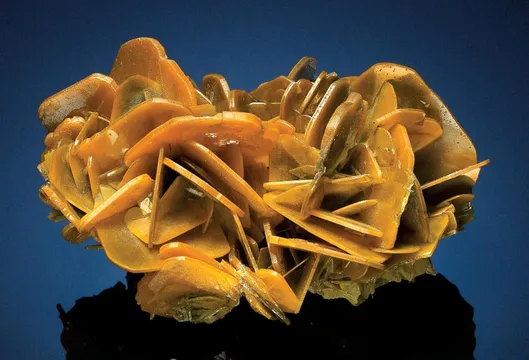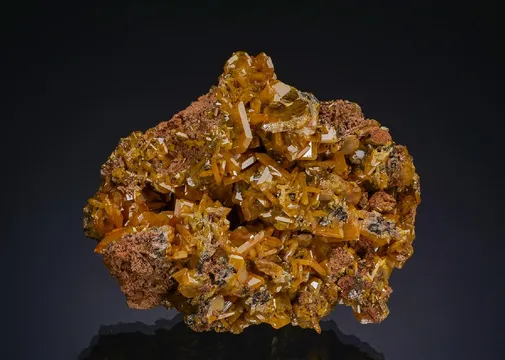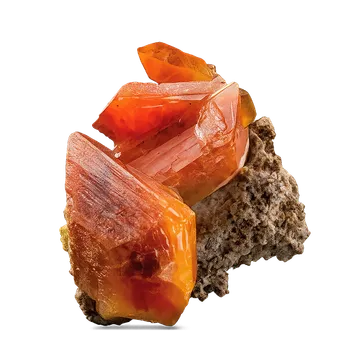
Glove Mine, Arizona: wulfenite with butterscotch to pale orange-yellow bladed crystals, often in dense vug linings; a classic locality prized by collectors.
Key facts
Glove Mine wulfenite is one of the unmistakable classics of Arizona mineral collecting: warm butterscotch to pale orange-yellow blades, commonly lustrous and translucent, packed in tight overlapping aggregates that look less like isolated crystals than a frozen sheet of amber shingles. The best pieces are not the fiery red “Red Cloud” style, nor the sharp honey-yellow sprays of some Mexican material. They have their own Glove character: stout tabular blades, rounded or stop-sign outlines, subtle darker edges, and a dense, sculptural habit that can leave little or no matrix visible.

Photo: Wikimedia Commons / Rob Lavinsky, iRocks.com
The mine sits in Cottonwood Canyon in the Tyndall Mining District of Santa Cruz County, in the western foothills of the Santa Rita Mountains south of Tucson. It was not primarily a specimen mine: it was a lead-zinc-silver-copper-gold-molybdenum operation. Yet its oxidized lead-zinc-silver replacement ores created exactly the chemical conditions collectors love—galena altered to cerussite and anglesite, zinc carried into smithsonite and hemimorphite, manganese and vanadium producing dark oxides and vanadate minerals, and molybdenum combining with lead in the oxidized zone to form wulfenite, PbMoO4.
The Glove’s best wulfenite came from solution cavities and leached caverns in limestone. Those cavities explain both the specimens and their reputation. Instead of isolated plates on open gossan, Glove material often appears as crowded vug linings, with plates pressed against one another in repeated habits. Some cavities yielded yellow-to-butterscotch blades; others produced darker brown or blackened wulfenites coated or included by manganese oxides such as coronadite. The classic collector phrase for the locality is “butterscotch-colored, bladed crystals,” and it remains apt: when a Glove specimen is right, the color and form are as diagnostic as a label.
Historically, the mine is important because it bridges ore geology and specimen lore. Formal mining exposed the cavities; specimen recovery turned one of those cavities into a world-circulating population of classic Arizona wulfenites. The finest pieces from that recovery are now old-label specimens, often tracing through mid-20th-century Arizona collectors and dealers. Collectors look for good luster, translucent blades, undamaged edges, strong coverage, and the rounded to octagonal blade outlines that separate Glove material from sharper, more glassy wulfenites from other districts.
Search for specimens: View all wulfenite specimens from Glove Mine, Arizona, USA
The Glove Mine, also known as the Sunrise Mine, is in the Glove Mine group at Cottonwood Canyon in the Tyndall Mining District, Santa Cruz County, Arizona. The main adit lies east of Amado in the Santa Rita Mountains at roughly 4,224 feet elevation. The broader mine group included claims and workings known in the literature as the Zombie and Zeco claims, Festiago-Franklin, and Blacksmith adit; nearby or related localities in the group include the Rover Mine and the Sheehy-O’Donnell, or O.K., Mine.
Geologically, the deposit is a replacement-style, oxidized lead-zinc-silver system developed in favorable beds of Permian Naco Group limestone. The ore minerals were deposited in permeable zones created at the intersection of a bedding-plane fault and reactive carbonate beds. Hydrothermal fluids associated with Laramide-age igneous activity introduced argentiferous galena, sphalerite, pyrite, chalcopyrite, and quartz. Later oxidation was deep and effective: limestone solution opened caverns, and secondary minerals were concentrated in leached zones as carbonate-rich oxide ore. Cerussite, anglesite, wulfenite, smithsonite, and related supergene species are the mineralogical signature of that process.
The Glove’s name is itself a mining image. The best ore was said to line or coat the ends of tubes or ore chimneys resembling large fingers, as a glove covers the fingers of a hand. That is a wonderfully literal name for a mine whose most collectible products came from lined cavities.
The claims were originally located in 1907, and work began intermittently in the early 20th century. Production commenced by about 1911, but the most important ore production came later, especially during the 1950s under Sunrise Mining Company. Published production figures for the mine group give about 29,260 tons of ore averaging roughly 22% lead, 9% zinc, 7 ounces silver per ton, 0.3% copper, and minor gold. A 1966 Economic Geology paper gives a slightly different earlier total—more than 21,000 tons of ore averaging 7.6 ounces silver, 25.5% lead, 4.1% zinc, and 0.1% copper per ton, worth slightly more than one million dollars—reflecting the production record available at that time.
Workings included shafts and adits. The mine group is described as having five shafts and an adit, including two older 75-foot shafts, a shaft reaching about 360 feet, 500- and 600-foot tunnels, and a 66-foot winze. The mine was worked at various times from about 1911 through 1972.
Collectors should treat Glove Mine as a closed historic mining locality, not an open rockhounding site. The locality has been under active claim in modern times, and heavy reinforced gates were installed on adits and shafts. Published locality notes warn that trespassing for collecting is prohibited without permission from the claim holders. Old Arizona mine workings are hazardous even where access appears possible, and this particular mine has had documented cleanup, gating, and post-fire safety concerns.
Notable finds center on the wulfenite-bearing caverns. The Glove is famous for large vugs lined with wulfenite; published Arizona geological writing describes crystals as much as four inches on a side, and Mindat’s locality entry records wulfenite crystals to four inches or more on an edge. The best-known specimen recovery came when mining opened a cave completely lined with high-quality wulfenite. That pocket supplied a large population of remarkably consistent butterscotch specimens, many of which entered classic collections and remain the benchmark for the locality.
Glove Mine wulfenite is most admired in tabular, bladed crystals rather than pyramidal or sharply isolated plates. The classic color is light yellow to pale orange, often described as butterscotch, tan-yellow, golden-yellow, or orange-yellow. The blades are commonly translucent, lustrous to sub-adamantine, and stout enough to feel visually heavier than the very thin “windowpane” plates of other localities.
A particularly diagnostic habit is the modified tabular plate with rounded or octagonal outline. Collectors often compare the outline to a stop sign. The better examples show dense, overlapping blades in tight coverage, sometimes with a gradual darkening toward the crystal edges. This edge-darkening, combined with the soft butterscotch body color, is one of the locality’s visual fingerprints.
Crystal size varies substantially. Thumbnail and miniature specimens may show crystals from a few millimeters to about a centimeter. Many classic specimens carry blades around half an inch to just over an inch on edge. Dealer and auction records describe typical high-quality crystals around 1.1 cm, 2.7 cm, 3.1 cm, 3.5 cm, and 3.7 cm on individual pieces, while locality references record exceptional crystals reaching four inches or more, about 10 cm, on an edge. The larger crystals are famous but not typical in clean condition.
The matrix is variable. Some specimens show limonite, gossan, limestone, or iron-oxide-rich matrix. Others are so tightly packed with wulfenite that the matrix is nearly hidden. Calcite is a common and visually important associate, sometimes present on the backs of wulfenite blades or as later coatings. Mindat photo data records calcite as the most frequent visual associate in photographed Glove wulfenite specimens.
The Glove mineral suite is broad and very useful for attribution. Common or documented associates include cerussite, anglesite, mimetite, mottramite, plattnerite, vanadinite, calcite, coronadite, descloizite, manganese oxides, pyrolusite, psilomelane, smithsonite, quartz, hematite, chrysocolla, and, more rarely in specimen context, willemite. Mottramite can replace or encrust wulfenite. Plattnerite is documented as crystals on wulfenite. Coronadite and other manganese oxides account for some of the dark to black Glove material, including the famous blackened wulfenites.
Quality is judged by the same unforgiving standards collectors apply to all wulfenite, but Glove specimens require a locality-aware eye. Perfect isolation is less important than rhythmic coverage, strong color, bright luster, intact blade edges, and recognizable Glove habit. The best pieces have a cohesive, almost architectural arrangement of blades rather than a chaotic jumble. Specimens with large, translucent, butterscotch blades and minimal edge damage are considerably more desirable than dull, broken, or heavily coated pieces, though black wulfenites and manganese-coated pieces can be very collectible when the form remains sharp and the coating is natural and attractive.
Glove Mine wulfenite is old-classic Arizona material. It appears regularly enough in the market that serious collectors can find examples, but fine, damage-free, large, aesthetic pieces are much scarcer than casual availability suggests. The mine is no longer a casual collecting locality, so the supply is dominated by older collections, dealer recirculation, estate material, and specimens released from long-held Arizona collections.
Condition is the central issue. Wulfenite is brittle, and Glove pieces are often made of overlapping blades with exposed edges. Broken margins, cleaved plates, bruised corners, and missing crystal faces are common. Older dealer descriptions repeatedly note that a pristine Glove wulfenite is difficult to find. Buyers should inspect blade edges under magnification, especially where darker limonite or manganese coatings can conceal chips. A few small nicks may be acceptable on a densely crystallized old piece, but major cleaves across display crystals should be priced accordingly.
Authenticity concerns are less about laboratory treatment and more about locality confidence. I am not aware of a documented Glove-specific treatment or fake problem in the standard mineralogical references; the major risk is misattribution. Butterscotch tabular wulfenite can be confused with material from other Arizona and Mexican localities, especially if the label is vague or the specimen lacks matrix clues. Ojuela Mine wulfenite, for example, can show yellow-orange plates but tends to differ in habit, associations, and style of matrix. Red Cloud material is usually far redder and sharper. Los Lamentos material is often thicker and more blocky. True Glove pieces are best supported by old labels, Arizona collection provenance, characteristic rounded to octagonal blades, pale orange-yellow to butterscotch color, and the appropriate lead-zinc-silver oxidation suite.
Black Glove wulfenite should not be dismissed as artificial simply because it is dark. The locality is known for black or dark specimens caused by manganese oxide inclusions or coatings, and coronadite over wulfenite is a recognizable Glove style. That said, dark coatings can obscure damage, so condition and underlying crystal form deserve close examination.
Market desirability rises sharply with size, luster, and integrity. Thumbnail and miniature pieces with typical yellow blades are accessible. Fine small-cabinet examples with 2–3 cm blades, good coverage, and old provenance are significantly more competitive. Cabinet pieces with large, rounded butterscotch blades and minimal damage can command strong prices; a Heritage Auctions Glove Mine wulfenite from the Keith Proctor Collection sold in 2013 for $11,250, a useful benchmark for the upper end of well-provenanced classic material.
The best Glove Mine story begins not with a collector swinging a hammer at a dump, but with ore miners opening the right void underground. For most of its life, the mine produced only limited amounts of decent wulfenite. Then, in the 1950s, formal mining broke into a cave completely lined with superb crystals.
The operators understood that the find was not ordinary ore. Word reached George Bideaux, father of Richard A. “Dick” Bideaux, one of the central names in Arizona mineral collecting and mineralogical publishing. Dick Bideaux and collector Bob Hagg then set up a specimen-mining effort to clear the cave carefully rather than destroy it as ore. Their job was slow because the mineral was wulfenite: brittle, bladed, easily bruised, and worth recovering only if the plates survived.
The cavity was not a hand-sized pocket. After it had been mined out, it was large enough for two people to crawl into on hands and knees and sit comfortably. Imagine that scene underground: a limestone cavity big enough to occupy like a cramped room, its walls formerly covered with butterscotch-yellow blades. Bideaux and Hagg spent several days removing specimens from it, and the effort succeeded well enough that Glove Mine wulfenite became distributed across collections far beyond Arizona.
The aftermath created an unusual collector’s problem: not scarcity, but consistency. The recovery produced hundreds of specimens of broadly similar quality, size, color, and form. Many averaged about 4 x 5 inches across. That uniformity forced Bideaux and Hagg to think like dealers as well as collectors. They chose a typical 4 x 5 inch specimen as the standard pricing unit, then scaled other pieces up or down based on size and exceptional features. The price they settled on for a typical 4 x 5 inch Glove Mine wulfenite was $5.
That figure is almost surreal today. A $5 Glove Mine specimen from that pocket, if well preserved, is now an old classic. The story explains why so many strong Glove examples share a family resemblance: butterscotch blades, tight coverage, similar sizes, and the same mid-century provenance stream. It also explains why the locality occupies such a large place in Arizona wulfenite collecting despite being a relatively small mine. One cave, handled carefully, put Glove wulfenite into collections around the world.