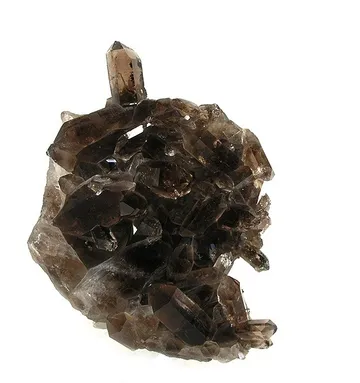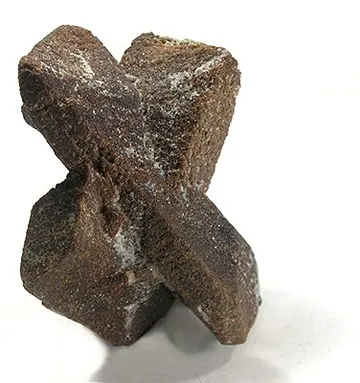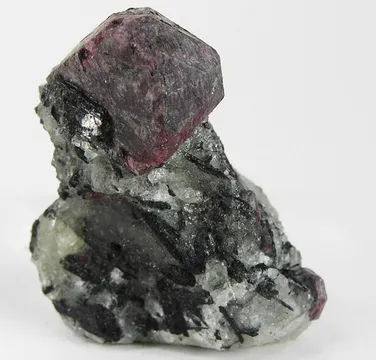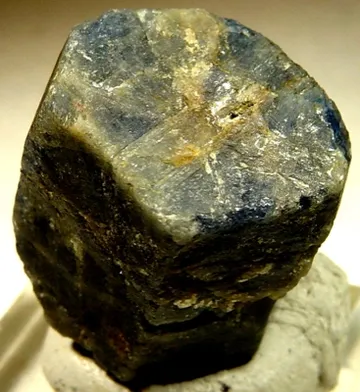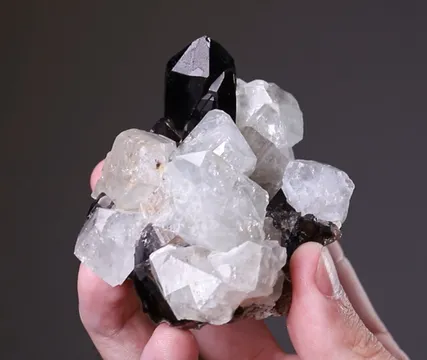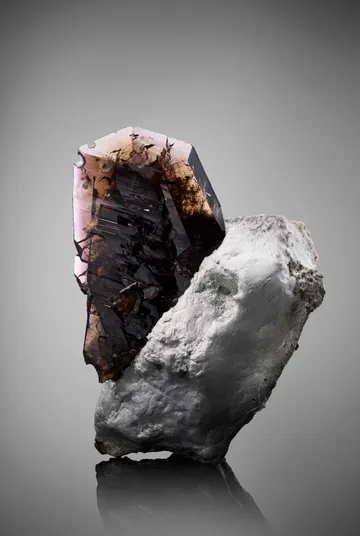
Puiva Mount, Russia — alpine-cleft locality in the Subpolar Urals, famed for axinite-(Fe) crystals on quartz, with historic large pockets up to 20 cm.
Key facts
Puiva Mount is one of the great Russian “alpine-cleft” mineral localities: a Subpolar Ural rock-crystal and axinite deposit near Saranpaul, on the eastern slope of the Urals in Khanty-Mansi Autonomous Okrug. To collectors, its name means large, sharp, glassy axinite-(Fe) — the classic old “ferroaxinite” of Russian labels — in brown, violet-brown, pale lilac and smoky tones, often perched on quartz, feldspar, calcite, chlorite-rich schist or fibrous amphibole. The best Puiva specimens have a distinctly alpine look, but with a Ural personality: thick axe-shaped blades, saturated color, high luster, and a rugged pocket-matrix style that separates them from the more delicate Swiss and French alpine-cleft pieces.
Geologically, Puiva belongs to the crystal-bearing quartz-vein province of the Subpolar Urals. The deposit is developed in Proterozoic Puiva Formation slates and related metamorphic rocks, cut by numerous dikes, with quartz veins and axinite mineralization assigned in the literature to a Middle Carboniferous–Early Permian interval. Its cavities yielded not merely quartz, but a broad alpine-cleft suite: axinite-(Fe), smoky quartz, quartz gwindels, fluorapatite, adularia, albite, calcite, titanite, rutile, anatase, brookite, epidote, chlorite-group minerals, amphiboles, zeolites, datolite, fluorapophyllite, rare-earth carbonates, and scattered sulphides and alteration products.
The historical importance of Puiva rests above all on its axinite. Russian museum and literature accounts treat the discovery of pale violet and lilac axinite at Puiva as a sensation, and later mining between 1984 and 1991 opened unusually large pockets with crystals reaching reported sizes of up to 20 cm. Those finds established Puiva as one of the world’s essential axinite localities. Good examples still appear on the collector market, but most of the finest pieces are old-pocket material that moved through Russian collections and Western dealers in the late Soviet and early post-Soviet years.
Regional View
Country View
For display, Puiva is at its best when the specimen still reads as a pocket object: axinite blades standing free from quartz or feldspar, smoky quartz gwindels showing a visible twist, fluorapatite plates edged by chlorite, or calcite and adularia giving pale contrast to the dark Ural axinite. The locality is not a single-species curiosity; it is a complete alpine-cleft collecting field, important both for cabinet aesthetics and for the mineralogical study of crystal-bearing quartz veins.

Photo: Wikimedia Commons

Photo: Wikimedia Commons
Search for specimens: View all specimens from Puiva Mount, Russia
Puiva Mount, also seen on older labels as Pouyva or Пуйва, lies near Saranpaul in the Berezovo district of Khanty-Mansi Autonomous Okrug, Russia. The standard published coordinates place it at approximately 64° 28' 59" N, 59° 40' 0" E. Mineralogically it belongs with the famous Subpolar Ural crystal-bearing quartz-vein localities around the Neroyka area, including Dodo and other deposits known to Russian quartz geologists and collectors.
The deposit is best understood as an alpine-type crystal-bearing quartz-vein system rather than an ordinary ore mine. The enclosing rocks are predominantly Proterozoic slates of the Puiva Formation, with dikes cutting the sequence; mineralizing fluids exploited fractures and open spaces to grow quartz and a characteristic suite of fissure minerals. As in classic alpine-cleft environments, the chemistry of the host rock strongly influenced the pocket assemblage, which is why Puiva combines quartz with borosilicates, amphiboles, chlorites, feldspars, carbonates, titanium minerals and rare-earth species.
The “ore bodies” of collector interest were crystal-bearing veins, lenses and pockets. Quartz was the industrial target, especially transparent vein quartz and rock crystal, while axinite, fluorapatite, titanite, rutile, brookite, adularia, calcite and related minerals were the collector by-products of pocket zones. Museum labels and Russian accounts document specific underground workings and veins, including material from vein 83, adit 6/38, at Puiva. Those labels are important because much Puiva material reached collections through older mining and geological channels rather than through modern specimen collecting.
Mining history at Puiva is tied to the Soviet and post-Soviet quartz industry. The Urals quartz organizations explored and worked crystal-bearing deposits for piezo-optical quartz, rock crystal and high-purity quartz raw material. After the collapse of centralized Soviet geological-mining structures, the old production system changed dramatically; by the early 1990s, major Soviet quartz organizations had been dissolved or reorganized, and many natural piezo-optical quartz deposits were no longer industrial priorities because synthetic quartz had displaced much of the former demand. Puiva is now generally treated as a defunct or conserved locality rather than an active collecting destination.
The famous axinite finds span more than one episode. Russian sources note an initial discovery of striking pale violet and lilac axinite at Puiva in 1974, followed by the opening, from 1984 to 1991, of unusually large nests with superb crystals. That later period is the source most often associated with the best old Puiva axinite: thick, lustrous crystals, sometimes in clusters, often with quartz, calcite, feldspar or fibrous actinolite-tremolite material. Fluorapatite from Puiva also reached the market in the mid-1990s, but in much smaller quantity than axinite; good examples are typically pale, glassy, tabular hexagonal crystals with chlorite edging or dusting.
Collecting access today should be regarded as highly restricted in practical terms. Puiva is remote, climatically severe, and not an open recreational collecting site in the manner of a roadside quarry. Most legitimate specimens on the market are older pieces from mine production, Russian collections, museum exchanges, or dealer inventories assembled after Russian material began moving westward. Provenance matters: a Puiva label with older Russian collection history, a mine-era label, or a traceable dealer pedigree carries real value.
Puiva axinite is axinite-(Fe), historically labeled ferroaxinite, and it is the mineral that made the locality famous. Crystals range from sharp thumbnail blades to cabinet crystals and clusters; the finest reported crystals reached roughly 20 cm, while market specimens commonly fall in the 2–8 cm range. Habit is typically wedge-shaped, axe-shaped or bladed, with strong glassy luster, sharp edges and color from brown through violet-brown to pale lilac, sometimes with conspicuous pleochroic effects. The best pieces come from open-pocket growth in the crystal-bearing quartz veins, especially the large nests opened in the 1984–1991 mining period, and are associated with quartz, smoky quartz, calcite, adularia, chlorite, actinolite-tremolite asbestos/byssolite, and occasionally other alpine-cleft minerals. A good Puiva axinite should have intact blade edges, a clean termination, strong internal color, and enough matrix or companion mineral to show its pocket context; ordinary examples are darker, more contacted, edge-chipped or visually crowded by chlorite and schist.
Fluorapatite from Puiva is much scarcer on the collector market than axinite but is one of the locality’s most attractive accessory minerals. It occurs in crystal-bearing cavities as tabular to bladed hexagonal crystals, commonly colorless, nearly colorless, very pale lilac, or delicate greenish-blue, with bright pinacoidal faces and thin prism faces that may be edged or dusted by dark green to black chlorite. Documented specimens include miniature groups in which the largest apatite crystals are around 2 cm across, and museum descriptions emphasize the platy pinacoidal habit as a characteristic feature. The most desirable pieces are glassy, sharply outlined plates with little damage, visible stepped terminations and attractive chlorite contrast; lesser examples are contacted at the base, dull from coatings, or too embedded in chlorite to display the apatite form clearly.
Quartz is the structural and economic backbone of Puiva: the deposit belongs to the Subpolar Ural crystal-bearing quartz-vein fields, and the collector minerals formed in and around its quartz pockets. Puiva quartz occurs as rock crystal, smoky quartz, gwindel forms, pocket linings, and matrix for axinite, apatite, feldspar, calcite and chlorite. Good clear quartz from these veins may show alpine-style growth features, contacts, overgrowths, inclusions and rehealed surfaces rather than the pristine isolated shape of pegmatite quartz. For collectors, the best Puiva quartz specimens are those that do more than “fill space”: they carry axinite dramatically, show a well-developed gwindel or smoky habit, preserve inclusion features such as rutile or amphibole, or document the mineral sequence of a real alpine-cleft pocket.
Smoky quartz from Puiva is most celebrated in gwindel form, where stacked, slightly rotated quartz growth produces the classic twisted alpine habit. Documented Puiva examples include gemmy smoky gwindels around 10 cm across, with complete terminations at both ends, glassy luster and a contacted underside from removal from matrix. Color is typically pale to medium smoky brown rather than opaque morion black, and the most attractive pieces show transparency, architectural stepping and an obvious twist. Good Puiva smoky quartz should be bright, visibly three-dimensional, and preferably associated with the axinite-bearing alpine suite; ordinary pieces are simple contacted crystals, cloudy fragments, or smoky quartz lacking either gwindel form or meaningful pocket association.
Beyond the four headline species, Puiva has a deep documented mineral list. Important and attractive accessories include adularia and albite, calcite, fluorapophyllite-(K), laumontite, heulandite-Ca, chabazite, epidote, clinozoisite, titanite, rutile, anatase, brookite, ilmenite, hematite, datolite, actinolite, tremolite, byssolite, chamosite and clinochlore. Rarer or more analytical collector species reported from the locality include allanite-(Ce), ancylite-(Ce), calcioancylite-(Ce), kainosite-(Y), arsenopyrite, breithauptite, chalcopyrite, galena, pyrrhotite, sphalerite, ullmannite, anglesite, cerussite, chrysocolla and hemimorphite. Puiva is not generally promoted as a type locality, but it is a classic locality for axinite-(Fe) and a significant Subpolar Ural reference locality for alpine-type quartz-vein mineralogy.
The chief authenticity issue with Puiva specimens is locality confusion rather than treatment. Axinite from Puiva, Dalnegorsk and other Russian localities has been mixed on the market, and old labels sometimes use broad or outdated wording such as “Ural,” “Polar Urals,” “ferroaxinite,” or “Puiva/Dodo.” Puiva is the classic source of the large Russian axinite-(Fe) pocket specimens; Dodo is nearby and mineralogically related, but it is much better known for quartz and other alpine-cleft minerals than for fine axinite. Dalnegorsk axinite has its own look and chemistry, and mislabelled Dalnegorsk pieces should not be upgraded to Puiva without convincing provenance.
Treatments are not a major documented problem for Puiva axinite, fluorapatite or quartz. Repairs, however, are always worth checking on larger bladed axinite clusters and matrix specimens. Examine blade bases, contact points, and any junction between axinite and quartz or schist under magnification and with a long-wave UV light if possible; glue lines, resin fills or overpainted matrix can be easier to spot in these areas. On smoky quartz gwindels, check the underside and terminal edges, because many pieces naturally have a matrix contact on one side, and a legitimate contact should not be confused with breakage unless fresh, sharp damage is present.
Condition is central to value. Puiva axinite blades have sharp projecting edges that chip readily, and even small nicks on the leading edge of a principal crystal are noticeable. Color and luster are more important here than sheer size: a smaller violet-brown or lilac, glassy, undamaged crystal is often a better specimen than a larger dark, battered blade. Fluorapatite is softer and more brittle than quartz and should be kept away from hard cabinet neighbors. Quartz gwindels and smoky quartz can be durable, but they lose much of their appeal if the staggered terminations are bruised.
Some Puiva specimens contain fibrous amphibole described on labels as actinolite-asbestos, tremolite-asbestos or byssolite. Stable, undisturbed fibers in a display specimen are usually not a practical problem if handled sensibly, but such pieces should not be trimmed, abraded, blown clean with compressed air, or scrubbed dry. Use a covered box, avoid shedding fibers, and keep labels noting the fibrous mineral association.
Rarity varies sharply by species. Axinite-(Fe) is the main market mineral, but top Puiva pieces are old-classic material and are not easy to replace. Fluorapatite from Puiva is genuinely scarce and often underappreciated, especially when the habit and chlorite edging are strong. Smoky quartz gwindels are desirable but less abundant than generic quartz from the region. Good matrix pieces with multiple Puiva species — axinite with quartz, apatite, albite, calcite or adularia — deserve extra attention because they preserve the locality’s alpine-cleft character.
In the Russian telling, Puiva’s axinite story begins with surprise. The Subpolar Urals were already a serious quartz province, worked and studied for crystal-bearing veins, but in 1974 the discovery of pale violet and lilac axinite at Puiva changed the way collectors and museum curators looked at the deposit. These were not anonymous brown slivers of an uncommon borosilicate; they were large, aesthetic, pleochroic crystals from a remote Ural mountain system, the sort of find that makes a locality name travel far beyond its mining district.
The larger chapter unfolded later, from 1984 through 1991, when mining opened extraordinary axinite-bearing nests. Russian museum accounts emphasize both the size and the beauty of the material: crystals reportedly reaching up to 20 cm, in colors that varied from pocket to pocket. Some were the familiar brown shades of axinite, but the most admired were pale violet and lilac crystals with strong pleochroism. Those finds are why Puiva specimens in old collections can have a presence out of proportion to their labels: a small tag reading “Пуйва” or “Puiva” may represent one of the finest axinite-producing events of the late twentieth century.
There is also a distinctly industrial irony to Puiva. The locality was part of a quartz world built for technology — piezo-optical quartz, rock crystal and high-purity silica raw material — not for the gentler priorities of specimen collecting. Quartz that would thrill a collector could be waste or feedstock depending on clarity, flaws and industrial needs. By the 1990s, as synthetic quartz displaced much natural piezo-optical material, the old reason for opening many such deposits faded. The specimen legacy of Puiva is therefore a by-product of a vanished industrial system: pockets opened for quartz, remembered by collectors for axinite.
Evgeni V. Burlakov, “Famous Mineral Localities: The Puiva Deposit, Subpolar Urals, Russia,” The Mineralogical Record, Vol. 30, No. 6, 1999, pp. 451–465. The key English-language locality article on Puiva. Mineralogical Record back issue
Evgeni V. Burlakov, “Puiva: Gwindel und Axinit aus dem Polar-Ural,” Lapis, Vol. 22, No. 7/8, 1997, pp. 59–70. German article documenting Puiva gwindel quartz and axinite. Journal of Gemmology abstract listing
V. N. Kalachev, “Axinite: new finds in Russia,” World of Stones, No. 1/93, 1993, pp. 3–4. Early report on fine brown axinite from cavities in the Puiva Mountains, including crystal forms and pleochroism. Journal of Gemmology abstract listing
L. S. Skobel, I. I. Nekhaenko and N. P. Popova, “Axinite mineralization from the Puiva deposit,” Izvestiya vuzov. Geologiya i razvedka, 1993, No. 11, pp. 139–141. Russian technical note on Puiva axinite mineralization. Russian mineral bibliography listing
P. P. Yukhtanov and V. I. Rakin, “Crystal morphology of axinite of the Subpolar Urals,” Trudy Instituta geologii Komi NTs UrO AN SSSR, Syktyvkar, 1991, issue 93, pp. 107–114. Russian study relevant to Puiva and related Subpolar Ural axinite. Russian mineral bibliography listing
V. V. Bukanov, Rock Crystal of the Subpolar Urals, Leningrad: Nauka, 1974, 212 pp. Foundational Russian work on the Subpolar Ural rock-crystal deposits. Webmineral Puiva bibliography
V. V. Bukanov, E. V. Burlakov, A. V. Kozlov and N. A. Pozhidaev, Subpolar Urals: Minerals of the Rock Crystal Veins, Mineralogical Almanac, Vol. 17, No. 2, Moscow, 2012, 136 pp. Major illustrated reference on the crystal-bearing vein mineralogy of the region. Smithsonian Libraries listing
O. L. Sveshnikova, “Exhibition ‘Minerals of crystal-bearing quartz veins’ in the Fersman Mineralogical Museum of the Russian Academy of Sciences,” New Data on Minerals, No. 51, Moscow, 2016, pp. 135–145. Museum-based article discussing Subpolar Ural quartz-vein minerals, including Puiva axinite, fluorapatite and titanite. Fersman Museum PDF
Fersman Mineralogical Museum specimen FMM 1-83326, axinite from the Puiva site near Mount Neroyka, Subpolar Urals, with actinolite-asbestos as an associated mineral; exhibition specimen length 10 cm, mineral size 7 cm. Fersman Museum specimen record
Fersman Mineralogical Museum “Minerals of crystal-bearing veins,” showcase 35, featuring Puiva axinite and other Subpolar Ural quartz-vein minerals. Fersman Museum showcase
Wendell E. Wilson, Joel A. Bartsch and Mark Mauthner, Masterpieces of the Mineral World, Houston Museum of Natural Science, 2004, pp. 104–105. Mindat records cite plate 36 for a Puiva axinite-(Fe) specimen. Mindat axinite-(Fe) occurrence record
Mindat: Puiva Mount, Saranpaul, Berezovo district, Khanty-Mansi Autonomous Okrug, Russia — Core locality database entry with coordinates, mineral list, references and photo links.
Mindat: Axinite-(Fe) from Puiva Mount — Species-specific occurrence record noting Puiva as a classic, world-class locality for axinite-(Fe).
Mindat: Fluorapatite from Puiva Mount — Species occurrence page useful for confirming fluorapatite, formula, associations and photo count.
Mindat: Smoky quartz gwindel photo from Puiva — Documented Puiva smoky quartz gwindel with size and descriptive notes.
Wikimedia Commons: Minerals of Puiva Mount — Open image category with axinite, quartz, fluorapatite and related Puiva specimens.
Webmineral.ru: Puiva deposit — Russian locality page with coordinates, mineral list, noted finds and bibliography.
Fersman Mineralogical Museum: Minerals of crystal-bearing veins — Museum exhibition text explaining alpine-type quartz veins and highlighting the 1974 Puiva axinite discovery.
Fersman Mineralogical Museum: Axinite specimen FMM 1-83326 — Museum record for a major Puiva axinite specimen with actinolite-asbestos association.
Mineralogical Record Vol. 30 No. 6, 1999 — Back-issue page for Evgeni Burlakov’s Puiva and Dodo locality articles.
Journal of Gemmology 1995 abstract listing — Includes an English abstract of Kalachev’s 1993 report on new Russian axinite finds, including Puiva.
Journal of Gemmology 1998 abstract listing — Includes an English abstract of Burlakov’s 1997 Lapis article on Puiva gwindel quartz and axinite.
Mineral Auctions: Puiva fluorapatite, ex Rich Kosnar — Useful market record for mid-1990s Puiva fluorapatite style, size and provenance.
News of the Ural State Mining University, 2021: history of Ural quartz raw-material exploration — Russian article giving industrial context for Ural quartz organizations and the later conservation of many natural quartz deposits.