Defiance Mine, USA: a renowned Arizona wulfenite locality famed for thin, lustrous butterscotch plates with calcite, prized by collectors for texture and color.
Key facts
The Defiance Mine is one of the unmistakable Arizona wulfenite localities: a small, oxidized lead-zinc-silver-copper mine on the southwest slope of Gleeson Ridge, in the old Turquoise or Courtland-Gleeson district of Cochise County. Its reputation rests on a very particular kind of specimen—thin, lustrous, butterscotch to yellow-brown wulfenite plates clustered in iron-stained cavities, commonly with calcite, and often showing the pointed, diamond-like outline that lets experienced Arizona collectors recognize Defiance material at a glance.
Geologically, the mine belongs to the family of southeastern Arizona base-metal replacement deposits developed in Paleozoic carbonate rocks near Laramide intrusions. At Defiance, oxidized replacement ore and pockety mineralization followed faults, fracture intersections, bedding-plane structures, and locally dike-related controls in Pennsylvanian-Permian Naco Group limestones and associated marble. Those same openings that carried ore also created the solution cavities in which wulfenite grew, producing specimens that are far more celebrated than the mine’s modest ore tonnage would suggest.
Regional View
Country View
The best Defiance pieces are not massive, blocky showpieces in the Mexican Los Lamentos style, nor are they the crimson classics of the Red Cloud. Their appeal is more architectural: blades and tablets stacked like shingles, honey to caramel plates flashing from rusty gossan, and pale calcite sparkling between the lead molybdate crystals. Many crystals are thin enough to look almost sheet-like, but the best survive with sharp edges, strong luster, a transparent or translucent glow when backlit, and enough three-dimensional matrix to make the specimen displayable rather than merely a loose cluster of plates.

Photo: Eric Hunt / Wikimedia Commons
Historically, Defiance sits in the orbit of the Costello mines, Silver Bill, Mystery, and the older mining camp of Gleeson. It was a small mine by production standards, worked sporadically through the first half of the twentieth century, but it became a mineral-collecting classic because miners and local collectors had access to wulfenite-lined openings at just the right moments. The great 1955 find—a long underground watercourse lined with brownish to yellow crystals—made the locality part of Arizona specimen lore and seeded collections with material that is still traded today.
Search for specimens: View all specimens from Defiance Mine, USA
The Defiance Mine is in Cochise County, Arizona, in the Gleeson part of the Turquoise Mining District, also known as the Courtland-Gleeson district, in the Dragoon Mountains. It lies immediately west of the Silver Bill Mine on the southwest slope of Gleeson Ridge, at roughly 5,400 feet elevation. Modern locality records place it in the north-central part of sec. 32, T.19S., R.25E., with coordinates close to 31.743° N, 109.823° W.
The deposit is best described as a small oxidized replacement and fissure-controlled base-metal deposit. Lead, zinc, silver, copper, minor gold, and vanadium are recorded commodities, but specimen collectors know the mine above all for wulfenite. The ore formed in carbonate host rocks—principally Pennsylvanian-Permian Naco Group limestone or metamorphosed impure Permian limestone and marble—close to quartz monzonite and related porphyritic intrusions. Mineralization is localized by fault fissures, fracture intersections, bedding-plane faults, and zones where structures change dip or intersect. The mine belongs to the same broad geologic setting as several classic Arizona wulfenite occurrences: oxidized Pb-Zn-Ag systems influenced by Laramide magmatism and later weathering.
The structural setting is important to understanding the specimens. The principal oxidized ore occurred as irregular replacements in impure limestone, especially in the hanging wall of a northwest-striking fault. Historical descriptions note an east-west fault separating impure limestone from marble, with another northwest-trending fault intersecting it in the Defiance workings. The mineralized bodies were not continuous veins in the simple sense; they were patchy, limonitic replacements and cavities developed along favorable structures. In such ground, wulfenite formed in open spaces where oxidized lead minerals and molybdenum-bearing groundwater chemistry met.
Mining was never on the scale of the larger Arizona copper camps. Published accounts describe the workings as mostly tunnel-based: an adit level of about 440 to 450 feet, two internal winzes about 100 feet deep, and connecting drifts. The mine began production around 1900 and continued only sporadically until 1958. Reported total production is roughly 10,000 tons or more of ore, mainly silver and lead with lesser zinc and traces of gold. During 1923–1924, about 300 tons were reported with 8–14 percent lead, a little zinc, and 4–7 ounces of silver per ton. Later lessee work during 1939–1944 removed additional tonnage. One small but spectacular silver-rich limonitic occurrence north of the marble-fault contact was described as horn-silver-bearing material with low lead and zinc; according to James Giacoma, four tons mined by him ran 3,000 ounces of silver per ton.
Ownership and operation history ties Defiance to the Costello group. Martin Costello, one of the powerful mining figures in the Gleeson-Courtland area, owned Defiance as well as the nearby Silver Bill. His accumulation of mining properties helped form the core of the Calumet and Arizona Mining Company’s regional interests. Later records also associate the mine with Giacoma Brothers mining activity, and locality summaries list the Giacoma Brothers among operators or owners in the later production period.
The famous specimen production came from oxidized cavities rather than routine ore runs. Arizona wulfenite studies describe the Defiance mine as containing large amounts of wulfenite lining solution cavities in oxidized lead, manganese, and iron deposits. The associated suite includes cerussite, anglesite, malachite, smithsonite, chlorargyrite, pyrolusite, calcite, limonite, hematite, jarosite, aragonite, and kaolinite, with additional zinc silicates, carbonates, and clays documented by later collectors and mineralogists. Wulfenite specimens often came as plates and clusters in rusty, vuggy gossan, sometimes on calcite or partly dusted by calcite.
Collecting access today should be regarded as closed unless explicit permission is obtained. Western Mining History cautions that MRDS land-status fields are not proof of access and should not be used as permission to enter; the Defiance record places the mine in a private-land setting. Glenn Snow’s Gleeson mining history is even more direct: the mines in the Gleeson area are on private land, abandoned, and dangerous. Shafts, adits, winzes, rotten timbers, oxidation, earth movement, and erosion make underground entry both illegal without permission and physically hazardous. Modern Defiance specimens are therefore obtained primarily from old collections, dealer inventories, auctions, and institutional deaccessions—not by casual field collecting.
Defiance wulfenite is classic for thin tabular to bladed PbMoO4 crystals in butterscotch, honey-yellow, golden-brown, reddish-brown, and darker chocolate-brown tones, commonly on rusty limonitic matrix and frequently accompanied by calcite; historical MRDS notes describe crystals often over 1 inch wide and ranging from a butterscotch aspect to yellow plates as thin as paper and clear as glass, while modern specimen records show crystals commonly in the 8 mm to 3 cm range, with exceptional cabinet plates carrying dense, shingled clusters. The most prized pieces trace their character to solution cavities and oxidized lead-manganese-iron zones, especially the famous 1955 watercourse discovery: good specimens have sharp undamaged edges, bright luster, strong backlighting, pleasing plate-on-matrix architecture, and the locality’s distinctive pointed or diamond-shaped habit, whereas ordinary examples tend to be flatter fragments with edge wear, dull surfaces, or too many incomplete blades.
Calcite at Defiance is most familiar as an association mineral with wulfenite, appearing as glassy colorless to off-white, amber, salmon, or pale brick-red crystals that can pepper the wulfenite plates, partly coat them as small rhombohedra, or form bladed and gemmy small-cabinet specimens of its own; although calcite is part of the mine’s gangue and occurs in the same oxidized replacement environment, standalone Defiance calcites are much less commonly seen on the market than wulfenite combinations. The best calcite-bearing pieces are those where calcite gives contrast without smothering the wulfenite—bright, transparent calcite tucked between caramel blades, or well-terminated bicolored calcite crystals from the mine’s carbonate-rich openings—while mediocre pieces are either visually dominated by common calcite or show the wulfenite reduced to worn remnants beneath later carbonate.
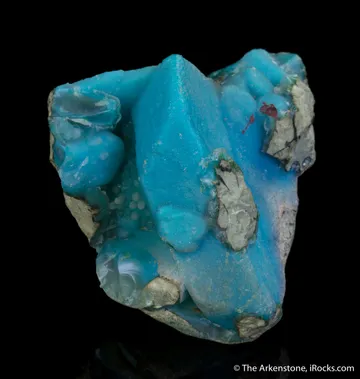
Other documented Defiance minerals reflect a deeply oxidized Pb-Zn-Ag-Cu system: anglesite, cerussite, chlorargyrite, malachite, smithsonite, aurichalcite, rosasite, descloizite, mimetite, hemimorphite, willemite, sauconite, fraipontite, chrysocolla, plattnerite, coronadite, aurorite, goethite, hematite, jarosite, aragonite, kaolinite, quartz, and chalcedony are all recorded from the mine or immediate Defiance-Silver Bill setting. The most significant rarities are the zinc phyllosilicates: fine-grained light blue-green material once likely to be mistaken for turquoise or chrysocolla was shown by X-ray diffraction and chemical work to be fraipontite, with sauconite admixed or forming from it. Plattnerite is another collector’s microscope target here, occurring on or near wulfenite-calcite specimens, sometimes at the bases of the blades.
Defiance wulfenite is distinctive but also frequently mislabelled. The commonest problem is not outright fakery but geographic slippage: old labels may say “Gleason” instead of Gleeson, “Gleason Mine,” “Bisbee,” or simply “Arizona.” Because Defiance produced abundant recognizable wulfenite and lies in Cochise County, some older labels picked up nearby better-known place names through dealer shorthand or collector memory. Dark brown, thin, pointed Defiance-style wulfenite with calcite is very different from typical Bisbee wulfenite and should not be casually reassigned to Bisbee.
Condition is the central issue. The crystals are thin, brittle, and exposed; edge chipping, broken tips, cleaved plates, and contacted basal margins are common even on otherwise good pieces. Many genuine Defiance specimens from the great finds have small breaks simply because the crystals grew as fragile plates in cavities that were mined under active ore-removal conditions. A collector should judge condition by the whole composition: a few peripheral chips may be acceptable on a large, lustrous, backlit plate, but central broken blades or sandblasted, dull surfaces sharply reduce desirability.
The best specimens are those with locality character: pointed tan to brown blades, preferably translucent, forming an aesthetic cluster on limonitic matrix with calcite contrast. Loose “float” groups and repaired plates should be examined carefully. Because thin wulfenite plates can be stabilized or repaired, inspect junctions under magnification and raking light, looking for adhesive gloss, unnatural alignment, or colorless glue films along blade bases. Avoid aggressive cleaning: calcite association is part of the classic look, and acid treatment would obviously damage or remove it. Wulfenite itself is lead-bearing; normal specimen handling is safe with common-sense hygiene, but avoid generating dust, keep fragments away from children, and wash hands after handling.
Fluorescence is not the selling point of Defiance wulfenite, but associated calcite from Arizona oxidized deposits may respond under UV depending on impurities. Any fluorescent claim should be treated as specimen-specific rather than locality-defining. For display, keep pieces away from vibration and edge contact; custom acrylic bases are worthwhile for cabinet specimens because the projecting blades catch on foam, cotton, and fingers.
Market availability is better than for many one-pocket Arizona classics because the 1955 and later collector recoveries placed a meaningful quantity into circulation. Still, genuinely fine Defiance specimens are not common. Small miniatures and thumbnails appear regularly, often with some wear. Large cabinet plates with sharp, translucent crystals over 2 cm, good luster, calcite contrast, and minimal damage are much scarcer and usually trade as classic Arizona wulfenites rather than merely as locality representatives.
In the collecting history of Defiance, the moment everyone returns to is 1955. Underground, a large inclined fault intersected a horizontal watercourse. A blast opened the end of a cavern, not a little pocket but a tunnel-like chamber reported at two to ten feet high, up to ten feet wide, and ninety feet long. The inside was lined with brownish to yellow diamond-shaped wulfenite crystals. The miners did not stop mining in any romantic sense—ore came first—but they allowed collectors to work ahead of drilling and blasting, saving much of the pocket before the mine advanced through it.
Bob Jones later tied that episode to Richard “Dick” Bideaux, one of the great Arizona collector-mineralogists. According to Jones, a miner alerted Bideaux’s father that a huge wulfenite-lined watercourse had been opened at the Defiance on a Friday. Bideaux and his collecting partner Dick Jones had only the weekend. They worked night and day, racing the mine schedule, and left with two vehicles and a small trailer filled with boxes of tan, arrowhead-shaped wulfenite clusters. That is why Defiance specimens still appear with the aura of a field rescue: they are not simply ore-zone byproducts but survivors from a chamber that active mining could easily have destroyed.
The mine’s broader human story is bound up with Martin Costello. Defiance was small, but it was part of the web of Gleeson-Courtland properties Costello assembled with remarkable success. His nearby holdings helped anchor the district’s transition from scattered claims to serious company mining, and local histories describe how those properties fed into the larger Calumet and Arizona enterprise. Costello retired to Los Angeles in 1902, leaving his family to continue Arizona operations. The contrast is striking: a mine that produced only a modest tonnage of ore became one of the enduring mineral names in the district, while the financial machinery around it belonged to men pursuing fortunes in silver, lead, copper, and zinc rather than cabinet specimens.
There is also a quieter, modern story in the labels. Collectors still encounter Defiance wulfenites marked “Gleason,” “Gleason Mine,” or even linked vaguely to Bisbee. Local Arizona collectors have repeatedly recognized such pieces by sight: darker brown plates, calcite along edges and bases, the thin pointed habit, the look of Gleeson Ridge rather than Bisbee. In one Mindat discussion, Rolf Luetcke—who knew the area from living nearby—called a specimen “absolutely typical” of Gleeson, Defiance Mine, and noted that under the microscope one may find plattnerite near the calcite and wulfenite bases. That is the collector’s Defiance in miniature: a locality read not only from a label, but from habit, association, matrix, and a practiced eye.