






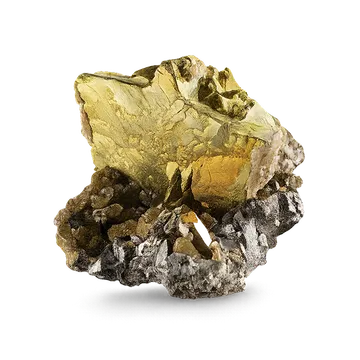
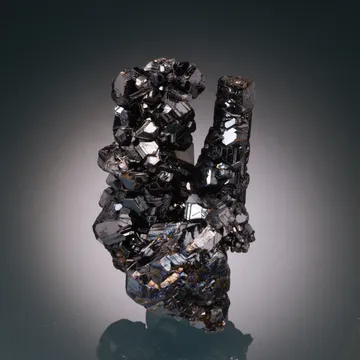
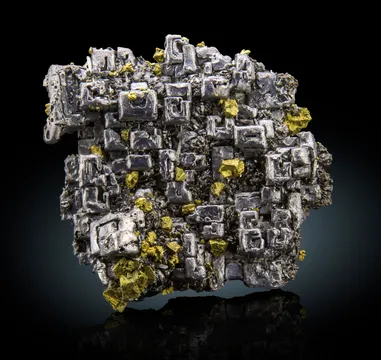
Chalcopyrite from Dalnegorsk, Russia — pseudotetrahedral crystals with complex twinning, striking contrast with sphalerite and galena, prized by collectors.
Key facts
Dalnegorsk chalcopyrite is one of the modern classics of the sulfide-collector world: not merely brassy accessory specks in a lead-zinc ore, but sharp, architectural crystals with a personality all their own. The district is better known to many collectors for galena, sphalerite, pyrrhotite, fluorite, calcite, quartz, datolite, ilvaite, and hedenbergite, yet chalcopyrite from here deserves separate attention because it appears in bold three-dimensional forms, often as pseudotetrahedral crystals and complex twins, and because the best pieces show a distinctly Dalnegorsk contrast: yellow-gold chalcopyrite set against black sphalerite, silver galena, bronze pyrrhotite, colorless to pale green fluorite, and white calcite.

Photo: Wikimedia Commons
The locality sits in the Russian Far East, in Primorsky Krai, within the broader Dalnegorsk ore district of the Sikhote-Alin region. The important chalcopyrite-bearing specimens come chiefly from the district’s lead-zinc-silver skarn-polymetallic systems, especially Nikolaevskiy, 2nd Sovetskii, Verkhnii, and related workings. These deposits developed where carbonate blocks and limestone units were invaded and altered by Cretaceous to Paleogene magmatic and hydrothermal systems, producing skarns, sulfide ores, veins, and large mineralized cavities. Those open spaces are the secret behind the locality’s superb cabinet pieces: crystals had room to grow.
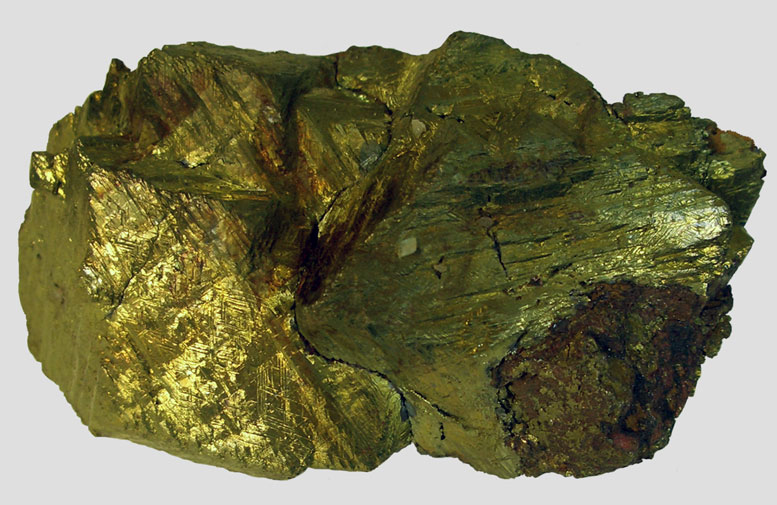
Photo: Wikimedia Commons
Dalnegorsk chalcopyrite is collectible for two different reasons. First, as a primary species, it can be large and impressively crystallized: crystals to several centimeters are known, and the district is specifically recorded for pseudotetrahedral and complex twinned chalcopyrites. Second, as an association mineral, it completes some of the most desirable Dalnegorsk combination specimens. A specimen with galena, sphalerite, pyrrhotite, fluorite, quartz, calcite, and chalcopyrite can read almost like a compact geological cross-section of the deposit: skarn silicates, open-space gangue, and ore sulfides all present in one sculptural object.
Collectors often look for specimens where the chalcopyrite is not visually overwhelmed by the more famous galena or sphalerite. The best examples show isolated, sharp, lustrous crystals perched in view, not buried in massive sulfide. Fresh brassy yellow is prized, but Dalnegorsk pieces may also show grayish, gunmetal, bronze, or iridescent surface tones. That subdued, metallic gray-gold look is not a defect when the form is sharp and the luster is strong; in fact, it is part of the locality’s character, especially on pieces where chalcopyrite contrasts with black high-iron sphalerite.
Search for specimens: View all chalcopyrite specimens from Dalnegorsk, Russia
Dalnegorsk is not a single mine locality in the collector’s sense, but a mineral district centered on a long-lived mining town. Older labels may read Tetyukhe, Tetjuche, Tjetjuche, Primorskiy Kray, Far-Eastern Region, Kavalerovo mining district, or simply Dal’negorsk. Modern locality work has separated many of the important occurrences, but older specimen labels are often less precise. For chalcopyrite, the most significant labels to watch are Nikolaevskiy Mine, 2nd Sovetskii Mine at the Partizanskoe Pb-Zn deposit, Verkhnii Mine, and broader Dalnegorsk district labels.
The deposit type is best understood as skarn-polymetallic mineralization, with lead-zinc-silver ores and copper-bearing sulfide phases developed in and around carbonate rocks. The company operating the district describes Nikolayevskoye, Partizanskoye, and Verkhnee as skarn-polymetallic deposits with differing ore-body configurations. The ore and collector mineralization developed in limestone skarns and related vein structures; in collector terms, this explains the repeated association of chalcopyrite with galena, sphalerite, pyrrhotite, fluorite, quartz, calcite, hedenbergite, ilvaite, and datolite.
The geologic setting is especially favorable for specimen growth. Carbonate host rocks were replaced by skarn assemblages and then cut or overprinted by sulfide-bearing fluids. Solution cavities, faults, veins, and open spaces became lined with ore and gangue minerals. In the best pockets, chalcopyrite crystallized as distinct pseudotetrahedral or twinned crystals rather than as anonymous ore grains. Some Dalnegorsk chalcopyrites occur on sphalerite matrix; others are intergrown with galena, perched among pyrrhotite blades, or scattered with quartz and calcite.
Mining history began under the old Tetyukhe name. On April 2, 1897, Julius Joseph Bryner staked a rich silver-lead-zinc deposit in the Tetyukhe, now Rudnaya, river valley and named it Verkhniy. The first 97 tons of ore were mined in 1902, and commercial development began in 1907. A mining corporation involving Bryner interests and foreign capital was established in 1909, and from 1911 to 1916 more than 100,000 tons of ore were mined from the Verkhniy mine. A concentration plant begun in 1912 produced its first lead concentrate in June 1914.
The Soviet and post-Soviet mining history created the modern specimen supply. Partizanskoye began operation in 1950, with the 2nd Sovetskii Mine established on that deposit. Nikolayevskoye entered operation in 1982 and is notable for shafts exceeding 800 meters in depth. Dalpolimetall records 1991 as a record mining year, with 1,245,000 tons of ore mined. The company remains active in the region, and its raw-material base includes Nikolayevskoye, Partizanskoye, Verkhnee, Mayminovskoye, Southern, and Silinskoye.
Collecting access should be treated as industrial-mine access, not casual field collecting. The important chalcopyrite specimens come from active or historically active mining operations, underground workings, ore bodies, and pockets encountered during mining. Modern access is controlled by operating companies and local regulations. For serious collectors, this means that provenance matters: good labels, old collection tags, and dealer notes indicating a specific mine are valuable, especially for distinguishing Nikolaevskiy material from 2nd Sovetskii or Verkhnii pieces.
Notable finds are not limited to chalcopyrite, but chalcopyrite participates in many of the district’s celebrated sulfide combinations. The best Dalnegorsk chalcopyrites are recorded as world-class for the species, with pseudotetrahedral and complex twinned crystals commonly reaching a few centimeters and exceptional pocket material reported far larger. The broader district has also produced famous galena, high-iron sphalerite, pyrrhotite, fluorite, calcite, datolite, ilvaite, hedenbergite, and rare sulfosalt assemblages, all of which give chalcopyrite specimens from Dalnegorsk their rich collector context.
Dalnegorsk chalcopyrite most characteristically forms pseudotetrahedral crystals, modified tetrahedral-looking forms, compound crystals, and complex twins. The district is recorded for crystals to about 3 cm as normal high-quality material, with extraordinary pocket material far larger. On cabinet specimens, collector-grade crystals are commonly small to thumbnail-sized crystals scattered across galena or sphalerite, but the better pieces show individual chalcopyrites in the 1–3 cm range with clear form and strong metallic luster.
Color ranges from fresh brassy yellow to bronze, grayish gold, dark gunmetal, and locally iridescent purple-gold surface tones. Some Dalnegorsk chalcopyrite crystals appear surprisingly gray at first glance, especially when associated with black sphalerite; under strong light, their metallic luster and brassy reflections separate them from pyrrhotite, galena, and dark sphalerite. The brassy to gold crystals on black sphalerite are among the most visually effective; so are pieces where chalcopyrite sits beside silver-gray galena or pale fluorite.
Associated minerals are a major part of the locality’s appeal. The most common and important companions include galena, sphalerite, high-iron sphalerite often described as marmatite, calcite, fluorite, quartz, pyrrhotite, tetrahedrite-group minerals, siderite, hedenbergite, ilvaite, datolite, and pyrite. Nikolaevskiy specimens in particular can be rich sulfide combinations, while 2nd Sovetskii material often presents classic skarn-polymetallic associations with galena, sphalerite, calcite, fluorite, quartz, hedenbergite, ilvaite, and chalcopyrite.
Quality depends on crystal definition more than sheer size. Fine Dalnegorsk chalcopyrite should show recognizable pseudotetrahedral or twinned form, bright metallic luster, and an exposed position on matrix. A 1 cm crystal placed prominently on quartz or sphalerite may be more collectible than a larger but buried or corroded mass. Sharpness is especially important because chalcopyrite is softer and more easily bruised than pyrite; flattened contacts, edge bruising, and dull abraded faces can reduce appeal quickly.
Matrix and contrast are also decisive. Black sphalerite makes the chalcopyrite read as gold. Silver galena adds a cool metallic counterpoint. White calcite or quartz can brighten the piece, while fluorite gives a distinctly Dalnegorsk signature. Pyrrhotite associations are particularly attractive when the chalcopyrite is not lost among other bronze-toned sulfides. On mixed specimens, the ideal is a balanced composition: chalcopyrite visibly present as crystals, not merely as a label species.
For locality attribution, form and association are useful but not enough by themselves. Dalnegorsk chalcopyrite can resemble material from other skarn and polymetallic sulfide districts. The strongest support for attribution is a specific mine label, preferably one that names Nikolaevskiy, 2nd Sovetskii, Verkhnii, or Partizanskoe, plus an association typical of the district. Labels reading only “Russia” or “Siberia” should be treated cautiously unless accompanied by old collection documentation or a dealer with credible provenance.
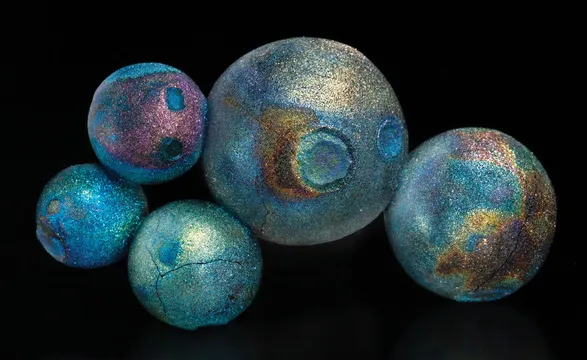
Dalnegorsk chalcopyrite is not generally associated with a well-publicized locality-specific fake problem, but chalcopyrite as a species carries a broader caution: artificial acid-induced iridescence is common in the mineral trade. Many “peacock ore” specimens sold commercially are treated chalcopyrite or bornite. For Dalnegorsk material, intense rainbow colors should be evaluated carefully. Natural tarnish and subtle iridescence can occur, but an overbright, uniform, electric purple-blue surface on otherwise ordinary chalcopyrite deserves skepticism unless the specimen has strong provenance and the treatment history is disclosed.
The most important authenticity issue is locality precision. Older Dalnegorsk material may be labeled Tetyukhe, Dal’negorsk, Kavalerovo District, Primorskiy Kray, Far-Eastern Region, or simply Russia. These labels can be legitimate, but they are less informative than modern mine-specific labels. Since chalcopyrite occurs at multiple Dalnegorsk sublocalities, collectors should preserve every old label and avoid over-refining the locality without evidence. If a specimen is labeled only “Dalnegorsk,” it may be more honest to keep that locality rather than assigning it to Nikolaevskiy or 2nd Sovetskii by visual resemblance alone.
Condition issues are typical of sulfide skarn specimens. Chalcopyrite is relatively soft, with a hardness around 3.5–4, so exposed crystal edges can be nicked. It also tarnishes, and on some specimens tarnish is part of the aesthetic; on others it dulls the luster. Mixed Dalnegorsk pieces often include fragile calcite, quartz points, or delicate fluorite edges, while galena can show cleavages or bruises and pyrrhotite can acquire patina. Cleaning should be conservative. Avoid acids, aggressive ultrasonic cleaning, and prolonged water exposure on mixed sulfide specimens, especially when pyrrhotite or altered sulfides are present.
Rarity depends on whether chalcopyrite is the main species or an association mineral. Dalnegorsk specimens with minor chalcopyrite on galena, sphalerite, fluorite, or calcite are available with some regularity. Strong chalcopyrite-dominant pieces, especially those with sharp crystals approaching several centimeters and an attractive matrix, are much less common. Large, aesthetic, undamaged chalcopyrite combinations from old finds are genuinely desirable and should be treated as significant district specimens rather than ordinary copper-ore examples.
Market availability is best described as intermittent. Dealer listings and archive records show a continuing trickle of Dalnegorsk chalcopyrite-bearing specimens, ranging from modest combination pieces to museum-sized galena-sphalerite-chalcopyrite examples. Sold listings document chalcopyrite crystals to nearly 3 cm on galena-sphalerite matrix and large 2nd Sovetskii combinations with chalcopyrite as part of the sulfide suite. The best pieces tend to disappear into collections quickly, especially when they are old Russian classics with mine-specific labels.
The story of Dalnegorsk begins before the name Dalnegorsk existed. In 1897 the place was Tetyukhe, a remote valley in the Russian Far East where Julius Joseph Bryner staked a rich silver-lead-zinc deposit in the Rudnaya river valley and named it Verkhniy. The first production was almost startlingly modest by later standards: 97 tons of ore in 1902. But by 1907 the deposit had entered commercial development, and in 1909 the Tetyukhe Industrial Mining Stock Corporation was formed with Bryner & Co. and German and English capital. From 1911 to 1916, the Verkhniy mine alone yielded more than 100,000 tons of ore.
The early ore was not the deep sulfide material collectors now associate with Dalnegorsk. It was largely supergene zinc ore from near-surface bodies, rich in calamine and smithsonite, and it was shipped by sea to England for processing. Then came the plant. In 1912, the German firm Gumbolt began building an enrichment plant in Tetyukhe. In June 1914 it produced its first lead concentrate, with a capacity of 8 tons of ore per hour. That plant changed the district from a remote ore discovery into an industrial mining center, and its later reconstructions would shape the specimen-producing mines that collectors know today.
The Bryner name carries an odd historical echo far beyond mineral collecting. Julius Bryner’s son Boris maintained mining rights at Tetyukhe until 1931, one of the unusually long-running private enterprises in the Soviet period. Boris’s son, born far from the ore valley’s stopes and skarn pockets, became Yul Brynner, the actor known worldwide. It is a strange lineage: a Swiss-Russian mining claim in a wild lead-zinc valley, an industrial settlement named Tetyukhe, and, two generations later, one of Hollywood’s most recognizable faces.
The 1920s brought a second surge. In 1924 the Tetyukhe mining company was granted as a concession to Bryner & Co., soon joined by an English mining corporation. Production rose sharply. In 1928 alone, the operation produced 19,925 tons of zinc concentrate and 6,335 tons of lead concentrate. The workforce grew just as dramatically, from 107 workers in 1924 to 850 in 1930. While exploiting Verkhniy, the concessioners prospected nearby deposits—the kind of district-scale work that eventually exposed the broader Dalnegorsk ore cluster.
In January 1932, the concession treaty was annulled, and the Sikhote Alin State Polymetallic Company, Sikhali, took over the story. During World War II, the company’s production became part of the Soviet war effort: in four years, workers produced 80,200 tons of lead and 60,500 tons of zinc. The numbers are industrial, not romantic, but they explain why Dalnegorsk was never simply a specimen locality. The beautiful crystals came from a working mining district whose first purpose was metal.
The postwar and late Soviet decades brought the mines most familiar to mineral collectors. Partizanskoye entered operation in 1950, and the 2nd Sovetskii Mine was established on that deposit. Sadovoye began in 1975 and was worked out by 1996. Nikolayevskoye began operation in 1982 and became one of the great names on Dalnegorsk specimen labels; its shafts are recorded as the deepest in the Far East, exceeding 800 meters. Dalpolimetall’s own history records 1981 construction at Nikolayevskiy and development of the first stage in 1983 with self-propelled mining machines.
The district’s specimen lore is bound up with this industrial rhythm. Pockets opened in working mines, sometimes producing galena, sphalerite, pyrrhotite, fluorite, quartz, calcite, and chalcopyrite combinations of extraordinary balance. A Dalnegorsk dealer and collector, Vladimir Kuvshinov, has described a monumental Nikolaevskiy combination of optic fluorite, galena, chalcopyrite, pyrrhotite, and quartz measuring 36.7 x 19.5 x 17.7 cm and weighing 6.5 kg, mined in the early 1980s. He wrote that he bought it in 1989, kept it in his collection for decades, and that only a few people had seen it in person. Whether viewed as dealer prose or collector testimony, it captures the way the best Dalnegorsk specimens have circulated: found in a mining district, held closely by those who recognized them early, and released only reluctantly.


_2.jpg)
