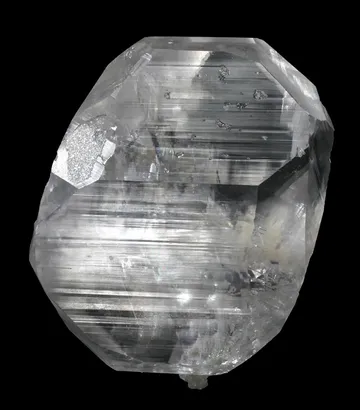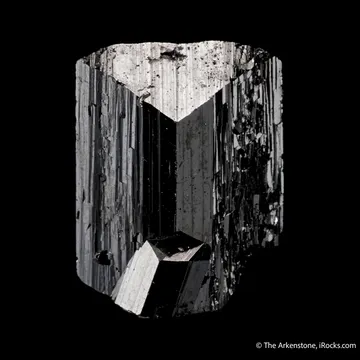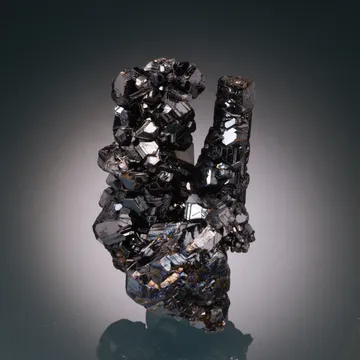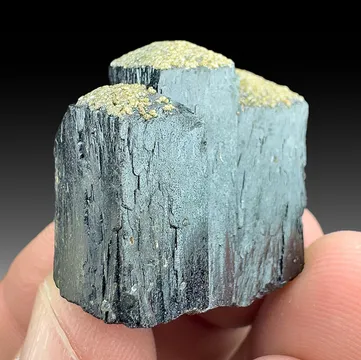
Dalnegorsk, Russia - ilvaite from this famed district features sharply prismatic black crystals in complex skarn matrices, prized for contrast and locality app…
Key facts
Dalnegorsk ilvaite is one of the great black-mineral classics of the late twentieth century: sharply prismatic, lustrous to almost resinous black crystals set against pale quartz, white calcite, greenish hedenbergite, siderite, fluorite, datolite, and skarn matrix. The best pieces have a very recognizable Far Eastern Russian look—blocky, dark, terminated ilvaite prisms rising from busy white-to-green skarn associations rather than the isolated, glassy “display clusters” familiar from some newer Chinese ilvaite occurrences.

Photo: Wikimedia Commons
The locality name “Dalnegorsk” covers a mining district in Primorsky Krai in the Russian Far East, and ilvaite specimens have been recorded from several mines and deposits within it, including the Nikolaevskiy Mine, the 1st and 2nd Sovetskii mines, the Partizanskoe Pb-Zn deposit, the Bor Pit of the Dal’negorsk B borosilicate deposit, Sentyabr’skiy, and the Verkhnii Mine. In collector usage, labels may simply say “Dalnegorsk,” “Dal’negorsk,” “Tetyukhe,” “Primorskiy Kray,” or “Kavalerovo Mining District,” so serious locality attribution depends on older labels, matrix associations, and, when available, mine-level documentation.
Geologically, Dalnegorsk ilvaite belongs to a district where skarn and hydrothermal systems produced both polymetallic Pb-Zn-Ag ores and boron-rich calcic skarns. The mineralogical setting is unusually rich: hedenbergite, garnet, axinite, datolite, danburite, quartz, calcite, fluorite, galena, sphalerite, pyrite, chalcopyrite, pyrrhotite, sulfosalts, and many rarer species occur in different parts of the district. That complexity matters to collectors because Dalnegorsk ilvaite is rarely just “black crystals on matrix”; the best specimens read as miniature geological cross-sections, with ilvaite fixed into the same hydrothermal architecture that gave the locality its famous calcites, fluorites, datolites, and sulfide combinations.
What collectors prize most is contrast. A fine Dalnegorsk ilvaite specimen has upright, terminated black prisms; sharply reflective faces; little peripheral breakage; and enough pale quartz or calcite to make the ilvaite stand out. Hedenbergite-rich examples can be especially distinctive, the green to olive acicular matrix giving the black ilvaite a textured, skarny foundation. Bor Pit pieces may show white calcite and colorless quartz against the ilvaite, while 2nd Sovetskii specimens often enter the market as compact miniatures with quartz, hedenbergite, or calcite.

Photo: Wikimedia Commons
Dalnegorsk also produced notable pseudomorphs after ilvaite. These are not substitutes for pristine black ilvaite crystals, but they are historically and mineralogically important: they record later carbonate replacement while preserving the original ilvaite form. Siderite and calcite pseudomorphs after ilvaite from the district appear periodically in collections and dealer archives, and good ones are collected as Dalnegorsk specialties in their own right.
Search for specimens: View all ilvaite specimens from Dalnegorsk, Russia
Dalnegorsk lies in Primorsky Krai, Russia, in the southern Russian Far East. The district was formerly widely known in mineral literature and older labels as Tetyukhe or Tjetjuche, and many specimens from the 1980s and 1990s still carry those legacy names. For ilvaite, “Dalnegorsk” is best understood as a district-level label unless a specimen is documented to a particular mine or pit.
The mineralized district includes both skarn-polymetallic Pb-Zn-Ag deposits and borosilicate skarn deposits. At the Partizanskoe Pb-Zn deposit, the ore system is described as a base-metal skarn deposit in which skarn bodies are composed mainly of hedenbergite, garnet, ilvaite, and axinite, with lesser wollastonite, vesuvianite, fluorite, quartz, and calcite. The ore minerals are dominated by sphalerite and galena, with chalcopyrite, arsenopyrite, pyrite, marcasite, pyrrhotite, acanthite, fahlores, sulfosalts, native elements, tellurides, and iron oxides appearing in subordinate or minor quantities.
The Partizanskoe system is hosted in a complicated olistostrome and limestone-block setting: large Middle to Upper Triassic limestone sheets and blocks occur within terrigenous rocks, and skarn orebodies are localized along contacts, faults, veins, lenses, and pipe-like bodies. Underground workings have intersected ore zones down to roughly 600 m, while deeper portions around 800 m are reported to pinch out into less altered limestone. This vertical architecture is reflected in the skarn mineralogy: ilvaite is part of the skarn-silicate assemblage, especially in lower-zone associations with hedenbergite, garnet, fluorite, quartz, and calcite.
The Bor Pit belongs to the Dal’negorsk B borosilicate deposit, a calcic-skarn boron deposit. Published work on the borosilicate deposit distinguishes skarn, borosilicate, and quartz-carbonate stages. In simplified collector terms, this is the source of many specimens in which black ilvaite appears with pale quartz, calcite, datolite, danburite-related borosilicate associations, hedenbergite, and other skarn minerals. The Bor Pit is also known under labels such as “Boron Pit” and “Bor Quarry.”
The Nikolaevskiy Mine is one of the district’s most important specimen sources and is recorded as having opened in 1982. It is famous far beyond ilvaite for crystallized sulfides, calcite, fluorite, quartz, and complex skarn associations. Mindat records ilvaite from Nikolaevskiy as lustrous black prisms with dominant 110 and 111 forms reaching 10 cm, and rates the occurrence as world-class for the species. Nikolaevskiy labels on ilvaite are especially desirable when supported by old collection tags or clear paragenetic context.
The Verkhnii Mine, also known as Verchniy or Verkhnee Rudnik on some labels, is identified as Dalnegorsk’s first commercial mine operation. It is particularly known to collectors for calcite specimens, but ilvaite occurs there as well, including combinations with calcite, datolite, and other skarn minerals. Verkhnii attribution should be treated carefully because similar-sounding locality names in the Russian Far East have caused occasional label confusion in online photo discussions and collection records.
Access today should be regarded as industrial, not recreational. These are mines, pits, and controlled working areas, and modern specimens reach collectors through mining recovery, old collections, dealers, and auctions rather than casual collecting. Older material from the 1980s through early 2000s is especially important in the market, and labels citing 1st Sovetskii, 2nd Sovetskii, Nikolaevskiy, Bor Pit, or Verkhnii add real value when credible.
Dalnegorsk ilvaite is characteristically black to very dark gray-black, with a vitreous, resinous, or submetallic surface when fresh. The classic crystals are prismatic and commonly striated, with chisel-like to wedge-like terminations. Nikolaevskiy occurrence data records prisms with dominant 110 and 111 faces up to 10 cm, though collector-grade display specimens more commonly feature crystals in the millimeter to several-centimeter range.
The most familiar habit is a cluster of stout, upright black prisms on quartz, calcite, or hedenbergite-rich matrix. 2nd Sovetskii pieces often appear as compact miniatures: sharp black ilvaite partly coated or accented by small quartz crystals, sometimes with a greenish cast from hedenbergite inclusions. Bor Pit specimens may show more dramatic contrast, with white calcite and colorless to frosted quartz grouped around the dark ilvaite. Verkhnii material can be more calcite-forward, with ilvaite as dark micro- to small crystals sprinkled on or included in transparent calcite.
Associated minerals documented from Dalnegorsk ilvaite records and specimen descriptions include quartz, calcite, hedenbergite, siderite, datolite, fluorite, pyrite, goethite, aragonite, prehnite, hematite, sphalerite, and, at district scale, the broader skarn suite of garnet, axinite, wollastonite, vesuvianite, and sulfides. This diversity makes association a major part of evaluation. A solitary black ilvaite cluster may be mineralogically correct, but a Dalnegorsk piece with ilvaite, quartz, calcite, and hedenbergite often carries stronger locality identity.
Size should be judged in context. A 3 to 5 cm miniature with crisp ilvaite crystals, full terminations, and clean quartz contrast can be better than a larger cabinet specimen with bruised terminations or heavy peripheral damage. Crystals in the 1 to 3 cm range are common enough to define the classic aesthetic; documented crystals above that size, especially sharp and undamaged, become much more significant. Larger specimens with 3 cm or longer upright crystals on attractive matrix are strongly collectible.
The most important quality factors are luster, termination, contrast, and composition. Look for glossy black faces rather than dull or oxidized surfaces; complete terminations rather than broken prism tops; a balanced matrix that does not overwhelm the ilvaite; and clean relationships among quartz, calcite, hedenbergite, and ilvaite. The best Dalnegorsk pieces have a sculptural quality: dark ilvaite standing proud, pale gangue providing depth, and the whole specimen displaying naturally without needing excessive trimming or support.
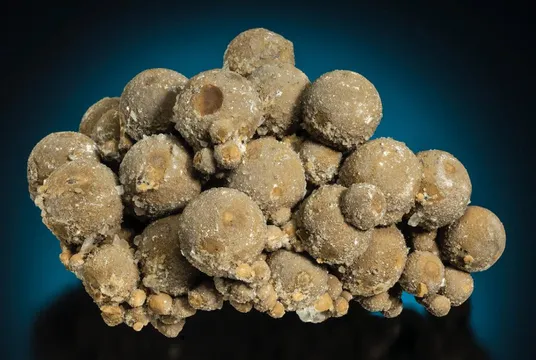
Pseudomorphs after ilvaite form a separate collecting category. Siderite or calcite may replace ilvaite while preserving the original sharp ilvaite morphology. These pieces can show tan, buff, or pale carbonate surfaces with cracks, granular texture, or preserved terminations. They should not be confused with fresh ilvaite; their value lies in replacement texture, morphology, and documented Dalnegorsk provenance.
Dalnegorsk ilvaite is available, but fine old pieces are not common. Small to mid-sized examples still appear through dealers and auctions, while highly aesthetic combinations with sharp crystals, bright luster, undamaged terminations, and clear mine-level attribution are increasingly difficult to replace. Market records show modest miniatures selling in the low hundreds of dollars and sharper, better-presented pieces reaching higher levels; dealer listings for well-crystallized Dalnegorsk ilvaite can run into the high hundreds or more depending on size, quality, and provenance.
The most common condition issues are broken terminations, rubbed prism edges, bruised quartz points, peripheral chipping, and contact damage where ilvaite crystals project from the matrix. Hedenbergite-rich matrix can be fragile, and quartz-calcite associations may have small broken points or cleavage chips that are easy to miss in photographs. A sawed base is not unusual on older Dalnegorsk display specimens and is not necessarily a defect if it is disclosed and does not compromise the specimen’s natural presentation.
Repairs should be checked for, especially where tall black crystals meet matrix or where ilvaite clusters are perched among quartz. Use strong side lighting and magnification to look for glue halos, mismatched luster at crystal bases, unnatural alignment, and broken-and-reset terminations. No well-documented Dalnegorsk-specific fake industry is established in the accessible mineralogical literature, but ordinary mineral-market problems—repairs, glued crystals, relabeled specimens, and undisclosed trimming—apply.
Authenticity is most often a locality-label issue rather than a species issue. Ilvaite from Huanggang, Serifos, Elba, Laxey, and other localities can also be black, lustrous, and prismatic. Dalnegorsk material is usually recognized by its skarn associations: quartz and calcite on hedenbergite, datolite-bearing combinations, sulfide-skarn matrix, or the distinctive Russian labels of older collections. A specimen labeled only “Russia” or “Dalnegorsk” may be perfectly correct, but mine-level precision should command a premium only when supported by reliable provenance.
Be alert to pseudomorph terminology. “Siderite after ilvaite” or “calcite after ilvaite” is not fresh ilvaite; it is a replacement specimen. Such pieces may be excellent and valuable, but they should be priced and appreciated as pseudomorphs. Natural desiccation or shrinkage cracks in carbonate pseudomorphs can be part of the replacement history, yet open fractures, glue, or stabilization should still be disclosed.
For buying, prioritize specimens with full terminations visible in multiple angles, older labels when available, and matrix associations consistent with the stated mine. A compact, undamaged miniature from 2nd Sovetskii or Bor Pit is often a better long-term collection piece than a larger but bruised cabinet specimen. For advanced collectors, the strongest Dalnegorsk suite would include at least one fresh black ilvaite-quartz-calcite combination, one hedenbergite-rich Sovetskii-style piece, and one documented carbonate pseudomorph after ilvaite.
One of the most evocative old labels is attached to a 1st Sovetskii Mine specimen recorded as collected in 1985. The piece carried a 3.0 cm sharply terminated jet-black ilvaite crystal as its focal point, with a longer 3.4 cm doubly terminated ilvaite nearby. Around them were frosted quartz points on lustrous olive-green acicular hedenbergite, the kind of busy skarn matrix that makes Dalnegorsk specimens instantly recognizable. The base had been sawed for display, and even with some peripheral wear and a few broken quartz points, the specimen was described as a fine combination example of material seldom available in that quality.
Another classic Dalnegorsk image comes from the Bor Pit: black ilvaite crystals to about one inch, white calcite clusters, colorless quartz, and massive hedenbergite beneath. The specimen measured 6.5 x 4.6 x 2.7 cm and was photographed before March 2010. Its description captures the moment when these Russian ilvaites were already becoming old classics: high-quality pieces had come out richly in the late 1980s and the 1990s, but by the time the photograph was published, that supply had largely disappeared from the market.
A quieter but highly mineralogical story is told by the siderite pseudomorphs after ilvaite from the Bor Pit. One documented example measures 10.2 x 7.4 x 6.8 cm and preserves the form of huge, sharp ilvaite crystals even though the black silicate has been replaced by tan siderite. The faces and terminations remain, but the specimen is crossed by natural fractures, probably from desiccation in the pocket. It is the kind of piece that rewards a second look: not the glossy black ilvaite most collectors first want, but a record of replacement chemistry that preserved the architecture of the original crystals.
The geology itself supplies a field image as vivid as any collecting anecdote. At Partizanskoe, skarn and ore bodies were followed underground at intervals of 35 to 70 m, down to roughly 600 m, before the system weakened and, by about 800 m depth, passed into nearly unaltered limestone. In the lower parts of the skarn column, hedenbergite, ilvaite, garnet, fluorite, quartz, and calcite occur together; upward, the assemblage changes, and in parts of the middle zone ilvaite disappears. The specimens on a collector’s shelf are therefore not random black crystals but fragments of a vertical chemical story written through hundreds of meters of skarn.