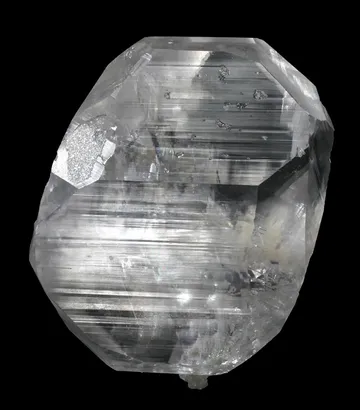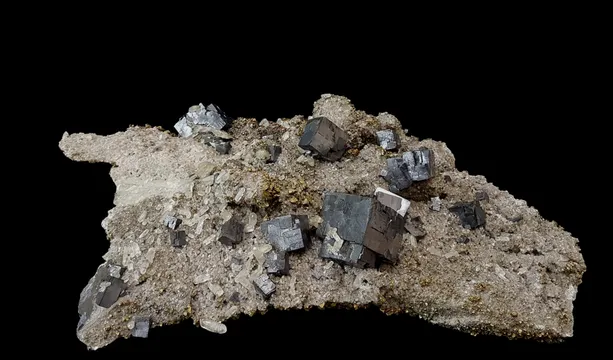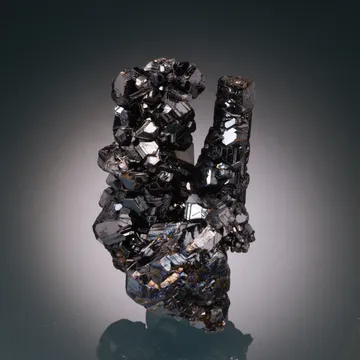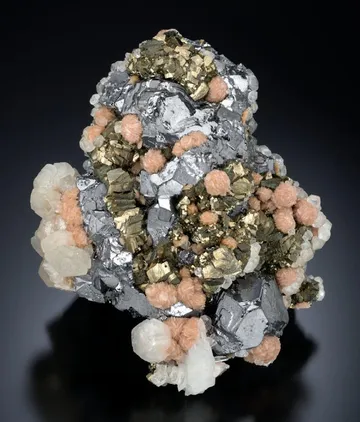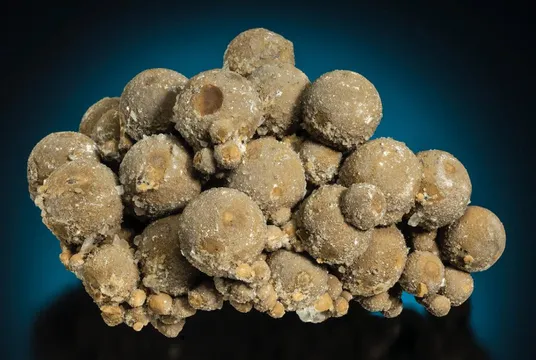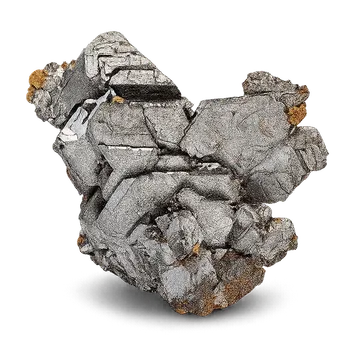
Galena — Dalnegorsk, Russia: heavy lead-gray metallic crystals with sculptural cuboctahedral faces and dramatic intergrowths; prized locality for collectors.
Key facts
Dalnegorsk galena has a look that serious collectors recognize at once: heavy, lead-gray metallic crystals with unusually sculptural geometry, often balanced against white quartz, pale calcite, dark sphalerite, pyrrhotite, chalcopyrite, fluorite, or siderite. The best pieces are not simply “cubes of galena.” They show stepped and skeletal growth, softened-looking but highly lustrous cuboctahedral faces, flattened spinel twins, pseudohexagonal outlines, and dramatic intergrowths that make the crystals appear architectural rather than merely blocky.

Photo: Wikimedia Commons / Marie-Lan Taÿ Pamart
The locality name “Dalnegorsk” is commonly used in the specimen trade for a group of mines and deposits in the Dalnegorsk ore district of Primorsky Krai, in the Sikhote-Alin Mountains of the Russian Far East. For galena, the two names a collector sees most often are the Nikolaevskiy Mine and the 2nd Sovetskii Mine at the Partizanskoe Pb-Zn deposit. Both belong to a broader district of skarn and hydrothermal polymetallic mineralization where lead, zinc, silver, boron, and associated minerals were formed in carbonate-rich rocks cut and replaced by ore-forming fluids.
The district’s galena owes much of its collector appeal to the way sulfide mineralization occupied cavities, fractures, and replacement zones rather than producing only massive ore. In the Nikolaevskiy Mine especially, solution cavities in limestone gave hot sulfide-bearing fluids room to grow freestanding crystals. That is why Dalnegorsk galena can show unusually complete, displayable crystals rather than broken ore fragments. At Partizanskoe, the mineralogical literature records a zoned skarn system in which galena and sphalerite proportions vary with depth and stage of mineralization, giving the district a richer geochemical story than the hand specimen alone suggests.

Photo: Wikimedia Commons / Robert M. Lavinsky
Historically, Dalnegorsk became one of the great modern mineral localities when Russian specimens began reaching Western collectors in quantity in the late Soviet and early post-Soviet years. The excitement was not just political access; the material itself was startling. Collectors saw Russian sulfides with mirror-bright faces, complicated twinning, quartz accents, and “old classic” cabinet presence almost as soon as they entered the market. Fine 1980s and 1990s galenas from Nikolaevskiy and the Sovietskii mines still carry that aura today.
For the collector, the ideal Dalnegorsk galena has sharp or strongly sculptural form, a bright metallic surface rather than dull gray abrasion, attractive association, and a believable mine attribution. A single spinel-twinned crystal on quartz can be as desirable as a larger cluster if it has strong geometry and good placement. Conversely, a large heavy piece loses much of its value if the edges are bruised, the luster is rubbed, or the specimen lacks three-dimensional display.
Search for specimens: View all galena specimens from Dalnegorsk, Russia
Dalnegorsk lies in Primorsky Krai in Russia’s Far East, in mountainous country of the southern Sikhote-Alin. In mineral collecting usage, “Dalnegorsk” is a district-level label rather than a single pocket or mine. The name has appeared historically in several spellings and forms, including Dal’negorsk, Tetyukhe, Tjetjuche, and Tetjuche, and older specimen labels may use one of these variants.
The principal collector localities for galena include the Nikolaevskiy Mine, the 2nd Sovetskii Mine at the Partizanskoe Pb-Zn deposit, and the 1st Sovetskii Mine. Nikolaevskiy is one of the district’s most important modern sulfide specimen sources. It is recorded at roughly 44°35′N, 135°40′E and opened in 1982. Mindat characterizes it as one of the world’s premier localities for crystallized sulfides, specifically noting that solution cavities in limestones gave hot sulfide solutions space to crystallize. The 2nd Sovetskii Mine, also known as the Second Sovietsky, 2nd Sovietskiy, Vtoroi Sovietskiy, or 2nd Sovietskii Mine, is part of the Partizanskoe Pb-Zn deposit and is recorded at roughly 44°32′53″N, 135°33′51″E. Its Russian name is Второй Советский рудник.
The ore district is fundamentally a skarn-polymetallic and hydrothermal system. In the Partizansky deposit, ore-hosting rocks include a terrigenous olistostrome complex with blocks and sheets of sandstone, siltstone, and Triassic limestone. Skarn orebodies occur along contacts of limestone with siltstone and sandstone, and their position is controlled by faults. The Partizansky literature describes two broad stages of mineralization: an earlier base-metal skarn stage and a later silver-sulfosalt stage. The productive galena-sphalerite assemblage came after quartz-arsenopyrite mineralization and filled fractures, cemented brecciated arsenopyrite, and formed a vertically zoned Pb-Zn system.
That vertical zoning matters because it explains why Dalnegorsk galena is more than a pretty crystal. In the Partizansky deposit, the Pb/Zn ratio changes upward through the orebodies; deeper zones are more sphalerite-rich, while middle and upper zones carry more galena and sphalerite together. The literature records galena at some deeper levels enriched in bismuth and silver, while upper-level galena may be nearly free of those isomorphic admixtures. Later silver-sulfosalt assemblages introduced minerals such as pyrargyrite, stephanite, acanthite, freibergite, and related Ag-Pb-Sb phases in and around galena and chalcopyrite.
The broader Dalnegorsk mining history begins long before the famous collector specimens. The enterprise now associated with Dalpolimetall traces its history to April 2, 1897, when the rich silver-lead-zinc Verkhnee deposit in the Tetyukhe, now Rudnaya, valley was staked by Yuliy Ivanovich Briner. Industrial exploitation of Verkhnee began in 1907, and the first lead concentrate from the enrichment plant was produced in June 1914. The 1st Sovetskii Mine was established on the Nizhnee deposit in 1949, the Partizanskoe deposit and 2nd Sovetskii Mine began in 1950, and the Nikolaevskoye deposit was brought into operation in 1982 with shafts described in the company history as more than 800 meters deep.
Today the district is not a public collecting ground in the casual sense. These are industrial mines and hazardous workings, and collector specimens generally reach the market through miners, mine-related recovery, dealer networks, old collections, or secondary sales rather than casual field collecting. Mine access requires permission from the operator and attention to industrial safety, ownership, and local regulations. Specimens with precise mine attribution, old labels, or documentation from reputable dealers are especially valuable because “Dalnegorsk” can be used broadly in trade and the individual mine name is often lost.
Notable finds span several specimen generations. The classic early material from the 1980s and 1990s includes spinel-twinned and pseudohexagonal galena crystals with sphalerite, quartz, and calcite. Later and current market examples continue to show cuboctahedral galena with sphalerite, chalcopyrite, siderite, dolomite, calcite, and fluorite. Fine pieces from old collections, especially Desmond Sacco, Philippe Morelon, Dr. Erika Pohl-Ströher, and other documented collections, are particularly prized because they link a specimen to the period when Dalnegorsk first transformed Western expectations for Russian sulfide specimens.
Dalnegorsk galena is most admired for crystal form. The Nikolaevskiy material is especially known for lustrous, aesthetic crystals described on Mindat as “melted cubes with octahedral modifications and flattened spinel twins to several cm.” That phrase captures the locality well: the crystals are often cubic in ancestry, but their faces are modified, stepped, twinned, skeletal, or apparently softened by growth and dissolution textures. Instead of the simple sharp cubes familiar from many Mississippi Valley or European lead-zinc deposits, Dalnegorsk pieces frequently show cuboctahedra, flattened spinel twins, bladed twins, pseudohexagonal plates, and composite clusters with multiple growth generations.
Color is the expected lead-gray to bright silver-gray of galena, but surface quality varies enormously. The best specimens show a high metallic luster that flashes in display lighting. Some faces are mirrorlike; others show fine growth striations, etched-looking recesses, or stepped terraces. Lower-grade pieces may be dull, darkened, or abraded, especially where heavy galena crystals were bruised during mining, transport, or handling.
Crystal size ranges from small matrix crystals of a centimeter or less to several-centimeter individuals, and cabinet specimens can carry multiple galena crystals on broad quartz, calcite, sphalerite, or mixed sulfide matrix. Verified examples include a Dalnegorsk specimen measuring 83 × 81 mm with galena crystals to 37 mm on quartz and disc-shaped calcite, a 12.7 × 8.0 × 6.8 cm cabinet piece of galena with snow-white quartz from Nikolaevskiy, and market examples of 6–14 cm specimens with spinel twins, sphalerite, quartz, fluorite, and calcite. Large museum-scale groups exist, but undamaged heavy Dalnegorsk galenas in that size class are much less common than smaller cabinet and small-cabinet specimens.
Associations are a major part of the locality’s appeal. Typical galena companions from Nikolaevskiy include quartz, pyrrhotite, sphalerite including marmatite, chalcopyrite, calcite, siderite, fluorite, pyrite, tetrahedrite-group minerals, arsenopyrite, dolomite, hedenbergite, and marcasite. At the 2nd Sovetskii Mine, the verified mineral list includes galena with calcite, manganese-bearing calcite, chalcopyrite, dolomite, fluorite, hedenbergite, ilvaite, pyrite, pyrrhotite, quartz, and sphalerite, along with boron-bearing skarn minerals such as datolite and axinite-(Mn). These associations are useful for authenticity: a Dalnegorsk galena with lustrous black sphalerite, white quartz, pale calcite, pyrrhotite, chalcopyrite, or fluorite is much more believable than a galena crystal perched on an unrelated matrix.
Quality is judged by a combination of form, luster, association, balance, and preservation. The finest Dalnegorsk pieces have a strong central crystal or rhythmic cluster, visible twinning or cuboctahedral modification, clean metallic luster, and a contrasting matrix. Quartz adds brightness; calcite and siderite add texture; sphalerite gives dark mass and depth; fluorite can elevate a specimen dramatically when present as clean colorless or pale green cubes. Damage matters strongly because galena is soft, heavy, and cleaves easily. A specimen can have excellent crystals yet lose collector rank if the prominent corners are bruised or the surface has been rubbed.
The best-known habits include:
For advanced collectors, mine attribution can influence desirability. Nikolaevskiy is strongly associated with classic crystallized sulfide specimens, including spinel-twinned galena with quartz and sphalerite. The 2nd Sovetskii Mine is particularly important for Partizanskoe material and is also famous in its own right for fluorite, sphalerite, calcite, and galena-bearing combinations. A label that simply says “Dalnegorsk” is acceptable for many older pieces, but a label that names Nikolaevskiy, 2nd Sovetskii, or 1st Sovetskii gives the specimen better mineralogical context.
The most common authenticity issue is not fake Dalnegorsk galena itself, but vague or inflated locality attribution. “Dalnegorsk” is a famous name, and some older labels use it broadly even when the exact mine is unknown. That is not automatically a problem, but the buyer should distinguish between a district-level label and a mine-specific attribution. If a seller claims Nikolaevskiy, 2nd Sovetskii, or 1st Sovetskii, the specimen should match known habits and associations from that mine and ideally carry an old label, dealer documentation, or a credible chain of ownership.
No well-documented, locality-specific industry of fake Dalnegorsk galena has emerged in the way that some other mineral scams have become notorious. Still, general galena fakes exist. The best-known are artificial “galena geodes,” often made from a fabricated or altered cavity lined with crushed galena, metallic coatings, paint, gypsum, glue, or cement. These should not be confused with Dalnegorsk matrix specimens. Natural Dalnegorsk galena grows as crystals in skarn and hydrothermal cavities or on mineral matrix; it is not sold as a hollow geode lined with loose metallic glitter.
Repairs and stabilization are more plausible concerns than outright fabrication. Galena is soft, dense, and has perfect cubic cleavage, so it breaks and bruises easily. Large crystals may have cleaved edges, contacted backs, glued repairs, or chips disguised by orientation. Heavy Dalnegorsk pieces that traveled from mine to dealer to show table often accumulated corner wear. Examine high points, cube edges, spinel-twin terminations, and the bases of crystals for glue, unnatural joins, or mismatched matrix. A repaired but honest specimen can still be collectible; an undisclosed composite should be priced and described accordingly.
Surface condition is crucial. Bright Dalnegorsk galena can be spectacular, but surfaces may tarnish, dull, or show gray rubbing if mishandled. Avoid aggressive cleaning. Water, acids, ultrasonic cleaners, and abrasive brushing can all create problems depending on the matrix and associated minerals. Pyrrhotite- or marcasite-bearing pieces should be kept dry and stable. If white calcite or quartz druse is present, dust removal should be gentle; a soft brush or air bulb is preferable to wet cleaning unless the specimen has been evaluated carefully.
Rarity is best understood by quality tier. Ordinary Dalnegorsk galena and galena-bearing sulfide matrix pieces remain available on the market. Attractive small-cabinet pieces with good luster and recognizable association are obtainable but not common. Fine, undamaged spinel-twinned or cuboctahedral crystals from the classic 1980s–1990s production are much scarcer, especially with old labels. Large, sculptural, damage-free cabinet specimens with quartz, calcite, fluorite, or sphalerite are increasingly difficult to replace.
Market availability is a mixture of old stock, recycled collections, auction material, and occasional newer offerings. Recent dealer and auction listings show a wide spread: modest small-cabinet specimens, high-quality spinel-twinned pieces, and large cabinet examples with sphalerite, chalcopyrite, siderite, calcite, or fluorite. Provenance adds value. Labels from established dealers, auction records, and noted collections can be more than paperwork; they may be the only way to separate a specific Nikolaevskiy or 2nd Sovetskii identity from a generic Dalnegorsk district attribution.
The Dalnegorsk story begins with ore, not display cases. On April 2, 1897, Yuliy Ivanovich Briner staked the rich silver-lead-zinc deposit in the Tetyukhe, now Rudnaya, valley and named it Verkhnee. Four mining allotments were formalized in 1902 at the site of the future Verkhniy Mine, and in that year miners extracted the first 97 tons of ore. Industrial exploitation began in 1907, and by 1909 the Tetyukhe joint-stock mining enterprise had been formed with Russian, German, and English capital. From 1911 to 1916, more than 100,000 tons of ore were mined from Verkhnee, much of it secondary calamine ore from near-surface bodies, shipped by sea to England for processing.
The concentrating plant became the district’s engine. Construction by the German firm Humboldt began in 1912, and the first lead concentrate was produced in June 1914. At that time the plant’s capacity was 8 tons of ore per hour. Decades later, the plant had been rebuilt repeatedly as mining expanded from near-surface oxidized ore into primary lead-zinc sulfides. The 1963 reconstruction, designed by Sibtsvetmetniiproekt, was one of the key modernizations; later improvements included a new tailings facility and circulating-water system in 1978, a new crushing section in 1979, and a 1986 grinding-section reconstruction that increased plant capacity by 30% within the same production space.
The Soviet mine names on specimen labels are milestones in the district’s industrial growth. The Nizhnee deposit began operation in 1949 and became the 1st Sovetskii Mine. The Partizanskoe deposit began in 1950 and became the 2nd Sovetskii Mine, a name that now appears on labels for galena, sphalerite, fluorite, calcite, and mixed sulfide specimens. In 1982 the Nikolaevskoye deposit entered operation with shafts described in the Dalpolimetall history as more than 800 meters deep, the deepest in the Russian Far East. For collectors, that 1982 date is more than corporate chronology: it marks the opening of one of the most important modern sources of crystallized sulfides from Russia.
The moment Dalnegorsk entered Western collecting memory came in the late 1980s and 1990s. Auction descriptions and dealer records repeatedly describe those specimens as “old Russian classic” material from the first great wave of exports. MineralAuctions characterized a spinel-twinned Nikolaevskiy galena as one of the “GREAT CLASSICS” of 1980s–1990s Russian mineral mining and noted that Dalnegorsk specimens were “shocking to collectors” when they first appeared on Western markets in the late 1980s. The word fits. Collectors accustomed to seeing Russian minerals mainly through old institutional labels suddenly encountered bright, sculptural sulfides: galena twins on quartz, glossy black sphalerite, pyrrhotite rosettes, fluorite, calcite, and combinations that felt both industrial and elegant.
One of the most vivid modern collector stories comes from Vladimir Kuvshinov, a Dalnegorsk-born mineral dealer and collector who has supplied Dalnegorsk minerals since 1982. Writing about a 36.7 × 19.5 × 17.7 cm, 6.5 kg specimen of optical fluorite with galena, chalcopyrite, pyrrhotite, and quartz from the Nikolaevsky Mine, he described it as mined in the early 1980s and bought by him in 1989. He kept it in his own collection for decades, reluctant to sell, and wrote that only a few people had seen it in person. His account is valuable not only because of the superlatives, but because it captures the collector reality of Dalnegorsk: some of the finest pieces were not steadily available commercial stock, but singular specimens held privately for decades after the first great period of mining and export.