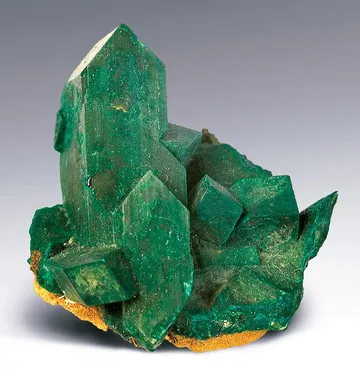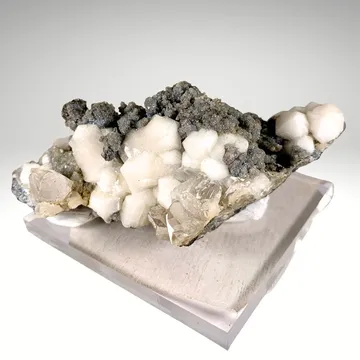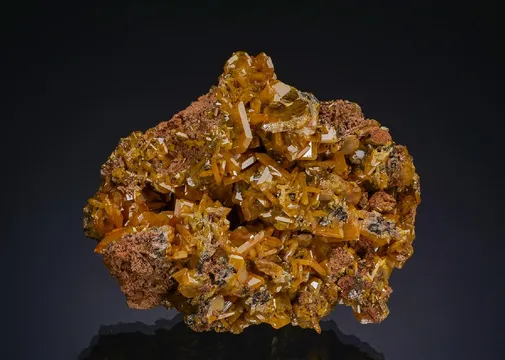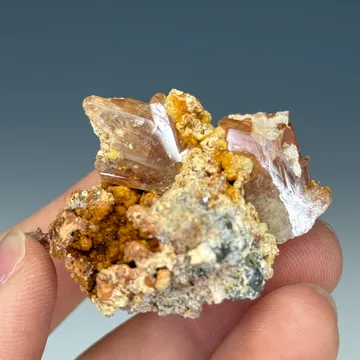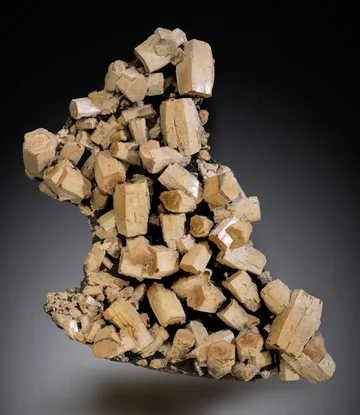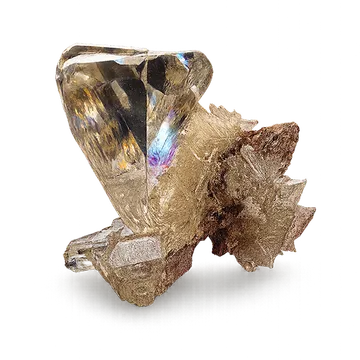
モロッコ、トゥイシット産のセレシサイト: 鈍く光るPbCO3結晶に鋭いV型ツインと煙色の琥珀色、見た目・産地・コレクター価値の点で際立つ。
Key facts
Touissit cerussite is one of the great Moroccan expressions of PbCO3: heavy, glassy, sharply twinned, and often unexpectedly elegant for a mineral born in the oxidized skin of a lead-zinc orebody. The classic pieces are colorless to smoky, amber, honey, or pale brown V-twins and cyclic twins, with bright adamantine luster flashing across strongly striated faces. Good examples have the visual contradiction collectors love in cerussite: a crystal that looks delicate and ice-like, yet feels startlingly dense in the hand.

Photo: Wikimedia Commons
The locality belongs to the Touissit-Bou Beker district of far eastern Morocco, a carbonate-hosted Mississippi Valley-type lead-zinc system close to the Algerian border. Primary galena and sphalerite mineralization was emplaced in dolomitic Jurassic strata by warm saline fluids; later weathering transformed parts of the ore into a remarkable suite of secondary minerals. That oxidized mineralogy is what made the district legendary to collectors: cerussite, anglesite, azurite, malachite, smithsonite, vanadinite, wulfenite, phosgenite, nadorite, paralaurionite, and related lead-copper-zinc species all came from the same broad mining belt.

Photo: Wikimedia Commons
The great appeal of Touissit cerussite is not simply that the crystals are attractive. It is that they belong to a locality with a recognizable personality. Touissit twins commonly show balanced V forms, sharp blade-like or prismatic arms, glassy to resinous faces, and smoky internal color. Some are free-standing off matrix; others are perched on galena, iron oxide-rich gossan, dolomite, smithsonite, or associated with yellow anglesite, blue azurite, and green malachite. The finest specimens combine crisp geometry, high transparency, and minimal edge wear, a demanding combination because cerussite is both soft and brittle.
Historically, Touissit’s collector fame arrived late relative to its mining history. The district had been mined for decades before the late 1970s and early 1980s brought world-class secondary mineral specimens to the international market. Since the main industrial mining era ended in 2002, the supply of top cerussite has shifted heavily toward old collections, estate dispersals, and the occasional piece from small-scale or residual production. For serious collectors, a pristine Touissit V-twin with strong luster and documented older provenance remains a classic Moroccan cabinet mineral.## 注目 specimen
Search for specimens: View all cerussite specimens from Touissit, Morocco
Touissit is part of the Touissit-Bou Beker mining district in Jerada Province, Oriental Region, northeastern Morocco. The district lies near the Moroccan-Algerian border, roughly south of Oujda, and is commonly treated by mineral collectors as a family of related localities: Mekta, Beddiane, Touissit, Bou Beker, and, across the border, El Abed in Algeria. Specimen labels may therefore read simply “Touissit,” “Touissit-Bou Beker,” “Bou Beker,” “Beddiane,” “Puits IX,” or “Puits XII,” and careful collectors pay attention to old labels rather than assuming all pieces came from the same shaft.
Geologically, this is a carbonate-hosted Mississippi Valley-type Pb-Zn district developed in dolomitized Jurassic carbonate rocks. The mineralization occurs as stratabound replacement bodies, veins, and mineralized breccias, with ore filling and replacing broken dolostone. The hypogene ore assemblage is dominated by galena and sphalerite, with pyrite or marcasite and lesser copper minerals. The later oxidized zone produced the collector minerals. Cerussite formed where lead released from galena reacted in carbonate-rich, oxygenated environments; anglesite formed in related sulfate-bearing settings, and both species may appear together along fractures and grain boundaries in altered galena.
The supergene story at Touissit is especially important for understanding its cerussite. Research on the district distinguishes an earlier earthy or stony cerussite associated with replacement of galena and host rock, and a later crystal generation that lines vugs, fractures, and remnant pore spaces. For collectors, the second style is the important one: transparent to translucent euhedral crystals, commonly several centimeters across, in drusy cavities within or near massive galena bodies. Some crystallized cerussite occurred down to depths on the order of 150 meters, showing that these were not merely shallow surface crusts but part of a deep, structurally guided oxidation system.
Mining began in the early twentieth century and became a major lead-zinc-silver operation. The district’s long production history culminated in industrial mining by Compagnie Minière de Touissit and related operators; mining ceased in 2002 after depletion of economic reserves. Total district production is reported on the order of tens of millions of tonnes of ore with significant lead, zinc, copper, and silver grades. After closure, only small-scale residual activity and artisanal production remained.今日の収集者アクセスは、限定的で潜在的に危険であると見なすべきです。
ここは放棄された坑道、廃鉱置き場、改変された地盤を伴う古い地下鉱山地域であり、気軽なレクリエーション採集地ではありません。
収集者にとって実際の情報源は標本市場であり、特に古い欧州およびモロッコのコレクション、ディーラー在庫、1970年代から1990年代にラベルが付された標本です。
Touissit の「華々しい時代」の標本――特に1970年代後半から1980年代初頭の材料――は、品質の面だけでなく、その地域が世界有数の二次鉛鉱物産地の第一級へ入った時代を代表するものとして価値が高いと評価されています。## Touissit, モロッコ産セリサイトの特徴
Signature Touissit habit is the V-twin: two lustrous prismatic or bladed individuals meeting at an angle to form a sharp, architectural pair. Balanced twins are the classic look, but uneven twins, cyclic twins, paired twins, and multi-twinned groups also occur. Some specimens show two or more twinned pairs joined together, while cabinet specimens may display sprays, fan-like clusters, or “flower-like” groups of multiply twinned crystals on iron oxide-rich matrix.
カラー ranges from water-clear and white through pale gray, tan, smoky brown, amber, and honey. The most desirable crystals are transparent to strongly translucent, with bright adamantine or resinous luster and crisp edge definition. Striated faces are typical and can give the crystals a silky internal shimmer when turned under a light. Smoky, gemmy V-twins from the older finds are among the most recognizable Touissit cerussites.
Typical collectible crystals are in the 2–6 cm range. Fine thumbnails and miniatures may be entirely off matrix, showing complete V-twins or compact groups. Small cabinet pieces with major crystals around 5–6 cm are highly desirable, especially when balanced and undamaged. Larger examples exist, including unusually robust multi-twinned groups and cabinet specimens with crystals approaching or exceeding 8 cm, but these are not routine and should be judged critically for repair, contact, and provenance.
Associated minerals are a major part of the Touissit identity. Galena is the key primary lead mineral and is a natural matrix for cerussite. Anglesite is one of the most important companions, sometimes appearing as yellow crystals with small brown or colorless cerussite. Malachite and azurite provide strong color contrast, especially on pieces from the broader Touissit-Bou Beker district. Dolomite, smithsonite, sphalerite, baryte, wulfenite, and iron oxides also occur in association. The best matrix pieces use those associations visually: glassy cerussite on dark galena, pale twins against rusty gossan, or colorless cerussite interrupting blue azurite and green malachite.
Quality is determined by geometry, luster, transparency, completeness, and condition. A top Touissit cerussite should have sharply developed twin form, undulled faces, and minimal bruising on terminations and twin edges. Internal clarity matters, but a smoky or amber crystal can be just as desirable as a colorless one if it is lustrous and architectural. Matrix examples are scarcer in elite condition because extraction, trimming, and transport are harder on fragile lead carbonate crystals. Free-standing V-twins are more common on the market, but fine matrix pieces with crystals properly elevated and visually balanced can be more compelling.## Collectors Notes
Touissit cerussite is not a rare species occurrence, but fine Touissit cerussite is a selective purchase. Many examples show chips, bruised terminations, cleaved edges, dulling, or contact areas where crystals were attached to the pocket wall. The mineral is soft, brittle, and dense; a specimen may survive decades in a collection and still be vulnerable to a single careless handling event. Always examine twin junctions, terminations, exposed blade edges, and any point where a crystal meets matrix.
Repairs should be expected often enough to inspect for them, especially on larger V-twins and matrix pieces. A clean repair across a twin junction can be difficult to see without magnification because cerussite’s high luster and strong internal reflections can mask glue lines. Check for mismatched luster, tiny bubbles, unnatural alignment, or a glossy film in protected recesses. Old collection pieces may be perfectly legitimate and still have stabilization or repair; the issue is disclosure.
Locality accuracy is another concern. “Morocco cerussite” is not enough. Mibladen, Touissit, Bou Beker, Beddiane, and other Moroccan lead districts have distinct collecting histories and appearances. Mibladen cerussite is famously associated with red to pink bladed baryte, whereas Touissit is especially known for smoky or colorless V-twins, cyclic twins, and associations with galena, anglesite, azurite, malachite, smithsonite, and iron oxides. Because labels have long been simplified by dealers, older handwritten labels, dealer tags, and collection numbers add real value.
A specific caution concerns lead oxides reported with Touissit cerussite. Modern paragenetic summaries for the district do not emphasize natural massicot or minium in the Touissit-Bou Beker sequence, and early goethite is abundant. Bright yellow-orange or reddish earthy material beneath or near cerussite should not automatically be accepted as massicot, minium, or another lead oxide without analysis. On valuable pieces, analytical confirmation is preferable to a romantic label.
Cleaning should be conservative. Cerussite reacts with acids and is easily damaged by aggressive chemical treatment. Avoid acid cleaning, ultrasonic cleaning, and sudden thermal shock. Display lighting should be cool and moderate; the mineral’s brittleness and possible sensitivity to temperature extremes make hot lamps and freezing storage poor choices. A stable acrylic base is often sensible for off-matrix twins, but mounting should avoid adhesives on important crystal surfaces.市場の流通状況は不均一です。低価格の小さめツインや控えめなマトリックス結晶は定期的に現れますが、古いTouissitの標本のトップ級はもはや豊富ではありません。最近の公開リストやオークションはこのレンジを示しています:小さなキャビネット級のV字ツインや古い単結晶は数百ドルで売れることがあり、巨大なマトリックス搭載品や異様に美しいキャビネット級ピースは千ドル前後の価格がつくことがあります。最も高値がつくのは、傷のない新旧の産地情報を持ち、サイズが珍しく、マトリックスの存在感が優れているツインです。## ストーリーとフィールドノート
Touissit は長い作業人生の大半を、まず鉱石地区として、次にコレクターの locality として知られてきました。 鉱山は鉛、亜鉛、銀、銅の採掘を目的として開かれたもので、後にこの地区を有名にした標本は、はるか昔の地質学的プロセスの二次産物で、産業鉱山の酸化ポケットや割れ目に潜んでいました。 それが Touissit の Cerussite の魅力の一部です:結晶は絵のようなアルプスの裂き目で見つかったのではなく、ガレナが砕かれ、運ばれ、加工されていたモロッコの鉛亜鉛操業の硬い幾何学の中に隠れていました。
転機は1970年代後半に訪れました。 その時点では堆積物はすでに何十年も採掘されていましたが、コレクターは「Touissit」という鉱山名を鉱物学的形容詞へと変える素材を目にするようになりました。 この地区は世界クラスのアズライト、アンゲライト、セリュシット、ヴァンダナイト、ウルフェナイトのほか、稀少な鉛系鉱物も産出するようになり、専門家の注目を集めました。 これらの発見から生まれた煙のようなV字型のセリュシットは、いまもその時代を形の中に残しています:周囲は完全、縞模様が濃く、ガラス質で自己完結しており、鉱石鉱物よりも完成された彫刻のように見える結晶です。
一つの標本の道が1995年のジョルディ・ファブレとモロッコへとつながります。 ファブレは自分の複製コレクションからのTouissit のガレナ付きセリュシットを循環双晶として描写し、サイズは6.3 × 5 × 4.8 cm、主晶は5.2 × 5 cmでした。 彼のノートには、多くのコレクターが最高の Touissit 材料に認めるものが記録されています:この地区はガレナ鉱山でしたが、二次の鉛鉱物は意外にも「きれい」に見えることがあり、特別な優雅さを帯びていました。 それはコレクターの示唆に満ちた観察です。 Touissit のセリュシットはしばしば乱雑な鉱石標本でなく、最良のときには、ひとつの自立した結晶体のような風格を持ち、ガレナに根ざしていてもそう見えます。
別の小さな時代のカプセルは Carles Curto の複製番号 1989.32: Touissit 産のアズライトとマラカイト、セリュシットを含む標本で、1989年頃の日付が付いています。 この標本は、一対の二重終端のアズライト結晶として描写され、片方は完全にマラカイトに偽装され、空気感のある展示に配置され、セリュシット結晶が部分的に覆われていました。 これはセリュシットだけの標本ではありませんが、最も輝かしい時代における Touissit のコレクターニーズを完璧に呼び起こします:青、緑、無色の二次鉱物が単一の彫刻的对象として相互に連結され、酸化帯の化学が visible に示されています。
後の市場ストーリーは、出所の影響が認識をいかに強く形作るかを示しています。 リチャード“リッチ”A. Kosnar のコレクションにあった 6.1 × 3.3 × 2.1 cm の Touissit の異例のV字型双晶は、1970年代後半から1980年代初頭頃に採掘されたと描写されました。 Touissit から期待される均整の取れたV形ではなく、ひとつの支配的な煙状の黄金色の結晶と、それからはみ出す小さな結晶が広がることで、アンバランスな双晶となっていました。 この作品は鉱物学的な関心と人の出所の両方を示しており、Kosnar は有名なコロラドのディーラー兼コレクターであり、希少なジルコニウムリン酸塩の kosnarite は彼にちなみ名づけられました。さらに珍しいことに、Bob Wernerコレクションの cabinetサイズの多重結晶 Touissit group が公市場へ出回り、最大クリスタルは10.1 cmと報告されました。これはどの産地の方解石としても大きく、特にTouissitでは3–6 cmの結晶が標準的な収集家向け品であることを考えると、印象的です。 Werner自身は深いルーツを持つコレクターで、彼は9歳のときの1946年に鉱物の収集を始め、地質学、鉱山工学、地球化学を学び、後に広範なコレクションの一部を分類・分散させました。そのような標本では、ポケットの晶体だけでなく、何十年にもわたる収集・ラベリング・保管・そして再発見の物語が、古いTouissit材料が再び姿を現すのを可能にしています。## 鉱物学的記録と出版物
Rainer Bode and Steffen Jahn, “The Touissit-Bou Beker mining district, Morocco,” The Mineralogical Record, 44(6), 595–651, 2013 — その地区と二次鉱物群に対する現代のコレクター志向の主要な解説。
Eric Asselborn, “Cerussit-Zwillinge,” Lapis, 8(11), 31–32, 1983 — Touissitのセリュサイト産出記録に引用され、セリュサイトのツインに焦点を合わせている。
Vandall T. King and George W. Robinson, “What’s New in Minerals? — Sixteenth Annual Rochester Academy of Science Mineralogical Symposium,” The Mineralogical Record, 20(5), 387–399, 1989 — Touissitのセリュサイトおよび関連二次鉱物について引用。
Mohammed Bouabdellah et al., “Origin of the Moroccan Touissit-Bou Beker and Jbel Bou Dahar Supergene Non-Sulfide Biomineralization and Its Relevance to Microbiological Activity, Late Miocene Uplift and Climate Changes,” Minerals, 11(4), 401, 2021 — セリュサイト、アングレサイト、スミスソナイト、アズライト、マラカイトを生産した超生ジネ鉱化に関する現代の詳細研究。
S. Makhoukhi, J. M. Schmitt, M. Bouabdelli, A. Bastoul, and Ch. Marignac, “Modelling of an MVT deposit: Touissit-Bou Beker district (eastern Morocco),” Journal of Geochemical Exploration, 69–70, 109–113, 2000 — 後期酸化鉱物の下にある熱水性MVT系の地質モデル。
Jacques Claveau, Jean Paulhac, and Jean Pellerin, “The lead and zinc deposits of the Bou Beker-Touissit area, eastern French Morocco,” Economic Geology, 47(5), 481, 1952 — 地区初期の経済地質学的参考文献。
Mindat cerussite occurrence record for Touissit — 出現記録と引用文献、関連鉱物写真データ、局所階層。
Mindat Touissit-Bou Beker district record — 地域規模の鉱物リスト、地質、産出要約、座標、および局所関係。## Videos & Media
「Touissit, Oriental Region, Morocco」からのセリウス石とガレナ — Fabre Minerals, Vimeo — Jordi Fabre の重複コレクションからのガレナ上の周期的双晶セリウス石の動画
「Touissit, Touissit District, Morocco」からの青綿雲母とセリウス石 — Fabre Minerals, Vimeo — セリウス石結晶に partly covered by cerussite の古典的 Touissit 青銅鉱物標本の回転動画
「JHG5113 Cerussite Touissit Morocco」— Crystal Classics, Vimeo — 手に取って/展示回転する Touissit セリウス石標本を示すディーラー動画
「Cerussite, Shaft XII, Touissit, Morocco」— Minerals & Crystals — Shaft XII に attributed された明るい自動対称性のセリウス石結晶の動画つき標本ページ
「Cerussite on anglesite and galena — Touissit, Morocco」— Exposants Confines — アンギュレサイトとガレナに関連するセリウス石のアーカイブドディーラーメディアページ## さらなる読書と外部リンク
Mindat: Touissit産のクリソセライト — 発生データ、関連鉱物、参考文献、写真記録の最良の出発点。
Mindat: Touissitの産地ページ — Touissit本体の産地規模の鉱物リスト。
Mindat: Touissit-Bou Beker鉱区 — より広い鉱区の地質、産出の歴史、鉱物在庫。
Wikimedia Commons: Cerussite-221060.jpg — 古典的な古い発見からの、煙色V字ペアリングを持つ Touissit クリソセライトの自由ライセンス画像。
Wikimedia Commons: Touissit の鉱物 — クリソセライト、ガンサイト、青石綠輝石(アズライト)など、Touissit関連鉱物の画像カテゴリ。
Bouabdellah ら 2021年、『 Minerals 』 — Touissit-Bou Beker超生地の非硫化物鉱化に関するオープンアクセスの科学論文。
Makhoukhi ら 2000年、『Geochemical Exploration Journal』 — Touissit-Bou BekerのMVT鉱床モデルの要約と文献情報ページ。
Bode and Jahn 2013年、『The Mineralogical Record』掲載 — 産地のコレクター向け刊行記録と要約。
Mindat: Best Minerals — Cerussite — Touissitを含む近隣モロッコ産地を含む、クリソセライトの比較コレクター向け概要。
Mineral Auctions: Touissit クリソセライトの珍しいツイン — Rich Kosnarの由来を持つ、古い煙色-金色の Touissit V字ツインの市場例。
Mineral Auctions: Touissit 大型の多重結晶クリソセライト群 — 異常に大きな Touissit クリソセライト群を記録した市場例。
EarthWonders Touissit クリソセライト標本アーカイブ — ファン状の噴出構造を持つ、マトリクス付きTouissit クリソセライトの市場例。