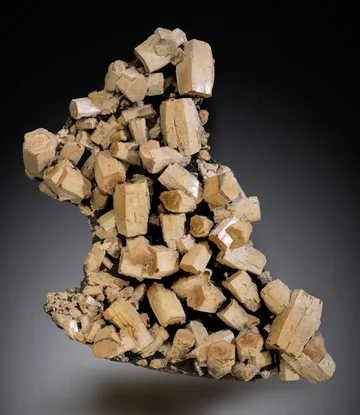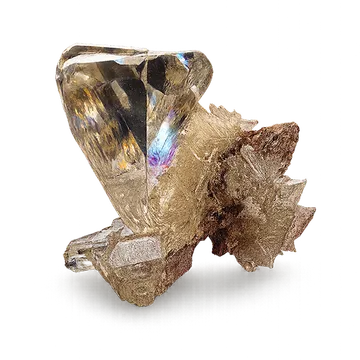
Cerussite from Touissit, Morocco: glassy PbCO3 crystals with sharp V-twins and smoky amber colors; a standout for appearance, locality, and collector value.
Key facts
Touissit cerussite is one of the great Moroccan expressions of PbCO3: heavy, glassy, sharply twinned, and often unexpectedly elegant for a mineral born in the oxidized skin of a lead-zinc orebody. The classic pieces are colorless to smoky, amber, honey, or pale brown V-twins and cyclic twins, with bright adamantine luster flashing across strongly striated faces. Good examples have the visual contradiction collectors love in cerussite: a crystal that looks delicate and ice-like, yet feels startlingly dense in the hand.

Photo: Wikimedia Commons
The locality belongs to the Touissit-Bou Beker district of far eastern Morocco, a carbonate-hosted Mississippi Valley-type lead-zinc system close to the Algerian border. Primary galena and sphalerite mineralization was emplaced in dolomitic Jurassic strata by warm saline fluids; later weathering transformed parts of the ore into a remarkable suite of secondary minerals. That oxidized mineralogy is what made the district legendary to collectors: cerussite, anglesite, azurite, malachite, smithsonite, vanadinite, wulfenite, phosgenite, nadorite, paralaurionite, and related lead-copper-zinc species all came from the same broad mining belt.

Photo: Wikimedia Commons
The great appeal of Touissit cerussite is not simply that the crystals are attractive. It is that they belong to a locality with a recognizable personality. Touissit twins commonly show balanced V forms, sharp blade-like or prismatic arms, glassy to resinous faces, and smoky internal color. Some are free-standing off matrix; others are perched on galena, iron oxide-rich gossan, dolomite, smithsonite, or associated with yellow anglesite, blue azurite, and green malachite. The finest specimens combine crisp geometry, high transparency, and minimal edge wear, a demanding combination because cerussite is both soft and brittle.
Historically, Touissit’s collector fame arrived late relative to its mining history. The district had been mined for decades before the late 1970s and early 1980s brought world-class secondary mineral specimens to the international market. Since the main industrial mining era ended in 2002, the supply of top cerussite has shifted heavily toward old collections, estate dispersals, and the occasional piece from small-scale or residual production. For serious collectors, a pristine Touissit V-twin with strong luster and documented older provenance remains a classic Moroccan cabinet mineral.
Search for specimens: View all cerussite specimens from Touissit, Morocco
Touissit is part of the Touissit-Bou Beker mining district in Jerada Province, Oriental Region, northeastern Morocco. The district lies near the Moroccan-Algerian border, roughly south of Oujda, and is commonly treated by mineral collectors as a family of related localities: Mekta, Beddiane, Touissit, Bou Beker, and, across the border, El Abed in Algeria. Specimen labels may therefore read simply “Touissit,” “Touissit-Bou Beker,” “Bou Beker,” “Beddiane,” “Puits IX,” or “Puits XII,” and careful collectors pay attention to old labels rather than assuming all pieces came from the same shaft.
Geologically, this is a carbonate-hosted Mississippi Valley-type Pb-Zn district developed in dolomitized Jurassic carbonate rocks. The mineralization occurs as stratabound replacement bodies, veins, and mineralized breccias, with ore filling and replacing broken dolostone. The hypogene ore assemblage is dominated by galena and sphalerite, with pyrite or marcasite and lesser copper minerals. The later oxidized zone produced the collector minerals. Cerussite formed where lead released from galena reacted in carbonate-rich, oxygenated environments; anglesite formed in related sulfate-bearing settings, and both species may appear together along fractures and grain boundaries in altered galena.
The supergene story at Touissit is especially important for understanding its cerussite. Research on the district distinguishes an earlier earthy or stony cerussite associated with replacement of galena and host rock, and a later crystal generation that lines vugs, fractures, and remnant pore spaces. For collectors, the second style is the important one: transparent to translucent euhedral crystals, commonly several centimeters across, in drusy cavities within or near massive galena bodies. Some crystallized cerussite occurred down to depths on the order of 150 meters, showing that these were not merely shallow surface crusts but part of a deep, structurally guided oxidation system.
Mining began in the early twentieth century and became a major lead-zinc-silver operation. The district’s long production history culminated in industrial mining by Compagnie Minière de Touissit and related operators; mining ceased in 2002 after depletion of economic reserves. Total district production is reported on the order of tens of millions of tonnes of ore with significant lead, zinc, copper, and silver grades. After closure, only small-scale residual activity and artisanal production remained.
Collector access today should be viewed as limited and potentially hazardous. This is an old underground mining district with abandoned workings, dumps, and altered ground; it is not a casual recreational collecting site. The practical source for collectors is the specimen market, particularly old European and Moroccan collections, dealer inventories, and specimens with labels dating from the 1970s through the 1990s. Pieces from the “splendid years” of Touissit—especially late 1970s to early 1980s material—are prized not only for quality but also because they represent the period when the locality entered the first rank of world secondary lead-mineral localities.
The signature Touissit habit is the V-twin: two lustrous prismatic or bladed individuals meeting at an angle to form a sharp, architectural pair. Balanced twins are the classic look, but uneven twins, cyclic twins, paired twins, and multi-twinned groups also occur. Some specimens show two or more twinned pairs joined together, while cabinet specimens may display sprays, fan-like clusters, or “flower-like” groups of multiply twinned crystals on iron oxide-rich matrix.
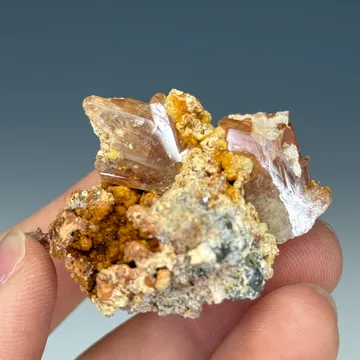
Color ranges from water-clear and white through pale gray, tan, smoky brown, amber, and honey. The most desirable crystals are transparent to strongly translucent, with bright adamantine or resinous luster and crisp edge definition. Striated faces are typical and can give the crystals a silky internal shimmer when turned under a light. Smoky, gemmy V-twins from the older finds are among the most recognizable Touissit cerussites.
Typical collectible crystals are in the 2–6 cm range. Fine thumbnails and miniatures may be entirely off matrix, showing complete V-twins or compact groups. Small cabinet pieces with major crystals around 5–6 cm are highly desirable, especially when balanced and undamaged. Larger examples exist, including unusually robust multi-twinned groups and cabinet specimens with crystals approaching or exceeding 8 cm, but these are not routine and should be judged critically for repair, contact, and provenance.
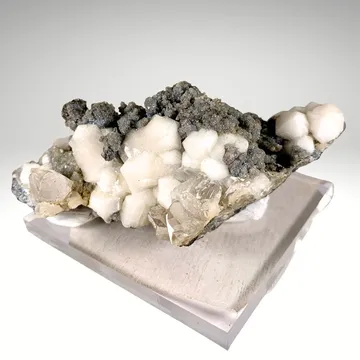
Associated minerals are a major part of the Touissit identity. Galena is the key primary lead mineral and is a natural matrix for cerussite. Anglesite is one of the most important companions, sometimes appearing as yellow crystals with small brown or colorless cerussite. Malachite and azurite provide strong color contrast, especially on pieces from the broader Touissit-Bou Beker district. Dolomite, smithsonite, sphalerite, baryte, wulfenite, and iron oxides also occur in association. The best matrix pieces use those associations visually: glassy cerussite on dark galena, pale twins against rusty gossan, or colorless cerussite interrupting blue azurite and green malachite.
Quality is determined by geometry, luster, transparency, completeness, and condition. A top Touissit cerussite should have sharply developed twin form, undulled faces, and minimal bruising on terminations and twin edges. Internal clarity matters, but a smoky or amber crystal can be just as desirable as a colorless one if it is lustrous and architectural. Matrix examples are scarcer in elite condition because extraction, trimming, and transport are harder on fragile lead carbonate crystals. Free-standing V-twins are more common on the market, but fine matrix pieces with crystals properly elevated and visually balanced can be more compelling.
Touissit cerussite is not a rare species occurrence, but fine Touissit cerussite is a selective purchase. Many examples show chips, bruised terminations, cleaved edges, dulling, or contact areas where crystals were attached to the pocket wall. The mineral is soft, brittle, and dense; a specimen may survive decades in a collection and still be vulnerable to a single careless handling event. Always examine twin junctions, terminations, exposed blade edges, and any point where a crystal meets matrix.
Repairs should be expected often enough to inspect for them, especially on larger V-twins and matrix pieces. A clean repair across a twin junction can be difficult to see without magnification because cerussite’s high luster and strong internal reflections can mask glue lines. Check for mismatched luster, tiny bubbles, unnatural alignment, or a glossy film in protected recesses. Old collection pieces may be perfectly legitimate and still have stabilization or repair; the issue is disclosure.
Locality accuracy is another concern. “Morocco cerussite” is not enough. Mibladen, Touissit, Bou Beker, Beddiane, and other Moroccan lead districts have distinct collecting histories and appearances. Mibladen cerussite is famously associated with red to pink bladed baryte, whereas Touissit is especially known for smoky or colorless V-twins, cyclic twins, and associations with galena, anglesite, azurite, malachite, smithsonite, and iron oxides. Because labels have long been simplified by dealers, older handwritten labels, dealer tags, and collection numbers add real value.
A specific caution concerns lead oxides reported with Touissit cerussite. Modern paragenetic summaries for the district do not emphasize natural massicot or minium in the Touissit-Bou Beker sequence, and early goethite is abundant. Bright yellow-orange or reddish earthy material beneath or near cerussite should not automatically be accepted as massicot, minium, or another lead oxide without analysis. On valuable pieces, analytical confirmation is preferable to a romantic label.
Cleaning should be conservative. Cerussite reacts with acids and is easily damaged by aggressive chemical treatment. Avoid acid cleaning, ultrasonic cleaning, and sudden thermal shock. Display lighting should be cool and moderate; the mineral’s brittleness and possible sensitivity to temperature extremes make hot lamps and freezing storage poor choices. A stable acrylic base is often sensible for off-matrix twins, but mounting should avoid adhesives on important crystal surfaces.
Market availability is uneven. Lower-priced small twins and modest matrix pieces appear regularly, but top old Touissit specimens are no longer abundant. Recent public listings and auctions show the range: small cabinet V-twins and older single crystals can sell in the hundreds of dollars, while large matrix-hosted or unusually aesthetic cabinet pieces may be priced in the low thousands. The strongest premiums go to sharp, damage-free twins with old provenance, unusual size, or excellent matrix presence.
For much of its working life, Touissit was an ore district first and a collector locality second. The mines were driven for lead, zinc, silver, and copper; the specimens that later made the district famous were secondary products of a much older geological process, hiding in oxidized pockets and fractures within an industrial mine. That is part of the charm of Touissit cerussite: the crystals were not discovered in a picturesque alpine cleft, but in the hard geometry of a Moroccan lead-zinc operation where galena was being broken, hauled, and milled.
The turning point came in the late 1970s. By then the deposits had already been mined for decades, but collectors began seeing material that transformed “Touissit” from a mine name into a mineralogical adjective. The district started yielding world-class azurite, anglesite, cerussite, vanadinite, and wulfenite, as well as rare lead species that made specialists pay attention. A smoky V-twin cerussite from those finds can still carry that period in its form: complete all around, heavily striated, glassy, and self-contained, the sort of crystal that looks less like a broken ore mineral than a finished sculpture.
One specimen trail leads to Jordi Fabre and Morocco in 1995. Fabre described a Touissit cerussite on galena from his own duplicate collection as a cyclic twin, 6.3 × 5 × 4.8 cm, with a 5.2 × 5 cm main crystal. His note captured what many collectors recognize in the best Touissit material: although the district was a galena mine, the secondary lead minerals could look surprisingly “clean,” with a special elegance. That is a revealing collector’s observation. Touissit cerussite is often not a messy ore specimen; at its best, it has the poise of a freestanding crystal object, even when rooted in galena.
Another small time capsule is a Carles Curto duplicate numbered 1989.32: azurite with malachite and cerussite from Touissit, dated around 1989. The specimen was described as a pair of doubly terminated azurite crystals, one completely pseudomorphed by malachite, arranged in an airy display and partly covered by cerussite crystals. It is not a cerussite-only specimen, but it perfectly evokes Touissit’s collector appeal during its brightest years: blue, green, and colorless secondary minerals intergrown in a single sculptural object, the chemistry of the oxidation zone made visible.
A later market story shows how strongly provenance now shapes perception. A 6.1 × 3.3 × 2.1 cm unusual Touissit V-twin from the collection of Richard “Rich” A. Kosnar was described as mined circa the late 1970s to early 1980s. Instead of the balanced V shape collectors expect from Touissit, it had one dominant smoky-golden crystal and smaller crystals flaring away from it, making an unbalanced twin. The piece carried both mineralogical interest and human provenance: Kosnar was a well-known Colorado dealer and collector, and the rare zirconium phosphate kosnarite was named for him.
Even more unusually, a cabinet-size multi-twinned Touissit group from the Bob Werner collection reached the public market with a reported largest crystal of 10.1 cm. That is large for cerussite from any locality and especially impressive for Touissit, where 3–6 cm twins are more typical collector fare. Werner himself was a collector with deep roots: he started collecting minerals in 1946 at age nine, studied geology, mining engineering, and geochemistry, and later catalogued and dispersed parts of an extensive collection. In a specimen like that, the story is not only the crystal in the pocket; it is also the decades of collecting, labeling, storing, and finally rediscovery that allow old Touissit material to keep resurfacing.