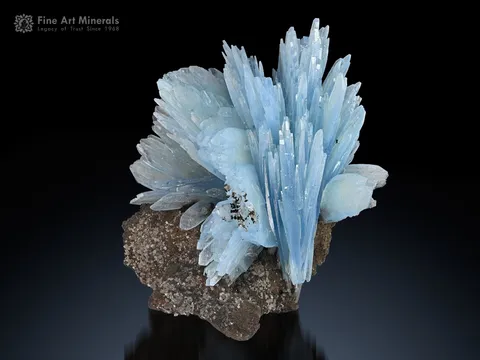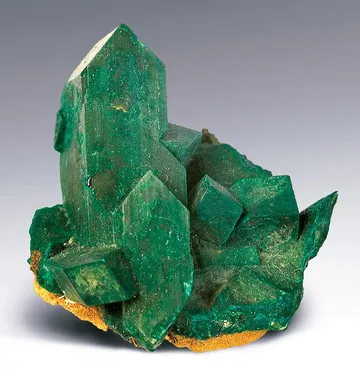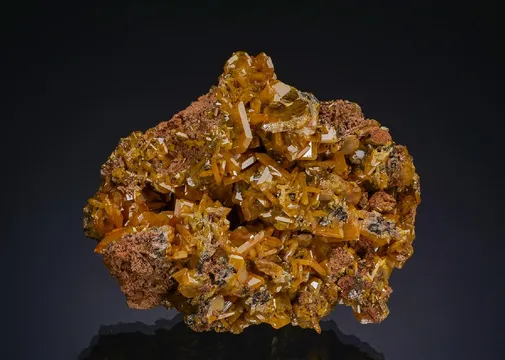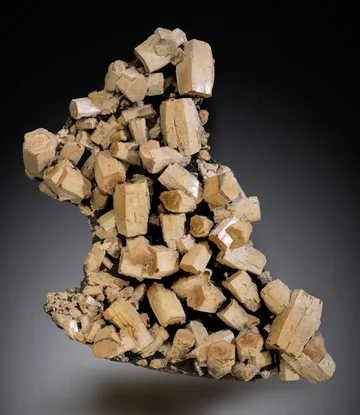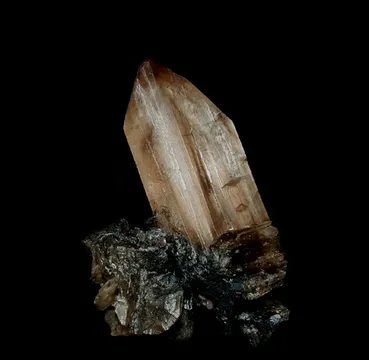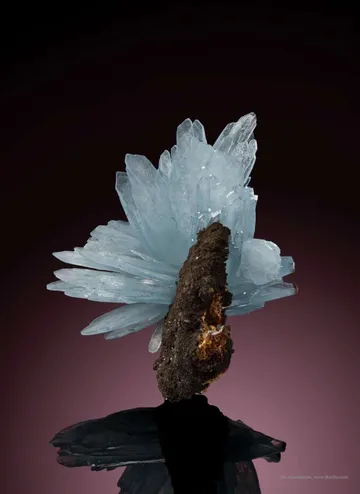
Bou Beker, Morocco — classic northeast lead-zinc belt locality, producing azurite, malachite, brochantite and related minerals prized by collectors.
Key facts
Bou Beker is one of the classic names of Morocco’s northeastern lead-zinc belt: a deposit near Sidi Boubker in the Touissit-Bou Beker mining district, close to Oujda and the Algerian border. For collectors, it sits in the same celebrated mineralogical province as Touissit, Beddiane, Mekta, and the Algerian El Abed continuation, a narrow ENE-WSW string of carbonate-hosted Mississippi Valley Type ore bodies in the Horsts Chain. The commercial ores were chiefly lead, zinc, silver, and subordinate copper, but the collector appeal comes from the oxidized zone, where galena, sphalerite, chalcopyrite, and minor sulfosalts were remade into azurite, malachite, brochantite, cerussite, anglesite, smithsonite, wulfenite, vanadinite, rosasite, gypsum, and other secondary species.
The deposit is hosted mainly in Aalenian-Bajocian Middle Jurassic dolostone: a receptive carbonate platform rock cut by faults, dissolution cavities, breccias, and karstic openings. That architecture is exactly why Bou Beker specimens can be so sculptural. The best pieces are not simply coatings of blue and green; they are open-space products—azurite rosettes and blocky crystals on malachite, velvety brochantite sprays on pale copper-stained matrix, selenitic gypsum blades over green rosasite or malachite, and lead minerals perched on dolomite or oxidized galena remnants. The strongest specimens have the unmistakable “Moroccan MVT” look: saturated color, cavernous carbonate matrix, and sharp contrasts between deep azure, emerald green, honey lead minerals, and tan to buff dolomite.
Regional View
Country View
Bou Beker also matters historically. The Société des Mines de Zellidja, founded in the late 1920s around the Bou-Beker operations, became one of the great mining concerns of eastern Morocco. The district was mined industrially through much of the twentieth century, and later geological work made it a reference district for North African MVT mineralization, with detailed studies of basin brines, dolomitization, organic matter, fault control, oxidation, and even microbial mediation in the formation of supergene non-sulfide ores.

Photo: Wikimedia Commons

Photo: Wikimedia Commons
Search for specimens: View all specimens from Bou Beker, Morocco
Bou Beker is one of the principal deposits of the Touissit-Bou Beker district in Jerada Province, Oriental Region, northeastern Morocco. The district lies roughly south of Oujda, near the Morocco-Algeria frontier, and continues eastward into Algeria at El Abed. In regional terms it occupies the northeastern part of the Chaîne des Horsts, where tabular Mesozoic cover rests on shallow Paleozoic basement and where inherited fault systems focused mineralizing fluids through a narrow structural corridor.
The district is a Mississippi Valley Type Pb-Zn-Ag ± Cu system. Ore bodies are developed in a relatively thin but highly favorable Middle Jurassic dolomitic unit, generally described as Aalenian-Bajocian dolostone. The mineralization is epigenetic: it formed after deposition and lithification of the carbonate host. It occurs both as replacement of dolostone and as open-space filling in faults, fractures, dissolution breccias, karst cavities, and vugs. Geological descriptions of the district emphasize a close spatial relationship between mineralized bodies and the major ENE-WSW fault trend, with subsidiary structures providing local conduits.
The primary ore assemblage is simple but powerful: galena and sphalerite dominate, with minor pyrite, marcasite, chalcopyrite, tetrahedrite-group minerals, and local bornite, in a gangue dominated by dolomite. The ore fluids have been interpreted as hot, evolved basin brines, with salinities above 20 wt.% NaCl equivalent and temperatures around 100 ± 20 °C. Lead-isotope work points to a metal source in Visean rhyodacitic and volcaniclastic basement rocks, while later models tie mineralization to Neogene-Quaternary tectonics, Africa-Europe convergence, uplift, and basin-brine circulation.
For specimen collectors, the critical event was not the primary sulfide stage but the deep oxidation that followed. Supergene alteration affected the district to depths on the order of 100 to 120 meters in published descriptions. In these oxidized zones, galena, sphalerite, pyrite, and chalcopyrite broke down to produce cerussite, anglesite, smithsonite, azurite, malachite, brochantite, gypsum, goethite, vanadinite, wulfenite, and related lead-copper-zinc secondary minerals. The carbonate host neutralized acidic fluids, allowing carbonates and sulfates to form close to their sulfide precursors rather than being transported far away. That near-source precipitation is one reason Bou Beker specimens so often show copper colors sitting directly on dolomite, oxidized sulfide remnants, or lead-zinc matrix.
The ore bodies of the broader district show both lateral and vertical zoning. Geological summaries note a western lead-rich tendency and a more zinc-rich eastern tendency, with zinc relatively abundant lower in the dolomitic sequence and lead becoming more prominent higher in the unit; copper is especially associated with the uppermost part of the dolomitic sequence and the “Toit jaune” facies. Such zoning helps explain why the district yields both classic lead specimens—cerussite, anglesite, vanadinite, wulfenite—and colorful copper secondary minerals such as azurite, malachite, brochantite, and rosasite.
Mining began from early surface indications recognized at the start of the twentieth century. Industrial exploitation in the district was carried out continuously from 1926 to 1973 by the Société des Mines de Zellidja and the Compagnie Royale Asturienne des Mines. In 1980 the district mines passed to the Compagnie Minière de Touissit, and an intensive exploration and drilling campaign re-evaluated the Beddiane and Mekta deposits, which had been discovered in the 1970s and then developed at depth. District production reached its strongest phase in the 1980s and 1990s, before declining late in the 1990s because of economics and reserve depletion. The CMT mines were reported closed in 2002, although small-scale and artisanal recovery of lead-rich material has persisted irregularly in the district.
Bou Beker itself had a distinct industrial history. The Société nouvelle des mines de Zellidja was organized around the Bou-Beker operations in the late 1920s, and its headquarters were listed at the Mines de Bou-Beker near Oujda. By the mid-1950s Bou Beker was a major zinc producer: Moroccan mining reports for 1955 state that the nearby Bou Beker mine produced about three times as much zinc concentrate as Touissit, with 51,400 tonnes of zinc concentrates that year. Together, Touissit and Bou Beker accounted for nearly 90% of Morocco’s zinc-concentrate production at the time. The same reports also describe the difficulty of concentrating oxidized zinc ores, the planned recovery of calamine by flotation and chemical treatment, and the use of the Oued el Heimer smelter for Bou Beker lead concentrates.
The mine-locality name “Zellidja Mine” is closely attached to Bou Beker specimens in collections and databases, but it should be used carefully. Mindat treats Zellidja Mine as a sublocality at Bou Beker and also notes that the Zellidja lead smelter itself was at Oued el Heimer, about 16 km west of Touissit. The Zellidja tailings storage facility covered about 96,335 square meters and received waste from Sidi Bou-Beker and Touissit in Morocco as well as El Abed and Aïn Arko in Algeria. Old labels may therefore use “Bou Beker,” “Bou Bekker,” “Bou Becker,” “Zellidja,” “Touissit District,” or “Oujda” in overlapping ways, and specimen-level geology is often more reliable than label shorthand.
Modern collecting access should be treated as restricted, hazardous, and not casual. The historical underground mines, shafts, decline workings, collapse zones, dumps, and tailings belong to a long-industrial district with environmental and safety concerns. Serious collectors normally encounter Bou Beker material through Moroccan dealers, European and North American old collections, or stock that entered the market after specific finds. Fresh surface digging and mine entry should not be assumed permissible, and any field visit requires local permission, a knowledgeable contact, and attention to unstable workings and lead-bearing dust.
Bou Beker azurite is best known as rich royal-blue to deep azure crystals and rosettes on malachite, dolomite, and oxidized carbonate matrix, with the finest old pieces showing isolated rosettes or lustrous crystal groups rather than mere blue druse. Verified specimen records include azurites to about 1.5 cm standing dramatically on flat malachite matrix, larger cabinet plates around 15.4 x 12.1 x 4.0 cm with dense azurite over malachite, and complete floater rosettes in the 4 cm range. The most desirable examples have sharp, highly lustrous crystals, strong separation from the green malachite or pale matrix, and minimal abrasion to the exposed rosette edges; ordinary pieces tend to be crusty, crowded, bruised, or too heavily altered toward malachite.
At Bou Beker, malachite is both a major display mineral and a key supporting actor for azurite, brochantite, gypsum, and rosasite. It occurs as massive to botryoidal green matrix, banded material, acicular crystal crusts, and replacements or partial pseudomorphs after earlier copper minerals; in the best azurite combinations it forms a velvety or massive green carpet that heightens the contrast with blue rosettes. Large-cabinet azurite-malachite plates from old Moroccan material are especially attractive when the malachite is not merely dull backing but shows texture—fine needles, banding, or fresh emerald color—and when the azurite sits proud rather than being swallowed by green alteration.
Bou Beker brochantite occurs as forest-green to emerald-green acicular crystals, velvety sprays, rounded crystal bursts, and bladed aggregates, commonly associated with malachite and sometimes with azurite, cerussite, or rarer beaverite-(Cu). One well-documented style consists of rich, velvety brochantite tufts set prominently on darker matrix, with specimens around 8.4 x 5.2 x 4.4 cm attributed to a find around 1988; another distinctive Bou Beker look shows lustrous brochantite blades festooned on nubby, vuggy pastel-blue azurite and banded malachite matrix. Good examples are judged by the freshness of the needles, even coverage, saturated green color, and three-dimensional separation of the crystal bursts; worn, dusty, or crushed acicular surfaces lose much of the appeal.
Gypsum from Bou Beker is most familiar to collectors as clear to pale selenite sprays, blades, rosettes, and occasionally contorted “ramshorn” growths on dolomite, often with green rosasite or malachite included beneath or within the gypsum. Documented specimens include malachite-included gypsum rosettes and elongated crystals to about 1.5 cm on lustrous tan matrix with small azurite druses, as well as rosasite partly coated by gypsum and selenite on dolomite. The best pieces are transparent, undamaged, and visually organized, with the green copper-zinc minerals giving color through the gypsum rather than forming a muddy crust; ordinary examples are commoner, fragile, chipped, or confused by mixed green coatings that require careful identification.
Other documented Bou Beker minerals include adamite, anglesite, aragonite, baryte, beaverite-(Cu), cerussite, chalcopyrite, covellite, descloizite-mottramite series minerals, possible devilline, dolomite, dundasite, galena, goethite, quartz, rosasite, smithsonite, sphalerite, vanadinite, arsenic-bearing vanadinite, and wulfenite. The lead-species suite is particularly important at the Zellidja/Bou Beker level, with anglesite, cerussite, vanadinite, and wulfenite all represented in verified records. Beaverite-(Cu) is a noteworthy rarity here: a Moroccan Bou Beker occurrence has been reported as yellow earthy masses of lenticular crystals associated with brochantite, cerussite, and malachite and checked by SEM-EDS. I found no accepted type-locality mineral whose type occurrence is specifically Bou Beker, but the locality is unquestionably important for Moroccan secondary copper-lead-zinc assemblages.
Bou Beker material sits in a labeling field where precision matters. Older labels may say Bou Beker, Bou Bekker, Bou Becker, Zellidja, Touissit, Touissit District, or Oujda; some are acceptable historical shorthand, but they are not always equivalent. Zellidja Mine is a Bou Beker sublocality in modern databases, whereas the Zellidja smelter and tailings facilities are separate industrial features tied to Oued el Heimer and mixed ore sources. For high-end specimens, especially azurite-malachite or lead-species pieces, retain old labels and verify whether the specimen is truly Bou Beker/Zellidja or from nearby Touissit, Beddiane, Mekta, or El Abed.
The most common identification issue is the green mineral on gypsum and dolomite. Specimens are sold as malachite, rosasite, aurichalcite, or mixtures, and visual identification can be unreliable when the green phase is a thin coating beneath transparent gypsum. Rosasite from Bou Beker is well documented, as is malachite; the two can be visually close in mixed secondary copper-zinc assemblages. On better pieces, especially where price depends on species, XRD, Raman, or another analytical confirmation is preferable to dealer shorthand.
Condition is a major value driver. Azurite rosettes chip along exposed crystal edges, and lustrous faces show rubs immediately. Malachite crusts can be powdery or dull if cleaned harshly. Brochantite needles are very vulnerable to brushing, vibration, and packing pressure; cabinet specimens with untouched velvety sprays are much more desirable than examples with flattened “nap.” Gypsum and selenite are soft, easily scratched, and sensitive to water and heat; avoid washing gypsum-rich Bou Beker specimens, and never use acids on carbonate matrix without knowing exactly what else is present.
Lead-bearing minerals are part of the Bou Beker assemblage, including galena, cerussite, anglesite, vanadinite, and wulfenite. They are safe as display specimens with normal mineral-collection hygiene, but collectors should wash hands after handling, avoid inhaling dust from broken matrix, and keep friable lead-rich specimens away from children and food-preparation areas. Gypsum, malachite, and azurite combinations should also be stored in stable humidity and out of direct sunlight to preserve luster and avoid deterioration of fragile coatings.
Documented treatment concerns in the broader Touissit-Bou Beker district are strongest for yellow to amber anglesite: collector and dealer notes have reported artificially intensified color, including bleach treatment, on some Moroccan anglesite. That concern should not be projected indiscriminately onto every Bou Beker specimen, but strongly colored anglesite from the district deserves scrutiny. For azurite, malachite, brochantite, and gypsum, the larger risks are mislocality, species confusion, repair, trimming, and concealed bruising rather than routine dyeing.
Market availability is uneven. Small azurite-malachite pieces, mixed green gypsum specimens, and rosasite/gypsum/dolomite combinations appear regularly enough to be obtainable. Fine old azurite rosettes, strong large-cabinet azurite-malachite plates, rich brochantite specimens from the older finds, and well-localized Zellidja lead-species pieces are much less common and should be treated as finite historical material. The best Bou Beker specimens combine saturated color with old provenance, sharp crystals, and matrix contrast; they are no longer simply “Moroccan blue-green” stock but recognizable classics of a closed industrial district.
The human story of Bou Beker begins like many great twentieth-century mining stories: with a name that became larger than the mine itself. The Société nouvelle des mines de Zellidja was organized at the end of the 1920s, with its registered mining seat at Bou-Beker near Oujda and the French industrialist Jean Walter as president. Contemporary and later accounts called Walter the “inventor” of the mine—not in the sense of making the ore, of course, but in the older mining sense of recognizing, backing, and bringing the deposit into production. The company began modestly, with capital of 2,200,000 francs, but Bou Beker was not a modest ore body. After early difficulties, exploitation became profitable, and the mine’s lead-zinc output rose rapidly.
By 1955, Bou Beker had become one of the engines of Moroccan zinc. Mining reports from that year put Bou Beker’s zinc-concentrate production at 51,400 tonnes, roughly three times the output of nearby Touissit. Together the two neighboring mines supplied almost 90% of Morocco’s zinc concentrates. The same report captures a technical problem every collector can recognize in specimen form: the oxidized zinc ore, the “calamine,” was abundant but difficult to concentrate. The operators were not thinking about beautiful smithsonite, green rosasite, or gypsum-coated copper minerals; they were trying to float and chemically treat oxidized zinc to produce a saleable zinc oxide. A rotary-kiln chemical plant ordered from Germany was being assembled in 1955, with a projected 15,000 tonnes of zinc oxide the following year.
The industrial optimism of Zellidja was shadowed by one of the stranger episodes in French business history. Jean Walter died in June 1957 after being struck by a car. In 1959, French newspapers were still describing the consequences of his death, the company’s enormous rise, and the legal drama around his widow and Jean Lacaze. Le Monde summarized the scale starkly: in 1957 the mine’s production reached 1,200,000 tonnes; that year the company made 730 million francs in profit and distributed 560 million francs to shareholders. For collectors handling a palm-sized azurite rosette today, it is easy to forget that these blue and green crystals came from a corporate and industrial world measured in shafts, smelters, dividends, lawsuits, and million-ton outputs.
There is also a quieter specimen story preserved in the labels and photographs. Some Bou Beker azurite-malachite pieces are explicitly described as old Moroccan material, not part of newer finds. One classic style shows bright azurite crystals standing isolated on a flat malachite matrix, with azurites reaching about 1.5 cm on a 9.7 x 6.3 x 1.8 cm specimen. Another old large-cabinet plate, 15.4 x 12.1 x 4.0 cm, carries deep-blue azurite over pale to deep green malachite, the sort of specimen that instantly separates historic Bou Beker material from later mass-market mixed copper pieces.
The brochantite story has its own chapter. Specimens from a find around 1988 show rounded bursts of velvety acicular crystals, emerald to forest green, standing proud from dark matrix. That is a demanding habit: every exposed spray is a little brush of fragile needles. Surviving examples that remain crisp and upright are not just attractive; they are minor miracles of extraction, wrapping, travel, and ownership. On some pieces the brochantite is paired with pastel-blue azurite and banded malachite, a combination that looks almost improbable until one remembers the chemistry of the oxidized zone—copper moving only short distances, carbonate host rock buffering the fluids, sulfate produced by sulfide oxidation, and cavities offering room for needles, blades, crusts, and rosettes to grow.