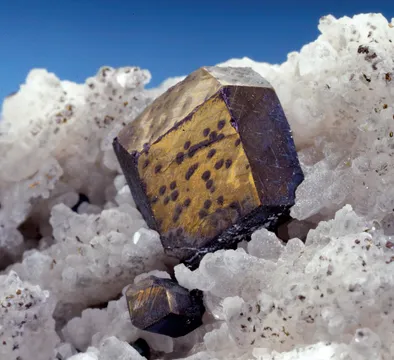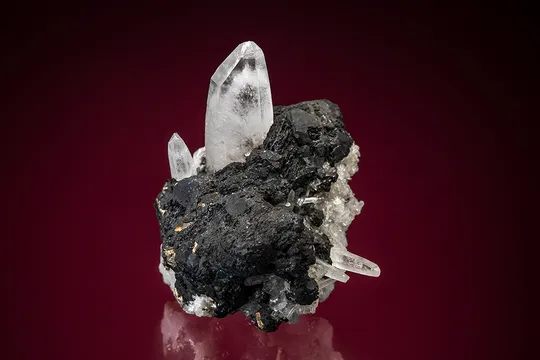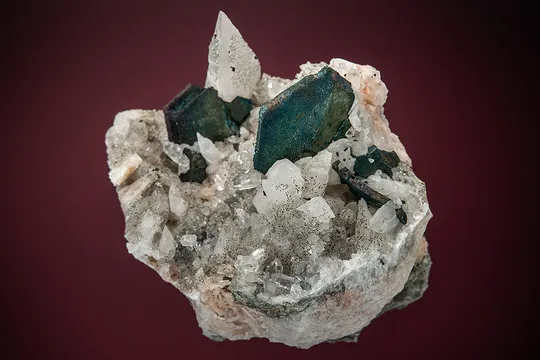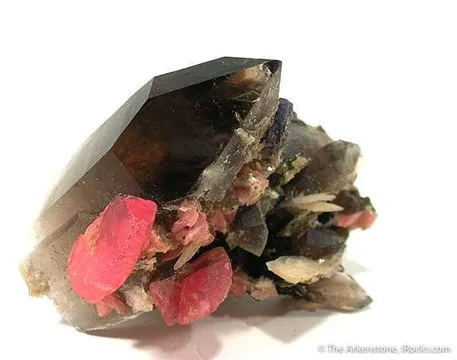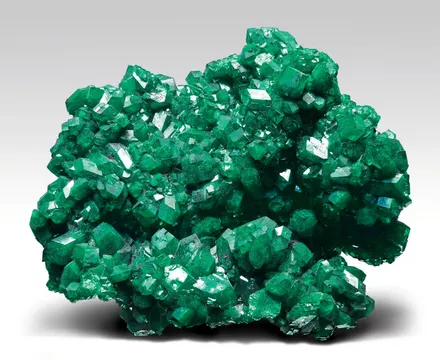
カザフスタン産のジェシュカズガン産ボルナイト。ディスプレイ用結晶の標準的な産地で、鋭い偽等方形の形と淡い基質の上に豊かな暗色の Tarnish が特徴。
Key facts
Dzhezkazganは、 serious collectors が基準として用いる方解石の産地です。方解石は鉱石鉱床の珍奇種ではありませんが、显示品質のシャープで光沢のある自立結晶は世界的に稀であり、Dzhezkazganは単なる金属鉱石としてでなく、 recognizable クリスタルとして現れた数少ない場所のひとつです。クラシックな外観は、暗く金属的な青黒~黒の結晶で、微妙なバイオレット、インディゴ、銀、ブロンズのさび色を帯び、淡いクォーツ、方解石、または剣状重晶石の基盤に置かれます。対比は魔法の一部です:濃密な銅-鉄硫化物が、光を放つ脈状の包囲体の上に載っています。

この鉱区は中央カザフスタンのChu-Sarysu盆地にある巨大な砂岩が支えた銅系統です。その鉱体は、砂岩と礫岩のPennsylvanian期の厚い赤色帯状層に位置し、銅硫化物は粒子置換と粒間結石として形成されました。標本として言えば、その地質は重要です:Dzhezkazganの方解石は、小規模な鉱山の脈洞のお遊びではなく、ユーラシア大陸の伟大な銅鉱区の一つから現れた収集価値の高い結晶です。
収集家は第一に形状を重視してDzhezkazgan方解石を評価します。最良の標本は超対称性の結晶を鮮明に示します—立方体、八面体風の結晶、十二面体形、台形十二面体形など—無構造の塊ではありません。次の品質要因は表面です。良好な結晶はシャープで金属的、過度に明るく虹彩色に崩されていません。最上の標本は、飽和した暗いさび、清潔な結晶幾何学、淡い基質とのバランスが取れており、ケース越しでも方解石が視覚的に読めるようになっています。
この産地の歴史的価値は魅力をさらに高めます。Зhezkazganはソビエト時代にKanysh Satpayevの探査活動によって科学的に評価され、主要な鉱業・製錬発展の基盤となり、カザフスタンの銅産業のアイデンティティと結びついたままです。しかし鉱物収集家にとって、この地区の最も親密な遺産は、特定の井戸と階で標本が収集に入った卓越した硫化物のsuiteです:方解石、 chalcocite-djurleite 群標本、betekhtinite、閃亜鉛鉱、蛍石、自然銀、自然銅、および重晶石の組み合わせです。## Featured Specimens
Search for specimens: View all bornite specimens from Dzhezkazgan mining district, Kazakhstan
Dzhezkazgan is best understood as a mining district rather than a single specimen pocket or single mine. Specimen labels may read Dzhezkazgan, Zhezkazgan, Dzezkazgan, Jezkazgan, Karaganda Region, Karagandy Province, or older Soviet-style locality names. Mindat notes that the district has been wrongly reported in some sources as a single mine, and that notable mineral specimens came from several shafts, including #31, #46, #55, and #57. For collectors, those shaft numbers are not decorative trivia: they help separate serious old labels from vague commercial ones.
The deposit belongs to the sandstone-hosted copper family. The main ore-bearing section consists of multiple copper-bearing sandstone members within a Pennsylvanian fluvial red-bed sequence. The ore minerals occur in sandstone and conglomerate as replacements and cement between grains, rather than as a simple vein system. U.S. Geological Survey work describes ten ore-bearing sandstone members and ore bodies distributed across a broad district-scale area. The system is tied to reduction zones in red beds, former petroleum accumulations, evaporitic brines, and structural controls along anticlines and cross-folds. Re-Os dating of copper sulfides places Dzhezkazgan mineralization around the Pennsylvanian-Permian boundary, roughly 299–309 Ma.
The district is enormous by specimen-locality standards. USGS summaries give Dzhezkazgan a copper metal content on the order of 22 million metric tons, with average grades in the associated sandstone copper deposits of about 0.85–1.7% Cu and important silver and rhenium values. Modern studies of Zhezkazgan sediment-hosted stratiform copper ores list bornite among the primary ore minerals together with chalcocite-group copper sulfides, chalcopyrite, galena, and sphalerite.
Mining history reaches far deeper than the Soviet industrial story. Archaeological and geological sources describe Bronze Age copper mining and metallurgy in the broader Zhezkazgan-Ulytau and central Kazakhstan region, with ancient miners exploiting oxidized copper ores and using stone tools, fire-setting, and ore-processing settlements. In modern industrial history, Kanysh Satpayev’s work in the late 1920s and early 1930s transformed Zhezkazgan from a promising copper field into a proven giant. By the end of 1931, Satpayev’s team had demonstrated copper reserves far beyond earlier estimates, and by 1937 Zhezkazgan was being described as one of the world’s great copper deposits.公的な産業年表は標本の由来にとっても同様に重要です。大規模な採掘作業は20世紀初頭に開始され、ツェフカザガンの鉱石から初めての粗銅が1928年に生産されました。1938年のソ連計画では、鉱山、濃縮施設、新しい都市、精錬所を備えた新しいツェフカザガン・コンビネを建設することが求められました。 Dzhezkazgan 鉱業・冶金コンビネは1958年に公式に承認されました。 北ツェフカザガン鉱山は1960年に、東ツェフカザガン鉱山#55は1964年に、南ツェフカザガンは1965年に、東ツェフカザガン鉱山#57は1967年に稼働しました。 ツェフカザガン銅精錬所で最初の陰極銅は1971年2月23日に発行されました。
採集アクセスは、カジュアルな野外採集ではなく、産業鉱山アクセスとして扱われるべきです。 Dzhezkazgan は活発で歴史的に複雑な採掘地域であり、市場で流通する可採性のボーンナイト標本は圧倒的に採掘者、旧在庫、コレクション、ディーラー網を通じて入手されるものであり、公開のレクリエーション採集から comes することは多くありません。良質な結晶は多くの場合、旧材、エステート品、または大規模コレクションから再流通した標本として出会われます。ラベルに特定の鉱井(井戸)やレベルが示されている場合、その情報は保存価値があります。## ドジェズカズガン鉱区(カザフスタン)産 Bornite の特徴
diagnostic Dzhezkazgan bornite habit is pseudo-isometric: cubes, octahedral-looking crystals, dodecahedral forms, and trapezohedral crystals, generally reaching from small thumbnail crystals to a few centimeters. A 9 mm pseudo-octahedral bornite on baryte is a classic miniature-scale example; dealer records also document sharp crystals reaching about 2.3 cm on contrasting matrix, as well as small-cabinet pieces with numerous 1 cm crystals scattered over quartz-coated matrix. A strong miniature may have just two or three superb crystals; a cabinet example may show many smaller crystals distributed across quartz, calcite, or baryte.
Color ranges from dark blue-black to black, commonly with iridescent overtones. The best Dzhezkazgan pieces are not necessarily the most rainbow-colored. Many top specimens have a restrained metallic patina—blue-black, silver-blue, violet, or bronzy—rather than the garish acid-bright colors often associated with low-grade “peacock ore” sold to beginners. On fresh or protected surfaces, bornite may be more bronze-brown, but collector specimens are usually judged by the quality of the natural tarnished surface and the crispness of the underlying crystal.
Matrix associations are one of the locality’s strengths. Bornite may sit on quartz crystals, calcite, or baryte; some specimens include chalcocite-group minerals, chalcopyrite, pyrite, or sphalerite. Dzhezkazgan baryte is itself collectible, often as pale to orange blades, and it makes an especially good contrast for dark bornite. Calcite matrix pieces can be very attractive when the bornite crystals are isolated and architectural rather than crowded into a massive sulfide patch.
A distinctive point for advanced collectors is bornite’s relationship to other Dzhezkazgan sulfides. Betekhtinite from the district is famous in its own right, and Mindat records dull grey to black needles interpreted as pseudomorphs after betekhtinite, commonly chalcocite or bornite. Bornite is also recorded as pseudomorphing after betekhtinite. The locality has additionally produced a lead-rich bornite variety described as “galenobornite,” in long yellow-brown prismatic crystals to about 3 cm. These unusual relationships make Dzhezkazgan more than a “pretty bornite” locality; it is a rich copper-sulfide mineralogical system with collector-grade expression.
Quality in Dzhezkazgan bornite is governed by five traits:1. 結晶の鋭さ: 明確な faces と認識可能な擬似等角形状は、かさばりよりも重要です。 2. 表面の健全性: 欠け、打痕のあるエッジ、髪の毛ほどの亀裂は一般的で、クリアな結晶にはプレミアムが付くことが多いです。 3. つやと patina: 微細な金属的な青黒色から紫色の光沢が好まれ、鈍い黒い被膜や人工的に見える虹色よりも評価が高いです。 4. 基質のコントラスト: 石英、方解石、重晶石の基質がボルネイトを読み取りやすく、展示しやすくします。 5. 出所情報: 古いラベル、名付けられたコレクション、 shaft-specific な情報は大きな価値を加えます。## Collector Notes
Dzhezkazgan bornite is a specialty sulfide for collectors who value crystal form. It should not be confused with the inexpensive “peacock ore” commonly sold in metaphysical shops and tourist bins, much of which is acid-treated chalcopyrite or mixed copper sulfide material with an exaggerated rainbow surface. Genuine Dzhezkazgan bornite crystals are typically darker, sharper, more metallic, and more disciplined in form. A specimen that is uniformly neon-purple, electric-blue, and gold over every surface deserves skepticism unless supported by strong provenance and mineralogical context.
The most common condition issues are edge chipping, bruising on exposed crystal corners, hairline cracks, and contact damage where the bornite protruded from matrix. Dealer descriptions of good pieces often still mention tiny chips under magnification; this is realistic for a brittle metallic sulfide from industrial mining. Buyers should inspect the high points of pseudo-octahedral and dodecahedral crystals carefully, as even a small chip can interrupt the geometry that makes the specimen desirable.
Bornite tarnish is part of the specimen, but it is also a surface phenomenon. Avoid aggressive cleaning, acids, ultrasonic cleaning, and repeated handling. The dark iridescent skin can be changed or dulled by chemicals and fingerprints. Store away from excessive humidity, and keep specimens from rubbing against harder minerals in drawers. Quartz matrix is hard; bornite is softer and more vulnerable.
Authenticity concerns center on three issues. First, some pieces are labelled simply “Kazakhstan” or “Dzhezkazgan Mine” without enough detail; this is common and not automatically suspicious, but old collection labels and dealer histories help. Second, mixed copper sulfides can be misidentified visually—chalcocite, djurleite, digenite, chalcopyrite, and bornite may occur together. Third, artificially bright “peacock” surfaces can distort identification and value. For an expensive specimen, the safest attributes are sharp Dzhezkazgan-style morphology, a credible matrix association, and provenance from a reputable dealer or collection.
Market availability is sporadic. Fine Dzhezkazgan bornite was available in meaningful numbers during the 1990s and early 2000s, but the best crystals are now mostly old-stock or collection material. Current and recent dealer listings show the range: modest miniatures may appear in the low hundreds of dollars, while sharp, undamaged miniatures with multiple bornite crystals on quartz or calcite can reach four figures. A specimen with over a dozen well-formed crystals on calcite was recently listed at $1,750, and a 3.5 cm miniature with three sharp bornite crystals on quartz was listed at $1,250. Cabinet-quality pieces with numerous sharp crystals, excellent matrix contrast, or strong old provenance can be much harder to replace than their size alone suggests.## Stories & Field Notes
Dzhezkazganの最初の大きな物語は、単一の結晶についてではなく、地質学者がステップpeの銅 provinceを読み解くことについてです。1927年、カニシュ・サトパイエフはカルサクパイ地域とその展望についての著作を発表し、ジェズカズガンでの真剣な探鉱の重要性を唱えました。1929年までには、そこの地質探鉱は彼に任されていました。数年のうちに彼のチームは銅鉱床が散在する小規模な露頭の一部ではなく、巨大なシステムの一部であることを証明しました。後の記録では、彼と彼のチームが確認した埋蔵量は少なくとも200万トンの銅に達しており、以前英語の専門家が推定した6万トンを大きく上回っていました。1937年までには、これらの埋蔵量がジェズカズガンを「世界最大の銅鉱床」と呼ぶに足りるだけのものであり、ジェズカズガン金属化合企業の建設を支えていました。
インフラは地質に続きました。1940年までには、ドスムルジンスコエ貯水池とジェズカズガンとカラガンダ、バルクハシュを結ぶ鉄道が地域の開発に含まれていました。コレクターの観点からは、生まれたてのビューネイト(Bornite)のミニチュアを手に取り、その背後にある産業規模を忘れてしまいがちですが、その標本ははるかに大きな物語の小さな磨かれた文です:探鉱、鉄道、貯水池、溶鉱炉、新しい町、中央カザフスタンが銅を中心に再編成されること。
古い物語はさらに古く、より物理的です。カザフスタンの青銅器時代の鉱業を記述する考古学的総説では、酸化銅鉱石―孔雀石や藍銅鉱を含む―が石のハンマー、ピック、火付けとともに採掘されたと記されています。密な岩石は焚き火で加熱され、水で急冷して破裂させられました。砕かれた鉱石はハンマーとポールピックで攻撃されました。金属を含む岩石は革袋にして表面へ運搬されました。微粉砕された鉱石は集落へ運び出され、特別な窯で銑鉄化されました。ジェズカズガン地区では、古代にはおおよそ10万トンの銅が硫化銅と酸化銃銅の鉱石として溶鉱されていたとする歴史的な記述もあります。
より最近の考古学的研究は、青銅器時代を個々の道具へと落とし込みます。ジェズカズガン銅鉱床帯のクレストセンター採石場とミリクドゥク集落の63点の石器の流体学的分析は、クレストセンターが鉱石採掘と結びつき、ミリクドゥクが鉱石加工に従事していたと結論づけました。研究の文体は淡白ですが、光景は生々しいです:採石場の鉱夫、集落の加工者、そしてジェズカズガン・ウリタイ山脈の銅鉱区の richest oxidized と sulfide 銅鉱石を軸にした冶金風景。## 鉱物学的記録と出版物
Pohwat, Paul W. (2014), “Connoisseur’s Choice: Bornite, Dzhezkazgan Mine, Dzhezkazgan, Karagandy Province, Kazakhstan,” Rocks & Minerals, 89(6), 530–537 — Dzhezkazganの閃複石を専ら対象とした、コレクター向けの主要出版物.
Smithsonian Research record for Pohwat’s 2014 Dzhezkazgan bornite article — Rocks & Minerals 論文と DOI の文献情報の確認.
Mindat reference entry for Pohwat’s 2014 article — 完全な参照データを含む、有用な鉱物コレクター向けの書誌エントリ.
Box, S. E., Seltmann, R., Zientek, M. L., Syusyura, B., Creaser, R. A., and Dolgopolova, A. (2012), “Dzhezkazgan and associated sandstone copper deposits of the Chu-Sarysu basin, Central Kazakhstan,” U.S. Geological Survey — 標準的な地質概要、堆積体の型、年齢、塩水還元モデル、品位、地域設定を示す権威ある情報源.
Spatial Databases of Geological, Geophysical, and Mineral Resource Data Relevant to Sandstone-Hosted Copper Deposits in Central Kazakhstan, U.S. Geological Survey Open-File Report — 広範な sandstone-hosted 銅鉱床評価のデータ指向 USGS リソース.
Kucha, H., et al. (2021), “Ore Minerals and Metal Distribution in Tailings of Sediment-Hosted Stratiform Copper Deposits from Poland and Kazakhstan,” Minerals, 11(7), 752 — Zhezkazgan の主鉱物および尾鉱物の鉱物学の現代的要約を含む.
Yerzhanova, A. E. (2021), “Traceological Analysis of Stone Tools of Miners and Metallurgists from Zhezkazgan Copper Deposits,” Povolzhskaya Arkheologiya, 3(37), 166–181 — Zhezkazgan の銅鉱床域におけるBronze Age の採掘・冶金工具の考古学的研究.
Mindat locality page for Dzhezkazgan mining district — 鉱物リスト、結晶標本ノート、竪坑参照、 locality 階層の情報.
Wikimedia Commons file: Bornite on baryte from Dzhezkazgan — 公共利用許諾画像。Dzhezkazgan産のバライト上の鋭く9 mmの擬正八面体結晶の Bornite の写真。元コレクションは Martin Zinn、Rob Lavinsky による撮影.## さらなる読書と外部リンク
Mindat: Dzhezkazgan mining district, Karaganda Region, Kazakhstan — コレクター志向の locality データベースエントリの最良例、種のリスト、習性、 shaft ノート、および参考文献を含む。
USGS: Dzhezkazgan and associated sandstone copper deposits of the Chu-Sarysu basin — 砂岩系銅鉱床系の必須 geological background。
Taylor & Francis: “Connoisseur’s Choice: Bornite, Dzhezkazgan Mine…” — Dzhezkazgan の bornite に関する専用 Rocks & Minerals 記事。
Wikimedia Commons: Minerals of Dzhezkazgan — district の鉱物の自由ライセンス画像、bornite-バライト標本を含む。
Collector’s Edge: Bornite, Calcite from Dzhezkazgan — コレクターコメント付きの高級 Dzhezkazgan bornite-Calcite 標本の現市場例。
Marin Mineral Company: Bornite from Dzhezkazgan — クォーツ上の三つの bornite 結晶を含むシャープなミニチュアを記録するディーラ一覧。
Minfind: Bornite with chalcocite, quartz, baryte, chalcopyrite from Dzhezkazgan — サイズ、関連物、状態ノート、産地を含むアーカイブ済み市場リスト。
Kazakhmys history — 現代の CNC ヒゲンのジヘズカズガン鉱業・冶金開発の企業タイムライン。
Kazakhstan Ministry of Foreign Affairs: Kanysh Satpayev 125th anniversary article — Satpayev の Zhezkazgan 銅鉱床の証明と開発における役割の要約リーダブル版。
ResearchBib: Traceological Analysis of Stone Tools of Miners and Metallurgists from Zhezkazgan Copper Deposits — Zhezkazgan-Ulytau 銅地域の Bronze Age 銅鉱業と冶金の文脈。