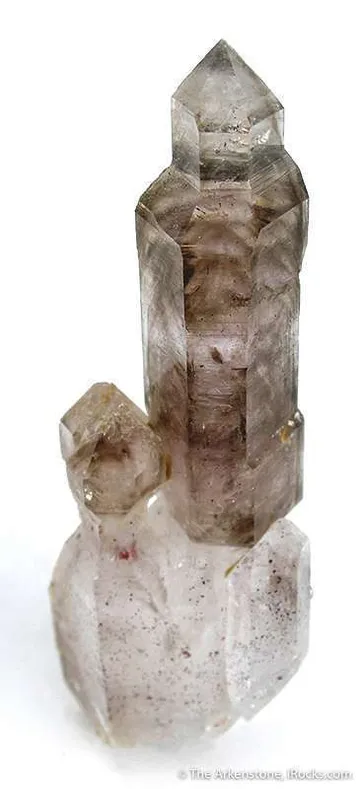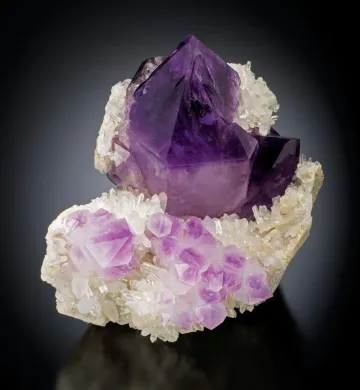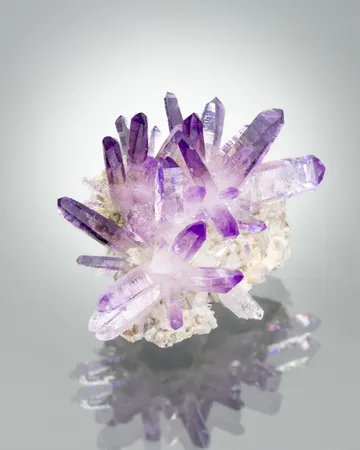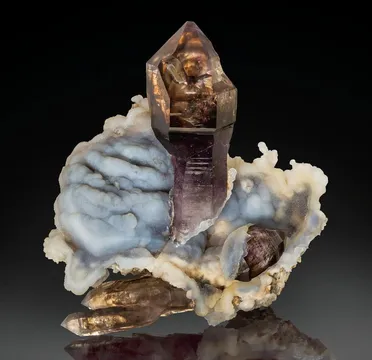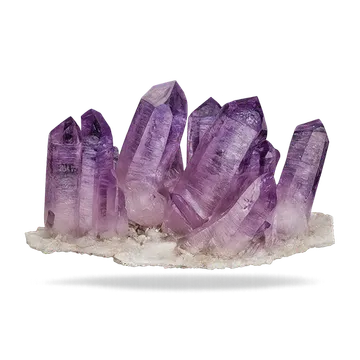
Goboboseb amethyst is the collector’s “Brandberg” amethyst in its most important market sense: glassy quartz from the basalt country west of the Brandberg massif, showing purple amethyst, smoky quartz, rock crystal, phantoms, hematite veils, and mobile fluid inclusions in combinations that are unusually expressive for quartz. The best crystals are not merely purple; they look internally built, with smoky stems, violet caps, ghost-crystal outlines, clay or hematite veils, and trapped liquid-vapor bubbles that animate the specimen when it is turned in the hand.
Key facts
Goboboseb amethyst is the collector’s “Brandberg” amethyst in its most important market sense: glassy quartz from the basalt country west of the Brandberg massif, showing purple amethyst, smoky quartz, rock crystal, phantoms, hematite veils, and mobile fluid inclusions in combinations that are unusually expressive for quartz. The best crystals are not merely purple; they look internally built, with smoky stems, violet caps, ghost-crystal outlines, clay or hematite veils, and trapped liquid-vapor bubbles that animate the specimen when it is turned in the hand.

Photo: Wikimedia Commons
The geological setting is a classic volcanic-cavity environment. The Goboboseb Mountains are part of the Early Cretaceous Etendeka volcanic province, where interbedded basalts and quartz latites of the Awahab Formation are tied to the Messum igneous complex. The specimen-producing rocks are chiefly amygdaloidal basalt flows around Tafelkop and nearby outcrops. Gas cavities in the basalt, from small vesicles to geodes larger than a meter, were later lined by quartz, amethyst, calcite, prehnite, and a modest suite of zeolite- and basalt-cavity minerals.

Photo: Mindat.org
The locality’s historical identity is a persistent source of confusion. Many specimens in old collections and dealer stocks are labeled “Brandberg,” because the Brandberg is the famous landmark and older trade name. Strictly, most fine amethyst, smoky quartz, and prehnite specimens sold under that name come from the Goboboseb Mountains west of Brandberg, especially the Tafelkop area and related claims. True collecting within the Brandberg mountain itself is restricted, and the major specimen-producing ground is the basaltic Goboboseb terrain, not the Brandberg granite complex.
Collectors prize Goboboseb amethyst for combinations that are rarely all present in one crystal: water-clear faces, strong luster, sharp doubly terminated growth, purple-to-smoky zoning, visible phantoms, hematite inclusions, scepter or reverse-scepter growth, and intact basalt matrix. Loose crystals are common enough that the locality remains accessible to collectors at many price levels, but exceptional matrix pieces, robust saturated crystals, and highly aesthetic scepters are genuinely selective specimens.
Search for specimens: View all amethyst specimens from Goboboseb Mountains, Namibia
The Goboboseb Mountains lie in the Brandberg area of the Dâures Constituency, Erongo Region, Namibia, west of the Brandberg massif and north of the Messum complex. Tafelkop, the flat-topped landmark that anchors much of the collecting district, is the highest peak in the northeastern Goboboseb Mountains and rises to about 1,073 meters above sea level. The country is stark desert pavement and basalt rubble, with cold-desert climate conditions and summer heat that can exceed 40°C.
The deposit is an amygdule-and-geode occurrence in basalt, not a pegmatite amethyst deposit. The most important host is the Tafelkop Basalt Member, a thick basal basalt sequence composed of multiple superimposed lava flows, some with amygdaloidal flow tops. The cavities range from tiny openings to basketball-sized vugs and, less commonly, geodes more than a meter across. These voids provided the open space for quartz and amethyst to crystallize freely. Where the basalt is slightly weathered or altered, pieces of matrix can sometimes be extracted; where the rock is fresh, it is extremely tough, and crystals are commonly recovered as singles or small groups detached from the cavity wall.
Production has been intermittent rather than industrial. Amethyst from the Brandberg-Goboboseb area was described in the German mineralogical literature in 1936, and the modern discovery west of Brandberg has often been attributed to Gawie Cloete in the 1950s. Significant collecting did not really develop until the 1980s, followed by legally pegged claims and more active working by mineral entrepreneurs and local Damara miners. By the early 2000s, the locality was already internationally established; a large flow of material reached the market during the following decade, while the finest pieces remained a small minority within a much larger output of small, loose, pale-to-moderate crystals.
Access has historically been by road from Uis toward Henties Bay, then northwest on the road toward the old Brandberg West mine, with tracks leading toward Tafelkop and the diggings. The landscape is remote, waterless, and mechanically unforgiving. Older accounts describe local diggers living in simple shelters, water and food trucked from Uis, and specimens offered from boxes or cardboard beer flats to visiting collectors and dealers. Even when access roads are passable, collecting is not casual recreation: permission, mineral rights, safety, vehicle reliability, water, and current claim status matter.
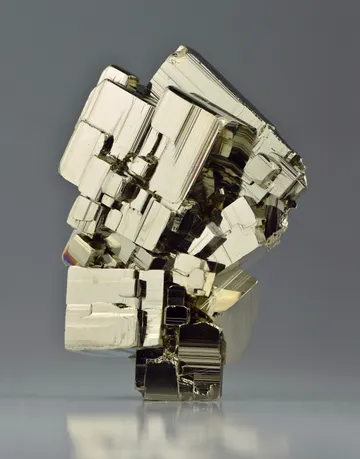
Modern work at Farm Goboboseb includes artisanal and semi-mechanized small-scale mining for gemstones such as amethyst, smoky quartz, rock crystal, and topaz. Government-related environmental documentation describes registered and applied-for mining claims in the Goboboseb area, along with manual digging, chisels, hammers, spades, and more mechanized approaches where equipment is available. Mindat records the Violet Crown Mine, formerly known as Buks Claim, as an active open-cast amethyst locality in the Goboboseb Mountains, noted for well-formed, large, richly colored crystals associated with calcite, dolomite, and pyrite.
Notable finds include large doubly terminated quartz and amethyst crystals, sceptered and reverse-sceptered crystals, pieces with visible moving bubbles, and rare matrix specimens where the basalt host survived extraction. Published accounts mention crystals more than 30 cm long, including a 35 cm crystal in the Desmond Sacco collection, while more typical marketed pieces are miniature to small-cabinet size. The locality is also notable for the uncommon association of amethyst and prehnite; large specimens showing both well are scarce even though the minerals occur in the same broad volcanic formation.
The essential Goboboseb look is glassy quartz with internal architecture. The amethyst may form as a full violet crystal, but just as often it appears as purple zoning within clear or smoky quartz. Fine examples show smoky bases grading into purple terminations, violet phantoms suspended inside colorless quartz, or amethyst caps on scepter heads. The purple can be pale lavender, grape-purple, or a deep saturated violet, but the most collectible pieces combine color with transparency rather than simply depth of color.
Crystal forms are varied. Doubly terminated crystals are common enough to be a signature of the locality. Scepters, reverse scepters, doubly terminated scepters, faden-like distortions, fenster or skeletal quartz, and “Herkimer-like” clear-to-amethyst crystals have all been described from the area. Some crystals are slender and elegant; others are chunky, barrel-like, and visually more powerful because the thicker mass increases apparent color saturation.
The typical size range is broad. Small crystals under 3 cm are common. Fine miniatures and small-cabinet specimens in the 4–10 cm range make up much of the serious collector market. Larger crystals around 20 cm are much less common, and crystals above 30 cm are exceptional. Matrix pieces are especially desirable because extraction from hard basalt usually favors loose crystals; intact basalt plates or geode sections with amethyst still attached are far scarcer than singles.
Inclusions are part of the locality’s identity, not defects by default. Hematite occurs as minute platelets, veils, red to black inclusions, and phantom-defining films within quartz. Fluid inclusions are abundant; microscopic inclusions may be less than 10 microns, while visible liquid-vapor bubbles can reach centimeter scale in exceptional crystals. These inclusions can create milky bases, internal veils, negative-crystal forms, and the sought-after moving bubbles collectors call enhydros. Fluid-inclusion work on Goboboseb quartz found low-salinity aqueous inclusions, about 5 weight percent NaCl equivalent, and homogenization around 201°C, consistent with relatively low-temperature hydrothermal crystallization in the basalt cavities.
Associated minerals help distinguish the locality when they are present. Quartz varieties include amethyst, smoky quartz, rock crystal, chalcedony, and scepter quartz. Common or notable associates include calcite, prehnite, hematite, analcime, epidote, goethite, feldspar, baryte, dolomite, siderite, and rarer basalt-cavity species. Calcite may line amethyst geodes as drusy coatings or occur with dolomite and pyrite at Violet Crown. Prehnite forms apple-green spherical to subspherical aggregates elsewhere in the same volcanic setting, but large amethyst-and-prehnite combination specimens are uncommon.
Quality is judged by a balance of sharpness, transparency, color placement, surface luster, and composition. A pale crystal with a dramatic phantom and mobile bubble may be more desirable than a darker but internally dull crystal. Conversely, a deep purple, glassy, undamaged doubly terminated crystal with good form stands among the locality’s classics. For advanced collectors, the elite pieces are those that make the locality unmistakable at a glance: smoky-amethyst zoning, scepter habit, hematite or clay phantoms, water-clear faces, and a natural base or matrix.
The most important authenticity issue is locality labeling. “Brandberg amethyst” in the trade very often means Goboboseb Mountains material from west of the Brandberg massif. That usage is historically entrenched, but a precise modern label should read Goboboseb Mountains, Brandberg Area, Dâures Constituency, Erongo Region, Namibia, and, when known, Tafelkop, Ras Greef claim, Violet Crown Mine, or another claim-level sublocality. A specimen claimed to be from Brandberg Mountain itself should be treated cautiously unless it has old, credible provenance and a clear explanation of legal status.
Documented problems are more often mislabeling and overbroad trade names than fabricated Goboboseb amethyst. The natural features that make these crystals desirable—fluid inclusions, smoky zoning, hematite veils, phantoms, and clay inclusions—are sometimes exaggerated in sales language, so look for photographs or video under strong light and from multiple angles. A claimed “large enhydro” should show a clearly mobile bubble, not merely a static veil or fracture. A claimed scepter should show true overgrowth geometry, not only a tapered or stepped termination.
No routine treatment defines legitimate Goboboseb amethyst specimens. General amethyst-market cautions still apply: dyed quartz tends to show unnaturally even or electric purple color, especially pooled in cracks; glass imitations may show rounded manufactured bubbles rather than natural negative-crystal fluid inclusions; and heat-treated amethyst is more relevant when purple amethyst is being sold as citrine, not when natural violet Goboboseb quartz is properly labeled. For this locality, natural irregularity is a positive sign: uneven purple zoning, smoky transitions, veils, growth phantoms, and tiny included mineral films are expected.
Condition issues are predictable. Terminations may be bruised, especially on loose crystals recovered from hard basalt. Edges and prism faces can show nicks from extraction, transport, or cleaning. Matrix specimens may have repaired contacts, missing side crystals, or sawn and trimmed bases; none of these are automatically disqualifying, but they should be disclosed. On transparent pieces, even small chips can be visually obvious, so examine terminations, sidecar crystals, and contact points under magnification.
Rarity is highly tiered. Small loose crystals remain available. Good doubly terminated crystals, attractive smoky-amethyst combinations, and small scepters are selective but not impossible to obtain. Richly colored, undamaged, lustrous crystals with strong phantoms or moving bubbles are much harder. Fine matrix specimens are the premium category because intact extraction from basalt is difficult. Large cabinet specimens with major amethyst crystals on basalt, or elegant scepters on contrasting calcite or matrix, are serious collector pieces and appear only intermittently.
The current market still contains Goboboseb material from older production as well as newer small-scale mining, but the “easy” supply of very best early-2000s to mid-2010s pieces has thinned. Modern listings often include small crystals, pale to moderate amethyst, smoky-amethyst crystals, and occasional matrix pieces. High-end dealers continue to handle exceptional scepters and cabinet specimens, but competition is strong for pieces with saturated color, complete terminations, and unmistakable locality character.
In August 2005, Bruce Cairncross and Uli Bahmann approached the Goboboseb diggings from Uis, following the road toward the Brandberg West mine and turning off toward Tafelkop. The route itself tells part of the story: a slow desert track over rough ground, the flat-topped Tafelkop ahead, the Brandberg behind, and the first scars of digging visible on scree slopes around the hills. In that barren setting, even a simple shelter stands out. They found a visible hierarchy of camps: makeshift dwellings of the local Damara diggers, the claim camp of Johann Cotze, and, about a kilometer away from the informal village, the house of Ras Greeff, who was working with Andreas Palfi.
By midday the heat was already in the mid-30s Celsius, and the place looked empty. Then people began to emerge from their shelters. The daily rhythm made sense immediately: nobody willingly hammers fresh basalt in the furnace of noon. Digging was done early and late, when the heat relented a little. The specimens came out not in velvet trays but in cardboard beer flats—one box with smoky quartz, another with pale amethyst—and the selling was described as orderly rather than chaotic. Each person waited for the visitors to approach.
The selection that day was a miniature portrait of the whole locality: pale amethyst, colorless quartz, darker amethyst, smoky crystals, color-zoned pieces, scepters, reverse scepters, and some Herkimer-like quartz on drusy white quartz that the authors had not seen before. The largest crystal offered to them was about 20 cm, but most pieces were miniature to cabinet size. Afterward they visited Gert Bachran’s camp at the foothills of Tafelkop; he had first mined specimens there in 1990 and used the camp on sporadic trips. At the Palfi and Greeff workings, the problem of matrix was plain. The crystals were locked in hard basalt, and most specimens came out as single crystals, small groups, or crystals on slabs pried from vugs. Palfi was already thinking about portable diamond saws as a way to cut geodes from the rock rather than break the crystals free.
A 2011 field account by Mark Kielbaso gives the district a different but complementary texture. He traveled to the Tafelkop area, about 35 kilometers from Brandberg, after being invited to visit a mining area claimed by Monty Van Der Smit, who ran a local crew. The approach included a handmade roadside sign indicating mineral specimens for sale ahead, then the road into Tafelkop and the mining camp. Water delivery to the miners’ camp was important enough to photograph, a reminder that the commodity most urgently needed in the field was not fuel or steel but water.
At the claim, miners drilled the basalt to set feathers and wedges, then applied pressure across the wedges to crack the rock. The method was slow, controlled, and physical: drill, set, tighten, listen, watch the overburden break, and hope the next cavity held crystals rather than emptiness. Kielbaso’s photographs documented Monty Van Der Smit and a colleague watching as miners removed overburden and revealed amethyst. Later, the search moved from the workings to local dwellings and truck beds, where men offered crystals for sale. Some offerings were rejected; others were better. The recorded sizes are the kind collectors remember: amethyst crystals over 8 cm long, a scepter about 7 cm long, a larger piece described at roughly 6 by 14 cm, and a 6 cm amethyst crystal from the Tafelkop area.
The day ended in the fading light—west over Tafelkop, east back toward Brandberg—and finally in Uis at The White Lady. That arc from basalt pit to roadside bargaining to guesthouse dinner is the practical history of Goboboseb amethyst: remote, negotiated, dusty, and dependent on the hands of small crews who knew where the cavities might be hiding.