
Pyrite cubes from the Ampliación a Victoria mine, Navajún, La Rioja, Spain. This is what you want your pyrite to look like in 50 years. Photo: M. Schaap, CC BY-SA 4.0, via Wikimedia Commons.
You open a drawer you haven't checked in a while, and there's a smell. Faintly sulfurous, a bit sharp. Then you spot it: a fuzz of white needles on a pyrite sun, a fresh crack through a marcasite nodule, and a brown stain spreading across the label underneath.
That's pyrite decay, which collectors also call "pyrite disease" or "pyrite rot". Most bright, well-formed pyrite crystals stay perfect for generations. Some pyrite, though, and a lot of marcasite, slowly destroys itself and damages everything around it. The good news is that it's preventable, and if you catch it early it can usually be stopped.
Pyrite and marcasite are both iron sulfide (FeS₂). Exposed to oxygen and moisture, they react to form iron sulfates and sulfuric acid. The new sulfates take up more room than the original mineral, so they prise the specimen apart from the inside. The acid then eats into labels, card trays, cotton wool and the specimens next door, especially carbonates.
Research at the Natural History Museum in London, which runs one of the best-documented pyrite programmes in the world, boils it down to three facts:
- Humidity is the trigger. Decay accelerates sharply once relative humidity (RH) passes about 60%.
- Once it starts, the bar drops. The decay products themselves keep forming at around 30% RH, much drier than the conditions that started it.
- Dry slows it, but doesn't stop it. Oxidation continues even between 0% and 30% RH. The museum's 15-month X-ray micro-CT study found the best storage was 40% RH with no oxygen at all.
Not all pyrite is equally fragile. Crystal size, porosity, carbon content and trace elements all play a part, and fine-grained or microcrystalline pyrite is the least stable.
Higher risk:
- Marcasite, and pyrite intergrown with marcasite.
- Sedimentary and concretionary pyrite: nodules, "pyrite suns" and concretions from shales and coal measures.
- Pyritized fossils such as ammonites, brachiopods and wood. These prompted the Natural History Museum's "Project Airless".
- Porous, cracked or finely included pieces, and anything that has lived somewhere damp.

Marcasite crystals on dolomite from the Reocín mine, Cantabria, Spain. Marcasite is more prone to decay than pyrite. Photo: Ivar Leidus, CC BY-SA 4.0, via Wikimedia Commons.

'Turkey tail' marcasite from Racine, Wisconsin: fine-grained, high-surface-area iron sulfide of the type collectors watch most closely. Photo: James St. John, CC BY 2.0, via Wikimedia Commons.

Pyrite concretion from the Pennsylvanian Anna Shale, Illinois. Sedimentary and concretionary pyrite tends to be finer-grained and more reactive than big crystals. Photo: James St. John, CC BY-SA 4.0, via Wikimedia Commons.

A pyritized ammonite. Pyritic fossils are the material the Natural History Museum London's 'Project Airless' was set up to protect. Photo: HildLSmith, CC BY 4.0, via Wikimedia Commons.
Lower risk:
- Large, bright, well-formed crystals (cubes, pyritohedra, octahedra) from hydrothermal veins.
About "it never decays" localities. Collectors often say certain localities, such as the famous Navajún cubes from Spain, never decay. They're widely reported to be very stable, but we found no formal study proving it. Treat every pyrite as a sulfide that will thank you for dry storage.
Check your sulfides every few months, giving fine-grained pieces and fossils the closest look. Warning signs:
- Powder or crust. White, yellowish or greenish powder or crystalline crust, often as fine needles, on the surface or in cracks.
- New cracks, often radiating, or flakes lifting from the surface.
- A smell. Rotten eggs or something sharp and acidic when you open the box.
- Brown droplets or a sticky surface. Salt contamination combined with pyrite can produce acidic, moisture-loving ferric chloride.
- Collateral damage. A label, tray or tissue that's discoloured, brittle or holed, or a rusty stain spreading from the specimen.
- Powdering and collapse in advanced cases.
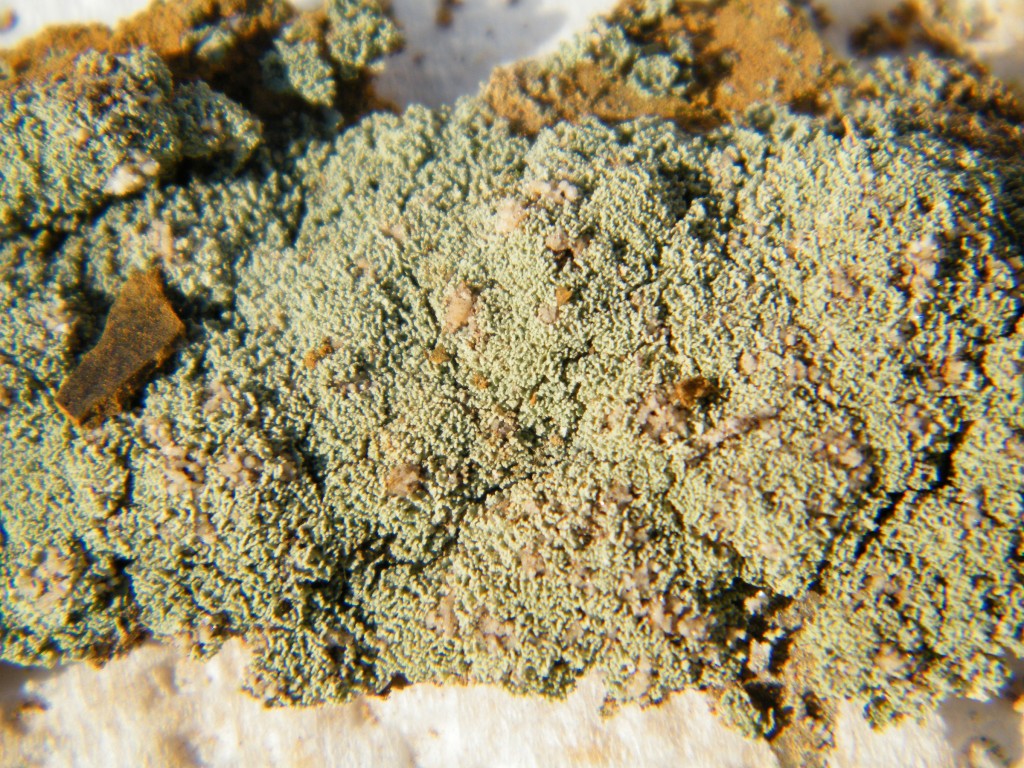
Melanterite efflorescence (hydrated iron sulfate) from Copperas Mountain, Ohio. Pale, fibrous or powdery iron sulfates like this are a typical product of iron sulfide oxidation. Photo: John Krygier, Public domain, via Wikimedia Commons.

Yellow copiapite with red botryogen: natural secondary iron sulfates formed by oxidation of iron sulfides. Yellow-white crusts on a stored pyrite are a warning sign. Photo: Twyla Baker, CC0, via Wikimedia Commons.
The two photos above show natural iron sulfate minerals (melanterite; copiapite with botryogen) that formed when iron sulfides oxidised in the field. They belong to the same family of compounds that blooms on decaying specimens in a drawer.
- Isolate it. Move it away from other specimens, especially carbonates and anything with a paper label, because the acid travels.
- Rescue the label. Photograph it and keep it in a separate polyethylene sleeve.
- Put on gloves and a mask. The decay products are acidic, and the dust shouldn't end up on skin or in lungs.
- Dry-brush off the loose decay products with a soft brush, wooden pick or blower bulb, over a disposable sheet. Don't wash it. Water can feed decay that has already started.
- Give it a dry box with silica gel (see below). Never put the specimen in the oven: heat risks cracking, and the piece can absorb moisture as it cools.
- Write it down. Note what you saw and did, with dated photos, on the specimen's catalog record, so you can tell next year whether it's stable.
- Call in a conservator for valuable or advanced cases. The museum treatment involves ammonia and isn't a kitchen-table job.
The Natural History Museum's approach, described in NatSCA's account of Project Airless, runs like this:
- Mechanical cleaning removes the decay products.
- Ammonia vapour treatment. The specimen sits in a closed container with ammonia vapour from ammonium hydroxide mixed with polyethylene glycol. The affected areas turn brick-red as the acid is neutralised, which makes the products stop absorbing water and resets the specimen's danger point to about 60% RH.
- Consolidation with Paraloid B-72, a stable conservation resin.
- Oxygen-free storage. Specimens are sealed in barrier-film bags with oxygen scavengers.
Treated specimens start decaying again if they go back into humid storage, so storage is what actually protects them.
⚠️ Ammonia is an irritant. Conservators use it under controlled conditions. Don't improvise this treatment in a living space, and never mix ammonia with bleach or other cleaners.
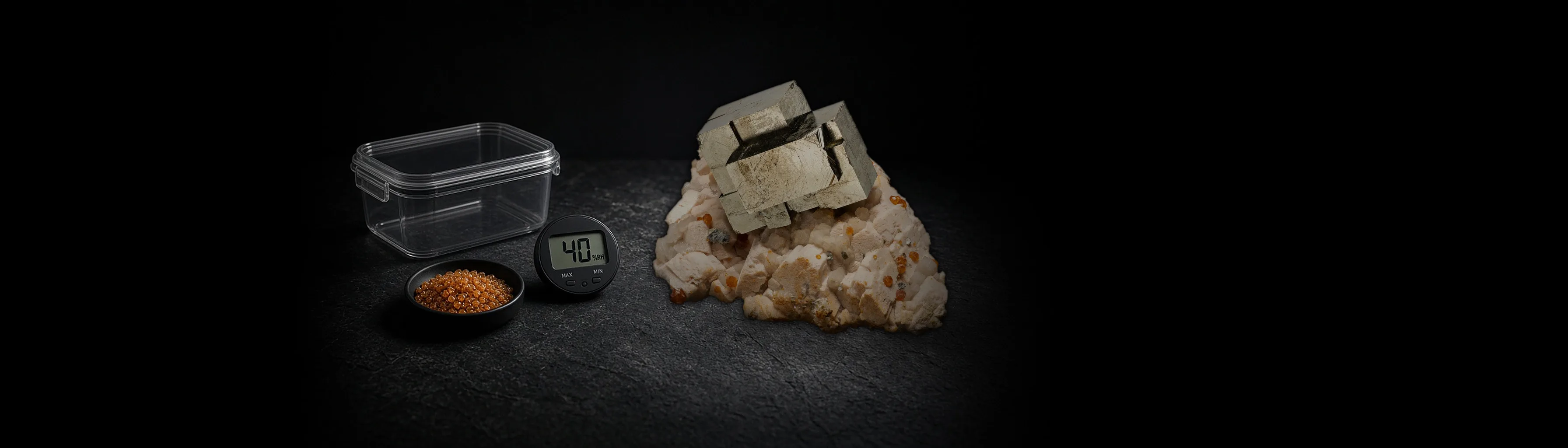
You don't need a museum lab. The collector-level setup recommended by the Institute of Conservation and NatSCA is simple:
- A well-sealed plastic box, such as a food box with a gasket lid, or a specimen box inside a sealed outer box.
- A cut-out of inert polyethylene foam to cradle the specimen.
- A small pierced zip-lock bag of oven-dried silica gel inside the box. Dry the gel in the oven, never the specimen.
- A humidity indicator card or indicating gel, so you know when the gel needs re-drying.
- The label outside the box, or in its own sleeve.
- Targets: below 60% RH, ideally 45% or less. The research optimum is 40% RH with no oxygen. For a valuable or vulnerable piece, oxygen-barrier bags with oxygen scavengers are the next step up.
- Location: a cool, stable room. Not the basement, bathroom or kitchen, and not against an outside wall.
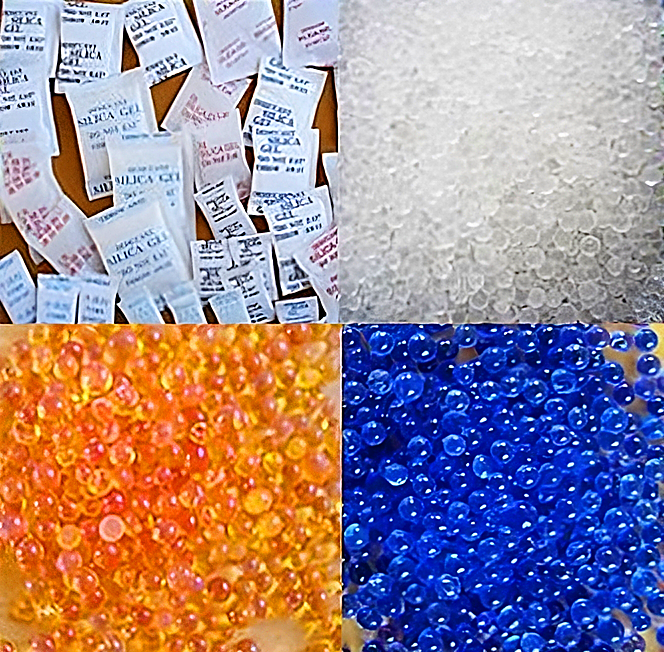
Indicating silica gel beads. Dry silica gel in a sealed box is the standard collector-level way to keep sulfides below the danger zone - but it must be kept away from hydrated minerals. Photo: XtremXpert, CC BY-SA 3.0, via Wikimedia Commons.
⚠️ Never share a dry box. Dry silica gel is great for sulfides and bad for water-bearing minerals. It will dry out and damage borax, chalcanthite, melanterite, opal, autunite and others. Check every species before you put a desiccant in a shared box.
For general storage and display, see How to Store and Display a Mineral Collection.
- Don't polish off a stable tarnish. A dull or brown tarnish on pyrite can act as a protective film. Removing it exposes fresh, reactive sulfide.
- Don't wash decaying specimens, and keep any rinse of sound pyrite brief, then dry it thoroughly.
- Don't use bleach. It can start or speed up decay.
- Don't try old home remedies like boiling in washing soda, antiseptics, bactericide rubs or radiator cleaner. All of them turn up in the history of failed treatments.
- Don't use acid to brighten pyrite. It can release toxic hydrogen sulfide.
- Don't varnish or oil it as a quick fix. Coatings can trap moisture, are hard to remove and change the specimen. Consolidation is a conservator's call.
- Don't store a decaying piece with others, or in card trays and paper.

Tarnished pyrite in a dolostone vug. A dull or brown tarnish can act as a protective (passivating) film; stripping it can do more harm than good. Photo: James St. John, CC BY 2.0, via Wikimedia Commons.
- Buying: check the photos for powder, cracks or a dull, crusty surface, and ask about storage history for marcasite and pyritic fossils. Our guide to buying minerals online covers what to check when the parcel arrives.
- Selling: disclose any decay or treatment in the listing.
- Shipping: seal vulnerable pieces in a bag with a small desiccant pack, so a damp sorting depot doesn't undo your storage.
Pyrite decay is iron sulfide reacting with oxygen and moisture, and humidity above about 60% sets it off. Marcasite, sedimentary pyrite and pyritized fossils are most at risk. Check them every few months for white powder, cracks and a sulfur smell. If you find decay, isolate the piece, rescue the label, dry-brush it (never wash it) and seal it in a box with dry silica gel. Keep sulfides below 60% RH, ideally around 40–45%, keep that dry box away from water-bearing minerals, and call a conservator for anything valuable. For everything else on caring for a collection, see our mineral specimen care guide and How to Clean Minerals by Type.









.jpg)
_2.jpg)


.jpg)

