






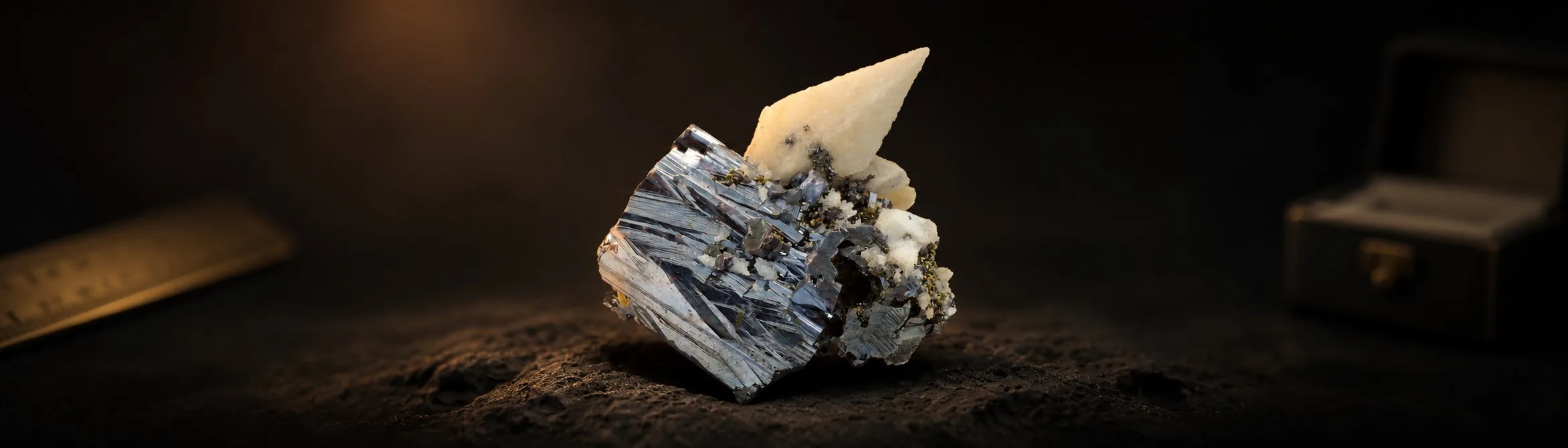
TN floater, DT, ex. collection, no repairs: collectors use these words constantly and rarely define them. Here is what each one means, including the size ranges EarthWonders uses and how to read a listing's dimensions line.
Read a few mineral listings and you start to pick up a dialect: "TN floater, DT, ex. collection, no repairs." Collectors use these words so often that they rarely stop to define them, and the definitions are not quite universal. A "cabinet" piece from one seller can be a "small cabinet" from another.
This guide starts with the size classes, then covers the words that describe how a specimen grew, where it came from, who owned it and what has been done to it since. Most are shorthand for questions a careful buyer would ask anyway.
Size classes, and why the numbers wander
A size class describes how big the whole specimen is. These classes are a collecting tradition, not a formal standard, so the boundaries shift. Show competitions are the strictest: under the rules many clubs follow, a thumbnail has to fit inside a 1-inch (2.5 cm) cube. Dealers are looser. Some stretch "thumbnail" to 3 cm or more, and the larger classes vary the most. Some lists call anything over 10 cm a cabinet, while others split it into cabinet, large cabinet and museum.
EarthWonders assigns every specimen a class from its longest measurement:
| Size class | Shorthand you may see | Longest dimension on EarthWonders | Roughly |
|---|---|---|---|
| Thumbnail | TN | up to 2.5 cm | up to 1 in |
| Miniature | MIN, mini | 2.5 to 5 cm | 1 to 2 in |
| Small cabinet | small cab | 5 to 10 cm | 2 to 4 in |
| Cabinet | CAB | 10 to 15 cm | 4 to 6 in |
| Large cabinet | large cab | 15 to 30 cm | 6 to 12 in |
| Museum | museum piece | over 30 cm | over 12 in |
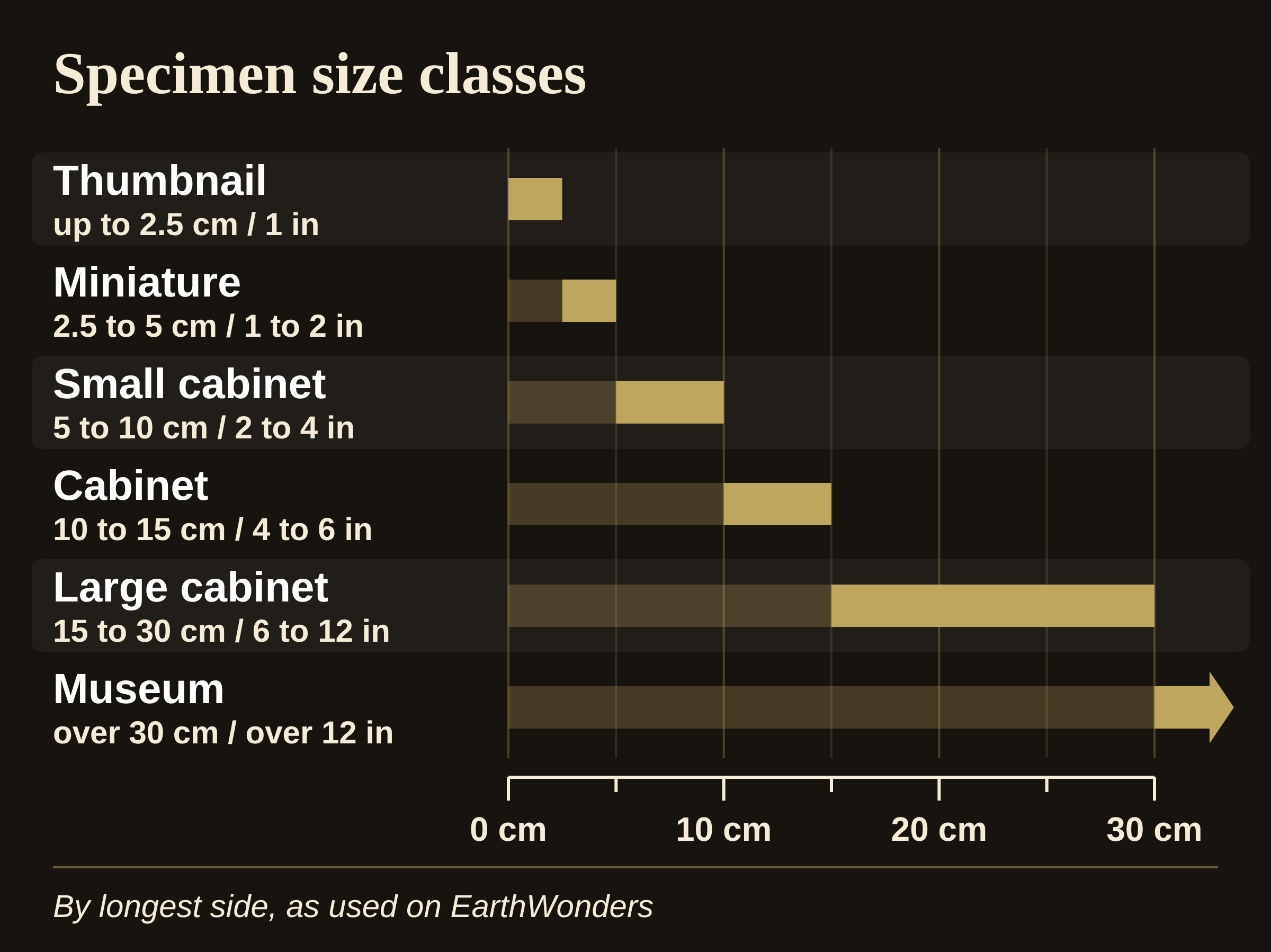
EarthWonders size classes by longest dimension, from thumbnail (up to 2.5 cm) to museum (over 30 cm).
Two more terms sit outside the table. A micromount is a specimen small enough that it needs magnification to appreciate, traditionally fixed in a small box and studied under a stereo microscope. Toenail is an informal word for pieces in the overlap between thumbnail and miniature, often thumbnails just too big for a competition box. It is not an official competition class, and there is no standard size for it.
Size class is not a quality grade. A fine thumbnail can be worth more than an ordinary cabinet piece, because value tracks quality for the size, as our guide to valuing a collection explains. What the class does tell you is how the piece will live: thumbnails suit small boxes and drawers, while cabinet pieces need shelf space and a stable base (more in How to Store and Display a Mineral Collection).
How to read the dimensions line
On an EarthWonders specimen page, size appears twice: a Size field with the class name, and a Dimensions line with three measurements in centimeters. The tourmaline further down this page reads "Size: Cabinet" and "Dimensions: 11.0 x 10.0 x 4.0 cm."
A few things to keep in mind when you read that line:
- The class comes from the longest number, wherever it sits. This euclase from Chivor, Colombia reads 1.8 x 2.0 x 2.4 cm. The 2.4 is what makes it a thumbnail.
- Dimensions cover the whole piece, matrix included.
- Crystal size is a different measurement. "Crystals to 2 cm" or "main crystal 3 cm" in a description refers to the largest crystal, not the specimen. A cabinet piece can carry small crystals, and a single large crystal can make a miniature.
- Weight is optional but useful for heavy species and for estimating shipping.
- Size words without numbers tell you nothing. "Big specimen" could mean anything. Ask for measurements if they are missing.
Photos strip out scale, so hold a ruler up to the numbers before you buy. When you know what fits your shelf or drawer, the market can filter by class. Here, for example, are the thumbnails currently listed.
Matrix, on matrix and floaters
Matrix is the rock or mineral a crystal grew on. On matrix means the crystals are still attached to it. The matrix can be plain host rock or another mineral species entirely, which is why listings often read "fluorite on feldspar" or "calcite on sphalerite." A good matrix piece shows how the crystals formed and sat in their pocket.
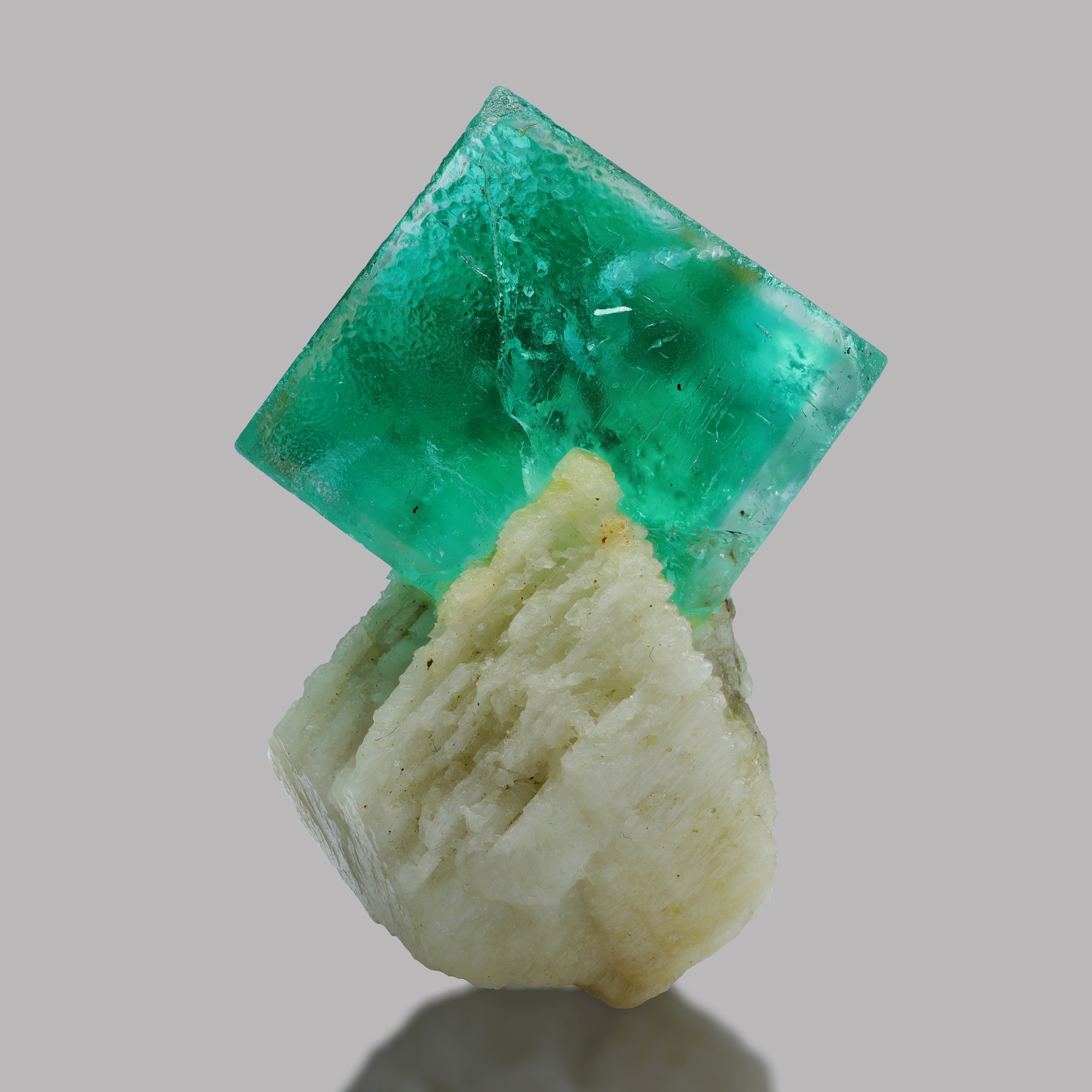
Fluorite on feldspar, Erongo Region, Namibia. A thumbnail on matrix, listed at 2.0 x 1.0 x 1.0 cm. Photo courtesy of John Capelli. View the specimen.
A floater is a crystal or cluster with no visible point of attachment, showing faces all the way around. The word describes how the piece looks rather than proving how it grew. Many floaters formed without touching a hard surface, for example suspended in soft clay. Collectors also use the word for crystals that broke free in the pocket and later healed over the break with new growth. The seller of the Chivor euclase mentioned earlier describes its underside as fully recrystallized and calls it "a true floater."
Do not confuse a floater with a loose crystal. A crystal that was simply broken off its matrix has a rough, broken base where it was attached. A floater does not. If the listing does not show the underside, ask for that photo.
Terminations, DT and contacts
A terminated crystal still has its natural end faces, the pointed or flat tip that closed off its growth. DT stands for doubly terminated: faces at both ends. A crystal attached at its base cannot form faces there, so a DT crystal either grew without attachment or was anchored along its side. The quartz crystals sold as Herkimer "diamonds" from Herkimer County, New York, are a well-known example.
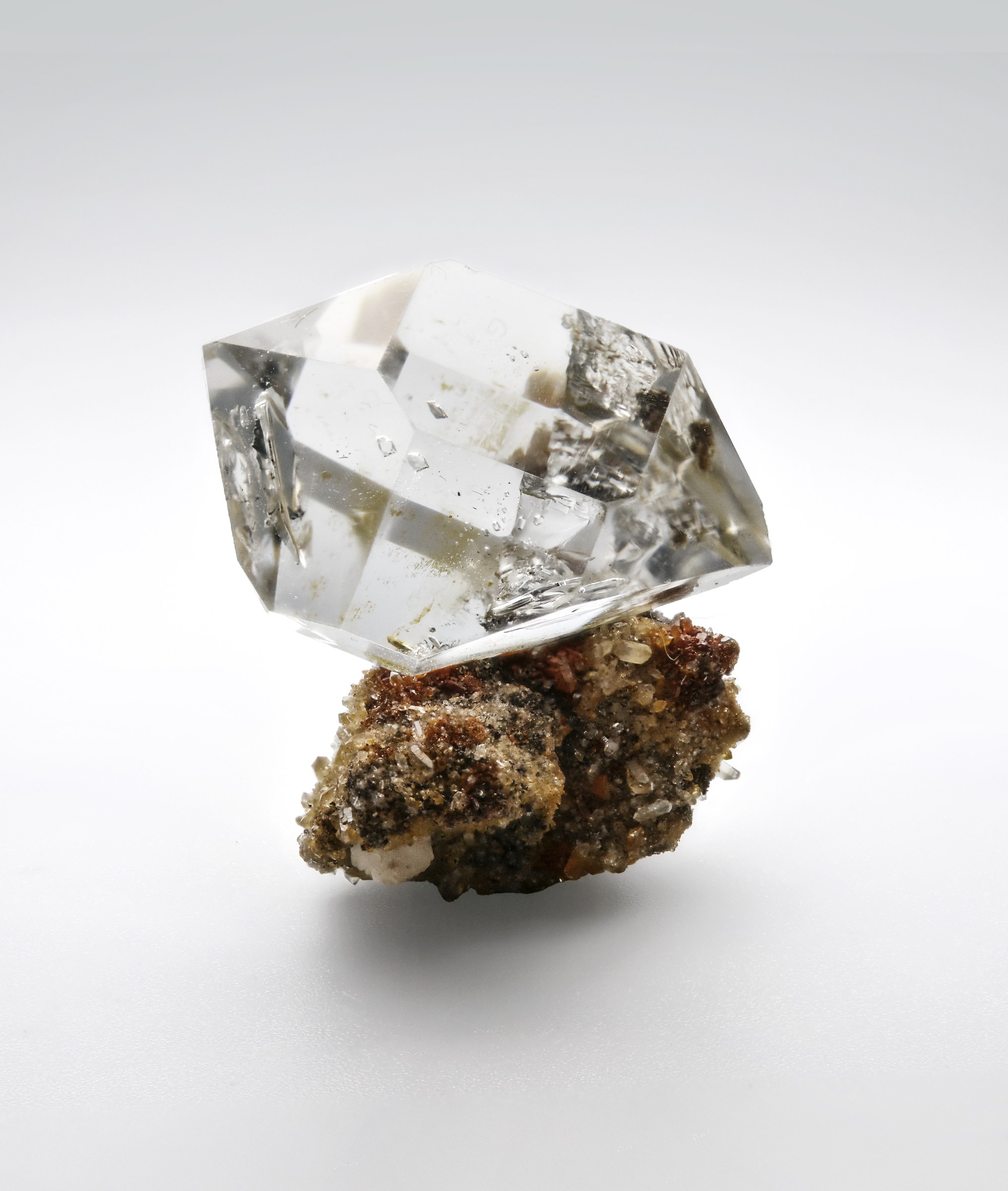
Quartz, Treasure Mountain Diamond Mine, New York, USA. Listed as a miniature at 2.6 x 2.1 x 2.1 cm, with faces visible at both ends of the crystal. Photo courtesy of Tama Higuchi. View the specimen.
A contact is a spot where a crystal grew against matrix or a neighboring crystal, so no face formed there. It is not damage, but a good listing still mentions or shows it. Damage words are different: a ding or chip is a small break after growth, and a broken termination means the tip is missing.
Locality, self-collected and old labels
Locality is where the specimen was found, ideally down to the mine or pocket rather than just the country. It is not the same as where the seller is. The Chivor euclase mentioned earlier was found in Colombia but ships from the USA, and its specimen page shows the two separately, under Locality and Ships from.
Self-collected (or field-collected) means the owner dug the piece out themselves. That usually means the locality is first-hand knowledge rather than something copied from a dealer's tag.
Old labels are the paper cards earlier dealers and collectors wrote for a specimen. They can confirm a locality, date a find or connect a piece to a known collection. Keep them with the specimen.
Ex. collection and provenance
Ex. on a label means "formerly in the collection of." "Ex. Smith collection" says the piece once belonged to Smith. Provenance is the full chain: where a specimen was found, who has owned it since and any documents that prove it.
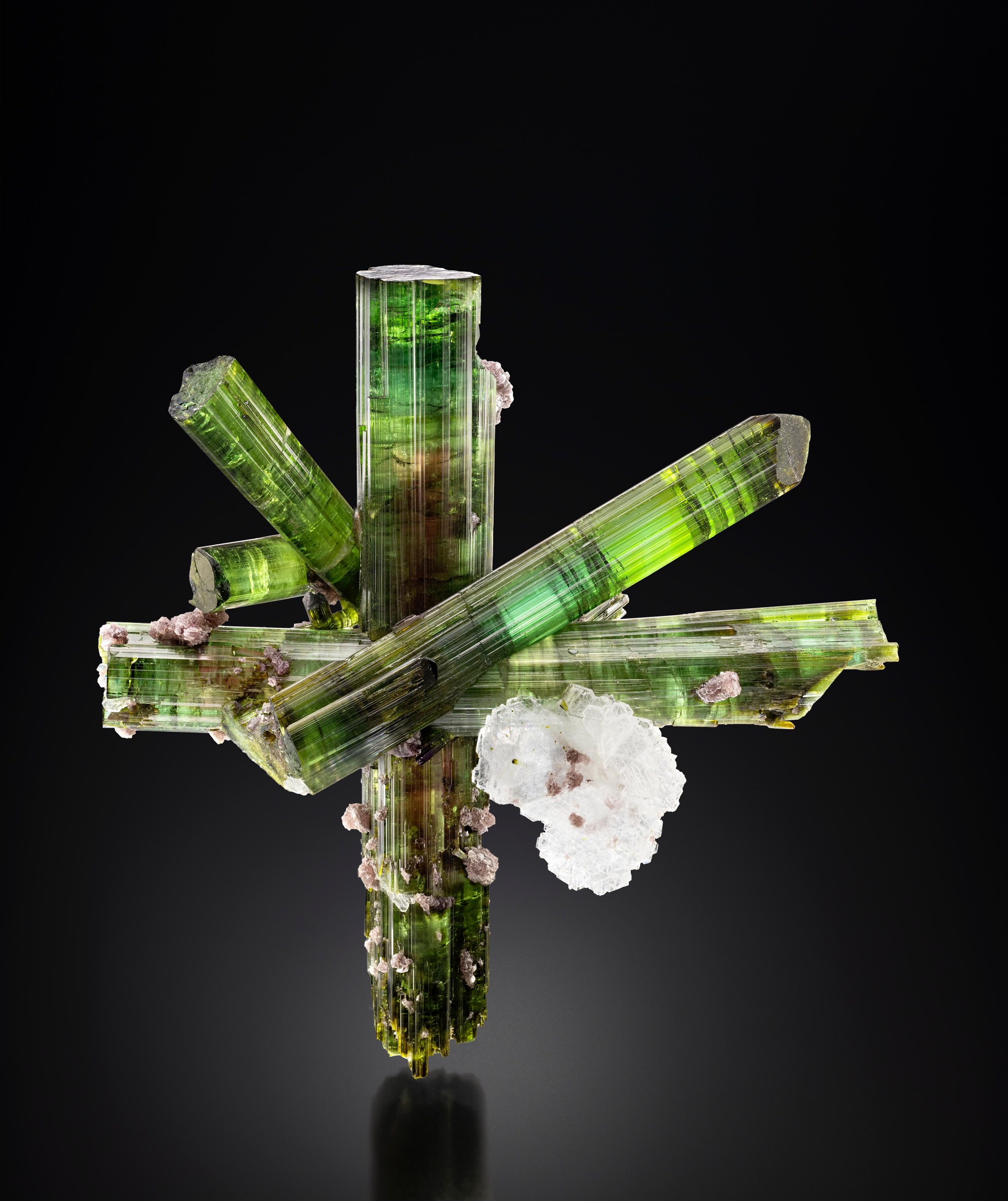
Tourmaline with albite and lepidolite, Pederneira mine, São José da Safira, Minas Gerais, Brazil. Listed as a cabinet piece at 11.0 x 10.0 x 4.0 cm, with Jack Halpern recorded as a previous owner. Photo courtesy of Fabian Wildfang. View the specimen.
A name on a label is only as good as what supports it. An old label in the collector's hand, a catalog number, an invoice or a published photo makes "ex." believable. A famous name with nothing behind it deserves a polite question, since pieces that passed through a dealer's stock sometimes pick up a collection name they never earned. EarthWonders records previous owners on the specimen page, and the help center's page on ownership and provenance explains what complete documentation looks like.
Repaired, restored, stabilized: the disclosure words
These terms move price the most, and they are easy to blur together.
| Term | What it usually means |
|---|---|
| No repairs | The seller states nothing has been glued or rebuilt |
| Repaired | Broken parts of the same specimen glued back together |
| Reattached | A crystal glued back onto the matrix where it broke off |
| Restored | Missing material rebuilt or filled, then shaped to match |
| Stabilized | Glue or resin added to hold fragile or crumbling material together |
| Assembled | Pieces that did not grow together glued into one; a composite, not a repair |
| Trimmed | Matrix cut or broken down to size, usually to help it sit well |
EarthWonders specimen pages have a Repairs field, so check it and read the description too. If neither mentions repairs, ask. A disclosed repair lowers the price honestly; how to spot and handle an undisclosed one is covered in how to buy minerals online without getting burned.
Common questions
What does TN mean on a mineral listing?
Thumbnail: a specimen up to about 2.5 cm (1 inch) on its longest side. EarthWonders uses 2.5 cm as the cutoff, and many competitions require a thumbnail to fit inside a 1-inch cube. Some dealers use a larger limit, so check the dimensions.
What size is a cabinet specimen?
On EarthWonders, a cabinet piece is 10 to 15 cm on its longest side, with small cabinet below it (5 to 10 cm) and large cabinet above it (15 to 30 cm). Other sources draw these lines differently, so the numbers on the listing matter more than the label.
Is a floater worth more than a specimen on matrix?
Neither is automatically worth more. Floaters are prized for complete crystals with faces all around; matrix pieces are prized for showing how the crystals grew.
Listing a piece of your own? The help center's guide to writing great descriptions shows how to cover dimensions, locality, provenance and repairs so buyers find them quickly.