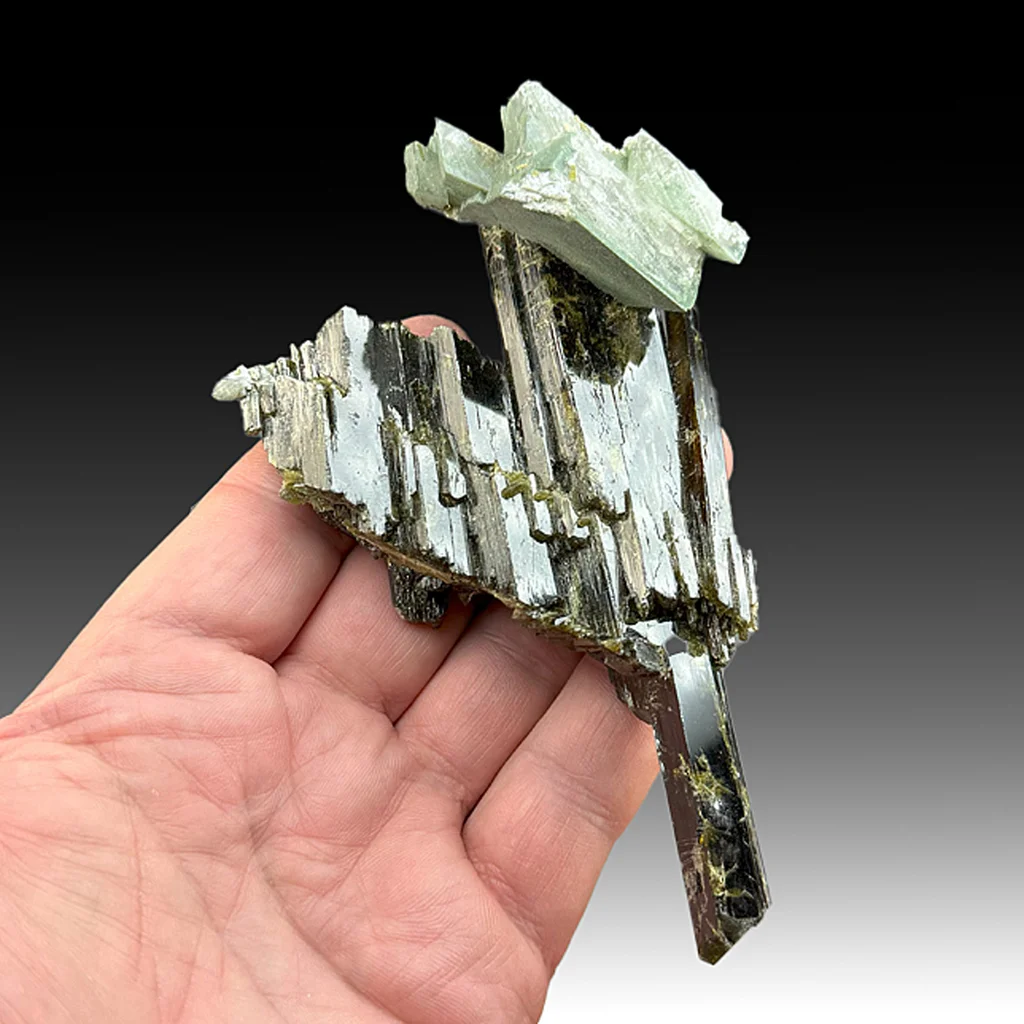
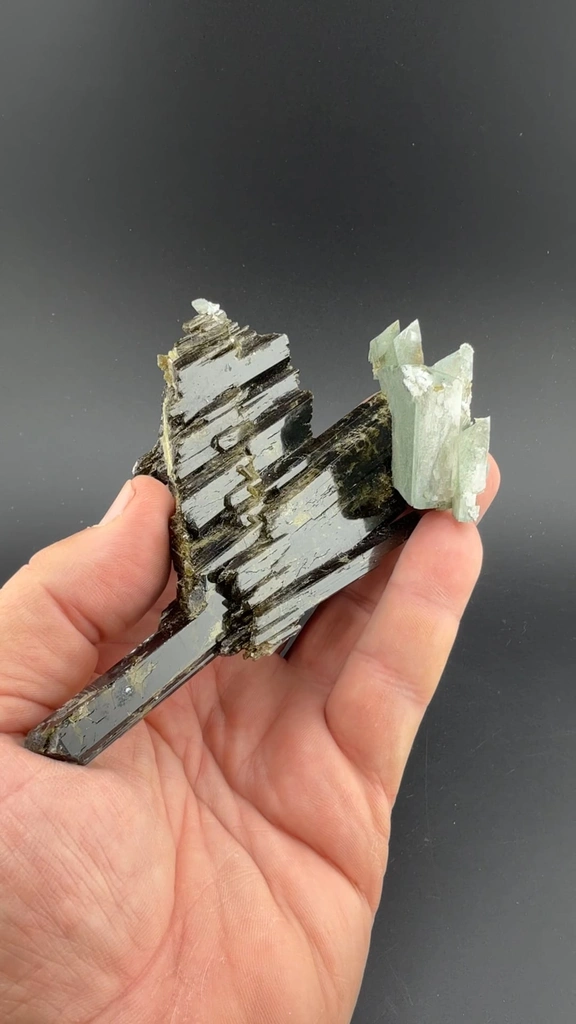
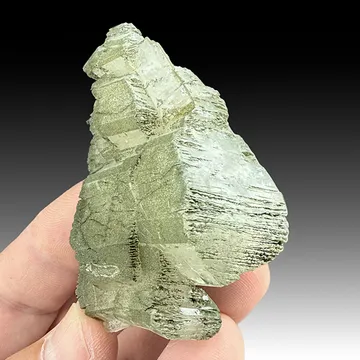
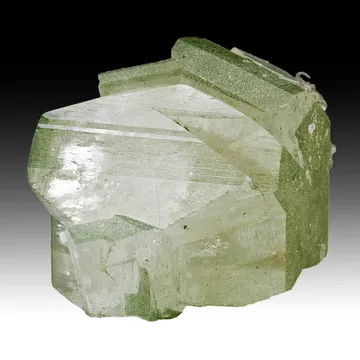
A herringbone crystal grouping of lustrous green translucent epidote crystals, one end hosting a cluster of blocky adularia crystals with minor chlorite. This is in super condition. There are no points of attachment.
Tormiq Valley, situated in the Karakoram region of Gilgit-Baltistan, Pakistan, between Shengus and Skardu, is not a conventional commercial ore mine with a fixed opening or closing date; instead, it is an artisanal, specimen-driven mineral field actively worked by local miners on an intermittent basis since the early 1990s. Geologically, the valley functions as a classic Alpine-type cleft locality rather than an industrial deposit. It was formed by intense tectonic deformation and fracturing associated with the Main Karakoram Thrust and the regional collision of the Indian and Eurasian plates. These tectonic processes opened open-space fissures and pocket seams in metamorphic and igneous host rocks—including amphibolites, gneisses, and metasedimentary schists—allowing hydrothermal fluids to circulate and crystallize fine, free-grown mineral specimens such as titanite, hematite iron roses, epidote, and quartz.


 Ships from USA
Comments