A collector's guide to Yaogangxian Mine, China: its geology, mining history and notable minerals, illustrated with the 1584 specimens documented from this locality on EarthWonders.
Key facts
Yaogangxian is one of the great modern specimen localities: a working tungsten-tin mining district in southern Hunan whose fine-mineral output has become as recognizable to collectors as its ore geology is to economic geologists. The mine lies in the central Nanling metallogenic belt, where Late Jurassic granitic magmatism drove a complex W-Sn-polymetallic hydrothermal system into Cambrian-Devonian clastic rocks and carbonate-bearing units around the Yaogangxian composite pluton. The collector material reflects that layered history. Early wolframite-group minerals and quartz were followed by sulfides and sulfosalts, then by the late fluorite-carbonate-quartz assemblages that make so many Yaogangxian specimens immediately identifiable.
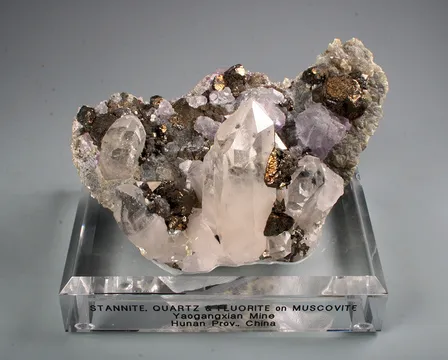
The mine matters because it is not a one-species locality. It is a fluorite locality, certainly, with purple, blue, green, and zoned cubic crystals that can sit on quartz, mica, calcite, dolomite, arsenopyrite, ferberite, scheelite, pyrite, chalcopyrite, and sulfosalts. But it is also a world-class arsenopyrite locality, an important bournonite and stannite locality, a classic source for black tungsten-mineral blades, and a remarkably productive source of mixed hydrothermal assemblages. The best pieces have a particular tension: gemmy pastel fluorite against glittering mica, silver-gray arsenopyrite wedges against white quartz, black ferberite blades cutting through late quartz and fluorite, or cogwheel bournonite and bronze stannite in metallic contrast with clear quartz.
Regional View
Country View
Historically, Yaogangxian bridges two worlds. As an ore deposit, it has been mined since the early twentieth century and remains part of China’s immense tungsten story. As a specimen locality, it rose to international prominence when Chinese minerals began reaching Western dealers in volume in the 1990s and 2000s. The finest cabinet specimens from this mine are not merely pretty fluorites; they are paragenetic diagrams in three dimensions, showing the progression from tungsten-quartz veining through sulfide mineralization to late-stage fluorite, calcite, dolomite, and quartz.
Search for specimens: View all specimens from Yaogangxian Mine, China
Yaogangxian Mine is in the Yaogangxian W-Sn ore field, Yizhang County, Chenzhou, Hunan Province, China. The mine is commonly abbreviated by collectors and dealers as YGX, but the full locality is important: it is part of a broader ore field that includes more than one mineralized center. The mine itself is reported at approximately 25° 38' 35" N, 113° 19' 17" E, in rugged southern Hunan terrain southeast of Chenzhou.
The mining field covers roughly 4 by 2.5 km and includes two major mineralization styles. The first is the Yaogangxian quartz vein-type tungsten-tin deposit, with minor greisen-style mineralization. This is the setting that produced much of the classic specimen material: quartz veins in and around the biotite-granite phase of the Yaogangxian pluton and its western and northern contact zone. The veins trend mainly NW to NNW and are grouped into vein swarms or ore blocks named Yangmeiling, Luchangping, and Hamashi. They are strongly zoned vertically and laterally and carry wolframite-group minerals, cassiterite, quartz, mica, fluorite, calcite, arsenopyrite, chalcopyrite, pyrite, sphalerite, bismuth minerals, and sulfosalts.
The second principal deposit is the Heshangtan skarn-type tungsten-tin deposit. It was discovered in 1947, explored in the 1950s, and mined from the early 1960s. Its orebodies are associated with Devonian sandstone and skarnized slate in the eastern contact zone of the Yaogangxian pluton, and they include scheelite mineralization and significant silver-bearing ores. This skarn component explains part of the mine’s unusually broad calcium-rich assemblage: scheelite, calcite, dolomite, grossular, diopside, epidote, tremolite, vesuvianite, fluorapatite, and related skarn minerals belong to the wider Yaogangxian mineralogical story.
Modern studies treat the quartz-vein wolframite mineralization and the skarn scheelite mineralization as products of a related granitic magmatic-hydrothermal system. The composite Yaogangxian granite includes coarse-grained biotite granite, medium- to coarse-grained two-mica granite, and fine-grained muscovite granite. Zircon, molybdenite, cassiterite, and mica dating in the literature places the principal mineralization broadly in the Late Jurassic, near the 160–150 Ma range, with several studies clustering important ages around 160–157 Ma and younger pulses near the mid-150s to late-140s Ma.
The vein paragenesis is the key to reading Yaogangxian specimens. Published work divides the wolframite-quartz vein system into an early wolframite-cassiterite-quartz stage, a later sulfide-quartz stage, and a still later fluorite-carbonate-quartz stage. That sequence is exactly what the collector sees in hand specimens: black tungsten minerals may be embedded in quartz and then overgrown or flanked by late fluorite; arsenopyrite may occupy quartz-rich sulfide assemblages; fluorite, calcite, dolomite, and rhodochrosite tend to represent later, cooler hydrothermal events.
Access should be understood as industrial and controlled, not recreational. Yaogangxian is not a casual collecting site for visiting hobbyists. Specimens have historically reached the market through miners, mine-associated recovery, Chinese buyers and dealers, and international dealers who handled the material as Chinese mineral exports expanded. Provenance is therefore a practical collecting issue: good labels, older dealer history, analytical notes for sulfosalts, and association minerals all help distinguish true Yaogangxian material from visually similar Chinese fluorite, quartz, and tungsten-mineral specimens.
Specimen production has come in waves. Early international market material included fluorite on quartz, arsenopyrite, ferberite, scheelite, stannite, bournonite, and sulfosalt combinations. Later finds added abundant purple and blue-green fluorite, calcite-fluorite combinations, and new pockets of complex mixed assemblages. The strongest specimens tend to preserve pocket architecture: isolated fluorite cubes set high on quartz, bright arsenopyrite wedges with space around them, ferberite blades not buried in massive quartz, or bournonite and stannite displayed as distinct metallic crystals rather than as indistinct ore patches.
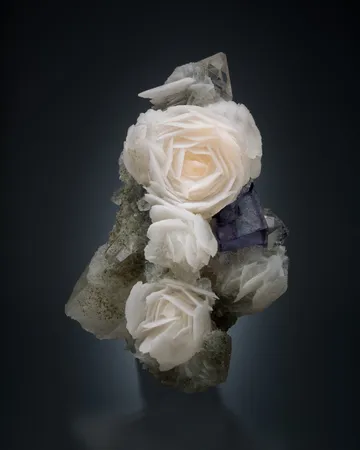
Yaogangxian fluorite is the mine’s most widely recognized collector mineral, typically forming cubes and modified cubic crystals in purple, blue-purple, blue-green, pale green, colorless, and zoned combinations, commonly on quartz, muscovite, calcite, dolomite, arsenopyrite, ferberite, pyrite, chalcopyrite, scheelite, stannite, boulangerite, jamesonite, and other sulfides or sulfosalts. Good pieces separate themselves by crystal clarity, sharp undamaged edges, distinct phantom zoning, attractive contrast against sparkling mica or white quartz, and a composition that makes the locality unmistakable: purple or blue fluorite perched on a textured tungsten-vein matrix rather than isolated cubes with little context. The late fluorite-carbonate-quartz stage explains why fluorite so often appears as the final aesthetic flourish on earlier ore minerals, and the best specimens preserve that overgrowth history without looking crowded or repaired.
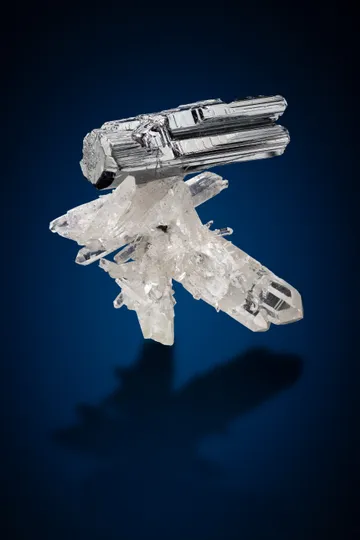
Quartz is both the structural backbone and the visual stage for Yaogangxian specimens, ranging from milky vein quartz and massive matrix to clear, lustrous, terminated crystals, sprays, and “forests” that host fluorite, arsenopyrite, ferberite, scheelite, bournonite, stannite, calcite, dolomite, rhodochrosite, sphalerite, and fibrous sulfosalts. The best quartz specimens are not merely clean crystals; they show the locality’s paragenesis, with terminated quartz carrying sharp purple fluorite cubes, metallic arsenopyrite wedges, black tungsten-mineral blades, or late carbonate accents. Ordinary pieces are common because quartz dominates the veins, but fine pieces have open architecture, undamaged terminations, bright luster, and enough associated species to make them distinctly Yaogangxian rather than generic Chinese hydrothermal quartz.
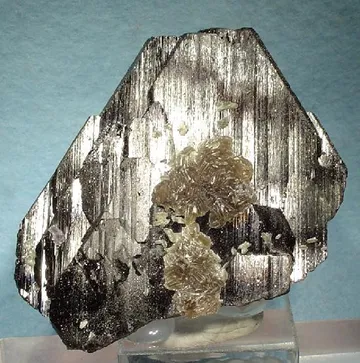
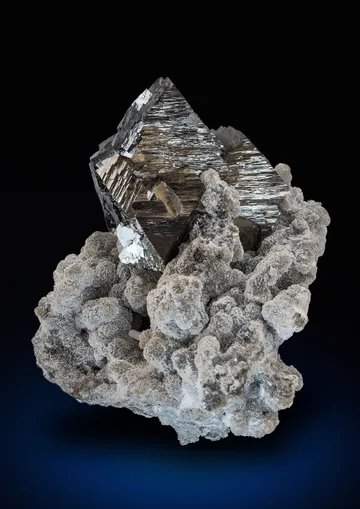
Yaogangxian is a world-class arsenopyrite locality, famous for gray to silver-gray prismatic wedge-shaped crystals that can reach about 6 cm and occur especially with quartz, fluorite, muscovite, ferberite, calcite, stannite, chalcopyrite, scheelite, dolomite, pyrite, sphalerite, cassiterite, siderite, and wolframite-group minerals. The luster may be less mirror-bright than the finest textbook arsenopyrite from some older European localities, but the size, sharpness, and abundance of well-formed crystals make the mine exceptional. High-quality pieces have crisp wedge terminations, bright metallic faces, minimal dull oxidation, and an arrangement that lets the arsenopyrite stand proud of the quartz or mica matrix rather than disappear into massive sulfide.
Bournonite from Yaogangxian is one of the mine’s great connoisseur species, forming gray metallic cogwheel twins and blocky twinned crystals to about 2 cm, typically with quartz and less commonly with fluorite, chalcopyrite, ferberite, arsenopyrite, stannite, boulangerite, jamesonite, calcite, sphalerite, siderite, pyrite, and bismuthinite. These specimens do not usually have the glassy metallic brilliance of the finest Cornish or Bolivian bournonites, but they are bright, large for the species, and highly important. The best examples show unmistakable cogwheel form, balanced placement on quartz, fresh faces, limited edge bruising, and associated sulfosalts or sulfides that enrich the specimen without obscuring the principal bournonite crystals.
Calcite at Yaogangxian is a late carbonate companion to fluorite and quartz, appearing as white, cream, colorless, pale tan, and locally manganese-bearing pink crystals, with collector-favored habits including flattened “poker-chip” rhombohedral plates, stacked rosettes, blades, small pagoda-like aggregates, and sharper rhombohedral or scalenohedral accents. It is commonly associated with fluorite, quartz, arsenopyrite, scheelite, ferberite, muscovite, pyrite, chalcopyrite, dolomite, pyrrhotite, fluorapatite, stibnite, bournonite, jamesonite, bismuthinite, and galena. Quality depends less on size than on contrast and delicacy: white calcite on purple or blue-green fluorite is the classic look, while pink calcite on quartz or calcite with tungsten minerals is more specialized; edge bruising, cleaved corners, and dull surfaces quickly move a piece from fine to ordinary.
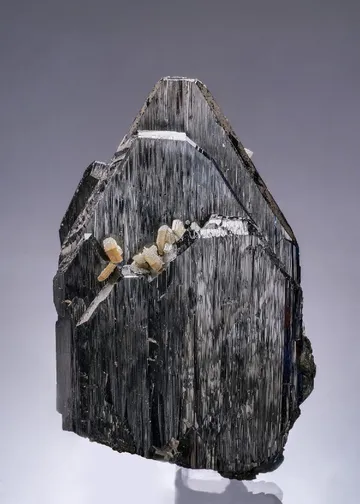
Ferberite is the black tungsten signature of many Yaogangxian specimens, occurring as lustrous bladed, tabular, and spear-like crystals embedded in or rising from quartz, often with fluorite, muscovite, arsenopyrite, calcite, dolomite, chalcopyrite, scheelite, pyrite, bournonite, sphalerite, rhodochrosite, cassiterite, boulangerite, siderite, stannite, and occasional tungstite. In the vein system, wolframite-group minerals belong to the early ore stage, so fine ferberite specimens often look like dark blades later framed by quartz, fluorite, and carbonates. The best pieces have sharp blades, strong black luster, visible crystal form rather than massive ore, and enough late-stage fluorite or quartz to create contrast; ordinary examples are heavy, broken, or mostly massive black tungsten ore with little display geometry.
Scheelite from Yaogangxian belongs both to the skarn story and to the vein assemblage, occurring as pale yellow, honey, tan, brownish, grayish, or translucent pseudo-octahedral crystals and crystal aggregates with quartz, calcite, fluorite, dolomite, arsenopyrite, ferberite, pyrite, muscovite, hübnerite, stannite, chalcopyrite, pyrrhotite, rhodochrosite, bertrandite, boulangerite, cassiterite, and other minerals. Its strong blue-white fluorescence under shortwave UV is a useful field and collection-room feature, although matrix minerals can complicate the visual response. Fine specimens show distinct scheelite crystals perched cleanly on quartz, mica, or carbonate matrix, ideally with fluorite or tungsten-vein associations; lower-grade pieces tend to be dull, massive, or visually lost in mixed skarn ore.
Muscovite is one of Yaogangxian’s most important matrix minerals, forming cream, tan, beige-silver, yellowish, and greenish micaceous carpets, books, plates, and rosettes that set off fluorite, quartz, calcite, dolomite, scheelite, arsenopyrite, pyrite, chalcopyrite, stannite, ferberite, molybdenite, sphalerite, chlorite-group minerals, chamosite, rhodochrosite, and sulfosalts. It is rarely the sole reason to buy a specimen, but it is often the reason a Yaogangxian specimen looks alive: glittering mica catches light beneath purple fluorite, black ferberite, or metallic arsenopyrite. Better pieces have fresh, undisturbed mica with sparkle and relief; poor examples have crushed, clayey, iron-stained, or scrubbed mica that deadens the surface and makes the associated crystals look pasted onto a dull base.
Chalcopyrite is a frequent sulfide accent in Yaogangxian’s polymetallic assemblage, appearing as brassy metallic crystals, grains, and small clusters with quartz, fluorite, arsenopyrite, boulangerite, calcite, stannite, ferberite, bournonite, muscovite, sphalerite, dolomite, pyrite, jamesonite, cassiterite, galena, scheelite, wurtzite, and other sulfides or sulfosalts. It rarely competes visually with the locality’s best fluorite, arsenopyrite, bournonite, or stannite, but in balanced combination pieces it supplies essential golden contrast. Good chalcopyrite-bearing specimens have fresh brassy luster and discrete crystals that brighten a quartz-fluorite or sulfosalt association; ordinary ones show tarnished, granular chalcopyrite scattered through matrix without crystal definition.
Yaogangxian stannite is a serious species collector’s prize, forming brown-black to bronze-olive tetrahedra, single crystals to about 2 cm, and complex crystal intergrowths reported to about 6 cm, most often with quartz and commonly with arsenopyrite, fluorite, chalcopyrite, muscovite, bournonite, jamesonite, boulangerite, scheelite, ferberite, siderite, kësterite, sphalerite, owyheeite, pyrite, dolomite, bismuthinite, and wolframite-group minerals. Fine pieces show recognizable tetrahedral form and metallic luster instead of massive tin-copper sulfide; the most desirable are sculptural stannite-on-quartz combinations or mixed stannite-arsenopyrite-fluorite specimens where the rare species remains clearly visible. Because stannite can be confused visually with other dark sulfides and sulfosalts, analytical confidence and reputable provenance matter more here than for common fluorite.
Dolomite at Yaogangxian is a carbonate companion in the late-stage assemblage, typically appearing as pale, cream, tan, or grayish rhombohedral crystals and crusts with fluorite, quartz, scheelite, pyrite, muscovite, arsenopyrite, ferberite, calcite, chalcopyrite, jamesonite, hübnerite, galena, sphalerite, boulangerite, wolframite-group minerals, stannite, mica, chamosite, helvine, siderite, marcasite, cassiterite, and rare rhodochrosite. It is not generally the star species, but it can sharpen the visual identity of fluorite-quartz and scheelite-rich specimens by adding pale rhombohedral texture. The best dolomite-bearing pieces have clean, lustrous, well-separated rhombs that complement fluorite or scheelite; ordinary examples are dull carbonate coatings that add little aesthetic or diagnostic value.
Pyrite is common in Yaogangxian combinations, usually as small brassy cubes, modified cubes, pyritohedra, or granular sulfide accents with fluorite, quartz, calcite, dolomite, scheelite, arsenopyrite, chalcopyrite, muscovite, ferberite, pyrrhotite, rhodochrosite, fluorapatite, sphalerite, stannite, jamesonite, and other sulfide-bearing matrix minerals. The best pyrite pieces are those where pyrite adds sharp golden punctuation to purple or blue fluorite, or where cubic pyrite crystals sit cleanly on fluorite and quartz without overwhelming the specimen. Ordinary pyrite from the mine is common and visually secondary; collectors should look for freshness, sharpness, and balanced placement, because dull or tarnished pyrite quickly makes a Yaogangxian piece look tired.
“Wolframite” on Yaogangxian labels should be read carefully because the mine contains wolframite-group material with both ferberite- and hübnerite-rich compositions reported from different contexts, and older labels may not distinguish the end-member without analysis. In hand specimens the group appears as black to brown-black bladed, tabular, and spear-like crystals with quartz, fluorite, dolomite, calcite, pyrite, scheelite, arsenopyrite, muscovite, stannite, and related sulfides. The finest wolframite-group specimens are strongly architectural, with lustrous blades exposed against quartz or late fluorite; lesser pieces are massive ore fragments or ambiguous dark blades where the exact species is uncertain. For a serious suite, a specimen documented as ferberite or hübnerite is preferable to one labeled only “wolframite” unless the aesthetics are exceptional.
Boulangerite from Yaogangxian is a rare and much-misunderstood sulfosalt, forming metallic silvery-gray acicular to fibrous crystals that have been reported to impressive lengths, with quartz, chalcopyrite, fluorite, muscovite, bournonite, stannite, ferberite, arsenopyrite, scheelite, calcite, dolomite, molybdenite, and other matrix minerals. It is rarer than many market labels suggest, because fibrous gray sulfosalts from the mine have often been traded under simplified or incorrect names. Good boulangerite specimens show distinct silky needles or sprays, preferably confirmed by analysis or from a reliable source, and are especially appealing when contrasted with purple fluorite or brassy chalcopyrite; ordinary or suspect examples are anonymous gray fibers with no analytical support.
Sphalerite at Yaogangxian is a subordinate but important zinc sulfide in the polymetallic suite, occurring as brown, dark brown, blackish, or resinous crystals and grains with quartz, arsenopyrite, chalcopyrite, ferberite, fluorite, stannite, kësterite, owyheeite, galena, pyrite, dolomite, bournonite, muscovite, calcite, cassiterite, siderite, and jamesonite. It rarely defines the locality visually by itself, but it contributes to some of the most complex sulfide-sulfosalt associations from the mine. Better sphalerite pieces show lustrous, identifiable crystals in balanced association with quartz, fluorite, or metallic species; ordinary pieces are dark, embedded, or easily overlooked in mixed ore matrix.
Mica on Yaogangxian labels usually refers to undifferentiated mica-group matrix, most often visually consistent with muscovite-rich material, occurring as sparkling plates, books, micaceous crusts, and rosettes with fluorite, quartz, ferberite, arsenopyrite, calcite, dolomite, scheelite, pyrite, chalcopyrite, stannite, rhodochrosite, sphalerite, and sulfosalts. Collectors value it for texture and contrast rather than rarity: a carpet of fresh mica can make purple fluorite float, can frame black tungsten blades, and can brighten silver arsenopyrite. Better mica-bearing specimens have clean reflective plates and an obvious genetic connection to the principal crystals; lower-quality pieces show crushed, muddy, iron-stained, or overly trimmed mica matrix.
Wurtzite from Yaogangxian should be treated as a specialist occurrence rather than a routine label, because published locality data list it as questioned or unconfirmed and the photographed associations are limited, chiefly with chalcopyrite, arsenopyrite, and cassiterite. In the market, small dark zinc-sulfide crystals from complex Yaogangxian assemblages can be tempting to call wurtzite, but sphalerite and other dark sulfides are more common and can be difficult to separate by eye. The best candidate specimens are analytically supported and show discrete crystals in a credible chalcopyrite-arsenopyrite-cassiterite association; ordinary unauthenticated “wurtzite” labels should be approached cautiously.
Bismuthinite is documented from Yaogangxian but is a caution species for collectors because slender metallic gray minerals from the mine have often been mislabeled, and some material sold as bismuthinite has proved to be jamesonite, boulangerite, stibnite, galenobismutite, berthierite, kobellite, cosalite, or related sulfosalts. Genuine bismuthinite is expected as lead-gray to tin-white acicular, bladed, or fibrous metallic material in the bismuth-rich part of the assemblage, commonly sought in association with fluorite, quartz, stannite, ferberite, calcite, and other sulfides or sulfosalts. A good specimen needs more than a label: visible habit, coherent Yaogangxian association, and preferably analytical confirmation. Without that, bismuthinite claims are weaker than comparable claims for fluorite, quartz, arsenopyrite, or ferberite.
Pyrrhotite is a lesser but attractive sulfide from Yaogangxian, occurring as bronze to brownish metallic crystals and aggregates with calcite, pyrite, arsenopyrite, scheelite, fluorite, chalcopyrite, quartz, marcasite, and stibnite. It is most interesting when it appears as distinct lustrous crystals in a mixed tungsten-sulfide association rather than as tarnished massive sulfide. Fine pieces show freshness, recognizable crystal form, and a balanced relationship to calcite or scheelite; ordinary pieces are dark, oxidized, or visually subordinate. Because pyrrhotite can oxidize and because marcasite or pyrite may be present nearby, stable storage in a dry environment is prudent.
Siderite is a minor carbonate in the Yaogangxian suite, appearing as tan, brown, gray-brown, or iron-stained rhombohedral crystals and coatings with fluorite, quartz, arsenopyrite, stannite, ferberite, bournonite, dolomite, sphalerite, chalcopyrite, and calcite. It is rarely the star of a specimen, but it can provide warm color and rhombohedral texture in late carbonate assemblages, especially where fluorite or quartz gives the piece stronger visual identity. Better siderite examples have crisp rhombs, fresh surfaces, and contrast with fluorite or metallic species; ordinary siderite is dull brown carbonate on matrix and can be confused in photographs with iron-stained calcite or dolomite.
Jamesonite is an important rare sulfosalt at Yaogangxian, occurring as gray metallic needles to about 2 cm and as fibrous aggregates, commonly with fluorite, quartz, dolomite, stannite, chalcopyrite, bournonite, pyrite, wolframite-group minerals, calcite, muscovite, arsenopyrite, and sphalerite. It is also one of the mine’s classic mislabeling traps: Yaogangxian jamesonite has been sold as bismuthinite, boulangerite, and galenobismutite, while X-ray work has confirmed jamesonite in some such material. The best specimens show visible needles or sprays in a well-balanced matrix, ideally with analysis or strong provenance; ordinary examples are anonymous gray fibers that cannot safely carry a premium species name.
Rhodochrosite from Yaogangxian is uncommon and prized when fresh, appearing as pink to red rhombohedral crystals, lenticular rhombohedra, small aggregates, or coatings with quartz, fluorite, ferberite, helvine, muscovite, bertrandite, scheelite, fluorapatite, calcite, pyrite, and cookeite. It gives Yaogangxian a softer palette than the familiar purple fluorite and black tungsten minerals, and damage-free aesthetic pieces are notably scarce. High-quality specimens show vivid uniform pink color, clean crystal faces, and strong contrast against quartz or ferberite; ordinary examples are tiny, bruised, pale, or hidden in mixed matrix where the rhodochrosite contributes little visual impact.
Fluorapatite is a rare but attractive accessory at Yaogangxian, recorded with quartz, fluorite, calcite, pyrite, rhodochrosite, siderite, bismuthinite, muscovite, and arsenopyrite, and also cited in broader descriptions with arsenopyrite, bournonite, boulangerite, stannite, ferberite, chalcopyrite, quartz, and fluorite. It is generally a small-crystal species here rather than a cabinet-scale showpiece, with collector interest strongest when pale to purple or bluish apatite crystals are clearly visible in a complex Yaogangxian association. The best examples have identifiable hexagonal crystals, fresh luster, and reliable provenance; ordinary apatite-bearing pieces require magnification or analysis to appreciate and are often bought by locality specialists rather than display collectors.
Beyond the species above, Yaogangxian has a remarkably broad documented mineral list that includes cassiterite, hübnerite, molybdenite, galena, stibnite, stolzite, stromeyerite, hessite, native silver, dyscrasite, gustavite, galenobismutite, cosalite, kobellite, ramdohrite, semseyite, stephanite, pyrargyrite, tetrahedrite-subgroup and freibergite-subgroup minerals, berthierite, beryl, bertrandite, bavenite, euclase, topaz, helvine, kaňkite, oxyplumboroméite, tungstite, grossular, diopside, epidote, tremolite, vesuvianite, chamosite, clinochlore, laumontite, albite, orthoclase, zircon, and several mica varieties including lithian muscovite and fuchsite. No valid type-locality mineral is generally credited to Yaogangxian, but the mine’s rarity suite is unusually deep: its collector importance rests not on type-locality status but on the sheer number of well-crystallized ore, gangue, skarn, and sulfosalt species preserved in specimen-quality form.
Yaogangxian is abundant on the market, but abundance does not make it simple. The most common issue is locality drift. Many Chinese fluorites, quartz-fluorite combinations, and tungsten-mineral specimens are visually similar in a broad sense, and labels such as “Hunan,” “Yao Gang Xian,” “YGX,” or simply “China” should be weighed against the mineral association. Convincing Yaogangxian pieces usually show some combination of purple or blue-green fluorite, quartz, muscovite, calcite or dolomite, arsenopyrite, ferberite or another wolframite-group mineral, scheelite, chalcopyrite, pyrite, stannite, bournonite, or sulfosalts.
The most important species-confusion problem is among fibrous and acicular metallic minerals. Material sold as boulangerite or bismuthinite may instead be jamesonite, stibnite, berthierite, galenobismutite, kobellite, cosalite, or another sulfosalt. Jamesonite itself has been sold under other names. Serious buyers should ask for analytical support when a specimen’s value depends on a rare sulfosalt identity. Aesthetic fluorite-quartz specimens do not usually need laboratory confirmation, but expensive sulfosalt, stannite, wurtzite, bismuthinite, or “wolframite end-member” claims often do.
Condition is central. Fluorite from Yaogangxian commonly has bruised cube corners, cleaved edges, internal veils, or contacts where it grew against quartz. Calcite cleaves and chips easily, especially in thin poker-chip plates. Mica matrix can be crushed or dulled by aggressive cleaning. Arsenopyrite can be naturally somewhat dull and may tarnish, while pyrrhotite and marcasite-bearing pieces deserve dry storage. Quartz points frequently show pocket contacts or small termination chips. The best specimens are not necessarily perfect, but they should have damage that is minor relative to the display face and the mineralogical significance.
Fluorescence adds another layer. Scheelite is strongly fluorescent under shortwave UV and is one of the easiest Yaogangxian minerals to appreciate under ultraviolet light. Some calcite is fluorescent, including manganese-bearing material, and fluorite may respond under UV depending on color, impurities, and specimen history. UV response is useful, but not a substitute for identification: scheelite fluorescence is distinctive, whereas mixed carbonate-fluorite-sulfide specimens can produce complicated visual responses.
Market availability remains high. Small fluorite, quartz, calcite, muscovite, and pyrite-bearing pieces are common. Good fluorite on quartz or mica is readily available but increasingly competitive when the fluorite has strong zoning, saturated blue or purple color, and little damage. Fine arsenopyrite, bournonite, stannite, ferberite, scheelite, rhodochrosite, and confirmed sulfosalt specimens are much less common in high aesthetic quality. For a serious Yaogangxian suite, aim for breadth rather than a single “best” fluorite: one fluorite-quartz piece, one arsenopyrite, one tungsten-mineral specimen, one bournonite or stannite, and one late carbonate or scheelite combination will tell the locality’s story far better than a row of similar purple cubes.
In the summer of 1947, Chinese geologists Xu Keqin and Ji Shouyuan were investigating the wolframite mine at Yaogangxian when they found something that shifted the district’s geological importance beyond vein tungsten. At Heshangtan, on the southeastern side of the mine, they recognized what was later described as China’s first skarn-type scheelite deposit. The following summer Xu returned with Jin Wanlin to carry out geological and topographic surveys in the scheelite district. Near Lin’s residence, about 200 to 300 m east on a hillside gully, they noticed small yellow crystals in clay and sludge. A blowpipe test in the field indicated lead and tungstate. The crystals were identified as stolzite, a secondary lead tungstate formed from tungsten in scheelite and lead from sulfides under oxidizing conditions. Xu and Jin dug and washed the clay and recovered about 200 g of small, well-formed yellow crystals, a modest physical haul but a vivid moment in the early scientific understanding of the Heshangtan skarn system.
A much later collector-era glimpse comes from a 2002 visit recorded in the Mindat photo gallery. The town and mine were already tied to the international mineral trade, but not always in ways that favored the traveler. One visitor photographed the main street of Yaogangxian with mine workings visible on the hill in the background and noted that a local man offered specimens for sale at “about ten times higher” than the price available back in Changsha. The visitor did not even bother to bargain. In the same scene stood Yang Zhuming, a figure known to many collectors by association with Chinese mineral dealing. It is a small anecdote, but it captures the early-2000s transition perfectly: a tungsten mining town becoming a specimen locality, with pocket material, local pricing, export dealers, and Western collectors all learning the new geography of Chinese minerals in real time.
Another telling episode is a mislabeling detective story from a mineral forum. A collector acquired an arsenopyrite specimen that was sold from a different locality, but close inspection revealed a suite of micro-minerals that did not fit the stated provenance: tiny fluorite containing minute inclusions of a boulangerite-like mineral and very small clear topaz crystals. The association pointed back to Yaogangxian. The collector changed the label, kept the original label, documented the reason, and left a question mark for the exact truth. That is Yaogangxian in miniature: visually distinctive enough for an experienced eye to recognize from its associations, but complex enough that honest uncertainty and careful labeling remain part of good collecting practice.