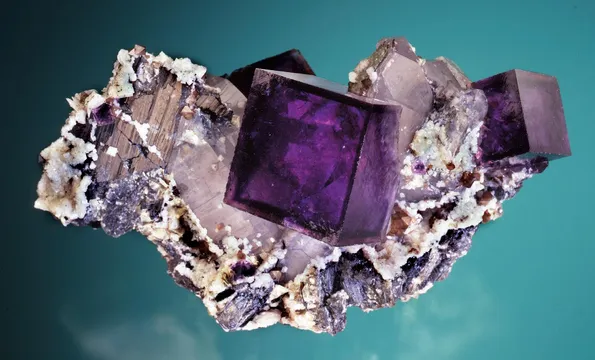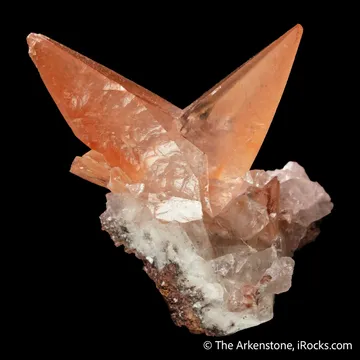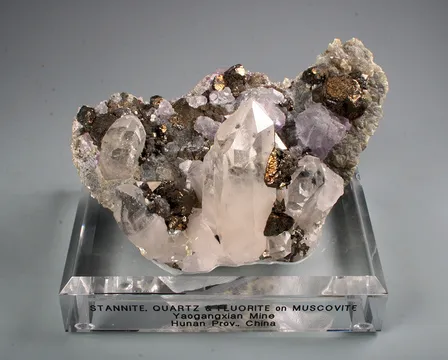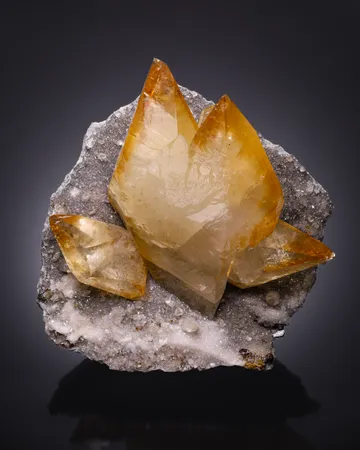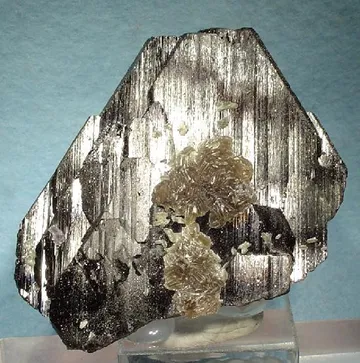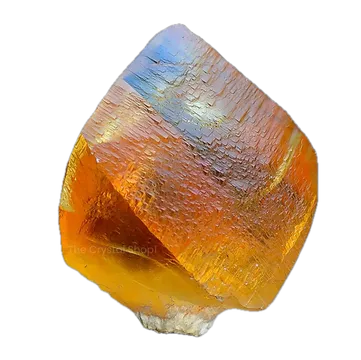
Calcite from the Yaogangxian Mine is not merely an accessory carbonate on famous Chinese fluorites; at its best it is one of the visual signatures of the locality. Collectors most often encounter it as crisp white to pale pink “poker-chip” aggregates, bladed rosettes, stacked pagoda-like sprays, steep scalenohedra, or flattened rhombohedral groups perched on fluorite, quartz, ferberite, scheelite, muscovite, pyrite, chalcopyrite, and other Yaogangxian species. The appeal lies in contrast: delicate, pearly calcite set against glassy purple or blue-green fluorite; pink manganese-bearing calcite on sparkling quartz; or a single water-clear calcite twin rising from metallic black ferberite.
Key facts
Calcite from the Yaogangxian Mine is not merely an accessory carbonate on famous Chinese fluorites; at its best it is one of the visual signatures of the locality. Collectors most often encounter it as crisp white to pale pink “poker-chip” aggregates, bladed rosettes, stacked pagoda-like sprays, steep scalenohedra, or flattened rhombohedral groups perched on fluorite, quartz, ferberite, scheelite, muscovite, pyrite, chalcopyrite, and other Yaogangxian species. The appeal lies in contrast: delicate, pearly calcite set against glassy purple or blue-green fluorite; pink manganese-bearing calcite on sparkling quartz; or a single water-clear calcite twin rising from metallic black ferberite.
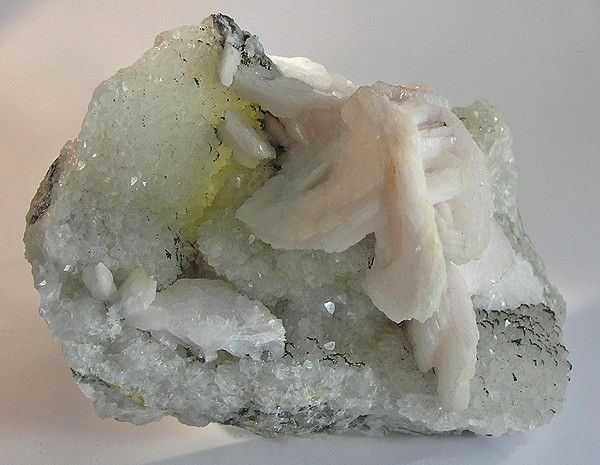
Photo: Wikimedia Commons
The mine is a granite-related tungsten-tin system in the Nanling metallogenic belt of southern Hunan. Its mineralogy reflects two linked but distinct environments: wolframite-bearing quartz veins, and skarn mineralization developed along the intrusive contact. Calcite belongs to the later and cooler carbonate-rich parts of the hydrothermal story, and that late-stage timing is why it so often decorates rather than dominates Yaogangxian specimens. In the collector market, the finest calcites are valued for clean, undamaged plate-like crystals, attractive pale pink manganese color, sculptural growth, and association with major Yaogangxian species rather than for size alone.

Photo: Wikimedia Commons
Yaogangxian’s fame rests on much more than calcite: arsenopyrite, fluorite, quartz, bournonite, scheelite, ferberite-hübnerite series minerals, cassiterite, muscovite, sulfosalts, pyrite, chalcopyrite, rhodochrosite, and other species have made the mine a classic modern Chinese locality. Calcite’s role is to bind those worlds together visually. It is the white or blush-pink architectural ornament in a mine better known for tungsten ore and luminous fluorite.
Search for specimens: View all calcite specimens from Yaogangxian Mine, China
The Yaogangxian Mine lies in Yizhang County, Chenzhou, Hunan Province, China, in the Yaogangxian W-Sn ore field. The locality is also commonly abbreviated as the YGX Mine, and the Chinese locality name is 瑶岗仙矿. Coordinates given by Mindat place the mine at approximately 25° 38' 35" N, 113° 19' 17" E.
Geologically, Yaogangxian is a tungsten-tin deposit developed in the contact aureole of the Mesozoic Yaogangxian composite pluton. That pluton includes coarse-grained biotite granite, fine-grained porphyritic granite, and quartz porphyry, intruded into Cambrian to Devonian sedimentary rocks and Jurassic limestone. The mining field is roughly 4 by 2.5 km and includes two principal styles of mineralization.
The classic collector material is largely tied to the quartz vein-type tungsten-tin deposit, with minor greisen-style mineralization. These veins have been worked since 1914 and are hosted in the biotite granite phase of the Yaogangxian pluton and in the western and northern contact zone. The vein swarms trend northwest to north-northwest and are grouped into the Yangmeiling, Luchangping, and Hamashi ore blocks. These veins contain the wolframite-quartz assemblages that made the mine famous, along with subordinate copper, silver, lead, zinc, bismuth-bearing, tin, and carbonate minerals.
The second major deposit is the Heshangtan skarn-type tungsten-tin deposit. It was discovered in 1947, explored during the 1950s, and mined from the early 1960s. It is hosted in Devonian sandstone and skarnized slate along the eastern contact zone of the Yaogangxian pluton, and it includes significant associated silver mineralization. Skarn minerals recorded from the broader mine system include grossular, diopside, epidote, tremolite, vesuvianite, fluorapatite, scheelite, and other calcium-rich species, which explains why calcite-bearing associations can be mineralogically complex.
Yaogangxian is not a recreational collecting locality. It is an underground industrial mine, and collector specimens have historically reached the market through miners, mine-associated recovery, local Chinese dealers, and later international mineral dealers. The arrival of Chinese mineral specimens on the international market in the 1990s and early 2000s transformed Yaogangxian from an important tungsten producer into one of the best-known modern specimen localities in the world.
Specimen production has come in waves. Older material from the late 1990s and early 2000s includes fluorite-quartz-calcite-scheelite combinations and classic metallic associations. A notable 2021 fluorite find produced cabinet specimens with rich Caribbean blue-green cubic fluorite, thin purple zoning, and coatings or accents of small white “poker-chip” calcite crystals. Separate manganese-bearing calcite pieces from the mine show pale pink stacked discs and pagoda-like growth on quartz, a less common Yaogangxian look that appeals strongly to calcite specialists.
The most recognizable Yaogangxian calcite habit is the flattened disc or “poker-chip” style: thin, stacked, tabular rhombohedral plates that form rosettes, blades, or clustered pagodas. These crystals are usually white, cream, translucent, or very pale pink. The pink material is manganese-bearing calcite, commonly written as (Ca,Mn)CO3, and tends to be most desirable when the color is even, delicate, and naturally integrated into the crystal rather than limited to surface staining.
A second important style is bladed or flower-petal calcite on fluorite. These specimens often show translucent white calcite blades partly wrapping purple fluorite cubes or cuboctahedral fluorite groups. The contrast can be superb: cool violet fluorite centers framed by frosty white calcite. In some pieces the calcite appears to predate the fluorite locally, with fluorite growing over or around calcite-rich areas; in others the calcite clearly decorates later surfaces.
Steeper scalenohedral calcites also occur. These are usually less famous than the disc and rosette forms but can be attractive when sharp, glassy, and well isolated on quartz or sulfide matrix. Rhombohedral calcite, including flattened rhombs and stacked groups, is also recorded from the locality. Manganese-bearing flattened rhombohedra are among the more distinctive collector forms because they depart from the more common white accessory calcite seen on fluorite specimens.
Size varies widely. On combination specimens, calcite may appear as millimeter-scale white discs sprinkled over fluorite or quartz, as 1–2 cm rosettes, or as plate-like crystals several centimeters across. Verified photographed examples include pale pink poker-chip crystals to about 3.5 cm across on a 10.9 x 7.9 x 7.8 cm specimen, a miniature fluorite-calcite association measuring 4.3 x 3.9 x 2.5 cm, and small cabinet fluorite-calcite specimens in the 5 cm range. Exceptionally large calcite groups are known from the Yaogangxian ore field, but the best fine-mineral pieces are usually judged more by balance, sculptural form, color, and condition than by sheer mass.
The most important associated minerals for collectors are fluorite, quartz, ferberite, scheelite, arsenopyrite, muscovite, pyrite, chalcopyrite, dolomite, rhodochrosite, sphalerite, stannite, and occasionally sulfosalts. Fluorite-calcite associations are the market staple. Calcite on ferberite or scheelite is more mineralogically pointed and speaks directly to the tungsten-mining context. Pink calcite with quartz is more specialized, but fine examples are prized because they show Yaogangxian in a softer and less predictable palette.
Quality is controlled by four factors. First is crystal architecture: clean rosettes, discrete stacked plates, and sharp bladed sprays are preferable to massive crusts. Second is contrast: white calcite on blue-green or purple fluorite, or pink calcite on quartz, gives the strongest display. Third is condition: calcite cleaves and bruises easily, so edge nicks on thin plates are common. Fourth is locality character: specimens that unmistakably show Yaogangxian associations—fluorite zoning, quartz, tungsten minerals, muscovite, sulfides—are more desirable than isolated calcite groups with weak provenance.
For calcite from Yaogangxian, the main authenticity issue is not a well-documented treatment tradition, but locality attribution. The mine’s reputation is so strong that specimens from other Chinese localities have sometimes been sold or discussed as Yaogangxian when they more closely match other districts. Fluorite on dolomite attributed to Yaogangxian has been challenged as likely Shangbao material, and some older Jiangxi fluorite-calcite-muscovite combinations have been noted as resembling Yaogangxian material closely enough to cause confusion. A careful collector should compare the whole association, not just the label.
There is no widely documented, locality-specific treatment known for Yaogangxian calcite comparable to dyed agate or acid-enhanced commercial calcite. That said, calcite in the broader mineral trade is soft, porous in some textures, and occasionally painted or dyed in low-end decorative material. For Yaogangxian specimens, be wary of unnaturally saturated pink surfaces, color concentrated only in cracks, or “manganoan calcite” claims unsupported by habit, association, or reputable provenance. Genuine pale pink Yaogangxian manganese-bearing calcite is subtle, usually blush to pastel rather than loud.
Condition is a major value factor. Calcite has perfect rhombohedral cleavage and a Mohs hardness of 3, so thin bladed crystals, poker-chip edges, and stacked rosettes chip easily. Small edge bruises are common and may be acceptable on complex combination specimens, especially when the fluorite or tungsten mineral association is strong. On calcite-dominant pieces, however, damage to the plate edges or broken rosette terminations is much more noticeable. Fluorite associations add another risk: fluorite itself cleaves readily, so a specimen may look strong in photos while having bruised fluorite corners and chipped calcite blades.
White calcite on fluorite is available with some regularity because Yaogangxian fluorite specimens circulate widely. Better calcite-dominant examples, especially pale pink manganese-bearing calcite in sculptural poker-chip or pagoda groups, are less common. Cabinet-quality pieces with clean pale pink calcite, sharp form, quartz matrix, and little damage should be treated as selective acquisitions. The most desirable combinations are those where calcite is not an afterthought but an active part of the composition: a halo around fluorite, a rosette field beneath a cube, or a strong pink calcite mass on sparkling quartz.
Prices vary widely with the associated minerals. Modest fluorite-calcite miniatures and small cabinets can remain approachable, while top Yaogangxian fluorite combinations, large cabinet pieces, unusual 2021-style blue-green fluorites with white poker-chip calcite, and rare manganese-bearing calcite groups command stronger prices. The best value often lies in specimens where the calcite is sharp, undamaged, and integral to the aesthetics rather than merely present as a white crust.
Yaogangxian is a mountain mine, and its specimen story begins with the geography. The mining town sits high on Yaogangxian Mountain in humid, forested southern Hunan, far from the coastal cities that later became export gateways for Chinese minerals. One account places the town at about 4,200 feet elevation on a 5,735-foot mountain, with pine-covered slopes and a mining settlement built specifically to serve the tungsten mine and mill. The setting matters: this was not a small collector’s pocket in an abandoned prospect, but a working industrial mountain pierced by adits and ore tunnels.
The mine’s modern history was shaped by world events. German and Swedish geologists recognized rich tungsten mineralization there in the early twentieth century, just as tungsten’s value in hardening steel was becoming strategically important. Mining began in 1914, the same year World War I erupted in Europe and demand for tungsten rose sharply. What collectors now prize as elegant fluorite, calcite, quartz, and sulfide combinations came from a deposit originally driven by military and industrial metallurgy.
The underground workings developed into a maze. More than 200 tungsten-quartz veins have been described, with the largest reported as about eight feet thick and more than half a mile long. Mining progressed downward from surface outcrops toward deeper levels, with workings reached by horizontal adits cut into Yaogangxian Mountain. Those adits branched into haulage drifts, crosscuts, winzes, raises, and inclines, together estimated at more than 30 miles. For a mineral collector, it is a striking image: delicate poker-chip calcite and sharp fluorite cubes emerging not from a tidy pocket mine, but from a sprawling industrial labyrinth built for tungsten ore.
By the mid-1980s the mine, mill, and related facilities employed nearly 5,000 workers. Later accounts describe a smaller but still substantial workforce, including hundreds of underground miners. The important collector shift came when mine managers and workers realized that the open cavities in ferberite-quartz veins were producing saleable crystals. Specially trained miners were reportedly used to recover specimens with minimal damage, and much of the material moved north to Changsha, where it was cleaned, trimmed, and passed into the export trade. That handling chain explains why so many Yaogangxian specimens are neatly trimmed and internationally distributed, even though the mine itself remains inaccessible to ordinary collectors.
The 2021 fluorite-calcite production added a modern chapter. Cabinet specimens from that find carried blue-green fluorite cubes with thin purple edge zoning and white poker-chip calcite on both sides of the pieces. One documented example measured 9.7 x 9.2 x 5.1 cm and had fluorite crystals to 4.0 cm on edge, with pyrite, chalcopyrite, dolomite, quartz, and possible sphalerite or stannite at the base. The description captured the uncertainty that accompanies good Chinese pocket material: few like it were found, and no one knew whether more would appear. That is the rhythm of Yaogangxian collecting—long industrial continuity punctuated by brief, memorable pocket styles.