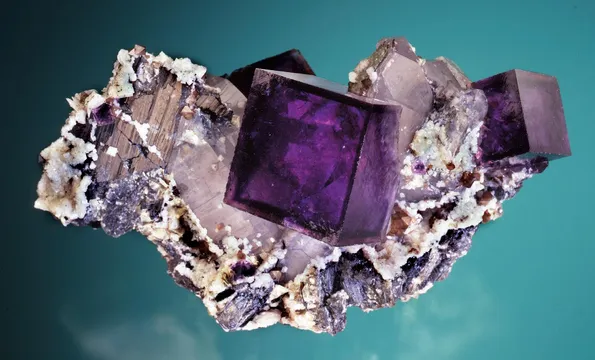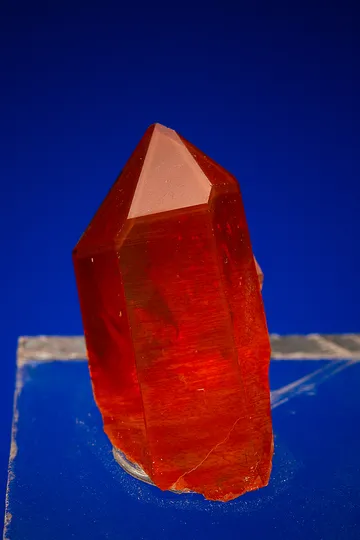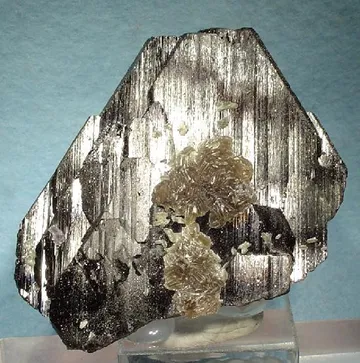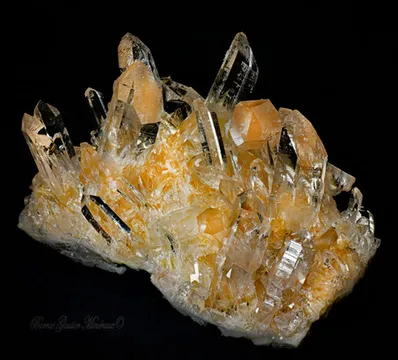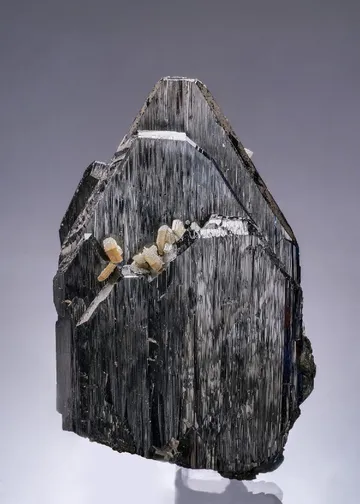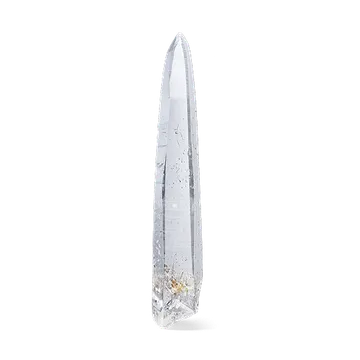
Yaogangxian Mine quartz, China — famed for pale quartz with purple fluorite cubes set in a tungsten-tin hydrothermal system; a premier locality for collectors.
Key facts
Quartz from the Yaogangxian Mine is rarely collected as an isolated species in the way one might pursue Alpine gwindels or Arkansas plates. Its power is as the luminous architecture of a complex tungsten-tin hydrothermal system: glassy points spearing through metallic bournonite, milky to water-clear groups carrying purple fluorite cubes, quartz prisms dusted with pyrite or arsenopyrite, and sharp crystals acting as the pale stage on which scheelite, muscovite, dolomite, calcite, stibnite, stannite, rhodochrosite, and chlorite play out one of China’s great specimen assemblages.
The locality sits in the Yaogangxian W-Sn ore field of Yizhang County, Chenzhou, Hunan, in the central Nanling metallogenic belt. The mine is a granite-related tungsten-tin deposit developed around the Mesozoic Yaogangxian composite pluton, where biotite granite, porphyritic granite, and quartz porphyry intruded Cambrian to Devonian sedimentary rocks and Jurassic limestones. For the quartz collector, the key setting is the quartz vein-type tungsten-tin system: veins hosted in the pluton and along its western and northern contact zone, grouped into the Yangmeiling, Luchangping, and Hamashi ore blocks, and strongly zoned both vertically and horizontally.

Photo: Rob Lavinsky, iRocks.com / Wikimedia Commons
The classic Yaogangxian look is contrast: pale quartz against fluorite in blue, lavender, violet, or purple-zoned cubes; quartz against black wolframite or ferberite-hübnerite series blades; quartz against mirror-bright sulfosalts. Good specimens are not simply “quartz with something on it.” They show a hydrothermal sequence in three dimensions—quartz prisms, later cubes or carbonates, sulfides caught in the open spaces of the vein, and late drusy overgrowths that can make a small cabinet piece read like a pocket wall.
Historically, Yaogangxian rose from an ore mine to a specimen locality during the modern opening of the Chinese mineral market. The deposit was discovered and put into production in 1914, but its best-known specimen era belongs chiefly to the late twentieth and early twenty-first centuries, when Chinese minerals began entering international markets in volume and Yaogangxian’s fluorite-quartz, bournonite-quartz, arsenopyrite-quartz, stannite-quartz, and scheelite-bearing combinations became fixtures of serious collections. Quartz is the thread running through that reputation: not always the headline mineral, but very often the reason the specimen has balance, depth, and a believable geological story.

Collectors look for sharp, undamaged quartz terminations; water-clear to translucent crystals; attractive preferential chlorite phantoms; quartz that carries or frames purple to blue fluorite; quartz with well-placed scheelite; and combinations in which the associated species are not merely present but compositionally integrated. Yaogangxian quartz is most desirable when it makes the specimen unmistakably local: angular Chinese fluorite on prismatic quartz, sulfides perched or embedded in the quartz cluster, or a clean, cabinet-scale combination that preserves the open-space vein texture rather than looking trimmed into anonymity.
Search for specimens: View all quartz specimens from Yaogangxian Mine, China
Yaogangxian Mine is located in the Yaogangxian W-Sn ore field, Yizhang County, Chenzhou, Hunan Province, China. Its geographic position is in southeastern Hunan, roughly in the mineral-rich Nanling belt that has supplied many of China’s great tungsten, tin, fluorite, and polymetallic specimens. The mining field covers about 4 by 2.5 kilometers and includes two principal mineralization styles: the quartz vein-type tungsten-tin deposit with minor greisen-style mineralization, and the Heshangtan skarn-type tungsten-tin deposit.
The quartz vein-type deposit is the collector’s principal source for many of the famous quartz-bearing combinations. These veins are associated with the Yaogangxian pluton and its contact aureole, hosted in granite and in adjacent sedimentary rocks. They strike mainly northwest to north-northwest and are arranged in the Yangmeiling, Luchangping, and Hamashi vein swarms. Ore minerals include wolframite-group minerals, molybdenite, cassiterite, arsenopyrite, chalcopyrite, pyrite, bournonite, and bismuth-bearing species; the gangue is dominated by quartz, with mica, feldspar, fluorite, calcite, dolomite, and other late vein minerals providing many of the specimen associations.
The skarn deposit was discovered in 1947, explored during the 1950s, and mined from the early 1960s onward. It is hosted in Devonian sandstone and skarnized slate in the eastern contact zone of the Yaogangxian pluton and is especially important for scheelite-rich mineralization. Because commercial specimens and older literature do not always distinguish sharply between the quartz-vein and skarn parts of the ore field, a careful collector treats “Yaogangxian Mine” as a broad but meaningful locality label and pays attention to associations: wolframite or sulfide-rich quartz-vein pieces differ from scheelite-skarn or carbonate-rich material in texture, matrix, and paragenesis.
The mine’s production history is long by modern Chinese specimen standards. Mining began in 1914, driven by the value of tungsten for hard steel alloys. Geological studies describe more than 200 ore veins, many cutting both granite and sedimentary strata. Individual veins can be very long and vertically persistent; published work records veins up to 1,200 meters long, 1.5 meters wide, and extending 100 to 1,000 meters downdip. The ore system is not a simple single vein but a complicated underground network of vein swarms, zoned ore shoots, greisenized granite, skarn bodies, and late crosscutting mineralization.
The specimen-producing history is more recent. Although miners encountered open cavities and crystals for decades, Yaogangxian became widely recognized as a world-class specimen source only as Chinese minerals entered the international trade in quantity in the 1990s and 2000s. Its reputation was first built on the dramatic associated species—fluorite, bournonite, arsenopyrite, stannite, wolframite-group minerals, scheelite—but quartz was present throughout the story as matrix, gangue, pocket lining, and sometimes as the chief display mineral.
Collecting access should be regarded as industrial rather than recreational. This is an active or historically active mining complex with underground workings, old adits, unsupported levels, and commercial ore operations. Serious specimens have typically reached collectors through miners, local dealers, Changsha and broader Chinese mineral channels, and international dealers—not through casual field collecting. Fine specimens may have older collection histories from the early years of China’s mineral boom, while newer pieces continue to appear sporadically when pockets are encountered during mining, trimming, or estate dispersals.
Yaogangxian quartz occurs as massive vein quartz, milky crystalline masses, drusy linings, and well-formed prismatic crystals. On collector specimens it is most often seen as short to moderately elongated hexagonal prisms with clean terminations, as dense clusters of milky points, or as glassy water-clear crystals emerging from fluorite, sulfide, or carbonate matrix. Some quartz crystals are flattened or tabular-looking by habit; others are stout, transparent points with internal veils, chlorite phantoms, or late surface coatings.
The color range is chiefly colorless, milky white, and smoky to grayish where included or irradiated by natural or artificial processes. Clear rock crystal is especially desirable when paired with purple or blue fluorite, because the optical contrast makes the fluorite appear suspended or backlit. Milky quartz remains collectible when the associated minerals are sharp and the composition is strong: pastel lavender fluorite cubes set on a milky quartz “loaf,” pyrite balls on quartz tips, or metallic arsenopyrite blades perched across white quartz can all be highly characteristic Yaogangxian combinations.
Crystal sizes vary widely. Small quartz points of a few millimeters are common in drusy coatings and as accents on sulfide specimens. Miniature and small-cabinet pieces often carry quartz crystals in the 1 to 4 cm range, while larger cabinet combinations may show quartz groups several centimeters across or individual crystals large enough to dominate the composition. The most prized quartz-bearing pieces balance scale and preservation: a fluorite cube or scheelite crystal placed naturally on quartz is more desirable than a bulky mass with broken peripheral quartz.
The locality’s signature associations define its quartz. The most familiar is fluorite on quartz: cubes or complex cubic aggregates in lavender, purple, blue, blue-green, colorless, or phantom-zoned material perched on quartz groups. Scheelite with quartz and fluorite is another classic, especially when scheelite appears as sharp brown to honey tetragonal bipyramids against pale quartz. Wolframite-group minerals occur with quartz in the ore veins, commonly as black to dark metallic blades or tabular crystals. Arsenopyrite, pyrite, stannite, bournonite, chalcopyrite, muscovite, dolomite, calcite, rhodochrosite, sphalerite, stibnite, jamesonite, and chlorite all appear in collectible quartz-bearing combinations.

Quality is judged first by the quartz terminations. Edge wear, bruised tips, and broken side crystals are common because the quartz grew in tight vein openings and specimens were extracted from underground ore. A top Yaogangxian quartz combination should show intact principal quartz points, natural contacts confined to the base or back, and associated minerals that are not cleaved away or visibly glued. Transparency matters, but it is not everything: a milky quartz base with pristine purple fluorite may outrank a clearer but less balanced cluster.
Phantoms and inclusions add value when they are natural and enhance the locality identity. Chlorite phantoms in quartz, greenish inclusions, and selective coatings can give Yaogangxian quartz a mossy or smoky interior. These features are especially attractive when the quartz remains sharp and transparent enough to show the internal growth history. Conversely, cloudy fractured quartz, heavily iron-stained surfaces, or random broken druse reduces the specimen to matrix unless the associated species is exceptional.
A useful way to read Yaogangxian quartz is paragenetically. Early wolframite-cassiterite-quartz veins represent the main tungsten stage. Later sulfide-quartz veining introduced many metallic species. A later fluorite-carbonate-quartz stage crosscut earlier mineralization and produced many of the visually dramatic fluorite, calcite, dolomite, and quartz combinations. Fine specimens often preserve evidence of more than one stage, which is why quartz can appear both as the structural vein mineral and as a late accent around earlier ore crystals.
The most important authenticity issue for Yaogangxian quartz is not synthetic quartz but assembly, mislabeling, and treatment of associated minerals—especially fluorite. A documented fraud history involves dark irradiated fluorite-quartz specimens attributed to a fictive or doubtful “Bikov, Siberia” locality; discussion among mineralogists identified some of that material as Chinese, including Yaogangxian-type fluorite/quartz, with irradiation darkening fluorite to blue or emerald-green and turning normal quartz smoky. For a Yaogangxian-labeled specimen, smoky quartz attached to unusually intense dark fluorite is not automatically fake, but it deserves careful scrutiny for color consistency, provenance, and unnatural darkening.
Repairs are a practical concern. Yaogangxian fluorite cleaves, quartz tips chip, and sulfide or carbonate attachments can separate during mining and shipping. Invisible professional repair may be acceptable on a display specimen if disclosed, but undisclosed reattachment of fluorite cubes, scheelite crystals, or quartz points changes value sharply. Examine contact points with magnification and UV light; glue may fluoresce differently, pool in unnatural menisci, or lack the microcrystalline continuity expected between naturally intergrown minerals.
Quartz damage is common and should be priced accordingly. Peripheral contacts where a cluster broke from the vein wall are normal. Tip bruises on the main display crystals, broken scepter caps, missing fluorite corners, or snapped sulfide blades are more serious. Yaogangxian pieces are often busy, so a seller may photograph only the strongest side; collectors should ask for back, side, and underside views, especially when fluorite or scheelite is positioned on quartz.
Rarity depends on the association. Plain milky quartz from Yaogangxian is not rare as a geological material. Sharp, aesthetic quartz with purple phantom fluorite is far more desirable and remains actively traded. Quartz with fine bournonite, iridescent arsenopyrite, stannite, sharp scheelite, or unusual stibnite associations can be genuinely scarce, particularly in cabinet size and undamaged condition. Published and ex-major-collection specimens from the early Chinese market era carry extra weight, because the best old pockets are not continuously repeated.
Market availability is healthy but uneven. Small fluorite-on-quartz and quartz-bearing combinations appear regularly through dealers and online marketplaces, while major cabinet pieces with old provenance, strong composition, and pristine associated crystals command premium prices. Recent listings show Yaogangxian fluorite-quartz specimens ranging from thumbnail and miniature pieces to cabinet specimens in the several-thousand-dollar class, depending on color, clarity, size, damage, and provenance. For quartz-focused buyers, the best value often lies in pieces where the quartz is excellent but the headline mineral is slightly less perfect; for fluorite collectors, the quartz is often treated as matrix, creating opportunities for collectors who appreciate the whole paragenetic specimen.
Yaogangxian is one of those localities where the mine and the specimens seem to have grown into each other. The town itself was built to serve the mine and mill, high on Yaogangxian Mountain in humid, forested southeastern Hunan. Mining began in 1914, just as the First World War drove tungsten demand upward for hardened steel. What had been a mountain deposit became a tungsten town, then a maze of underground workings, and eventually a name that collectors would recognize from labels in show cases across the world.
The underground geography was as tangled as the mineralization. More than 200 tungsten-quartz veins were reported, with the largest described as eight feet thick and more than a half-mile long. Mining followed the veins downward from surface outcrops toward the 1,300-foot level. The workings did not form a clean textbook grid; they spread through adits, haulage drifts, crosscuts, winzes, raises, and inclines, an underground fabric estimated at more than 30 miles. For a collector holding a cabinet specimen of purple fluorite on quartz, that context matters: the neat display piece is the polished end of a very complicated, deep, industrial pursuit of ore.
By the mid-1980s the Yaogangxian mine, flotation-separation mill, and related facilities employed nearly 5,000 workers. Later accounts describe about 2,000 workers, including roughly 400 underground miners, at a time when the mine-mill complex was producing tungsten concentrate and by-product tin. Specimen recovery was not the point of the mine, but the veins kept opening cavities. Miners had long encountered crystals in voids in the ferberite-quartz veins; only when Chinese minerals began moving in quantity into the collector market in the early 1990s did those crystals become internationally recognized as more than underground curiosities.
One of the most memorable Yaogangxian stories belongs to the bournonite-quartz pockets. Old specimen descriptions record bournonite from older tunnels mined out in the 1950s to 1970s, where artisan miners had to travel back into dark, dangerous, unsupported levels to reach remaining material. The best bournonite was reportedly left in pillars, so recovering it involved robbing the very supports that held old ground open. In 2007, this danger turned tragic when miners died after such work weakened old levels. The story is tied to bournonite, but the specimens themselves commonly carry quartz, and it gives a sober edge to those brilliant metallic wheels and water-clear points: some Yaogangxian pieces are not merely rare because pockets were small, but because the places that produced them were genuinely perilous.
There is also a quieter market story. After recovery, many Yaogangxian specimens passed north to Changsha, the provincial capital, where they were cleaned, trimmed, and moved into the export trade. That route helped shape the “Yaogangxian look” that western collectors came to know: trimmed miniatures and cabinet pieces, often carefully cleaned of clay and iron film, with purple fluorite cubes standing out against pale quartz. Some pieces entered famous collections almost immediately; others circulated under broad Chinese locality labels before being recognized by habit and association. A good old Yaogangxian quartz combination can therefore carry two histories at once—the geological sequence of a tungsten vein and the commercial sequence of China’s modern rise as a world mineral-specimen source.