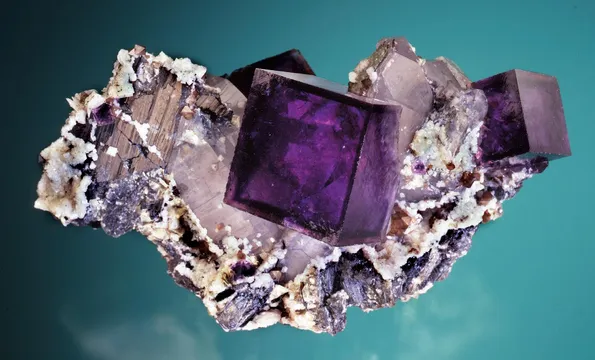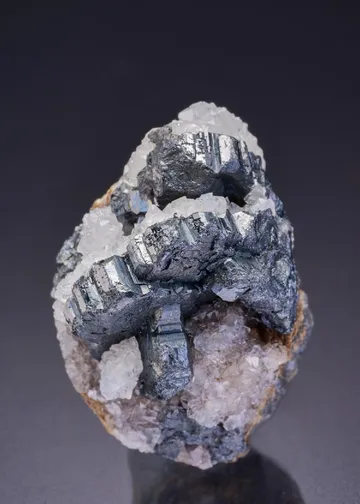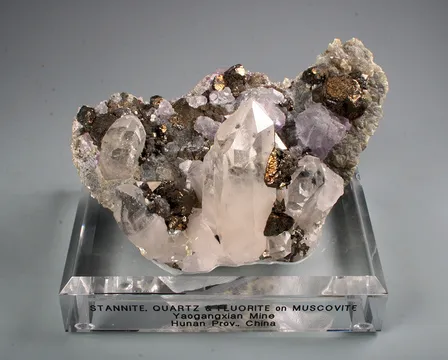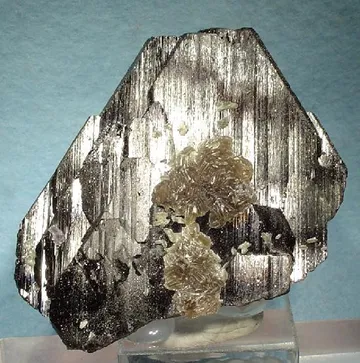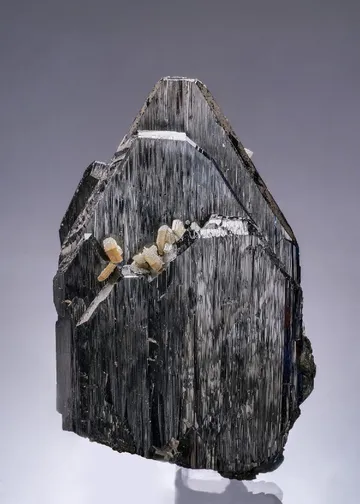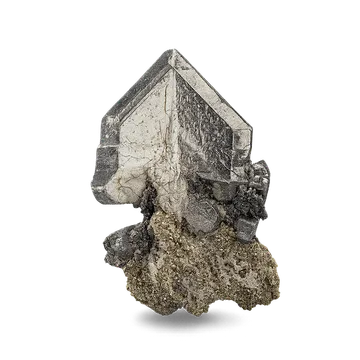
Bournonite from Yaogangxian Mine, China: silvery gray, sharply crystallized crystals with twinning; part of a rich hydrothermal assemblage prized by collectors.
Key facts
Yaogangxian bournonite occupies a special place among modern sulfosalt specimens: it is unmistakably bournonite, but it is not simply a late echo of the old European “cogwheel ore” tradition. The finest Yaogangxian pieces are silvery to steel-gray, sharply crystallized, highly lustrous, and often more blocky, prismatic, or elongated than the classic English cogwheels. Good crystals show the species’ prized twinning and striated metallic faces, while the best examples carry the extra drama of quartz, fluorite, arsenopyrite, ferberite, stannite, jamesonite, boulangerite, chalcopyrite, or other sulfide and sulfosalt associates from one of China’s most diverse specimen-producing tungsten-tin systems.

Photo: Mineral Auctions
The mine sits in the Yaogangxian tungsten-tin ore field of Yizhang County, Chenzhou, Hunan Province. Its mineralization belongs to the granite-related Nanling metallogenic province, where Mesozoic granitic intrusions, quartz-vein tungsten-tin systems, greisen-style mineralization, and skarn mineralization overlap in a complex and unusually productive district. For the collector, that geological complexity matters because the bournonite is not an isolated curiosity: it is part of a rich hydrothermal assemblage that can place a lustrous PbCuSbS3 crystal beside clear to milky quartz, purple-blue fluorite, black tungsten minerals, arsenopyrite, and other metallic species.

Photo: Mineral Auctions
Yaogangxian’s historical importance began as a tungsten mine, not as a specimen locality. Mining of the quartz vein-type tungsten-tin deposit began in 1914, and the mine became one of the major tungsten producers of South China. Collector recognition came much later, when Chinese specimen material began to reach Western markets in quantity and the locality proved capable of producing world-class examples of several species. Bournonite was sufficiently important by 2005 to be treated by Robert B. Cook in a “Connoisseur’s Choice” article in Rocks & Minerals, and it remains one of the species by which serious collectors judge the locality.
What collectors look for is straightforward but unforgiving: crisp metallic luster, strong form, visible twinning or “cogwheel” architecture, undamaged edges, and a matrix or association that makes sense for Yaogangxian. The most desirable specimens are not merely gray metallic lumps; they have clean terminations, rhythmic striations, well-developed prismatic or cogwheel geometry, and enough three-dimensional separation to read as sculptural crystals rather than massive ore.
Search for specimens: View all bournonite specimens from Yaogangxian Mine, China
Yaogangxian Mine is in the Yaogangxian W-Sn ore field, Yizhang County, Chenzhou, Hunan Province, China, at the southern Chinese tungsten-tin belt for which the Nanling region is famous. The mine field is developed around the Mesozoic Yaogangxian composite pluton, including coarse-grained biotite granite, fine-grained porphyritic granite, and quartz porphyry, intruded into Cambrian-Devonian sedimentary rocks and Jurassic limestones.
The district includes two principal mineralized systems. The older and most specimen-relevant in the collector literature is the Yaogangxian quartz vein-type tungsten-tin deposit, with minor greisen-style mineralization, mined since 1914. These veins are hosted in the biotite granite phase of the pluton and in the western and northern contact zone. They trend mainly northwest to north-northwest and are grouped into named ore blocks including Yangmeiling, Luchangping, and Hamashi. The Heshangtan skarn-type tungsten-tin deposit, discovered in 1947, explored during the 1950s, and mined from the early 1960s, represents the second major style. It is hosted in Devonian sandstone and skarnized slate along the eastern contact zone of the pluton and is noted for associated silver-bearing ores.
From an ore-geology standpoint, Yaogangxian is a granite-related tungsten system in which wolframite-quartz veins, scheelite-bearing skarn, and associated sulfide-sulfosalt assemblages overlap. Published work on the deposit records more than 200 ore veins, some individual veins reaching approximately 1,200 m in length and extending hundreds of meters down dip. Wolframite and molybdenite are among the principal ore minerals in the vein system, with cassiterite, arsenopyrite, chalcopyrite, pyrite, bournonite, and related sulfide and sulfosalt species present as subordinate but highly collectible constituents. Quartz is the dominant gangue mineral, with mica, feldspar, fluorite, and calcite also present.
Collectors should think of Yaogangxian not as a public rockhounding locality but as an industrial mine and specimen source. Access to productive underground zones has historically been controlled by mining operations, and the most desirable bournonite material is associated with old mine levels, pockets, and ore zones rather than casual surface collecting. Specimens that reach the market have come through mining and dealer channels, often with incomplete pocket-level documentation but with a recognizable Yaogangxian visual signature.
Production history is long and uneven from a collector’s perspective. The mine’s economic tungsten story begins in 1914; the skarn system enters the record with discovery in 1947 and production from the early 1960s. The collector story becomes especially prominent in the late twentieth and early twenty-first centuries, when Yaogangxian began yielding the now-familiar suite of fluorite, arsenopyrite, ferberite, stannite, quartz, and bournonite specimens. By the early 2000s, enough fine bournonite had emerged for the locality to be treated as a benchmark modern source for the species.
Notable finds include sharp cogwheel twins, elongated and prismatic single crystals, bournonite on quartz, bournonite with fluorite, and bournonite on arsenopyrite- or wolframite-rich matrix. One documented small-cabinet specimen had a single bournonite crystal measuring 4.2 cm on arsenopyrite-rich matrix, a size and association that illustrates why serious collectors treat Yaogangxian as more than a locality for attractive miniatures. Dealer records also document a distinctive “fiber optic” style in which a silvery bournonite crystal is divided by straight, vertically oriented outgrowths, with a spray of jamesonite perched on the upper surface.
Yaogangxian bournonite is typically metallic gray to silvery gray, with a bright luster that ranges from merely strong to splendent. The classic habit is the familiar twinned “cogwheel” form, but the locality is especially interesting because many specimens depart from the old European model. Collectors see blocky, prismatic, tapered, elongated, and platy forms, sometimes with cogwheel features visible only on portions of the crystal. The best pieces combine clear twinning with strong elongation, giving the crystal both mechanical geometry and sculptural presence.
Mindat’s occurrence record describes large cogwheel twins to about 2 cm, but the market record shows that larger prismatic or elongated Yaogangxian bournonite crystals can occur. Fine individual crystals and groups in the 2-4 cm range are significant; specimens with crystals or crystal groups approaching 7-10 cm are far more serious and command immediate attention when sharp and undamaged. Minfind’s archived dealer listings include bournonite specimens and bournonite-on-quartz pieces from roughly 28 mm thumbnails to 100 mm elongated examples, with a large 160 mm specimen offered at a five-figure price.
The surface character is central to identification and quality. Good Yaogangxian bournonite commonly shows vertical striation, metallic reflection, and a steel-gray tone that may grade into bluish or iridescent areas on some specimens. Edges can be sharp but vulnerable; the species is brittle enough that many larger crystals show contacts, bruising, rough spots, or incomplete terminations. A crystal free of matrix is not automatically inferior—some very fine Yaogangxian examples are single crystals—but a well-composed matrix specimen with quartz, arsenopyrite, ferberite, or fluorite is often more visually and locality-specific.
The most common documented photo-associated minerals for Yaogangxian bournonite are quartz and fluorite, followed by chalcopyrite, ferberite, stannite, boulangerite, arsenopyrite, jamesonite, calcite, freibergite subgroup minerals, sphalerite, siderite, pyrite, mica-group minerals, and related tungsten minerals. Quartz is the most frequent and most useful stage: white, milky, or translucent quartz can frame the metallic bournonite and make the gray crystal readable. Fluorite adds color, especially when blue to purple cubes accompany sulfides. Arsenopyrite and ferberite associations speak directly to the tungsten-vein environment and are especially satisfying to locality specialists.
Quality is judged first by crystal integrity, then by luster, form, and association. A superb Yaogangxian bournonite should show bright metallic faces, crisp striation or twinning, strong three-dimensional shape, and minimal post-mining abrasion. Blocky-prismatic crystals with readable cogwheel terminations are desirable; elongated crystals with sharp, architectural growth are distinctive for the locality. Patina is not necessarily a flaw. In fact, overly bright, aggressively cleaned specimens may lose some of the subtle surface character that helps distinguish natural mine-run bournonite from cosmetically overworked material.
The main authenticity risk with Yaogangxian bournonite is not a flood of fabricated bournonite crystals; it is context. The locality has produced many real specimens, but it has also generated a confusing trade vocabulary around gray metallic sulfides and sulfosalts. Yaogangxian fibrous or acicular material has often been sold under doubtful names, especially “bismuthinite” and sometimes “boulangerite,” when analyses have shown many such pieces to be stibnite or other sulfosalts. That problem does not make a bournonite crystal fake, but it does mean that labels for associated needle-like or fibrous minerals deserve caution.
For bournonite itself, ask whether the crystal morphology matches the locality. Yaogangxian examples should usually be metallic gray to silvery, striated, twinned or prismatic, and plausibly associated with quartz, fluorite, arsenopyrite, ferberite, stannite, chalcopyrite, sphalerite, jamesonite, boulangerite, calcite, or related ore minerals. A specimen labeled Yaogangxian but carrying an improbable matrix, odd glue-like contacts, suspiciously mismatched crystal attachment, or a mineral association foreign to the locality should be examined carefully under magnification.
Common condition issues include contacted faces, broken terminations, bruised ridges, edge wear, and incomplete matrix attachment. Larger Yaogangxian bournonites are often not perfect all around, and that is normal; many were extracted from ore pockets or old mine levels where space, safety, and time did not favor gentle specimen recovery. The key is whether the visible display face is sharp and lustrous, whether damage is old and unobtrusive, and whether any repair or reattachment has been disclosed.
Cleaning is another concern. Bournonite can take a bright polish-like metallic reflection naturally, but some Yaogangxian specimens are best appreciated with a thin original patina. Overcleaning can make surfaces look harsh, erase subtle color, and highlight bruising. One documented auction specimen was explicitly noted as retaining original patina rather than having been overcleaned, a reminder that “brighter” is not always better.
In rarity terms, Yaogangxian bournonite is available enough that patient collectors can find thumbnails and miniatures, but truly excellent pieces are scarce. The market supports a wide range: small or imperfect examples can sell modestly, while sharp, lustrous, well-composed specimens with size, matrix, association, or notable provenance can rise into the thousands of dollars. Archived dealer listings show small pieces in the hundreds, fine miniatures and small cabinets from around $1,000 to several thousand, and exceptional large cabinet examples advertised at much higher levels. The most competitive specimens combine recognizable cogwheel or prismatic form with a complete, aesthetic presentation.
Provenance can add real value. Documented examples from the collections of Dr. Stephen Smale, Dr. Erika Pohl-Ströher, and Bill and Anne Cook have appeared in auction records, and such histories matter because Yaogangxian bournonite spans both the modern Chinese specimen boom and serious international collecting circles. For important pieces, retain old labels, dealer descriptions, auction records, and photographs.
The most sobering Yaogangxian bournonite story is not about a glittering pocket photograph; it is about where some of the best crystals reportedly remained after the easy ore was gone. A later auction note for an 8.1 cm bournonite on arsenopyrite and wolframite stated that the bournonites came from old tunnels mined out in the 1950s-1970s. To reach them, artisan miners had to travel up into old levels in darkness through dangerous, unsupported workings. The remaining crystals were said to be in pillars, which meant that recovery involved pillar-robbing: removing mineralized support left in place to hold the old workings open.
That same note connected the practice with tragedy in 2007, when a number of miners died and the government subsequently clamped down on official access to those levels. For collectors, it is an uncomfortable but important detail. The dramatic price and desirability of a lustrous 4.2 cm bournonite crystal on arsenopyrite-rich matrix are only one side of the specimen’s story; the other is the physical risk of retrieving remaining crystals from abandoned or weakened underground ground.
Another revealing episode comes from the specimen world rather than the mine itself. A small-cabinet bournonite with jamesonite, sold from the Dr. Stephen Smale collection, was described as having an unusual “fiber optic” style: straight-line outgrowths arranged vertically across a sharp, silvery-gray crystal, making the piece look like an exquisitely machined object rather than a natural sulfosalt. It was noted as nearly a complete floater, extracted skillfully from a pocket without hammering, and retaining excellent luster despite having been mined in the early 2000s. The association—a delicate spray of jamesonite on the upper surface—made it more than a large bournonite; it became a distinct Yaogangxian style, unusual enough that the cataloger wrote that few fine examples of the type had been seen.
A third thread follows a much smaller object with a much larger collecting pedigree. In 2024 a 2.4 cm thumbnail bournonite from Yaogangxian was offered from the collection of William “Bill” Cook and Anne Cook of Cleveland. Bill, a PhD geologist, served for years as adjunct curator of mineralogy at the Cleveland Museum of Natural History; Anne, a mathematician and serious micromounter, was inducted into the Micromounters’ Hall of Fame in 2019. Both had served as presidents of the Mineralogical Society of Cleveland and of the Micromineral Society of the Cleveland Museum of Natural History. The rare phosphate wilancookite was named for them in 2015. Against that background, a small Yaogangxian bournonite becomes more than a thumbnail—it is part of the movement by which Chinese localities entered the cabinets of highly disciplined American collectors in the early twenty-first century.