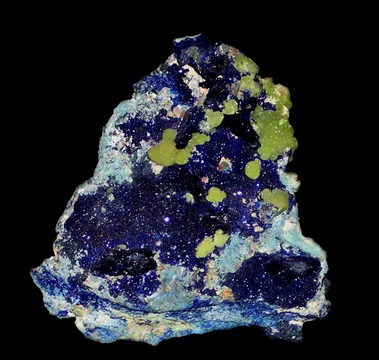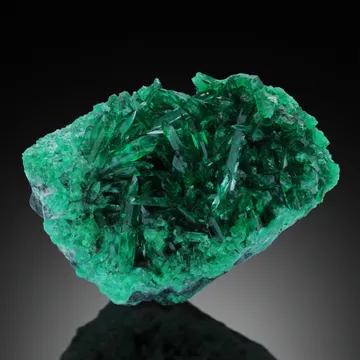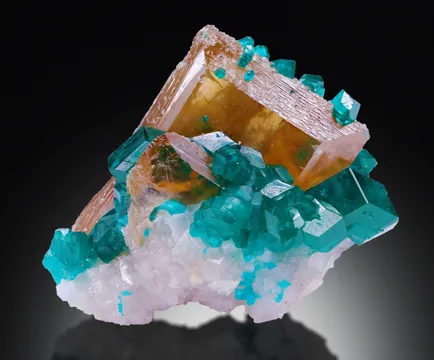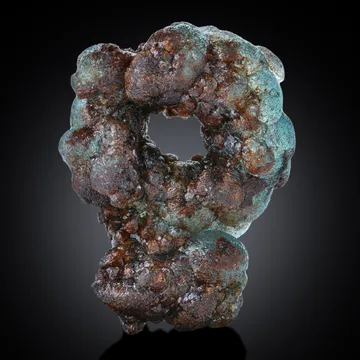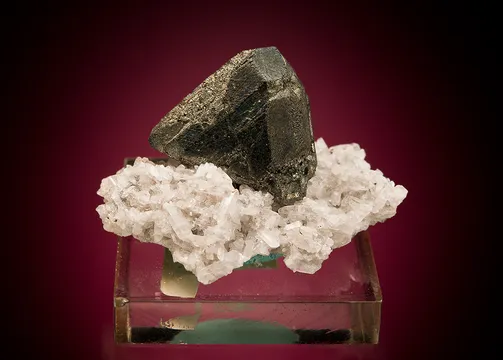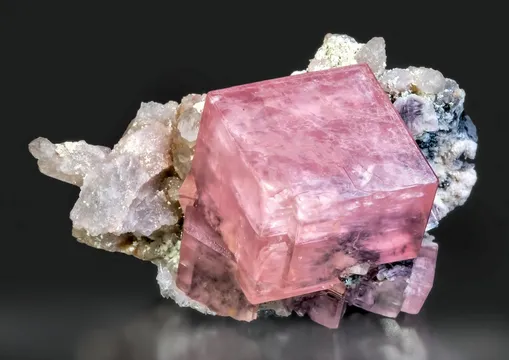
Tsumeb Mine, Namibia - a classic locality famous for dramatic color contrasts and a vast mineral range, from azurite and malachite to dioptase and cerussite.
Key facts
Tsumeb is the locality by which many serious collectors calibrate the word “classic.” The mine sat within the town of Tsumeb in northern Namibia’s Oshikoto Region, in the Otavi Mountainland, and exploited a steep, pipe-like, carbonate-hosted Cu-Pb-Zn-Ag-Ge-Cd orebody developed in Neoproterozoic dolomites and limestones. Its fame is not merely that it produced beautiful copper, lead, and zinc minerals; it is that the pipe behaved like a mineralogical engine. Primary sulfides rich in copper, lead, zinc, arsenic, germanium, cadmium, gallium, silver, and other metals were overprinted by three vertically separated oxidation zones, giving rise to a supergene assemblage of extraordinary chemical range and display quality.
For collectors, Tsumeb’s signature is contrast and complexity. Azurite, malachite, cerussite, dioptase, mimetite, smithsonite, wulfenite, calcite, willemite, duftite, tsumcorite-group arsenates, germanium minerals, and many species first described from the mine occur in combinations that would look over-composed if they were not natural. The best specimens have a particular Tsumeb look: blue-black azurite with electric green malachite; transparent dioptase on pale carbonate; honeycomb cerussite from galena-rich vugs; mimetite in rich yellow-orange clusters; pink, blue-green, or colorless smithsonite on dolomite, sulfide, or carbonate matrices; and micro-rarities that demand both a microscope and a library.
Historically, Tsumeb spans the whole arc of modern mineral collecting: indigenous copper working at the “green hill,” German colonial development by Otavi Minen- und Eisenbahn-Gesellschaft, Newmont-era scientific study and deep mining under Tsumeb Corporation Limited, the post-closure specimen-mining years, and the present market in old collections. Unlike many famous specimen mines, Tsumeb did not produce one species well; it repeatedly reset the standard for numerous species and supplied generations of museums, dealers, researchers, and private collectors with both cabinet specimens and type material.
Regional View
Country View
The orebody was narrow in plan but immense in mineralogical consequence. A simplified cross section is often described as a steeply dipping elliptical pipe only about 120 by 15 m across, but extending roughly 1.7 km downward. Inside that restricted volume, brecciation, feldspathic sandstone infill historically called “pseudo-aplite,” massive sulfide replacement, carbonate alteration, silicification, calcite plugs, vugs, and repeated water movement created a stratified vertical laboratory. The first oxidation zone occupied the upper workings, the second was centered around the North Break horizon in the deep mine, and a third oxidation zone appeared still lower in late-stage mining. To collectors this matters because “Tsumeb” is not one paragenesis: a specimen labelled 5 Level, 8 Level, 29 Level, 35 Level, 43 Level, or 44 Level can belong to a very different chemical world.
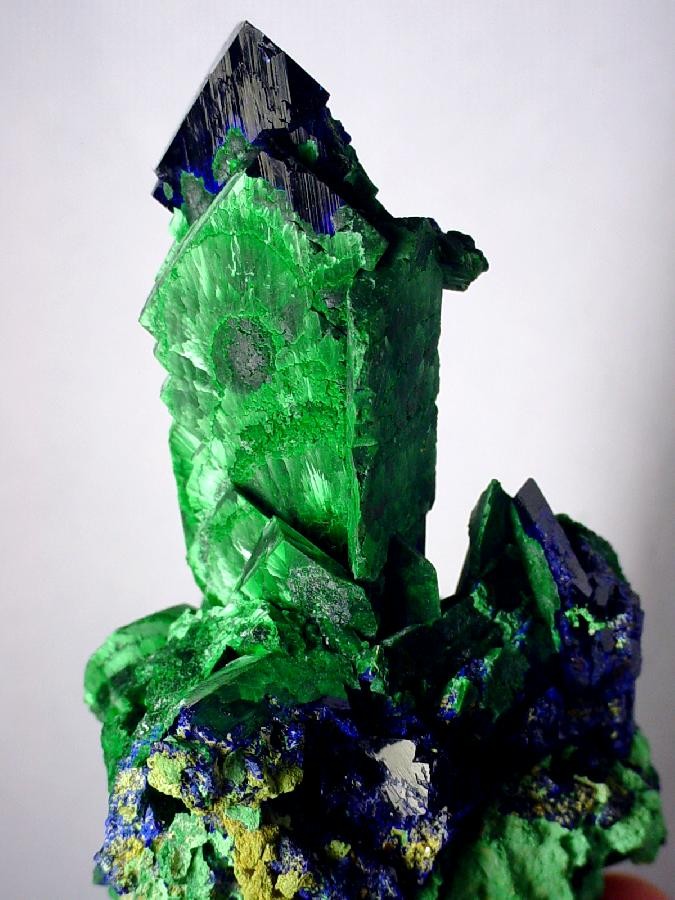
Photo: Wikimedia Commons
Search for specimens: View all specimens from Tsumeb Mine, Namibia
The Tsumeb deposit is a polymetallic, carbonate-hosted pipe deposit emplaced in the upper part of the Otavi Group carbonate sequence on the northwestern limb of the Tsumeb Syncline. The host rocks are Neoproterozoic dolomites and limestones of the Northern Carbonate Platform, including stromatolitic, oolitic, and algal carbonate rocks with shale and mudstone intervals. The ore pipe cuts through the Tsumeb Subgroup carbonates and is filled by dolomite breccias, feldspathic sandstone, silicified and calcitized breccias, massive sulfide ore, and local calcite-rich bodies.
The primary ore assemblage was dominated by galena, sphalerite, tennantite, chalcocite, enargite, and bornite, with lesser chalcopyrite, pyrite, germanite, renierite, and other sulfides and sulfosalts. Much of the richest ore was developed along the margins of the pipe and in replacement zones around breccia and sandstone bodies. Massive peripheral ores could be exceptionally metal-rich, while manto-style bodies and stringer/disseminated mineralization occurred in and near the pipe. A notable structural and hydrologic feature, the North Break Zone, intersected the pipe in the deep workings and helped focus oxidation and secondary mineral growth in the second oxidation zone.
For collectors, the oxidation history is the key to the mine. The first oxidation zone extended from the surface down through the upper mine, approximately to 11 Level, with reduced oxide mineralization below that to around 15 Level. This was the zone of many early azurite, malachite, cerussite, smithsonite, and copper-arsenate specimens. The second oxidation zone, roughly from 24 to 35 Level and centered near the North Break horizon around 29 Level, produced many of the deep-mine classics: dioptase, wulfenite, mimetite, calcite, smithsonite, rare zinc and lead arsenates, and some important azurite-malachite finds. The third oxidation zone, from about 42 Level downward, was recognized late in the mine’s life and produced additional rarities, including unusual germanium-, zinc-, lead-, and arsenic-bearing species.
Mining history began long before formal European development. The outcrop was known as a green hill and had been worked for copper by local people before colonial mining. In the late nineteenth century, mineral rights were acquired and surveyed; organized mining was followed by development under Otavi Minen- und Eisenbahn-Gesellschaft, which established commercial production in the early twentieth century after railway construction made export practical. Operations were interrupted by war and economic downturns, then revived under Tsumeb Corporation Limited after the Second World War. Newmont controlled the mine for much of its great mid-century and late-twentieth-century collecting period; Gold Fields Namibia later acquired Newmont’s African assets. Large-scale mining effectively ended in 1996 after economic pressure, labor conflict, and flooding of the workings. Short-lived later specimen-mining efforts between about 1998 and 2002 reworked parts of the upper mine but did not restore Tsumeb as a production mine.
Access today is not comparable to the working-mine years. The deep workings are flooded and closed, and the great collecting history now lives mainly in old mine material, museum holdings, dealer stocks, estate collections, research collections, and a limited residue of stockpile or post-closure material. The Tsumeb Mineralogic & Mining Museum in town preserves the district’s mining heritage, and the National Earth Science Museum of the Geological Survey of Namibia holds major Tsumeb material, including specimens and research collections transferred from the mining company in 1996.
Several named finds anchor Tsumeb collecting lore. The Gordon/Kegel Pocket, found on 8 Level in December 1929, was one of the earliest legendary azurite occurrences. The Newmont Azurite, a huge and celebrated azurite crystal group associated with Newmont’s corporate collection and widely described as one of the finest mineral specimens ever found, came from the second oxidation zone. The Gem Pocket mimetites of 1971, the mid-1970s Ice Cream Pocket calcites, and the Blue Pocket smithsonites all belong to the mine’s classic modern period. The Perkins Sams Pocket, discovered in 1980 and associated with Charlie Key, Sid Pieters, and Perkins Sams, produced major azurite and malachite-after-azurite specimens from deep in the second oxidation zone. The 1994 Easter Pocket, encountered during pillar-robbing on 8 Level, was one of the last great named azurite discoveries and produced lustrous, tabular, often twinned crystals unlike the older upper-zone habits.
Azurite is one of Tsumeb’s defining species, occurring chiefly in the first and second oxidation zones as lustrous crystals ranging from small rosettes and nodular aggregates to major cabinet crystals and groups; the best pieces show saturated dark blue to blue-black color, glassy luster, sharp faces, and enough translucency at edges to glow rather than read as flat black. Early upper-zone crystals came from the surface-to-8-Level world of cerussite, smithsonite, dolomite, kaolinitic clay, malachite, and copper arsenates, while important deep-mine examples came from second-zone finds such as the Newmont, Charlie Key, Bailey, and Perkins Sams occurrences; named 8-Level finds include the Gordon/Kegel Pocket and the 1994 Easter Pocket. Habits at Tsumeb are notably varied—prismatic, equant, elongated, rosettiform, spear-like, and tabular—and many crystals are partly or wholly altered to malachite, so elite specimens are judged not simply by size but by crystallographic sharpness, luster, depth of color, sculptural balance, association, and how gracefully any malachite alteration enhances rather than obscures the azurite form.
Malachite at Tsumeb is far more than green background: it is the mine’s most abundant secondary copper mineral and occurs in all three oxidation zones as earthy ore, velvety botryoidal crusts, radiating acicular tufts, spherules, uncommon blocky crystals, pseudomorphs after copper and cuprite, and, most famously, malachite after azurite. The first oxidation zone yielded abundant pseudomorphs after azurite, including sharp crystals on white dolomite and complex mixtures with cerussite, smithsonite, bayldonite, arsentsumebite, gartrellite, duftite, and other arsenates; the deep Perkins Sams Pocket yielded large second-zone pseudomorphs, some to about 20 cm across, with vivid green malachite preserving azurite form beneath a thin remnant or veneer of intense blue azurite. Fine Tsumeb malachite is separated from ordinary material by chatoyancy, crisp replacement textures, sharp preserved azurite morphology, contrast with blue azurite or pale carbonate matrix, and the absence of bruised velvet, rubbed high points, glue-filled repairs, or anonymous “green rock” presentation.
Beyond azurite and malachite, Tsumeb is a type-locality powerhouse and one of the most species-rich mines on Earth. Otavite, tsumebite, arsentsumebite, schneiderhöhnite, leiteite, ludlockite, reinerite, stottite, söhngeite, tsumcorite, warikahnite, stranskiite, keyite, feinglosite, gallobeudantite, tsumgallite, krieselite, eyselite, otjisumeite, ovamboite, zincroselite, plumbotsumite, sidpietersite, and many other rare species are tied to the mine’s unusual metal inventory and repeated oxidation. The classic display minerals are just as important: Tsumeb cerussite includes reticulated “honeycomb” forms and twinned groups; dioptase from the 29-to-32-Level zone is among the locality’s most beloved modern classics; mimetite from the Gem Pocket and related finds ranks with the finest known; smithsonite occurs in a remarkable spread of colors and habits; wulfenite appears in yellow, orange, colorless, and unusual blue-toned associations; and calcite from deep calcite-rich pockets can be both sculptural and paragenetically informative.
Tsumeb specimens reward labels. A good label does not merely say “Tsumeb, Namibia”; it may name a level, stope, sublevel, pocket, collector, dealer, or museum trail. Provenance to old European collections, Tsumeb Corporation personnel, well-known dealers such as Charlie Key or Sid Pieters, or documented collections such as Kegel, Sussman, Pinch, Newmont, or Harvard-associated holdings can be more than romance—it can help place a specimen into a specific oxidation zone and paragenesis.
The most common authenticity issue is not outright fabrication but locality and species confidence. Tsumeb produced so many blue-green secondary minerals that small crusts and sprays are easily miscalled: malachite, rosasite, aurichalcite, chrysocolla, plancheite, zincolivenite, conichalcite, duftite, bayldonite, arsentsumebite, and mixed copper-lead-zinc arsenates can be confused on appearance alone. Old labels using “cuproadamite,” “veszelyite,” “tsumebite,” “tennantite,” or general group names may need revision under modern nomenclature or analytical work. For fine micro-rarities, assume that XRD, Raman, SEM-EDS, or a published provenance is part of the value proposition.
Repairs and restorations are real concerns on large azurite, cerussite, wulfenite, calcite, mimetite, and delicate pseudomorph specimens. Tsumeb azurite can be dense and robust, but major crystals are often heavy, brittle, and naturally attached along limited contact points; old repairs, reattachments, and stabilized bases are not rare. Malachite-after-azurite pseudomorphs may show natural roughness, contacted tips, or altered surfaces, but watch for repaired blades, glued terminations, and disguised bruising on velvety material. Cerussite “snowflakes” and reticulated groups are especially vulnerable to broken arms and old restorations. Wulfenite and mimetite are prone to edge damage, and deep-pocket calcites may carry cleaves or bruises that are easy to miss under bright lighting.
Handling should respect the chemistry of the mine. Many Tsumeb specimens include arsenates or arsenic-bearing sulfides such as tennantite and enargite; some contain lead, cadmium, mercury, selenium, or other metals. Normal display and careful dry handling are appropriate for stable specimens, but avoid grinding, trimming without protection, licking, soaking friable material, or letting dust accumulate where it can be inhaled. Wash hands after handling mixed ore or friable arsenate material, and keep small attractive specimens away from children.
Market availability is broad but sharply tiered. Modest Tsumeb malachite, azurite-malachite, cerussite, calcite, smithsonite, mimetite, and mixed ore specimens still appear regularly because the mine supplied the market for nearly a century and many collections are now being dispersed. Fine named-pocket azurites, top malachite-after-azurite pseudomorphs, major dioptase, superb mimetite, important smithsonite, and rare type-locality species with analytical documentation are in a different category: they are old-collection objects, often priced and pursued like named classics rather than ordinary locality examples.
The first great Tsumeb collecting story begins not underground but in transit. Around 1900, before full-scale commercial mining had begun, ore was shipped to Germany for metallurgical testing. At the Bergakademie in Freiberg, Wilhelm Maucher recognized that the test material was not just ore. It held crystallized secondary minerals—azurite, cerussite, malachite, smithsonite, and related species—in forms worth saving. Those preserved pieces helped establish the early mineralogical identity of a deposit that might otherwise have been treated simply as rich copper-lead-zinc feed.
The mine’s name itself carries the feel of unstable ground and green copper. One explanation traces it to a San word rendered as Tsomsoub, meaning “to dig a hole in loose ground that keeps collapsing,” a strikingly apt phrase for a karstic dolomite hill riddled with cavities and breccias. In Nama usage the name was modified toward Tsumeb, often glossed as a place of green rock or a green hill. Long before collectors used the name as shorthand for mineralogical abundance, it described a visible copper-stained landmark.
In December 1929, Samuel Gordon arrived from the United States and encountered what became one of the mine’s foundational specimen events: a pocket of large, pristine azurite crystals on 8 Level. The Gordon/Kegel Pocket belongs to the old upper mine, the first oxidation-zone world where azurite, cerussite, smithsonite, malachite, and dolomite appeared in quantity. It set a precedent for Tsumeb collecting that would recur for decades: a working ore mine accidentally opening cavities whose aesthetic value far exceeded what the broken rock would have been worth as ore.
The Newmont Azurite became the mine’s most famous single specimen. The great crystal group was associated with Newmont Mining and has been described repeatedly as one of the finest mineral specimens in existence. Tsumeb Mine Notebook records its discovery in 1962 in the second oxidation zone, specifically the West 80 Stope on 28 Level, while an American Museum of Natural History photographic record identifies an azurite crystal group from Newmont’s Tsumeb mines as “considered the finest example in the world.” The specimen’s legend rests on scale, preservation, and color: the kind of object that moves azurite from a species category into the realm of mineral icons.
The 1980 Perkins Sams Pocket is a dealer-and-collector story as much as a geological one. Deep in the second oxidation zone, azurite crystals grew in voids between slightly iron-stained siliceous breccia shards. Much of the find consisted of blocky crystals, many almost completely replaced by malachite while retaining a thin blue skin or bright relict azurite contrast. The pocket took its name from Texas oilman Perkins Sams, who bought most of the specimens, while Charlie Key and Namibian dealer Sid Pieters are woven into the pocket’s trade history. Its best pieces capture one of Tsumeb’s most seductive effects: a green malachite crystal that still remembers the geometry and blue flash of azurite.
Then, late in the mine’s life, came the Easter Pocket. In April 1994, during pillar-robbing operations on 8 Level, miners broke into a large cavity of lustrous tabular azurite crystals. This was not simply “more azurite.” The habit was unusual for Tsumeb, and many specimens were strikingly lustrous, deep blue, and sharply formed. Later descriptions emphasize that the pocket appeared in old first oxidation-zone ground that many would have considered exhausted as a source of major azurite. Some Easter Pocket crystals are described as twinned, a rarity for the species and one reason the find remains so prized. Its timing added to the drama: one of the last great Tsumeb specimen pockets appeared just before the mine’s final collapse into closure and flooding.
The end of Tsumeb was abrupt enough to become part of its mythology. By the mid-1990s, metal prices, costs, and labor trouble were pressing hard. In 1996, striking miners denied management access to essential services; pumps were switched off, and water rapidly reclaimed the mine. The De Wet Shaft flooded within days. For collectors, that moment was not just an industrial shutdown. It closed the deep pipe—the second- and third-zone world of dioptase, germanium rarities, zinc arsenates, and late surprises—under hundreds of meters of water.