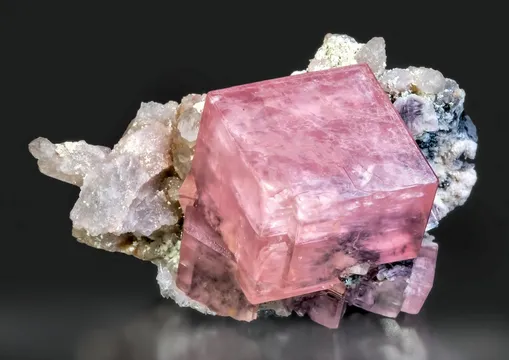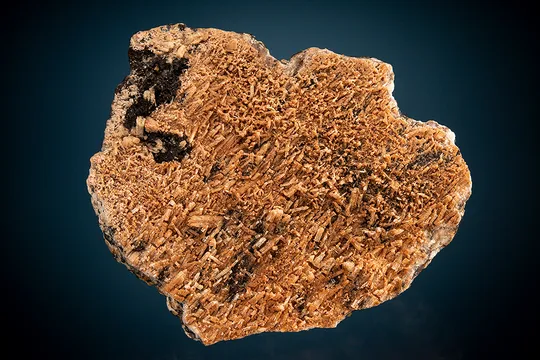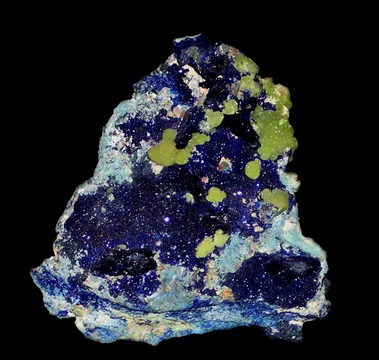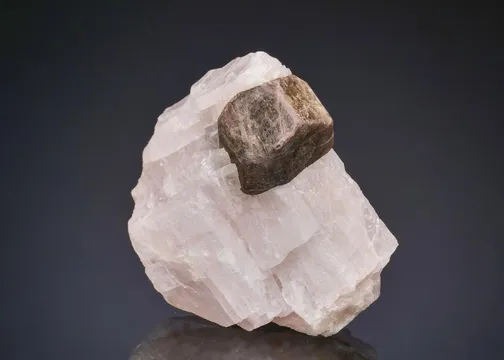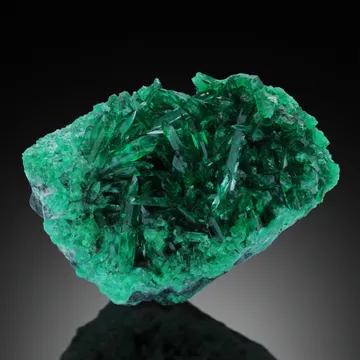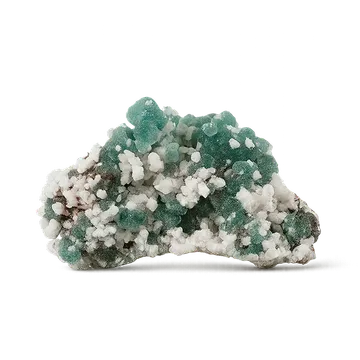
Willemite — Tsumeb, Namibia: glassy to sparkling crystals in blue-green to champagne hues, botryoidal crusts and hexagonal prisms; classic oxide-zone formation.
Key facts
Tsumeb willemite is the zinc silicate for collectors who usually think of willemite as a fluorescent-mineral classic from Franklin, New Jersey, and then discover that Tsumeb rewrote the aesthetic rules. Here, Zn2SiO4 appears not as massive ore but as glassy to sparkling crystal groups, botryoidal crusts, radiating sprays, delicate acicular “lawns,” and rare individual hexagonal prisms. The colors are equally un-Franklin-like: white, gray, yellow, green, blue-green, turquoise-blue, pale blue, reddish brown, and the much-loved champagne to honey tones. The best pieces have a crisp, jewel-like presence in daylight, often on white calcite or dolomite, with the color contrast that Tsumeb collectors prize.

Photo: Wikimedia Commons
The mineral belongs to the supergene story of the Tsumeb orebody. The mine was a copper-lead-zinc-silver-germanium-cadmium deposit in a steep, pipe-like body hosted by Otavi Group carbonate rocks. Oxidizing waters did not merely attack a shallow cap; Tsumeb developed three oxidation zones, including an extraordinary second zone centered around the North Break Zone at depth and a still deeper third zone. That plumbing system, combined with a remarkably metal-rich primary ore, made Tsumeb one of the world’s great laboratories of secondary mineral formation.
Willemite was present in all three oxidation zones, but the collector material did not arrive as a single uniform “find.” It appeared at intervals through the life of the mine: early upper-zone material that went unrecognized, second-zone blue and green material that became a classic, and deep-level yellow material from the third oxidation zone that was initially confusing even to experienced observers. Fine specimens may carry the quiet elegance of pale botryoidal spherules, the high color of blue-green aggregates, or the real rarity of sharp, gemmy crystals to about a centimeter.
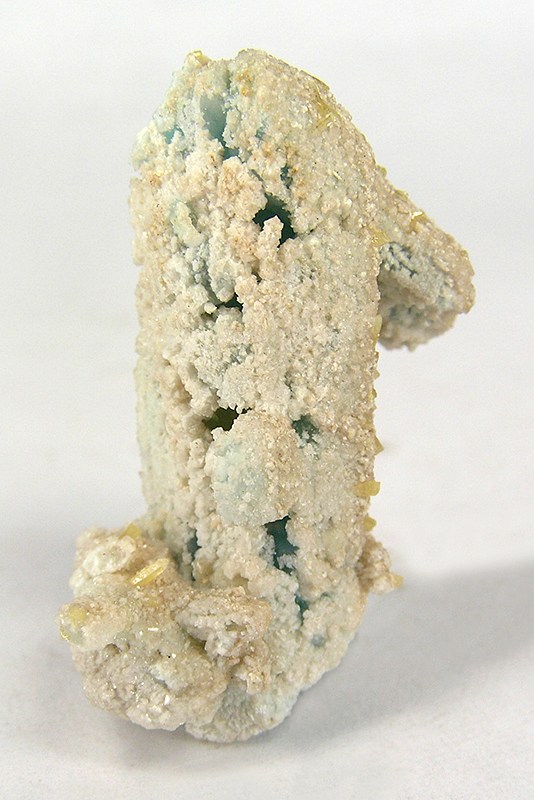
Photo: Wikimedia Commons
Collectors look first for unmistakable Tsumeb character: lustrous blue to blue-green spherules on pale carbonate matrix; well-formed hexagonal prisms; acicular sprays with clean separation; attractive associations with rosasite, smithsonite, mimetite, cerussite, dolomite, calcite, duftite, malachite, conichalcite, or tsumcorite; and, when documented, a mine-level or old collection provenance. The finest Tsumeb willemites are not merely species examples. They are small records of a deposit where zinc, silica, carbonate wall rock, groundwater, copper arsenates, lead carbonates, and the habits of old specimen miners all met in the same pocket.
Search for specimens: View all willemite specimens from Tsumeb, Namibia
The Tsumeb Mine, also known historically as the Tsumcorp or Ongopolo Mine, lies within the town of Tsumeb in the Oshikoto Region of northern Namibia. The locality is world-famous because it combined commercial ore richness with a degree of specimen mineralogy almost without parallel. Copper, lead, zinc, silver, germanium, cadmium, arsenic, and other elements were available in abundance; the carbonate host rocks supplied reactive chemistry and open space; and the mine’s oxidizing groundwater system reached unusual depths.
The orebody was an irregular, steeply plunging pipe in Neoproterozoic carbonate rocks of the Otavi Group. Its internal geology included dolomite breccias, feldspathic sandstone breccias, massive sulfide bodies, open vugs, fractures, and intensely altered carbonate. In plan the pipe was elliptical, locally narrow and locally broad; in section it extended for roughly 1.7 km through the carbonate sequence. The ore was not simply a vein or a replacement body but a complicated collapse-and-breccia structure later mineralized by metal-bearing fluids and overprinted by oxidation.
The mineralogical importance of Tsumeb depends heavily on its three oxidation zones. The first oxidation zone extended from the surface down to about 11 Level and reflects the shallow vadose environment and fluctuating water table. The second oxidation zone, from about 24 to 35 Level, centered near the intersection of the North Break Zone with the pipe around 29 Level. The third oxidation zone began at about 42 Level and was recognized only after deeper exploration and mining. Willemite occurred in all three zones, which is one reason the species shows such a range of habits and associations.
Commercial mining began in the early twentieth century after the “green hill” had already been known and worked locally for copper. European-scale development followed the 1893 recognition of the deposit, with operations becoming one of the great mining enterprises of the Otavi Mountainland. The mine produced ore for decades, interrupted by world events and ownership changes, and postwar deepening revealed the second oxidation zone that transformed both the science and the collecting history of Tsumeb.
By the late twentieth century the mine was nearing the end of its economic life. It closed in 1996 after labor unrest, weak metal prices, and flooding. The De Wet shaft was ultimately left flooded, and modern collecting access is not comparable to the historical specimen-producing years. Serious collectors today are dealing almost entirely with old production, museum and private collection deaccessions, dealer inventories, and the occasional specimen that reappears with older labels. The mine itself is inactive; any site access would require permission from the relevant land and rights holders and is not a casual field-collecting opportunity.
Notable willemite finds include early upper-zone examples that were not initially recognized, second-zone blue and blue-green material from the 1970s that became highly sought-after, rare pseudomorphs involving azurite, mimetite, and cerussite, and lemon-yellow crystals from the deepest oxidation levels. The most desirable material is usually miniature to small-cabinet size, because the mineral’s best habits at Tsumeb are often made of millimeter-scale spherules, sprays, crusts, or prisms rather than large isolated crystals.
Tsumeb willemite is a confirmed, common supergene mineral at the mine, but “common” at Tsumeb does not mean ordinary on the specimen market. The mine produced a broad suite of habits, and the best styles are localized enough that collectors often recognize them by look before checking a label.
The classic habit is botryoidal to mammillary crusts made of sparkling spherules. These rounded aggregates may be pale gray, blue-gray, blue-green, white, or yellowish. Broken edges can reveal a radial internal structure, especially in spherules on altered carbonate matrix. Some specimens show contrasting generations, with one generation of blue-green botryoidal willemite later dusted or partly covered by reddish-brown crystals.
Another important habit is acicular to short-prismatic sprays. Tsumeb literature describes crystal forms ranging from short prismatic crystals terminated by pinacoids to long prismatic crystals with pyramidal faces. Needle-like crystals can form radiating bundles or dense “lawns,” commonly white to colorless, yellowish, or pale gray. The more delicate of these pieces are condition-sensitive because the needles and crystal tips sit proud of the matrix.
The finest crystals are the gemmy blue to blue-green prisms, reported to reach about 10 mm. These are the specimens that make Tsumeb willemite a true connoisseur species rather than simply a locality variant. Crystals may sit on white calcite, dolomite, smithsonite-bearing carbonate, or mixed secondary-mineral crusts. Well-formed individual hexagonal prisms are much rarer than rounded aggregates.
Yellow willemite is a special Tsumeb style. Deep-level lemon-yellow crystals were described from the 43 to 46 Level range, with crystals to about 10 mm fused into composite aggregates to about 30 mm. Some were at first mistaken for warikahnite because of their appearance. These yellow pieces are commonly discussed in the trade under the obsolete and discouraged label “cadmian willemite,” a name based on an assumed color cause rather than a formal varietal status.
Blue material is especially prized. Blue willemite from Tsumeb ranges from pale duck-egg and steel-blue tones to stronger turquoise-blue. The finest pieces combine color, translucency, luster, and contrast against pale carbonate or calcite. Blue spherules, blue-green crusts, and rare blue prisms are all collectible, but the crisp, gemmy crystals are the most avidly pursued.
Brown to reddish-brown willemite is often called troostite in older or dealer descriptions. At Tsumeb the color has been interpreted differently by different authors, with manganese and hematite inclusions both discussed as possible causes in the literature. For collectors, the practical point is to treat “troostite” as a descriptive varietal/trade usage and to value the specimen by aesthetics, documentation, and mineral confirmation rather than by the name alone.
Fluorescence is real but variable. Tsumeb willemite is not typically collected as a Franklin-style ultraviolet showpiece, and older statements about its fluorescence have been inconsistent. More recent observations with shortwave UV equipment show that many specimens fluoresce variably from yellow to green, and some specimens show other responses depending on wavelength, generation, and associated minerals. Fluorescence can help support an identification, but it should not be the only basis for buying a valuable Tsumeb specimen.
Commonly associated minerals include cerussite, dolomite, duftite, malachite, mimetite, rosasite, calcite, smithsonite, conichalcite, and tsumcorite. Mindat photo data also strongly reflects associations with dolomite, calcite, mimetite, smithsonite, malachite, and cerussite. A strong Tsumeb willemite specimen often gains importance from such associations: pale blue willemite with yellow-green conichalcite, blue-green spherules with rosasite, willemite with mimetite and smithsonite, or willemite carrying sparse tsumcorite can be more interesting than a visually larger but less characteristic crust.
Quality is judged by color, luster, form, association, and integrity. The best spherules sparkle rather than look chalky. The best prisms are sharp, translucent to gemmy, and visibly terminated. The best acicular groups are undamaged and not matted. Matrix matters: white calcite, dolomite, or contrasting secondary minerals can elevate a specimen dramatically. Provenance matters too; a Tsumeb willemite with old labels, a named collection, a documented 1970s association, or a museum-recorded style is far more desirable than an attractive but contextless piece.
Tsumeb willemite is not a species where the principal problem is widespread treatment. The more serious issues are identification, terminology, and provenance. The mine produced many pale, botryoidal, acicular, and carbonate-associated zinc and lead minerals that can be visually deceptive. Smithsonite, hemimorphite, hydrozincite, calcite, dolomite, cerussite, and mimetite may all occur in visually confusing combinations. A valuable blue, yellow, or unusual green specimen deserves analytical support if the morphology is not decisive.
Old labels are helpful but not infallible. Tsumeb labels have traveled through dealers and collections for decades, and some specimens were labeled by appearance before routine XRD or microprobe work was available. The obsolete “Cd-willemite” or “cadmian willemite” label should be read as a historic color-name convention, not as a modern species or approved variety. Similarly, “troostite” on a Tsumeb label usually means brownish willemite and does not by itself establish a particular chromophore.
Provenance should be read carefully. Tsumeb produced willemite in multiple oxidation zones, but most specimens on the market are simply labeled “Tsumeb Mine” without a level. Precise level information is scarce and valuable when trustworthy. Claims such as “second oxidation zone,” “1970s blue pocket,” or “deep level yellow willemite” should be supported by an old label, a reputable collection record, or a specimen style consistent with published examples.
Condition issues are common and often subtle. Botryoidal willemite may have bruised high points that show as dull patches under angled light. Acicular sprays lose tips easily. Crusts on friable carbonate can shed tiny crystals along edges. Pseudomorphs and epimorphs may look naturally irregular, so distinguish genuine growth texture from later abrasion. Because many pieces are small, a single broken crystal can significantly affect value on a high-end thumbnail or miniature.
The rarest collector styles are gemmy blue crystals, sharp individual prisms, fine blue-green spherules on attractive white matrix, well-documented pseudomorphs, and deep yellow third-zone material. More available are small botryoidal crusts, gray-blue aggregates, white acicular coatings, and mixed willemite-carbonate pieces. Even these are not abundant in fresh supply because the mine has been closed for decades; most specimens now come from old collections, dealer back stock, and resale.
Market availability is sporadic. Tsumeb willemite appears regularly enough that a patient collector can find an example, but the great pieces are contested. Blue material, old labels, and well-balanced miniatures move quickly. For serious buying, compare the piece against published Tsumeb habits, ask for provenance photographs of old labels, examine under magnification, and use UV only as a supporting observation rather than a verdict.
The earliest Tsumeb willemite story is a story of missed recognition. A specimen recovered in 1915 showed willemite replacing mimetite as an epimorph, then partly overgrown by smithsonite. In hindsight, it was an elegant little paragenetic sequence frozen in one object: mimetite form, willemite substance, smithsonite finishing coat. Yet the early observers did not identify it as willemite. That absence is telling. Wilhelm Maucher’s early description of the Tsumeb ore did not mention willemite, Wilhelm Klein’s 1938 account did not list it, and the famous Karabacek Collection at Harvard has no representative example. A mineral now considered common at the mine was effectively hiding in plain sight.
The second oxidation zone changed that. Strunz and Tennyson gave the first informative description in 1967, noting white, gray, and yellow crystals and aggregates from the deeper oxidized levels, along with fine fibrous white crusts. By the 1970s the picture sharpened: Tsumeb willemite was not merely a pale zinc silicate but a mineral of yellow, green, blue, and gray moods, massive in some places, well crystallized in others, and often fluorescent under ultraviolet light.
The blue crystals became the material collectors remembered. The best examples, believed to have been collected in the early 1970s, were small but arresting: gemmy blue willemite crystals, to about 10 mm, on white calcite. That is the kind of description that looks modest on paper and becomes electric in a cabinet. Tsumeb had already made collectors expect impossible azurites, cerussites, dioptases, and smithsonites; here it turned a mineral better known for ultraviolet response into a daylight specimen with color and architecture.
One of the strangest Tsumeb willemite episodes took place in the deep third oxidation zone. On the 44 Level, lemon-yellow crystals appeared with yellow-green conichalcite and colorless acicular smithsonite. Some aggregates reached about 30 mm, composed of individual crystals to about 10 mm. Their form was so unusual that they were initially mistaken for warikahnite. The mistake is understandable: Tsumeb’s deeper levels produced such a bewildering mineralogical cast that even experienced workers could be led astray by color and habit. The correction made the find more interesting, not less. It showed that willemite, already known from the upper and second oxidation zones, had a distinctive late chapter in the deepest oxidized ground.
The pseudomorphs are quieter but no less evocative. Willemite has been reported after azurite, cerussite, and mimetite, all rare. The azurite cases are especially Tsumeb-like: blue copper carbonate form, pale to blue willemite replacement or coating, and sometimes later minerals on the surface. Some specimens described as willemite after azurite may actually be dolomite epimorphs after azurite later covered by willemite, with labels placing such material on 29 Level in the second oxidation zone. That distinction matters to a mineralogist, but to a collector the magic is the same: Tsumeb preserved the memory of one mineral in the shape of another, then wrote a second mineral history across it.