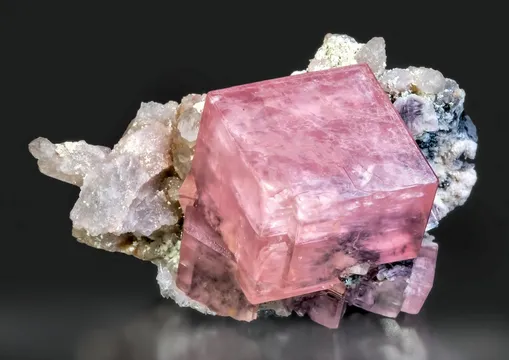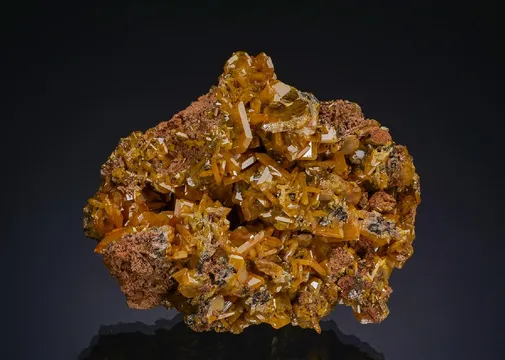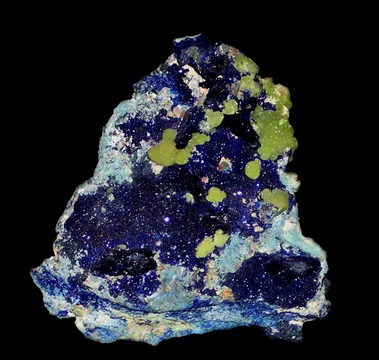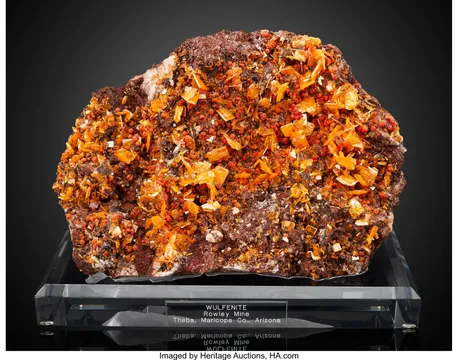
Wulfenite from Tsumeb, Namibia offers a spectrum of colors from honey-yellow to blue, with varied habits and rich paragenesis that attract advanced collectors.
Key facts
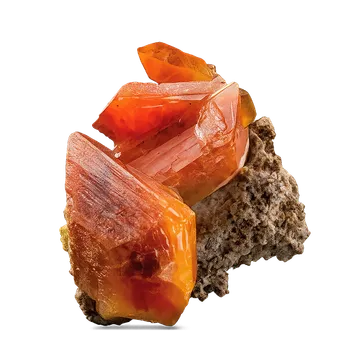
Tsumeb wulfenite is not famous because it outguns the great Arizona or Mexican localities in sheer abundance of large, glassy, orange plates. Its distinction is subtler and, for the advanced collector, often more compelling: no single locality has shown wulfenite in such a varied Tsumeb language of color, association, habit, and paragenesis. The species occurs there as pale grey and colorless tablets, honey-yellow windowpanes, sherry-brown beveled plates, orange-red dipyramids, toffee-brown crystals with internal phantoms, and the rare blue tungsten-bearing material historically discussed under the name “chillagite.” In the best examples, the crystals have the sharp, architectural restraint that makes Tsumeb specimens feel less like isolated mineral examples and more like small, complete geological scenes.

Photo: Wikimedia Commons
The setting is the legendary Tsumeb pipe, a steep, polymetallic lead-copper-zinc-silver deposit hosted in Neoproterozoic carbonate rocks of the Otavi Mountainland. The orebody’s unusual chemistry supplied lead, copper, zinc, arsenic, molybdenum, cadmium, germanium, gallium, silver, and other elements; the carbonate host and pipe-like geometry supplied the deep plumbing. Oxidizing groundwaters reached not only the near-surface ore but also deeper parts of the system, creating the first, second, and third oxidation zones. Wulfenite is a supergene lead molybdate, PbMoO4, and at Tsumeb it records those oxidizing episodes in a way that is unusually rich in associations: duftite, mimetite, malachite, quartz, goethite, calcite, cerussite, tennantite, dioptase, azurite, dolomite, mottramite, smithsonite, and many more.
Historically, wulfenite was not the mineral that first made Tsumeb a household name among collectors; azurite, cerussite, dioptase, mimetite, and smithsonite carried that banner more conspicuously. Yet wulfenite became increasingly important as collecting attention turned to the deeper second oxidation zone, especially the productive interval around the late 1960s and 1970s. The best Tsumeb wulfenites are prized for unusual color, complex association, documented level or stope provenance, and above all for the unmistakable Tsumeb balance of scientific interest and cabinet aesthetics.
A serious collector looks first for undamaged crystal edges. Tsumeb wulfenite is commonly tabular, and those plates advertise every nick. Good pieces may be thumbnail to cabinet size, but the value is often in the combination: sherry-brown plates on goethite, yellow crystals with cerussite, wulfenite tucked among malachite, wulfenite on tennantite, orange-red dipyramids with quartz, or the especially desirable dioptase-wulfenite combinations from deeper oxidation-zone material. Blue crystals and phantom-zoned crystals are special subcategories; they are not everyday Tsumeb wulfenites, and when fine, they belong in advanced collections.
Search for specimens: View all wulfenite specimens from Tsumeb, Namibia
The Tsumeb Mine lies at the town of Tsumeb in the Oshikoto Region of northern Namibia, within the Otavi Mountainland. The deposit is a carbonate-hosted, polymetallic, pipe-like orebody developed in Neoproterozoic dolomites and limestones of the Otavi Group. It was not a broad, simple vein system but a steep, irregular pipe with feldspathic sandstone and brecciated carbonate material, cut by fractures, altered by hydrothermal fluids, and later attacked by oxidizing waters. That combination made Tsumeb both an ore deposit and a mineralogical laboratory.
The orebody extended from the surface to roughly 1,700 meters below surface by the time mining ended, with the workings reaching 48 Level. In plan, the pipe varied from level to level, narrowing dramatically in some parts and expanding in others; on 26 Level the projection of the orebody reached its largest known scale. The upper portions produced oxidized copper-lead-zinc ores and many of the early classic specimens. Deeper down, the second oxidation zone began around 24 to 26 Level and was centered near the North Break Horizon, a permeable palaeo-aquifer that intersected the pipe around the 28 to 30 Level interval. This deep oxidation zone was crucial for Tsumeb’s later specimen fame and for much of the best wulfenite.
Commercial mining began after early European investigations in the 1890s and development by the Otavi Minen und Eisenbahn Gesellschaft. Two trial shafts were started in 1900, but full-scale commercial production had to wait for railway access and began in the first decade of the twentieth century. The outcrop itself, the “Green Hill,” had been worked for copper long before by local African miners, and European explorers in the 1880s encountered copper ores and smelted metal being transported and traded. The place name Tsumeb is generally traced to Otjisume, “the place of the frog,” a name linked to the appearance of the copper-stained outcrop.
The mine’s production history is nearly a century long, with interruptions during the World Wars and the Great Depression. It produced copper, lead, zinc, silver, and notable byproduct metals including arsenic, cadmium, germanium, and gallium. A modern review gives total production on the order of 30 million tonnes of ore, with rich average grades for lead, copper, and zinc. As the mine deepened, it passed from the first oxidation zone into sulphide ores, then into the remarkable second oxidation zone beginning around 810 meters below surface, then again into largely unoxidized sulphides, and finally into a third oxidation zone from around 1,380 meters depth.
For wulfenite collectors, the second oxidation zone matters most. The best Tsumeb wulfenites are recorded from that deeper oxidized interval, with important finds in the 1960s and 1970s. Specific labels are frustratingly uncommon; much Tsumeb material reached dealers and collectors without exact stope data. Still, some level and stope records survive. The East 95 Stope on 28 Level yielded a very large pale grey wulfenite crystal figured in the literature. Walther Bartelke’s labels record wulfenite with malachite and cerussite-wulfenite-malachite from East 65 Stope on 28 Level, wulfenite on tennantite from 32 Level, dioptase with wulfenite from East 19 Stope on 32 Level, and yellow wulfenite with cerussite from West 80 Stope on 32 Level. Taken together, the most productive documented interval for the species lies between about 28 and 32 Level, roughly 880 to 1,040 meters below surface.
The S110 orebody on 30 Level is also important to collectors because it produced many spectacular dioptase and wulfenite specimens from the 26 to 30 Level sector. The North Break Zone and associated manto-style massive sulphide bodies helped localize rich mineralization and deep oxidation. Those geological structures explain why Tsumeb could produce delicate supergene crystals at depths that would be implausible in a more ordinary mine.
Large-scale mining ceased in the mid-1990s. In 1996, labor conflict, high pumping costs, and low metal prices converged; when management was denied access during a strike, the pumps were switched off and the mine flooded rapidly. Small-scale work in the upper levels continued briefly, and a later attempt to mine specimens operated for a short period between 1998 and 2002. For present-day collectors, Tsumeb is essentially a closed classic locality: no ordinary field collecting access exists, and the supply is drawn from old mine output, historic collections, dealer inventories, and the continuing redistribution of specimens that left the mine decades ago.
The usual Tsumeb wulfenite habit is tabular and tetragonal, dominated by the basal pinacoid. Collectors often describe the best plates as windowpanes, tablets, or beveled square crystals. The edges may be simple and narrow, or the pyramidal faces may broaden enough to make the crystals thicker and more architectural. Less commonly, Tsumeb produced dipyramidal or pseudo-octahedral crystals in which the basal face is reduced or nearly absent. Steep dipyramidal crystals are uncommon; true prismatic habits are very unusual but documented in old material.
Color is the heart of Tsumeb wulfenite. The locality produced colorless and clear crystals, pale brown, pink, pale yellow, orange, brownish red, sherry-brown, greenish brown, light blue, dark blue, grey, and white examples. The sherry-brown to toffee-brown plates are the most recognizable cabinet type. Pale yellow-green “windowpane” crystals on gossan are also classic. Orange-red dipyramids are much less common and can be striking, especially with quartz. Blue wulfenite is the connoisseur’s color: rare, literature-famous, and easily overvalued when labels are vague or crystals are damaged.
The blue Tsumeb material is not a single simple category. One group of tabular crystals was historically discussed as “chillagite,” a tungsten-bearing wulfenite-stolzite series material, with some reported specimens containing significant tungsten. Another blue habit consists of pyramidal-prismatic, hemimorphic crystals with brown cores, blue zones, and colorless outer areas or tips. Analytical work on that second type found much lower tungsten contents, and the blue color was proposed to relate to partial reduction of molybdenum. For the collector, the practical lesson is that “blue Tsumeb wulfenite” needs more scrutiny than an ordinary color label: habit, provenance, and analysis matter.
Crystal sizes vary widely. Much Tsumeb wulfenite is small, with crystals a few millimeters across, especially on complex matrix specimens. Good miniatures may carry crystals around 1 cm. Fine examples reach 2 cm or more, and the best individual plates can be several centimeters across. A documented phantom crystal in the Southwood collection is 37 mm on the diagonal; Mindat records a specimen with a 3.6 cm-wide wulfenite crystal and a bluish phantom; cabinet specimens with fields of smaller lustrous tablets can be visually stronger than a single larger but damaged plate.
Associations are a major reason to collect Tsumeb wulfenite. Duftite, goethite, malachite, mimetite, and quartz are especially important recurring associates. Calcite and dolomite are common matrix or late-stage companions. Cerussite, tennantite, dioptase, azurite, mottramite, smithsonite, hematite, and bayldonite also occur in notable assemblages. Some combinations are genuinely rare and instantly elevate a specimen: wulfenite with azurite, wulfenite with dioptase, wulfenite with well-formed cerussite, or wulfenite involved in pseudomorph sequences.
Tsumeb is also important for pseudomorphs after wulfenite. Duftite after wulfenite is the best-known replacement, but bayldonite, conichalcite, dolomite, malachite, mottramite, quartz, smithsonite, and even stolzite are reported as rare pseudomorphs after wulfenite. These are specialist pieces: the value is not just visual but interpretive, because they preserve the shape of a vanished wulfenite crystal while replacing its substance with another mineral.
The best Tsumeb wulfenites combine five qualities: sharp intact edges, glassy to adamantine luster, a distinctive color, a matrix or association that says “Tsumeb” rather than simply “wulfenite,” and believable old provenance. A single perfect pale plate can be excellent, but a slightly smaller crystal with dioptase, cerussite, malachite, tennantite, or a well-documented level may be more desirable to the advanced Tsumeb collector.
Tsumeb wulfenite should be bought with the same care given to any fine wulfenite: assume fragility first. The mineral is brittle, the plates are exposed, and edges chip easily. Even old, high-quality Tsumeb pieces often carry small fleabites, repaired crystals, contacted edges, or cleaved plates. Minor edge wear may be acceptable on historic specimens, especially where the association or provenance is exceptional, but a premium Tsumeb wulfenite should have the main display crystals intact under magnification.
Condition language matters. “Good for Tsumeb” may mean something different from “pristine.” Many Tsumeb crystals are thicker and more robust than ultra-thin Red Cloud-style plates, but they still show edge chatter quickly. Look at every corner of the main crystals with a 10x loupe. Pay special attention to the bases of larger plates, where reattachments are easiest to conceal, and to the high points of dipyramidal crystals. Repairs are not automatically disqualifying in old Tsumeb material, but they must be disclosed and priced accordingly.
Matrix authenticity is another concern. Tsumeb has such a distinctive mineralogical vocabulary that plausible associations can be persuasive, but they should still be examined critically. Wulfenite glued onto unrelated gossan, mismatched calcite, or a generic limonitic matrix is possible in the broader wulfenite market. Warning signs include glue sheen at crystal bases, crystals that sit on top of dust rather than grow into it, mismatched dirt in crevices, improbable orientation, or matrix contacts that lack natural overgrowth relationships. Longwave UV can help detect some adhesives, but it is not definitive.
The blue material deserves special caution. True blue Tsumeb wulfenite is rare and literature-famous, which makes the label attractive. A blue cast, grey translucency, bluish phantom, or backlit effect is not the same thing as a fine blue wulfenite. The strongest examples should have credible provenance or a respected dealer history; analytical confirmation is ideal for high-value tungsten-bearing “chillagite” claims. Avoid paying a blue-wulfenite premium for a merely smoky, grey, or lighting-dependent crystal.
Treatments are not a dominant problem for Tsumeb wulfenite in the way they are for some gem minerals, but older coatings and repairs occur in the mineral specimen trade. A lacquered or oiled wulfenite may show an unnatural plastic gloss, film trapped in protected areas, dust sealed into crevices, or an inconsistent surface sheen. Filling of fractures is harder to see but may reveal itself as glossy lines or unusual behavior under magnification.
Provenance adds real value. Labels naming old collections, dealers, mine levels, stopes, or recognizable Tsumeb collectors can separate a good specimen from a merely attractive one. Names such as Wilhelm Klein, Walther Bartelke, Richard Barstow, Mark Feinglos, Sid Pieters, Bruce Cairncross, and museum catalog numbers become meaningful when the physical specimen matches the label history. Because many Tsumeb wulfenites left the mine with no precise location, a credible old label is especially valuable.
Market availability is steady but limited. Tsumeb wulfenite appears regularly in dealer inventories, auctions, and collection dispersals, mostly as thumbnails and miniatures, with occasional small cabinet specimens. Ordinary small pieces with millimeter crystals remain accessible. Attractive miniatures with centimeter-scale, sharp, lustrous plates are much less common. Large, undamaged, highly aesthetic pieces; blue material; red dipyramidal crystals; strong dioptase associations; and documented level-specific specimens are genuinely scarce and should be expected to command a premium.
The story of Tsumeb begins, as many great mineral localities do, with a hill that did not look like ordinary country rock. The copper-stained outcrop was the “Green Hill,” already known and worked before Europeans arrived. In January 1893, the British mining engineer Mathew Rogers reached the site on behalf of the South West Africa Company. His reaction was not the dry language of a reserve estimate. He wrote that he had “never seen such a sight” as the one before him at “Soomep,” adding that he doubted he would ever see another like it. For a modern collector holding a delicate wulfenite miniature from the second oxidation zone, that first astonishment still matters: the same improbable orebody that announced itself as a green hill at the surface later produced supergene lead molybdate crystals more than 800 meters below ground.
Wulfenite enters the written Tsumeb record in a strangely delayed way. Early mineral lists by Schneider, Maucher, and Schneiderhöhn did not include it, even though it was present in the first oxidation zone. Wilhelm Klein, one of the key early Tsumeb managers and collectors, later described wulfenite as relatively common in the upper levels, especially in the Nebentrümern, a side-shoot of the main orebody. Then comes the puzzle: Klein’s unpublished catalogue attributed wulfenites in his collection to 6 Level, 9 Level, and 11 Level, but his published notes stated that wulfenite was unknown below 160 meters, equivalent to 6 Level. For a locality where labels often make or break scientific value, this is a vivid reminder that even the best old Tsumeb records can contain contradictions.
One early specimen in the Natural History Museum, London, shows how seriously the early collectors regarded unusual Tsumeb wulfenite habits. The specimen, catalogue number BM.1932,1081, carries small prismatic wulfenite crystals only to about 3 mm, with smithsonite and cerussite in a vug in oxidizing sulphide ore. Its label records that it was presented by Wilhelm Klein of Tsumeb, South West Africa, in June 1932. Prismatic wulfenite is so atypical for Tsumeb that Klein evidently considered the piece worth preserving and sending abroad. It is not a big, flashy cabinet plate; it is the sort of specimen that tells you how alert the early Tsumeb people were to odd mineralogical detail.
By the mid-1970s, the wulfenite story had shifted downward into the second oxidation zone. Walther Bartelke’s specimen labels read almost like telegrams from the workings: “wulfenite with malachite” and “cerussite with wulfenite and malachite” from East 65 Stope on 28 Level; “wulfenite on tennantite crystals” from 32 Level; “dioptase with wulfenite” from East 19 Stope on 32 Level; “yellow wulfenite crystals with cerussite” from West 80 Stope, also on 32 Level. Those brief notations are precious because so many Tsumeb specimens lost their exact mine positions. They place wulfenite in a real vertical world: 28 to 32 Level, about 880 to 1,040 meters below the surface, not simply “Tsumeb, Namibia.”
The blue wulfenite episode is one of the most attractive scientific side stories. Blue wulfenite was first reported from Tsumeb in the 1970s. Some tabular crystals were found to contain substantial tungsten and were discussed as “chillagite,” but the color did not behave as simply as collectors might wish. Later work showed that not all blue Tsumeb wulfenite was strongly tungsten-rich. A different pyramidal-prismatic blue habit proved even more intriguing: brown cores, blue zones around the prism and lower pyramid, and colorless tips or outer surfaces. These crystals were hemimorphic, with a complex pyramidal termination at only one end. Their tungsten content was much lower than in the tabular “chillagite” material, and the blue color was instead proposed to reflect partial reduction of molybdenum. What looks to a collector like one romantic color term, “blue Tsumeb wulfenite,” is actually several mineralogical stories wearing similar clothing.
The mine’s ending gives every Tsumeb specimen its modern poignancy. By the mid-1990s, workings had reached about 1,700 meters below surface. Pumping costs were high, metal prices were low, and labor relations deteriorated. In mid-1996, striking miners denied management access to the site; the pumps were switched off, and the mine flooded rapidly. A short-lived specimen-mining effort followed in the late 1990s and early 2000s, but the great flow of Tsumeb material was over. Today, a wulfenite from Tsumeb is not just a specimen from a closed mine. It is a survivor from a specific geological plumbing system, a specific era of underground mining, and often a specific old collection.