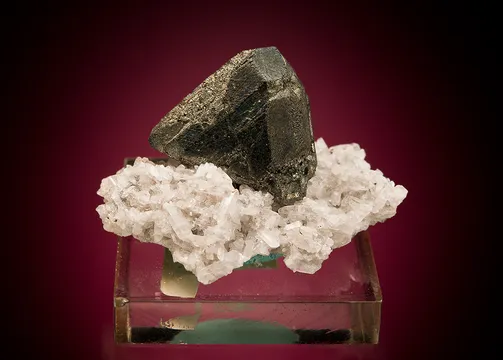
Zincolivenite from Tsumeb, Namibia, vivid green arsenate with color zoning and gemmy crystals; prized by collectors for locality rarity, beauty, and interest.
Key facts
Zincolivenite from Tsumeb is the modern name for much of the vivid green “cuproadamite” and “cuprian adamite” that circulated for decades from this legendary Namibian mine. It sits between adamite and olivenite in the adamite–olivenite solid-solution series, with ideal composition CuZn(AsO4)(OH), and Tsumeb is one of the places where that chemistry becomes a collector’s problem as much as a mineralogical one: color, habit, and zoning can suggest the identity, but the most careful determinations rely on quantitative chemical analysis.
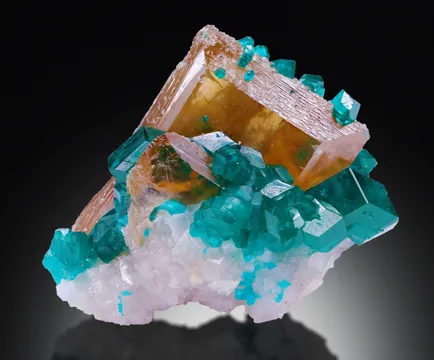
At Tsumeb, zincolivenite is not a one-note green arsenate. It ranges from pale spearmint through saturated emerald to dark bottle green, with the lighter colors generally richer in zinc and the darker colors more copper-rich, edging toward olivenite. The best crystals are bright, glassy, translucent to gemmy, and sharply terminated—often with chisel-shaped ends on prismatic crystals. The finest pieces combine that green with Tsumeb’s unusually sophisticated arsenate palette: mustard-yellow to brown ferrilotharmeyerite, yellow gartrellite or zincgartrellite, colorless schultenite, quartz, malachite, azurite, wulfenite, and an extraordinary tail of rare species that can make even a small specimen worth microscopic study.
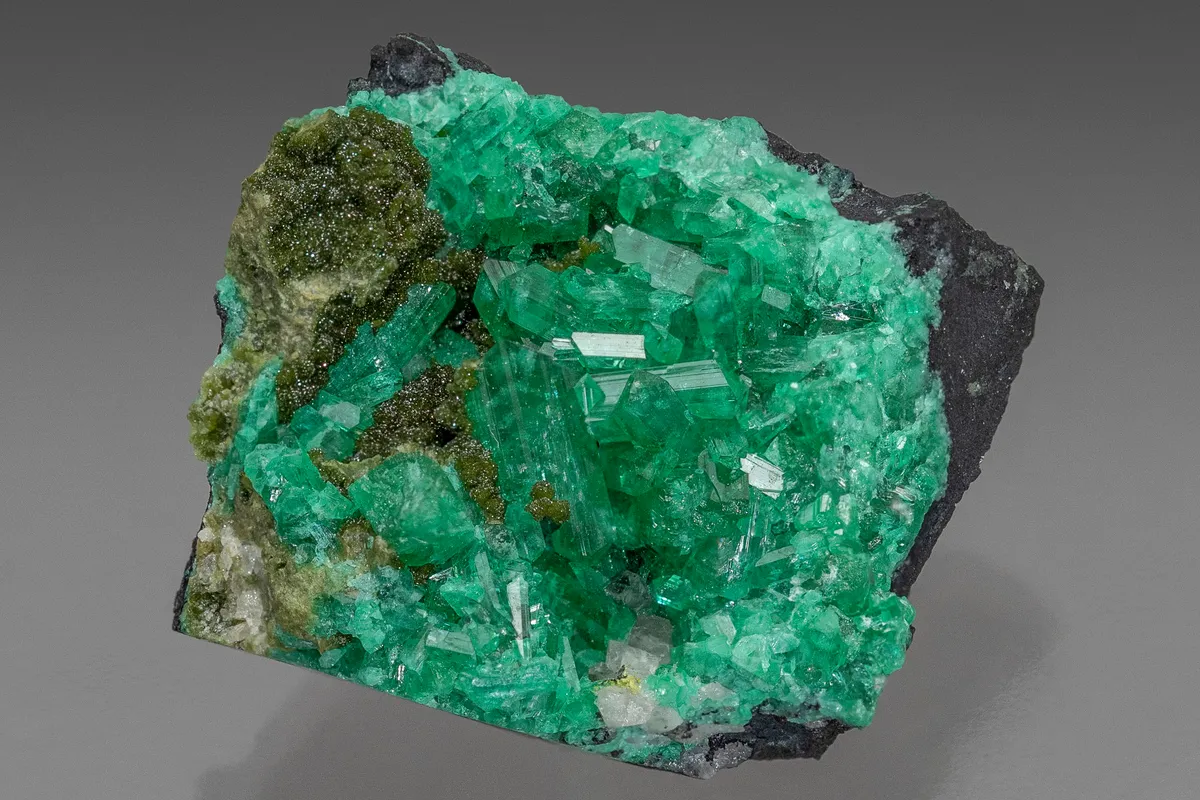
Photo: Tsumeb Mine Notebook
The locality itself explains the richness. Tsumeb was a steep, pipe-like, polymetallic copper-lead-zinc-silver orebody hosted by Neoproterozoic carbonate rocks of the Otavi Group. Oxidizing groundwater did not merely alter a shallow cap; it penetrated to exceptional depths through the mine’s fractured, brecciated, karst-influenced “plumbing system.” That produced three oxidation zones, each with its own secondary-mineral character. Zincolivenite is confirmed from all three.
For collectors, Tsumeb zincolivenite has a double appeal. Visually, it can be a beautiful green display mineral in thumbnail to small-cabinet size. Intellectually, it is one of the best examples of how a classic old locality can change under modern mineralogy: older labels saying “cuproadamite,” “cuprian adamite,” “adamite,” “zincian olivenite,” and even incorrect species names may conceal material that now belongs under zincolivenite. The best specimens have strong color, distinct crystal form, attractive contrast with associated minerals, and, ideally, either a good Tsumeb provenance or analytical confirmation.
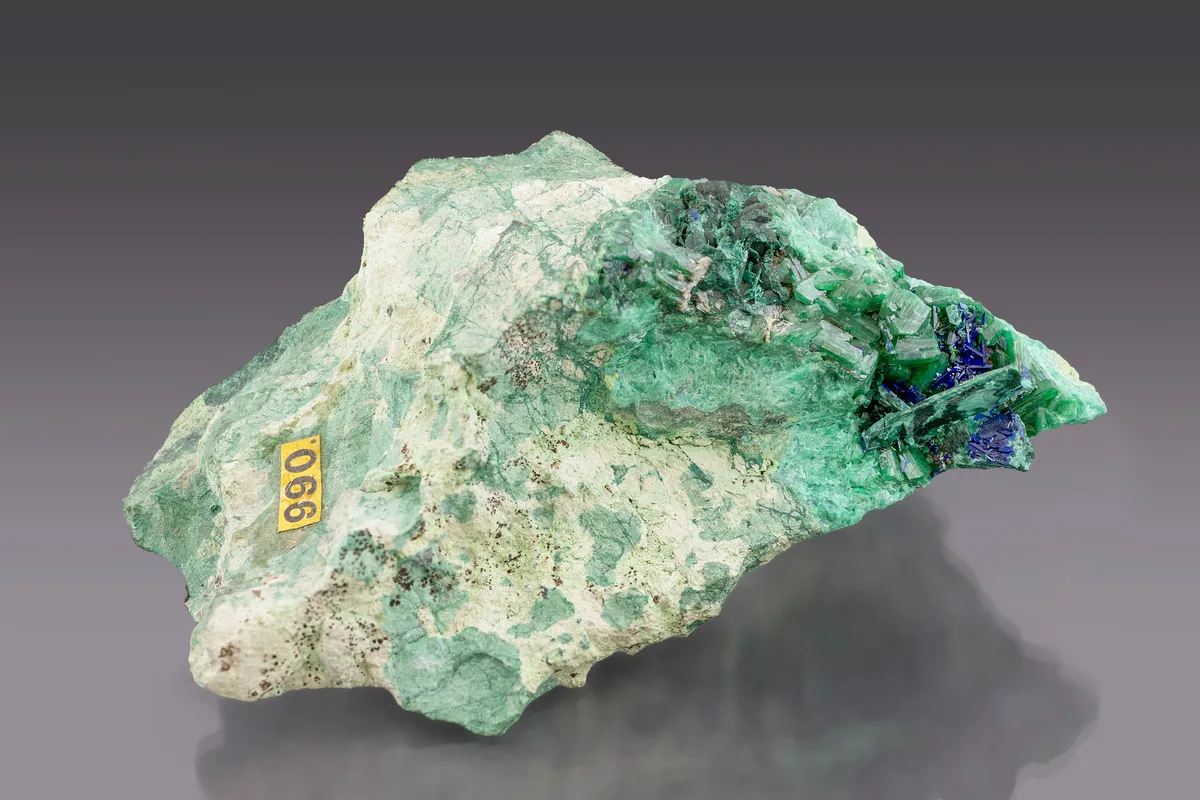
Photo: Tsumeb Mine Notebook
Search for specimens: View all zincolivenite specimens from Tsumeb Mine, Namibia
The Tsumeb Mine, also known as the Ongopolo Mine, lies at the town of Tsumeb in the Oshikoto Region of northern Namibia, within the Otavi Mountainland. It was a modest-sized but extremely rich polymetallic deposit that produced copper, lead, zinc, silver, and a suite of byproduct elements including arsenic, cadmium, gallium, germanium, and silver-bearing copper minerals. In mineral-collecting terms, its importance is far larger than its tonnage: Tsumeb is among the world’s benchmark localities for species diversity, rare arsenates, and display-quality secondary minerals.
Geologically, the deposit was an irregular, steeply dipping to near-vertical pipe-like body cutting carbonate host rocks. The pipe extended roughly 1,700 meters down through the Tsumeb Subgroup dolomites and limestones, with feldspathic sandstone, sandstone breccia, dolomite breccia, massive sulfide veins, replacement zones, and later carbonate-silica alteration. In plan it was typically elliptical; on some levels it narrowed dramatically, while on 26 Level it reached a much larger projection. The orebody’s structure, brecciation, and permeable horizons allowed oxidizing fluids to enter far below the normal shallow weathering zone.
The three oxidation zones are central to understanding zincolivenite. The first extended from the surface down to about 11 Level, with diminished oxide minerals between 11 and 15 Level. The second, from roughly 24 to 35 Level, was centered around the North Break Zone, a vuggy carbonate horizon interpreted as a paleoaquifer. The third began from about 42 Level downward and was recognized as deeper mining and exploration advanced. Zincolivenite is confirmed from the first, second, and third oxidation zones, and it formed as a supergene arsenate in the same geochemical theatre that produced many of Tsumeb’s rarest secondary species.
The mining history began before European development. Local African workers used copper from the outcrop known as the “Green Hill” before commercial mining. European interest followed in the 1880s and 1890s, with Mathew Rogers visiting the outcrop in January 1893 for the South West Africa Company. The Otavi Minen und Eisenbahn Gesellschaft began development with trial shafts in 1900, but full commercial production waited until 1906, after construction of a dedicated railway from the coast.
Early production came from the open pit and shallow workings, then moved underground as the near-surface ore was exhausted. Mining was interrupted by the two World Wars and the Great Depression, but Tsumeb remained a major producer for much of the twentieth century. Postwar work under Tsumeb Corporation Limited resumed in 1947 and eventually reached the second oxidation zone, which transformed the mine’s importance for modern collectors. Later workings reached the third oxidation zone, where still more unusual secondary assemblages were recovered.
Large-scale mining ended in the mid-1990s. By then the deepest workings had reached about 1,700 meters below surface, down to 48 Level. High pumping and mining costs, low metal prices, and labor unrest culminated in 1996, when access to the mine was lost during a strike, pumping ceased, and the workings flooded rapidly. Small-scale upper-level work continued for a time, and a short-lived specimen-mining effort operated between 1998 and 2002, but Tsumeb is effectively a closed historical locality. Collectors today are dealing with old production, old collections, dealer inventories, and reidentified material—not newly mined, routine supply.
For zincolivenite specifically, several finds stand out. A major occurrence on 28 Level around 1973–1974 produced a variety of arsenates and material historically described as grading between cuproadamite and zincian olivenite, including dark olive-green blocky crystals reported to 35 mm and emerald-green prismatic crystals with schultenite. In 1986, a celebrated 30 Level pocket in the second oxidation zone produced emerald-green material on yellow ferrilotharmeyerite; this is the famous material many older collectors still remember as exceptional “cuproadamite.” In the third oxidation zone, sharp bright-green zincolivenite with mustard-yellow ferrilotharmeyerite was found on 43 and 44 Levels, and some material from 44 Level is associated with rare species such as chudobaite and johillerite.
Tsumeb zincolivenite is best understood as a compositional and visual bridge. The species occupies the intermediate Cu-Zn range between adamite and olivenite, and the Tsumeb material illustrates that continuum exceptionally well. Crystals may be equant, tabular, pseudo-octahedral, short prismatic, slender prismatic, bladed, fan-shaped, or radially intergrown. Prismatic crystals commonly show chisel-shaped terminations. Fans, sprays, crusts of intergrown crystals, and discoidal to spheroidal aggregates are all known from Tsumeb material.
Color is one of the great pleasures of the locality. Spearmint-green zincolivenite is typically toward the zinc-rich side; emerald-green material often falls near the middle of the zincolivenite field; bottle-green crystals are generally more copper-rich and may approach olivenite. Some crystals show visible zoning, with paler cores or bases and darker green rims or terminations. In exceptional cases, analyses have shown mixed zones of adamite plus zincolivenite, or zincolivenite plus olivenite, within what appears outwardly to be one green crystal generation.
The crystals are usually vitreous and translucent, and the small crystals can be sharply gemmy. Tsumeb pieces range from submillimeter druses to well-formed crystals several millimeters long; notable analyzed examples include crystals to 8 mm, 10 mm, and 11 mm in published figures and Tsumeb Mine Notebook specimens. Historically reported “cuproadamite” from major finds reached much larger sizes, including crystals to 35 mm from the 28 Level occurrence and crystals to 5 cm from the 1986 30 Level find. Such large, fine crystals are exceptional and belong to the top tier of Tsumeb arsenates.
Associations are a major part of the locality’s character. Common and desirable companions include quartz, ferrilotharmeyerite, schultenite, malachite, azurite, goethite, wulfenite, duftite/conichalcite, gartrellite, zincgartrellite, tsumcorite-group minerals, smithsonite, and tennantite-rich sulfide matrix. The wider Tsumeb association list is much longer and includes adamite, olivenite, bayldonite, cerussite, chudobaite, johillerite, keyite, leiteite, mimetite, reinerite, stranskiite, warikahnite, and other rare arsenates. This is why even unattributed green arsenate crusts on Tsumeb matrix can merit careful inspection.
Quality is judged first by crystal definition and color. The best zincolivenite should show discrete, glassy, sharply terminated crystals rather than dull granular coatings. Rich emerald to bottle-green color is highly prized, but paler spearmint material can be excellent when the crystals are sharp and lustrous. Contrast matters: emerald-green crystals on mustard-yellow ferrilotharmeyerite, green zincolivenite with white schultenite, or green crystals over quartz and sulfide can make a specimen far more memorable than color alone. Good three-dimensional coverage, balanced matrix, and undamaged terminations are critical.
The most desirable pieces also tell a Tsumeb story. A specimen from 30 Level with ferrilotharmeyerite, a 44 Level association with rare arsenates, an old Klein or Innes provenance, or a label carrying the historical term “cuproadamite” can add interpretive value. Analytical confirmation—WDS, EMPA, or reliable EDS where appropriate—raises confidence, particularly for high-value specimens and for pieces near the adamite or olivenite boundaries.
The main authenticity issue with Tsumeb zincolivenite is not widespread treatment; it is nomenclature. Older labels may read “cuproadamite,” “cuprian adamite,” “zincian olivenite,” “adamite,” or “olivenite.” “Cuproadamite” is now a discredited name, and much material once sold under that name falls within the compositional range of zincolivenite. Conversely, not every green adamite–olivenite series specimen can be safely relabeled by eye, especially when crystals are zoned or lie close to compositional boundaries.
For serious collecting, the label should be evaluated in three layers: species identity, locality, and provenance. A classic Tsumeb association—green arsenate crystals with ferrilotharmeyerite, schultenite, quartz, malachite, azurite, wulfenite, or sulfide matrix—is supportive but not conclusive. Quantitative chemical analysis is the best way to separate adamite, zincolivenite, and olivenite where value depends on exact identification. X-ray diffraction alone can distinguish olivenite from the orthorhombic adamite/zincolivenite side, but adamite and zincolivenite are too similar in diffraction behavior for XRD alone to be definitive in many cases.
Condition issues are typical of small arsenate crystals. Chisel terminations and bladed fans can nick easily; radial sprays may lose tips; crystals on friable sulfide or oxidized matrix can shed grains if handled roughly. Ferrilotharmeyerite and other yellow to brown associated arsenates may occur as powdery or botryoidal aggregates that should not be cleaned aggressively. Avoid soaking or ultrasonic cleaning; mechanical cleaning under magnification is safer, and even that should be conservative.
Rarity is nuanced. Zincolivenite as a species at Tsumeb is not a great rarity in the way some Tsumeb type-locality arsenates are. The Tsumeb Mine Notebook lists it as common and records it from all three oxidation zones. But attractive, well-crystallized, damage-free, analytically secure examples—especially with important associations or documented level information—are far less common. Large crystals from the famous “cuproadamite” finds are legitimately rare and command a different level of attention.
Market availability is mostly a function of old stock. Since the mine has been effectively closed since 1996 and the later specimen-mining attempt was short-lived, fresh supply is not expected in any regular sense. Specimens appear through old collections, dealer inventories, auctions, and relabeling of historical “cuproadamite” or “cuprian adamite” pieces. Buyers should welcome old labels, but not let them substitute for modern identification when the price is tied to the name zincolivenite.
Before there was a mine, there was the Green Hill. In January 1893, Mathew Rogers reached the copper-stained outcrop for the South West Africa Company and was struck by the scene at “Soomep,” an old rendering of the name. He wrote that he had “never seen such a sight.” The outcrop was already known through African copper working and trade, and the Herero name Otjisume—often translated as the place of the frog—survives in the later name Tsumeb.
One of the first quiet acts of mineral preservation happened before Tsumeb was famous to collectors. In 1900, a large ore sample was shipped to Germany for metallurgical testing. Wilhelm Maucher, handling the material at the Bergakademie in Freiberg, recognized that the test ore contained well-crystallized secondary minerals worth saving. His 1908 description became one of the first serious mineralogical treatments of the Tsumeb ore, and it already noted zinc-rich olivenite behavior that later generations would come to understand in the adamite–zincolivenite–olivenite framework.
The mine also created its own collector culture. During the interwar years, senior OMEG managers such as F. W. Kegel, Wilhelm Klein, W. Thometzek, and a shift boss named Keller assembled important collections. Klein’s material is especially valuable because he recorded levels for his specimens, making his collection more than a gallery of beautiful minerals: it is a map of the upper mine’s mineral distribution. Much of the Klein collection was purchased by Harvard in 1954, and modern reexamination has shown that some old labels were wrong in revealing ways. A Klein specimen recorded as “Tsumebit ? auf Azurit” from Open Pit East is now recognized as zincolivenite with azurite and malachite after azurite.
The 1929 Gordon/Kegel azurite pocket is not a zincolivenite find, but it captures the atmosphere of Tsumeb collecting. Samuel Gordon, visiting from the United States, encountered a pocket of large pristine azurite crystals on 8 Level in December 1929. He had to share the find with mine manager F. W. Kegel, and the occurrence entered collector lore as the Gordon/Kegel Pocket. That pattern—miners, managers, scientists, and visiting collectors crossing paths underground—continued for decades.
Zincolivenite’s own classic moment came under its old name. Around 1973–1974, 28 Level produced a major arsenate discovery with material described as grading between cuproadamite and zincian olivenite. The standout crystals were dark olive-green and blocky to 35 mm, accompanied by prismatic emerald-green crystals with schultenite. The descriptions read today like a forecast of the nomenclature problem: collectors could see a continuum, but the species boundaries were not yet being handled with modern analytical precision.
Then came the 1986 30 Level find in the second oxidation zone. Later writers remembered it as the source of “probably the finest cuproadamite in existence,” and Bruce Cairncross called it the “Famous Find.” The combination was irresistible: emerald-green crystals, some reported to 5 cm, set with yellow ferrilotharmeyerite and sparse wulfenite. A 10.9 cm Des Sacco specimen photographed by Bruce Cairncross became an emblem of that find—green crystals against powdery lemon-yellow ferrilotharmeyerite, exactly the color contrast collectors now associate with top Tsumeb zincolivenite.
The third oxidation zone added a deeper chapter. On 44 Level in the early 1990s, “cuproadamite” finds included several habits, from stubby zoned crystals to 2 cm with rare chudobaite and johillerite, to minute white needle-like crystals associated with leiteite and legrandite. These finds helped establish the practical field wisdom that a Tsumeb zincolivenite specimen may be more than it appears: the green crystals may be the obvious prize, but the matrix and associated microcrystals can carry some of the mine’s rarest chemistry.
Tsumeb’s ending was abrupt. By the mid-1990s, the mine had reached about 1,700 meters depth and 48 Level. Costs were high, metal prices were low, and labor relations deteriorated. In mid-1996, striking miners denied management access to the site; the pumps were switched off, and the workings flooded rapidly. There were later small-scale efforts and a specimen-mining attempt from 1998 to 2002, but the great productive era was over. The headframes remain; the minerals now move through collections.
Malcolm Southwood, Martin Števko, and Paul F. Carr, “Tsumeb: Zincolivenite and the Adamite-Olivenite Series,” Rocks & Minerals 95(3), 210–233, 2020 — The essential modern paper on Tsumeb zincolivenite, including analytical work on 43 adamite–olivenite series specimens and many illustrated Tsumeb examples.
Chukanov et al., “Zincolivenite CuZn(AsO4)(OH): A new adamite-group mineral with ordered distribution of Cu and Zn,” Doklady Earth Sciences 415, 841–845, 2007 — The species-defining publication for zincolivenite, with DOI and bibliographic details.
E. A. J. Burke, “A mass discreditation of GQN minerals,” The Canadian Mineralogist 44(6), 1557–1560, 2006 — The publication associated with discrediting numerous grandfathered or questionable names, including the nomenclatural background relevant to “cuproadamite.”
Mineralogical Society of America, Handbook of Mineralogy: Zincolivenite — A concise mineral-data sheet for zincolivenite, including formula, crystal data, physical properties, type material, and references.
Tsumeb Mine Notebook: Zincolivenite species page — The best collector-facing locality summary for Tsumeb zincolivenite, including distribution, paragenesis, historical notes, color range, habits, associations, and linked specimens.
Tsumeb Mine Notebook: TSNB584 zincolivenite specimen — A 27 mm WDS-analyzed specimen with emerald-green crystals to 8 mm and ferrilotharmeyerite-associated matrix.
Tsumeb Mine Notebook: TSNB727 zincolivenite with azurite and malachite after azurite — A historically important 80 mm cabinet specimen from Open Pit East, formerly in Wilhelm Klein’s collection and now recognized as zincolivenite.
Tsumeb Mine Notebook: TSNB472 zincolivenite with malachite — A 55 mm cabinet specimen showing translucent emerald-green zincolivenite intergrown with dark green malachite.
Tsumeb Mine Notebook: TSNB965 zincolivenite — A 13 mm matrix-free radial aggregate, useful for understanding the fan-shaped habit.
Tsumeb Mine Notebook: About — A concise introduction to the mine’s mineralogical importance, closure, and legacy.
Tsumeb Mine Notebook: History — The best accessible narrative history of the mine, from the Green Hill and early European development through the second and third oxidation zones and the 1996 flooding.
Tsumeb Mine Notebook: Geology — A detailed explanation of the pipe-like orebody, host rocks, breccias, oxidation zones, North Break Zone, and mineralizing structure.
IUGS Geological Heritage Site: Tsumeb Ore Deposit — Places Tsumeb in global geological context and summarizes its mineral diversity and scientific importance.
Mindat: Tsumeb Mine locality page — A broad locality database entry with species list, references, and links into individual mineral records.
ResearchGate: “Tsumeb: Zincolivenite and the Adamite-Olivenite Series” — Full bibliographic and article access page for the key modern zincolivenite study.
Handbook of Mineralogy: Zincolivenite PDF — Compact mineralogical reference data for the species.
Rocks & Minerals: “Tsumeb—200” — Publication record for the post-closure Tsumeb specimen-mining period discussed by Cook, Nicolson, and Bruce.