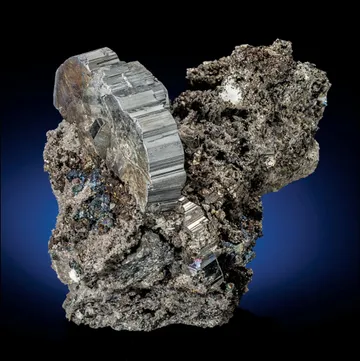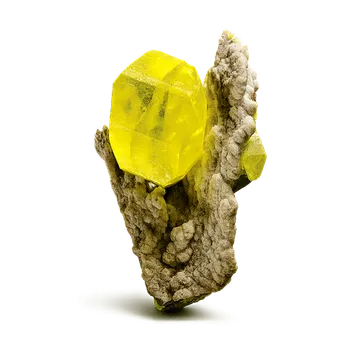
Soufre de Sierra Mojada, Coahuila, Mexique — un soufre natif localisé avec potentiel de rareté, débat sur la provenance et un fort attrait pour les collectionneurs.
Key facts
Sulfur attributed to “El Desierto Mine, Sierra Mojada, Coahuila, Mexico” sits at a difficult but important intersection of specimen aesthetics and locality discipline. The name reads like a promising Mexican sulfur occurrence: vivid native sulfur, S8, from one of northern Mexico’s most storied mining districts. Yet the independently published mineralogical record for Sierra Mojada does not establish an El Desierto sulfur mine there. The verified Sierra Mojada occurrence of native sulfur is the Veta Rica Mine, a historic silver-copper-lead locality in the same district. Meanwhile, marketplace records under the El Desierto name overwhelmingly resolve to the well-known El Desierto sulfur mine in Potosí, Bolivia.
For serious collectors, that distinction matters more than cosmetics. A true Sierra Mojada sulfur specimen would be a locality-sensitive native-element occurrence from a complex carbonate-hosted Ag-Pb-Zn-Cu district, not merely another bright yellow sulfur crystal. Sierra Mojada is documented as a deeply oxidized, structurally controlled mining district hosted largely by Lower Cretaceous limestone and dolomite, with mineralization ranging from polymetallic sulfides and sulfosalts to nonsulfide zinc assemblages dominated by smithsonite and hemimorphite. Native sulfur at Veta Rica belongs to that oxidized mineralogical environment, recorded alongside silver, copper, lead, cobalt, sulfate, carbonate, and oxide species.
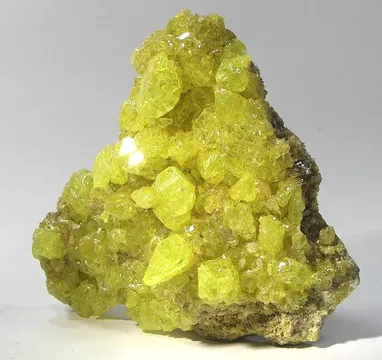
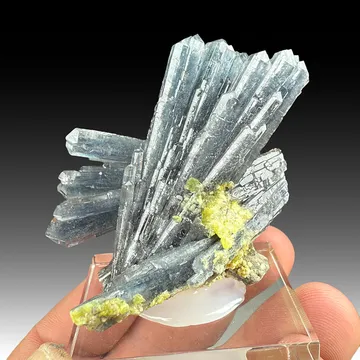
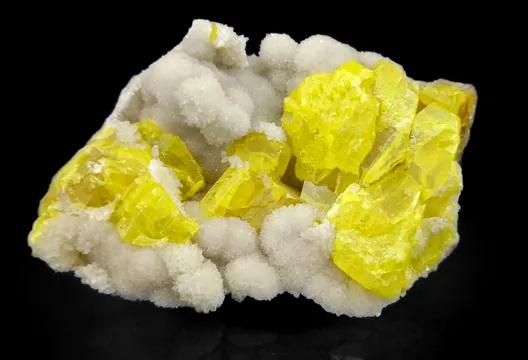
The collector appeal, therefore, is twofold. If the specimen is truly from Sierra Mojada, the value is in rarity and locality specificity rather than in the large transparent sulfur-crystal style familiar from Sicily, Poland, or Bolivia. If the specimen is actually from the Bolivian El Desierto mine, then the appeal is classic modern sulfur aesthetics: bright lemon to canary-yellow crystals, glassy luster, transparency to translucency, and sculptural growth. The two possibilities should not be blurred. A premium label should be supported by old collection labels, dealer chain of custody, or an explicit correction tying the piece either to Veta Rica, Sierra Mojada, Coahuila, Mexico, or to El Desierto, Potosí, Bolivia.
Chercher des spécimens : Voir tous les spécimens de soufre provenant de la Mine El Desierto, Sierra Mojada, Coahuila, Mexique
Le nom de la localité nécessite une manipulation soigneuse. Le district de Sierra Mojada est réel, historique et d’importance minéralogique. Le soufre natif est documenté à partir de la Mine Veta Rica à Sierra Mojada. Cependant, la localité soufre « Mine El Desierto » qui apparaît dans les enregistrements actifs de commerce de spécimens est systématiquement Bolivie, Potosí. Le lien de recherche ci-dessus renvoie actuellement des spécimens de soufre El Desierto listés comme Bolivie, Potosí, mine El Desierto, et non Sierra Mojada, Coahuila. À des fins de collecte, tout spécimen portant l’étiquette combinée « Mine El Desierto, Sierra Mojada, Coahuila, Mexique » devrait être traité comme nécessitant une vérification.
Sierra Mojada se situe dans l’extrême ouest du Coahuila, près de la frontière avec le Chihuahua, dans la région aride du Bolsón de Mapimí et du désert Chihuahuan. Le camp minier historique s’est développé autour des minerais argentifères-plombifères puis argentifères-cuivre, et au début du XXe siècle il était devenu l’un des districts plomb-silver notables du nord du Mexique. La liaison ferroviaire vers Escalón a été construite pour le camp minier, et les premiers auteurs ont souligné l’importance du minerai de Sierra Mojada pour la croissance de la métallurgie mexicaine.
Géologiquement, Sierra Mojada est un district hébergé par des carbonates. Les travaux techniques modernes décrivent des accumulations de zinc et d’argent présentes dans des roches calcaires et dolomitiques, avec une géométrie en manteau et un contrôle structural près du système de fautes de Sierra Mojada. Le district plus large comprend des zones sulfureuses polymétalliques, des gisements de zinc nonsulfures, et une minéralisation argentifère riche plomb-carbonate hébergée par des couches carbonatées du Crétacé inférieur. L’hydrotémo-dolomitation, la silicification, l’oxydation ultérieure et la redistribution supergénèse ont tous joué des rôles dans la production des assemblages minéraux du district.
La Mine Veta Rica, la localité Sierra Mojada vérifiée pour le soufre natif, est enregistrée à environ 27°19' N, 103°42' W, à environ 3,1 km de Sierra Mojada et 4,9 km de La Esmeralda. Sa liste d’espèces documentées comprend l’acitite, l’azurite, la baryte, la calcite, la cérussite, la chalcopyrite, la chlorargyrite y compris la bromiano-chlorargyrite, la covellite, la cuprite, l’érythrite, la galène, le gypse et la sélénite, l’hématite, la limonite, la malachite, le cuivre natif, l’argent natif, le soufre natif, la pearséite, la proustite, des minéraux du sous-groupe serpentine, la skutterudite et la strontianite.
L’accès ne doit pas être supposé. Sierra Mojada est un district minier historique et moderne avec des concessions, d’anciennes zones souterraines et des dangers de sécurité typiques des mines abandonnées ou ponctuellement actives. La collecte devrait être considérée comme autorisée uniquement sur permission, et l’accès à d’anciennes mines n’est pas approprié sans le consentement du titulaire du terrain ou du droit minier et des contrôles de sécurité souterrains compétents.## Caractéristiques du sulfure provenant de la mine El Desierto, Sierra Mojada, Coahuila, Mexique
Le relevé vérifié de Sierra Mojada confirme le sulfure native provenant de la mine Veta Rica, mais les sources minéralogiques publiées ne décrivent pas des cristaux de sulfure spectaculaires de Sierra Mojada de la même manière que les enregistrements modernes des marchands décrivent le sulfure d’El Desierto, Bolivie. Aucune description publiée fiable ne précise la taille des cristaux, l’habitus des cristaux, la transparence, le style de matrice ou l’historique de production des spécimens pour une occurrence de sulfure « Mine El Desierto » à Sierra Mojada.
Cette absence elle-même est diagnostiquement utile. Une étiquette affirmant de gros cristaux de sulfure « El Desierto », nets, transparents et d’un jaune intense, correspondrait davantage à la mine bolivienne El Desierto qu’au rare relevé historique de Sierra Mojada. Les exemples listés par EarthWonders sous la recherche de localité pertinente incluent des cristaux jaune vif, tailles allant de miniature à petit cabinet, et des spécimens individuels décrits avec un éclat vitreux, une croissance en forme d’auge, et des dimensions telles que 4,1 x 2,5 x 2,1 cm, 8,2 x 7,7 x 4,8 cm, et 9,0 x 4,5 x 3,8 cm — mais ces relevés identifient la localité comme Potosí, Bolivie.
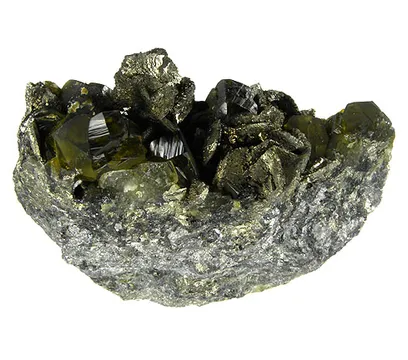
Pour un spécimen véritablement issu de Sierra Mojada, les attentes des minéraux associés devraient être guidées par Veta Rica plutôt que par les habitudes du sulfure bolivien. L’association confirmée avec Veta Rica inclut calcite, gypse, barytine, cérussite, galène, chalcocite, covellite, cuivre pur, cuprite, malachite, azurite, hématite, limonite, cuivre natif, argent natif, acanthite, pearceite, proustite, érythrite, skutterudite et strontianite. Un spécimen de sulfure Sierra Mojada accompagné de vieilles étiquettes nommant Veta Rica, ou d’une matrice cohérente avec l’ensemble minéral oxydé Ag-Cu-Pb de cette mine, serait bien plus convaincant qu’une étiquette qui répète simplement « El Desierto » sans contexte.
Les facteurs de qualité pour un spécimen crédible de sulfure Sierra Mojada sont donc différents des esthétiques ordinaires du sulfure. La provenance passe en premier : étiquettes papier anciennes, historique de collection, formulation locale spécifique à la mine et absence de réétiquetage ultérieur sont centraux. L’état vient ensuite : le sulfure est tendre, fragile, sensible à la chaleur, et sujet à des bosses, à la cassure, à l’ébrèchement des arêtes et à l’assombrissement par manipulation. La netteté visuelle et la couleur comptent, mais sans support de localité, ils ne peuvent pas sauver une attribution douteuse au Coahuila.## Notes du collectionneur
La préoccupation principale d’authenticité est la confusion de localité. “El Desierto Mine” est une localité de soufre célèbre en Bolivie, et les enregistrements actuels du marché liés à la liste de recherche de localités EarthWonders indiquent Bolivia, Potosí, El Desierto mine. Sierra Mojada, Coahuila, possède un enregistrement de soufre natif vérifié à la mine Veta Rica, mais ce n’est pas le même nom de localité. Les collectionneurs sérieux devraient demander aux vendeurs quelle localité est visée et demander des photos des étiquettes avant d’accepter une attribution mexicaine El Desierto.
Il n’y a pas de problème documenté de faux ou de traitement spécifique au soufre de Sierra Mojada dans les sources consultées pour ce guide, mais le soufre en tant qu’espèce présente des vulnérabilités prévisibles. Il se raye facilement, s’ébrèche aisément et peut être endommagé par la chaleur, la pression et un nettoyage négligent. Les spécimens plus anciens peuvent présenter des arêtes abrasées, des points de contact mats, des fissures internes, de la poussière piégée dans des surfaces résineuses et des réparations difficiles à voir sous une teinte chaude jaune. Évitez les éclairages d’exposition chauds, les vitrines chaudes, le nettoyage ultrasonique, les acides et toute tentative de laver une matrice instable de manière agressive.
La rareté doit être encadrée avec soin. Le soufre natif mexicain n’est pas inconnu, et le Coahuila compte plusieurs localités de soufre documentées. Le soufre natif de Sierra Mojada, plus précisément de Veta Rica, est une occurrence enregistrée mais pas un style de spécimen largement disponible. La disponibilité sur le marché sous le nom de “El Desierto” est élevée uniquement si du matériel bolivien est inclus. Sous une norme stricte “Sierra Mojada, Coahuila”, les bons spécimens de soufre semblent rares, et une provenance convaincante peut être plus importante que la taille du cristal.
Pour l’achat, une règle utile est simple : si cela ressemble à un cristal de soufre El Desierto moderne, brillant et transparent et que l’étiquette indique “Sierra Mojada, Coahuila”, faites une pause. Si le vendeur peut documenter une correction de Bolivie vers le Mexique, ou fournir une provenance ancienne Sierra Mojada/Veta Rica, le spécimen peut mériter une étude plus approfondie. Sans cela, il est plus sûr de cataloguer la pièce comme El Desierto mine, Potosí, Bolivie, ou comme soufre à provenance incertaine.## Stories & Field Notes
L’histoire minérale de Sierra Mojada commence par une ruée désertique. La ville a été fondée en mai 1879 après la découverte d’un minerai d’argent attribuée à Néstor Arreola. Le camp se développa rapidement au point d’obtenir le statut de villa, émergeant du désert comme l’un des établissements miniers qui transformèrent les borderlands du Coahuila et du Chihuahua. Le nom lui-même appartient au paysage : la chaîne apparaît sombre et humide vue de loin, une sierra “mojada” qui se distingue dans le désert.
L’isolement du district faisait partie de son identité. Les premiers récits situaient Sierra Mojada à des centaines de milles au sud d’El Paso et liaient sa survie pratique au chemin de fer. Le chemin de fer nordmexicain, une ramification de 78 miles depuis Escalón, fut construit en grande partie à cause du district minier, transformant un camp isolé d’argent et de plomb en un envoi d’metal vers les centres de fonderie à Torreón, Monterrey, El Paso, Aguascalientes, San Luis Potosí, Pueblo et Kansas. D’ici 1901, les écrivains pouvaient évoquer environ 3 000 000 de tonnes de minerai extraites depuis 1886, un chiffre qui explique pourquoi le camp attirait ingénieurs, investisseurs, métallurgistes et minéralogistes dans ce fragment isolé du nord du Mexique.
Le dossier minéralogique de Veta Rica a aussi une trame personnelle. L’article de 1913 de Frank R. Van Horn dans l’American Journal of Science s’appuyait sur des spécimens présentés à la Case School of Applied Science par R. B. Cochran, superviseur de la Compañía Metalúrgica Mexicana à la mine. Van Horn insistait sur le fait que la littérature antérieure avait traité Sierra Mojada principalement par le biais de l’exploitation minière et de la métallurgie, et non de la minéralogie. Son article a aidé à transformer un camp minier opérationnel en une localité minéralogique, enregistrant un assemblage comprenant des espèces d’argent, de cuivre, de cobalt, de plomb, de sulfate, de carbonate et d’éléments natifs.
Une autre histoire de Sierra Mojada appartient davantage au folklore qu’à la minéralogie, mais elle montre à quel point l’endroit demeure vivant dans la mémoire du nord du Mexique. La tradition orale locale a lié la ville à la disparition d’Ambrose Bierce en 1913, avec une version affirmant que Bierce aurait été exécuté par peloton d’exécution dans le cimetière de la ville. Qu’elle soit acceptée ou doutée, cette légende colle à l’image plus large de Sierra Mojada : éloignée, riche en minerais, historiquement turbulente, et juste assez au fond du désert pour que la légende s’accroche aux rochers.## Registres et publications minéralogiques- Mindat — Mine Veta Rica, Sierra Mojada, Municipalité de Sierra Mojada, Coahuila, Mexique — L’enregistrement local clé pour le soufre natif vérifié à Sierra Mojada, avec coordonnées, liste des minéraux et références.
Mindat — Sierra Mojada, Municipalité de Sierra Mojada, Coahuila, Mexique — Page locale régionale résumant le district de Sierra Mojada et ses espèces minérales documentées.
Mindat — Liste des localités de soufre natif — Utile pour vérifier les localités mexicaines documentées du soufre et voir Veta Rica répertorié sous Sierra Mojada.
Van Horn, Frank R. 1913. “A New Occurrence of Silver, Copper, and Cobalt Minerals in Mexico.” American Journal of Science, series 4, 35(205), 23–30 — Article minéralogique classique sur Veta Rica, basé sur des échantillons de la mine.
Van Horn, Frank R. 1912. “The Occurrence of Silver-, Copper-, and Lead-Ores at the Veta Rica Mine, Sierra Mojada, Coahuila, Mexico.” OneMine record — Important traitement économique-géologique de la mine Veta Rica.
Malcolmson, James W. 1902. “The Sierra Mojada, Coahuila, Mexico, and Its Ore-Deposits.” OneTunnel record — Ancien article d’ingénierie minière avec histoire, descriptions des dépôts, contexte ferroviaire et chiffres de production.
Kyle, J. Richard, Hyein Ahn, et H. Albert Gilg. 2018. “Nature and origin of the nonsulfide zinc deposits in the Sierra Mojada District, Coahuila, Mexico.” Mineralium Deposita 53, 1095–1116 — Étude moderne évaluée par les pairs sur la minéralisation zinc non-sulfure du district, l’oxydation, les isotopes et le cadre carbonaté-host.
Ahn, Hyein, J. Richard Kyle, et Nathan R. Miller. 2012. “Origin of the Non-Sulfide Zn Deposits of the Sierra Mojada District, Coahuila, Mexico.” Geological Society of America abstract — Résumé technique concis de la minéralogie zinc non-sulfure du district.
Pincock Allen & Holt. 2010. “Sierra Mojada 43-101 Technical Report” — Rapport technique décrivant le type de dépôt, les roches hôtes, les contrôles structurels et les zones minéralisées.
Silver Bull Resources. 2022. “Sierra Mojada S-K 1300 Technical Report” — Rapport technique ultérieur avec stratigraphie détaillée, structure, altération hydrothermale et cadre supergène.## Lectures complémentaires et liens externes
Recherche sulfur EarthWonders pour la localité 75952 — Résultats actuels du marché liés à l’ID de localité fourni; utile car les spécimens répertoriés se résolvent en Bolivie, Potosí, mine El Desierto.
Specimen EarthWonders 111470 — Soufre de Bolivie, Potosí, mine El Desierto — Enregistrement de spécimen en vedette montrant comment la recherche de localité fournie se mappe actuellement au matériel bolivien d'El Desierto.
Specimen EarthWonders 84292 — Soufre, mine El Desierto, San Pablo de Napa, Province de Daniel Campos, Potosí, Bolivie — Exemple de marché avec dimensions, poids, énoncé sans traitement et origine bolivienne explicite.
Specimen EarthWonders 63354 — Soufre, mine El Desierto, Potosí, Bolivie — Exemple de revendeur décrivant un flotteur de soufre à texture en hopper de grande taille provenant de la localité bolivienne.
Wiki du soufre EarthWonders — Vue d’ensemble sur le soufre par EarthWonders; utile pour voir la formulation interne de la localité qui doit être conciliée avec les enregistrements externes.
Sierra Mojada, Coahuila — Vue d’ensemble en espagnol — Histoire générale et géographie de la ville, y compris sa fondation, son isolement et son contexte minier.
« De Brez, Trento au minéral de Sierra Mojada, Coahuila, Mexique » — Étude historique sur les réseaux miniers transnationaux liés à Sierra Mojada.