A collector's guide to Stanley Butte, USA: its geology, mining history and notable minerals, illustrated with the 29 specimens documented from this locality on EarthWonders.
Key facts
Stanley Butte is one of Arizona’s classic andradite localities: a rugged, semi-arid skarn occurrence in Graham County, near the northern Santa Teresa Mountains and the old Stanley mining district south of San Carlos Lake. The collector name “Stanley Butte” has long been used broadly for a cluster of garnet-bearing outcrops around the butte and nearby Quartzite Mountain, rather than for a single neat mine portal. That distinction matters, because the finest specimens came from skarned Paleozoic limestone near granitic intrusive rocks, not from the lead-zinc-copper prospects that gave the mining district its original economic identity.
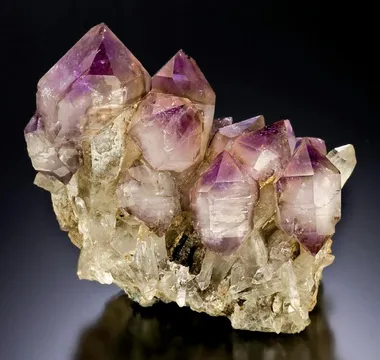
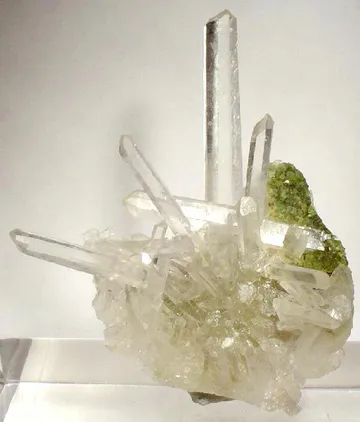
For collectors, the locality is famous above all for lustrous andradite in olive-green, brownish green, yellow-green, bronze, dark reddish brown, and locally nearly black tones. The best pieces are unmistakable: dense druses and sculptural mounds of dodecahedral garnet, often with a slightly metallic or iridescent skin, and at their finest showing sharp crystals large enough to read individually across the surface. Quartz is the other important specimen mineral here, sometimes as slender colorless to faintly amethystine crystals, and the most desirable association pieces place pale quartz over or among green andradite-coated matrix.
Regional View
Country View
The classic Stanley Butte look is not the emerald demantoid look of the Urals or the black melanite look of volcanic localities; it is a peculiarly Arizona grandite-skarn look: olive to green-gold crystals with a frosted sparkle, metallic sheen, granular to “scaled” growth texture on some faces, and a weathered desert matrix that can make even modest pieces look ancient and sculptural. Older labels may read Stanley Butte, Quartzite Mountain, San Carlos Reservation, Graham County, or simply “Stanley Butte garnet,” reflecting decades of collector shorthand for several nearby skarn exposures.

Photo: Wikimedia Commons / Didier Descouens

Photo: Wikimedia Commons / Rob Lavinsky, iRocks.com
Search for specimens: View all specimens from Stanley Butte, USA
Stanley Butte lies in the Stanley mining district of Graham County, Arizona, within the broader Aravaipa–Santa Teresa mineral belt. In mining terms the district is a Cu-Pb-Zn-Ag area, but in specimen terms the name is attached most strongly to skarn garnets developed in metamorphosed Paleozoic limestone near Laramide granitic intrusive rocks. The better-known Quartzite Mountain garnet locality is described as lying north of Stanley Butte on the south slope of Quartzite Mountain, in section 36, T4S, R19E, roughly ten miles southeast of Coolidge Dam. The specimen-producing rock is not ordinary quartzite despite the place name; the andradite formed in contact-metamorphosed limestone and related skarn zones, with quartz and calc-silicate gangue minerals.
The economic deposits of the Stanley district are vein and replacement bodies in Carboniferous-age sedimentary rocks, including the Tornado Limestone, as well as mineralization in Cretaceous andesite and younger volcanic rocks. The district sits on the west side of the Santa Teresa granite batholith. Sulfide mineralization recorded from the mine groups includes sphalerite, pyrite, chalcopyrite, bornite, and locally galena, with calcite and quartz as gangue. Oxidized copper minerals such as malachite occur in the old copper prospects, and baryte and fluorite are documented in veins in the Stanley Butte–Quartzite Mountain area. These ore minerals are historically important, but they are secondary to the locality’s collector identity: Stanley Butte is a garnet locality first.
Several old claim groups and prospects frame the locality history. The Copper Dike group occupied the south slope of Stanley Butte and consisted of fourteen unpatented claims adjoining the Princess Pat group. Ross described a rusty, silicified shear zone in andesite there, with a mineralized underground zone about seven feet wide encountered in a crosscut roughly 320 feet from the tunnel portal. The rock on the dump included light-green brecciated and chloritized andesite with abundant sphalerite, pyrite, minor chalcopyrite, probable galena, calcite, and quartz. The Princess Pat group, south of Stanley Butte on Old Deer Creek, was located by members of the Allison family around 1900 and purchased by the Princess Pat Mining Company in 1916; a tunnel nearly 900 feet long was driven, but the operation did not become a major ore producer. Other named workings in the district included the Friend Mine, Starlight Mine, Soldier prospect, Silver Spar prospect, Copper Belle Mine, and Cold Spring prospect.
The settlement of Stanley was a short-lived mining camp rather than a long-lived town. It had a post office from 1906 to 1926, reached a recorded population of 139 in 1910, and had dwindled dramatically by the 1920s. The locality’s later fame among collectors came after the main mining period: from roughly the postwar decades into the early 1980s, the Stanley Butte area was accessible enough for rockhounds and field collectors, and a number of andradite and quartz pockets were opened. Published collecting accounts record quartz crystals up to about 12 inches associated with andradite, clear crystals with tan chalcedony coatings, faintly amethystine quartz, and colorless quartz on green andradite-coated matrix. A particularly admired pocket dug in 1984 produced clear, slender quartz crystals on green andradite-coated matrix.
Access today is a serious matter. Much of the Stanley Butte–Quartzite Mountain collecting area is on or associated with lands of the San Carlos Apache Reservation and the former San Carlos Mineral Strip. The area is not an open public collecting ground, and modern sources repeatedly note that the classic Stanley Butte collecting region is closed to casual collecting. Specimens now reaching the market are therefore usually old-stock pieces, material collected when access was different, or specimens from collections and dealer inventories that preserve older field labels.
Stanley Butte andradite is typically seen as dense clusters of sharp to slightly rounded dodecahedral crystals in olive-green, brownish green, yellow-green, bronze, reddish brown, or dark nearly black tones, with individual crystals commonly in the millimeter to centimeter range and older records noting exceptional crystals up to about 2 inches across from the Quartzite Mountain garnet occurrence. Fine pieces are judged less by sheer size than by crystal definition, uninterrupted coverage, luster, and the distinctive metallic or faintly iridescent surface that marks the locality. Most specimens are garnet-only druses on matrix, but the most desirable association pieces show andradite with quartz, and less commonly with diopside or hedenbergitic pyroxene. A recent crystallographic study of Stanley Butte material described olive-green euhedral dodecahedra 2 to 10 mm across, with late-stage birefringent grandite rims around andradite cores; that microscopic zoning helps explain why some crystals here show optical effects and surface character that are more complex than ordinary brown skarn garnets. The strongest collector pieces combine sharp form, lively green-gold color when backlit, clean display faces, and minimal pocket-wall breakage around the edges.
Other documented minerals from the Stanley Butte locality group include baryte, fluorite, quartz including amethyst, hedenbergite, diopside, calcite, hematite, malachite, pyrite, chalcopyrite, bornite, and sphalerite. Quartz is the most collectible companion species, especially the slender colorless to faintly amethystine crystals that occur with andradite or on andradite-coated matrix. Baryte and fluorite belong principally to vein mineralization in the area, while the copper and iron sulfides, malachite, calcite, and hematite are tied more closely to the old mine prospects than to the specimen garnet pockets. No well-established IMA type-locality mineral is normally credited to Stanley Butte itself, but the locality has acquired unusual scientific interest because its garnets have been used in modern work on birefringent, compositionally zoned grandite and orthorhombic garnet structure.
The chief authenticity issue with Stanley Butte specimens is not treatment or outright fakery, but locality precision. For decades, “Stanley Butte” has been used as a convenient label for garnets from several skarn outcrops around Stanley Butte proper, Quartzite Mountain, and the surrounding Stanley Butte area. Some old labels may say Quartzite Mountain; others may say Stanley Butte; some dealer labels compress the geography to “San Carlos” or misplace the occurrence in the Pinaleno Mountains rather than the Santa Teresa Mountains. There are also documented market examples where a specimen was labeled Limestone Mountain but was suspected by the dealer to be more properly Quartzite Mountain. Serious collectors should preserve original labels, but they should also distinguish between a specimen genuinely from the Stanley Butte area and one whose exact outcrop is unknown.
Condition is the practical buying issue. Good Stanley Butte garnets often came from pocket walls or skarn seams, so even attractive pieces may show breakage along the perimeter where they were removed. Look closely for bruising on exposed dodecahedral edges and for flattened or sawed backs on specimens prepared for display. The garnets are hard and robust compared with many collector minerals, but the best surfaces can be subtly frosted, iridescent, or metallic, so aggressive cleaning is a mistake. Acid treatment is not normally needed for display-quality pieces and may alter associated calcite or surface films. Ultrasonic cleaning should be avoided on pieces with quartz attachments, friable skarn matrix, or delicate drusy coatings.
There are no widely documented locality-specific fakes of Stanley Butte andradite in the way one sees with certain high-value gem species, but misidentification happens. The most common confusion is visual: dark, blocky, brown to green garnet aggregates from other skarn localities may be offered loosely as Stanley Butte material because the locality name is marketable and familiar. True Stanley Butte pieces tend to have a recognizable olive to green-gold cast, metallic sparkle, and compact dodecahedral druse texture; association with slender quartz can support the attribution, but quartz association alone is not proof.
Market availability is steady but not abundant. Stanley Butte andradite appears regularly as thumbnails, miniatures, and small cabinets, usually from older collections or dealer backstock. Good miniatures with sharp, lustrous, undamaged greenish crystals are more desirable than large but dull plates. Association pieces with clean quartz on green andradite-coated matrix are substantially scarcer, and unusual habits such as dark reddish-brown trapezohedral crystals or nearly black garnet from separate skarn outcrops should be treated as special if the provenance is credible.
Long before collectors learned to recognize the metallic green sparkle of Stanley Butte andradite, the place was a hard mining frontier tied to the San Carlos Mineral Strip. The butte took its name from Lieutenant Stanley, remembered in local accounts as the officer in charge of a military guard unit that accompanied a survey party down the Aravaipa in the 1860s. The country around the butte later became a contested mineral belt: rich enough to attract prospectors, remote enough to frustrate development, and politically complicated because of its relationship to the San Carlos Apache lands.
The old Stanley camp rose and faded quickly. Spanish or Mexican miners had worked parts of the district at an undetermined early date, and when American prospectors rediscovered the area in the early 1880s they found glory holes in Godless Gulch and the remains of an old adobe smelter. By 1906 the camp had a post office; by 1910 it counted 139 residents. Ten years later the population had fallen to fifty-four, and by 1925 the once-busy district was reduced in one account to a single resident, J. Flaherty, a veteran prospector living in Garden Gulch. His vegetable patch in the stony wash was memorable enough that the canyon name was explained by his surprising success in raising vegetables there.
The mining names around Stanley Butte still read like fragments from a desert ledger: Starlight, Friend, Copper Reef, Silver Spar, Soldier, Copper Dike, Copper Belle, Cold Spring, Princess Pat. The Friend Mine, above Garden Gulch on Little Stanley Butte, was said to have been discovered in the early 1880s by an Indian named Bob McIntosh and two partners, one white and one Black; later records describe about 2,000 feet of underground workings. The Soldier prospect, a mile east of Stanley on Limestone Mountain, had an inclined shaft and a tunnel more than 1,000 feet long. The Princess Pat group lay four miles from Stanley on Old Deer Creek and carried forty-four unpatented claims. The Copper Dike group, on the south slope of Stanley Butte, had fourteen claims and enough promise for a tunnel, crosscuts, and a brief corporate campaign before work stopped in December 1918.
For mineral collectors, the telling line appeared in the April 1952 issue of Desert Magazine, where an enthusiastic amateur geologist remarked, “There are beautiful yellow garnets at Stanley Butte.” That phrase catches the locality at the moment it was passing from mining geography into rockhound geography. Later field accounts describe the postwar to early-1980s period as the great collecting window. Pockets were dug; andradite plates entered collections; and quartz crystals as much as 12 inches long were recovered with andradite. The 1984 pocket of clear, slender quartz on green andradite-coated matrix became a small Arizona classic precisely because it joined two Stanley Butte signatures in one specimen: the pale, glassy quartz of the area and the green, metallic garnet skin beneath it.
A later Mindat discussion captured what old labels often obscure. Arizona collector Tony Potucek noted that there was “no mine per se for the garnets,” but rather multiple skarn outcrops around Stanley Butte, some a mile or more apart. He also recalled that Andy Clark, better known to many collectors for the Greyhorse vanadinite mine, had worked a separate black-garnet locality distinct from the more typical green-yellow andradite spots. That is the key to reading Stanley Butte specimens today: the name is both a locality and a collecting tradition, preserving a family of nearby skarn occurrences whose exact pocket names were often lost as specimens moved from field buckets to show flats to old collection cabinets.
Clyde P. Ross, “Geology and ore deposits of the Aravaipa and Stanley mining districts, Graham County, Arizona,” U.S. Geological Survey Bulletin 763, 1925. The foundational geologic and mining report for the district, including the Stanley district mines and prospects.
https://pubs.usgs.gov/publication/b763
John W. Anthony, Sidney A. Williams, Richard A. Bideaux, and Raymond W. Grant, Mineralogy of Arizona, 3rd edition, University of Arizona Press, 1995. A standard Arizona mineral reference cited for Stanley Butte and Quartzite Mountain andradite, baryte, fluorite, hedenbergite, and quartz.
F. W. Galbraith and D. J. Brennan, Minerals of Arizona, University of Arizona Bulletin / Arizona Bureau of Mines, 1959. An important mid-century Arizona reference cited in later locality summaries for the Stanley Butte–Quartzite Mountain garnet occurrence.
John Sinkankas, Mineralogy for Amateurs, Van Nostrand Reinhold, 1964. Cited in locality records for the Stanley Butte / Quartzite Mountain andradite occurrence and part of the early collector-literature trail for the locality.
Terry C. Wallace, editor, Collecting Arizona: State of Mines, Legacy of Minerals, Lithographie, LLC, 2012. A major collector-oriented Arizona mineral history that includes accounts from Arizona field collectors and is repeatedly referenced in discussions of Stanley Butte collecting.
https://mineralogicalrecord.com/book_list/collecting-arizona-state-of-mines-legacy-of-minerals/
Jocelyn A. Peterson and Mark H. Hibpshman, Status of Mineral Resource Information for the San Carlos Indian Reservation, Arizona, U.S. Bureau of Indian Affairs / U.S. Geological Survey and U.S. Bureau of Mines, 1981. Government compilation on the mineral resources of the San Carlos Indian Reservation, relevant to the land and mineral context around Stanley Butte.
https://azmemory.azlibrary.gov/nodes/view/118809
Huifang Xu, Shiyun Jin, Seungyeol Lee, and Philip E. Brown, “Cation ordering, twinning and pseudo-symmetry in silicate garnet: the study of a birefringent garnet with orthorhombic structure,” American Mineralogist preprint. A modern crystallographic study using a University of Wisconsin specimen from Stanley Butte, documenting late-stage orthorhombic grandite rims on andradite and associated quartz and epidote.
https://msaweb.org/MSA/AmMin/AM_Preprints/8455XuPreprint.pdf
“Arizona Quartz Crystals: Classic and New Localities,” 37th Annual New Mexico Mineral Symposium, 2016. Includes a concise collector account of Stanley Butte-area quartz and andradite pockets, the 1984 quartz-on-andradite pocket, and the closure of the classic collecting region.
https://geoinfo.nmt.edu/museum/nmms/abstracts/view.cfm?aid=522
“Andradite Garnet - Stanley Butte” — Catawiki / Luca Esposito. Short specimen video linked from an auction listing, showing a substantial old-time Stanley Butte andradite with dark green dodecahedral crystals and the locality’s characteristic scaled surface texture.
https://vimeo.com/1136838329/3111168c60
“Andradite” specimen video — Weinrich Minerals. Dealer specimen video for a miniature with iridescent sharp andradite crystals to 1.5 cm and an old label dating the piece to 1980.
https://www.weinrichmineralsinc.com/products/andradite-9851301.php
Mindat: Stanley Butte, Stanley Mining District, Graham County, Arizona — Broad locality page for Stanley Butte, including the mineral list, coordinates, sublocalities, and historical note on the name.
Mindat: Stanley Butte area — Useful for the collector shorthand “Stanley Butte area” and for baryte, quartz, amethyst, hedenbergite, and andradite references.
Mindat: Quartzite Mountain / Quartzite Mountain Garnets — Essential page for the classic garnet occurrence north of Stanley Butte, including the skarn description and historical references.
USGS Publications Warehouse: Ross, 1925, Bulletin 763 — Primary geologic and mining report for the Aravaipa and Stanley mining districts.
New Mexico Mineral Symposium abstract on Arizona quartz crystals — Includes specific Stanley Butte collecting history, quartz associations, and the 1984 quartz-on-andradite pocket.
Wikimedia Commons: Andradite-Arizona.jpg — Large specimen photo of andradite from Quartzite Mountain near Stanley Butte by Didier Descouens.
Wikimedia Commons: Andradite-258450.jpg — Rob Lavinsky photo of an older Stanley Butte andradite specimen with olive-green dodecahedral crystals.
Minerals.net: Andradite locality notes — General andradite reference that specifically notes Stanley Butte and Quartzite Mountain as a famous U.S. locality for brownish-green and bronze topazolite-type andradite.
Mineral Auctions: Andradite Garnet, Quartzite Mountain / Stanley Mining District — Market example noting the locality’s distinctive semi-metallic luster, dodecahedra to 8 mm, and label confusion between Limestone Mountain and Quartzite Mountain.
Mineral Auctions: Andradite Garnet, ex Kay Robertson Collection — Useful market comparison for a less typical dark reddish-brown trapezohedral Stanley Butte specimen.
Weinrich Minerals: Andradite specimen no. 9851301 — Dealer record for an iridescent Stanley Butte miniature with crystals to 1.5 cm and a 1980-dated previous label.
Mindat discussion: “Looks like one (or two or ...) Stanley Butte (AZ) too many” — Valuable locality discussion explaining why many garnets are labeled Stanley Butte even though they came from multiple nearby skarn outcrops.
Status of mineral resource information for the San Carlos Indian Reservation, Arizona — Government report page for the 1981 mineral-resource compilation relevant to the reservation and mineral-strip context.