Sheshodonnell East Mine, Ireland — famed for lemon-yellow smithsonite on purple fluorite in the Burren, a classic small locality prized by collectors.
Key facts
Sheshodonnell East Mine is one of those small localities whose mineralogical reputation is wildly out of proportion to its physical scale. In the limestone country of the Burren, near Carran in County Clare, a narrow calcite-fluorite-galena vein in Carboniferous limestone produced a suite of zinc and lead minerals dominated, from the collector’s point of view, by extraordinary cadmium-yellow smithsonite. The mine was not a great industrial enterprise; it was a short-lived Victorian lead working. Yet its discarded zinc carbonate became one of the classic British Isles smithsonites: botryoidal, mammillated, waxy to satiny, lemon-yellow to yellow-green, and commonly draped over purple fluorite or filling cavities in fluorite-rich vein material.
Regional View
Country View
The best Sheshodonnell specimens have an unmistakable colour contrast: rounded yellow smithsonite bubbles rising out of lilac to deep purple fluorite, with grey limestone, galena, quartz, or altered brown iron-stained areas giving the pieces a compact, old-mine character. Many are not large by international standards, but good cabinet pieces do exist, and the locality has produced specimens in which the yellow smithsonite forms rich crusts, open vugs, or thick botryoidal linings rather than mere stains. Under magnification, some of the rounded surfaces break into minute crystal faces and “shark tooth” terminations, giving serious collectors another level of interest beyond the immediate colour.

Photo: Wikimedia Commons
Search for specimens: View all specimens from Sheshodonnell East Mine, Ireland
Sheshodonnell East Mine lies in the Burren of County Clare, a karst landscape developed on Mississippian, or Lower Carboniferous, limestones. The mineralization belongs to the Burren’s vein system: mostly calcite veins, locally carrying fluorite, quartz, galena, chalcopyrite, sphalerite, and their oxidation products. The important host unit for many of the galena- and sphalerite/smithsonite-bearing veins is the Slievenaglasha Limestone Formation, a Brigantian limestone succession of crinoidal grainstones, coral-rich units, and cherty limestones in the southern Burren.
The worked structure at Sheshodonnell was a small calcite vein, reported at roughly 30 to 45 cm wide, followed by shallow workings for about 100 m. The ore sought by the miners was lead, chiefly galena. Zinc sulphide was present in the original system, but the locality is famous precisely because so much of the zinc mineralization was altered to smithsonite. Modern descriptions of the vein material record limestone replaced by quartz and galena, coarse purple fluorite in narrow veinlets, and pale yellow to yellow-green colloform smithsonite coating fluorite, galena, and quartz. The specimen texture is therefore a direct expression of the ore’s history: hydrothermal vein filling, sulphide deposition, and later supergene alteration in a limestone karst environment.
The mine’s working life was brief, generally given as 1862–1863. It was a Victorian lead venture rather than a sustained zinc mine, and the yellow smithsonite appears to have been rejected as gangue and left on the dumps. That accident of nineteenth-century ore sorting created the later collector locality. Sir Arthur Russell visited in 1917, when several tonnes of smithsonite were still reportedly visible on the spoil. Much later, collectors recovered many specimens from the small tip during the 1980s and early 1990s. By the early twenty-first century, the site had declined badly as a collecting locality; the remaining tip material was reportedly pushed down the shaft in spring 2005, and only a small, weathered remnant of spoil has been described since.
Access today should be regarded as effectively non-collecting without explicit permission from the landowner and any relevant mineral-rights holder. The locality is on private land in a sensitive rural and karst setting, and the remaining mine features are old, unstable, and of little specimen potential. Modern Sheshodonnell pieces on the market are overwhelmingly old dump material, older collection specimens, or pieces recycled from British and Irish collections.
The notable “finds” from Sheshodonnell were not single named pockets in the modern mine-picking sense. They were vuggy pieces of fluorite- and limestone-hosted vein material rescued from the dump. Fine specimens show open cavities lined by botryoidal smithsonite; richer examples have yellow smithsonite covering much of the display face; the most desirable combinations preserve purple fluorite crystals or crystalline fragments beside or beneath the smithsonite. Calcite crystals, including weathered nail-head habits coated by smithsonite, are recorded but are much rarer and usually less aesthetic than the classic smithsonite-fluorite pieces.
Sheshodonnell smithsonite is the mineral that defines the locality: yellow, yellow-green, orange-yellow, greenish, grey, and white zinc carbonate formed as a supergene alteration product of earlier zinc sulphide mineralization in the narrow calcite-fluorite-galena vein. The classic specimens are botryoidal to mammillated crusts and vug linings, with satiny to waxy lustre and lemon-yellow colour attributed to cadmium sulphide inclusions; some pieces show microscopic rounded tetrahedral faces or tiny sharper terminations on the botryoids. Typical collector pieces range from thumbnails and miniatures to small cabinets, with known cabinet specimens around 11 to 13.5 cm across and historically figured examples around 15 cm; the best pieces have rich, undamaged yellow smithsonite in open cavities or on contrasting purple fluorite, while ordinary pieces are duller, bruised, iron-stained, matrixless lumps or thin crusts with little relief.
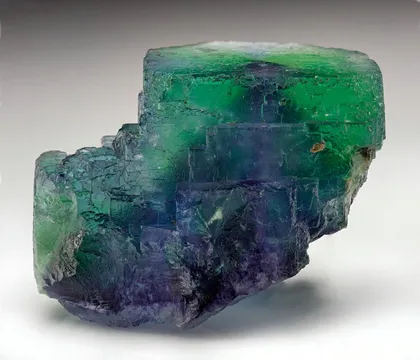
Fluorite at Sheshodonnell is both a major vein constituent and the essential contrast mineral for the finest specimens. It occurs as massive to crystalline fluorite, most memorably lilac to deep purple cubic crystals and fragments, though colourless and orange material are also recorded. In much of the old dump material the fluorite is fractured and cemented or overgrown by smithsonite, and well-formed crystals are distinctly scarcer than the smithsonite itself; documented collector pieces include translucent purple cubes to about 7 mm on edge associated with very pale yellow smithsonite, while other specimens show only purple crystalline remnants embedded in or peeking through yellow botryoidal smithsonite. Superior fluorites from the mine are therefore not judged by large crystal size, but by clean cubic form, visible purple colour, and sharp association with Sheshodonnell’s cadmium-yellow smithsonite.
Other minerals documented from Sheshodonnell East Mine include galena, sphalerite, chalcopyrite, calcite, quartz, cerussite, anglesite, hydrozincite, malachite, rosasite, greenockite, and otavite. The rarities are mostly of micro-mineralogical interest rather than cabinet-display importance. Greenockite is important because cadmium sulphide inclusions are tied to the celebrated yellow colour of the smithsonite, and otavite is recorded as microscopic white skeletal crystals, with pink fluorescence, on cadmium-rich smithsonite. Cerussite occurs on oxidising galena and may fluoresce pale yellow; malachite is rare as coatings on oxidised chalcopyrite; quartz is uncommon as clear prismatic crystals with crystallized purple fluorite or fluorotized limestone.
The principal authenticity issue with Sheshodonnell is locality attribution, not treatment. Genuine pieces have a very particular look: lemon-yellow to yellow-green botryoidal smithsonite, commonly cadmium-rich, on purple fluorite or grey limestone/vein matrix. That association is uncommon enough to be helpful, but not so unique that labels should be accepted uncritically. Old specimens may be labeled simply “Sheshodonnell Mine,” “Sheshodonnell,” “Carron,” or “Carran,” and all may refer to the same classic locality when the mineralogy and provenance fit. Conversely, at least one documented auction example entered commerce with a Wanlockhead, Scotland label before being recognized as likely Sheshodonnell East material, so mislabelled British Isles smithsonites deserve careful scrutiny.
Condition is the usual limiter. Sheshodonnell smithsonite occurs as rounded crusts and vug linings, and the projecting botryoids are easily bruised. Look for flattened contact points, rubbed high spots, chalky weathered surfaces, iron-oxide staining, and broken edges where the smithsonite crust detached from fluorite or limestone. Many pieces are old dump specimens and naturally show peripheral damage or weathering; that does not disqualify them, but high-grade examples retain strong colour, three-dimensional relief, and fresh lustre on the display face.
Fluorite association increases desirability when it is visible and crystallized. Purple cubes, even small ones, are scarcer than massive fluorite and can lift a good smithsonite specimen into classic status. Smithsonite-only pieces can still be excellent if the colour is vivid and the coverage rich, especially on matrix. Matrixless lumps are less desirable unless they show sculptural vugs and fine surface texture.
No well-established tradition of dyed, stabilized, or artificially enhanced Sheshodonnell smithsonite is associated with the locality in the collecting literature. Still, because the colour is the value driver, collectors should be wary of unnaturally uniform yellow on broken surfaces, recent-looking glue repairs, or labels that lack any plausible Irish, British, or old-collection chain of custody. Specimens with ex. Sir Arthur Russell, Stephen Moreton, Barry Flannery, Tim Sherburn, Mike Brooke, or other documented British and Irish collection provenance carry a premium when the labels are intact.
Availability is limited and increasingly collection-driven. The mine is long closed, the dump is effectively exhausted, and the remaining site has little realistic specimen potential. Good pieces do appear from older collections and dealer stock, but large, richly coloured, minimally damaged cabinet specimens with purple fluorite are now genuinely scarce.
The story of Sheshodonnell is a collector’s parable about ore value and specimen value passing one another in opposite directions. In 1862 and 1863, the mine was worked for lead from a narrow vein in the Burren limestone. The yellow smithsonite, now the glory of the locality, was discarded on the spoil as gangue. For the miners it was waste; for later collectors it became the mine’s reason for being remembered.
When Sir Arthur Russell reached Sheshodonnell in 1917, the little lead working still held an astonishing treasure in plain sight: three or four tonnes of yellow smithsonite reportedly lay visible on the dump. In industrial terms that was a trivial quantity, but for a specimen collector it was a mountain of opportunity. Russell had a genius for arriving before the last good material vanished, and Sheshodonnell became one of those localities where an apparently minor abandoned working yielded specimens that would outlive the mine’s commercial history by a century.
The dump still had life in it many decades later. During the 1980s and early 1990s, collectors recovered numerous specimens from the tiny tip: yellow botryoidal smithsonite, sometimes greenish, sometimes brilliantly lemon-coloured, and occasionally partnered by purple fluorite good enough to make a complete display specimen. Stephen Moreton’s figured material showed that the cadmium sulphide inclusions were not just a chemical curiosity; their distribution could intensify the yellow on one side of projecting botryoids, preserving a clue to how a specimen had sat in the vein as it grew.
The end came not with a grand mine closure, but with a small act of tidying that erased a classic collecting site. By spring 2005, what little waste remained was reportedly bulldozed down the shaft. In a landscape famous for open limestone pavement and long geological memory, Sheshodonnell’s specimen ground disappeared into its own working. The pieces that survive in collections now carry more than locality data; they are the physical remainder of a dump that once held tonnes of one of the finest smithsonites of the British Isles.
John J. Walsh, John Paul Moore, Colin Bunce, Steve P. Hollis, John Kelly and Julian F. Menuge, “The origin and nature of hydraulic fractures and veins within the Burren, County Clare, Ireland,” Irish Journal of Earth Sciences 37, 61–84, 2019 — The key modern structural and geochemical paper for the Burren vein system, including Sheshodonnell galena, fluorite, and smithsonite-bearing vein material.
P. J. O’Connor, H. Hogelsberger, M. Feely and D. C. Rex, “Fluid inclusion studies, rare-earth element chemistry and age of hydrothermal fluorite mineralization in western Ireland — a link with continental rifting?” Transactions of the Institutions of Mining and Metallurgy, Section B: Applied Earth Science 102, 141–148, 1993 — Important for the interpretation of fluorite-bearing hydrothermal fluids in western Ireland, including Burren fluorite veins.
Cian O’Raghallaigh, Martin Feely, Peadar McArdle, Conor MacDermot, Michael Geoghegan and R. Keary, “Mineral Localities in the Galway Bay Area,” Geological Survey of Ireland Report Series RS97/1, 1997 — Frequently cited source for the Galway Bay and Burren mineral localities; referenced for Sheshodonnell species including sphalerite and greenockite.
David I. Green and Stephen Moreton, “Twenty Years in Minerals: Ireland,” UK Journal of Mines & Minerals No. 20, 29–36 — Collector-focused review that singles out Sheshodonnell East for perhaps the best yellow botryoidal smithsonite in the British Isles and discusses 1980s–1990s collecting.
Geological Survey of Ireland / Burren Geopark, “The Geology of the Burren Region, Ireland,” Chapter 5: Mineral Deposits — Useful regional summary of Burren calcite, fluorite, galena, and accessory mineral deposits, including Sheshodonnell East among the vein-hosted fluorite localities.
Mining Heritage Trust of Ireland, Newsletter No. 39, March 2008 — Includes the “Disappearing minerals and mine sites” listing noting Sheshodonnell East’s cadmian smithsonite and fluorite and the loss of the tip in spring 2005.
Mindat locality page: Sheshodonnell East Mine, Carran, The Burren, Clare County, Munster, Ireland — Consolidated locality coordinates, mineral list, descriptive notes, references, and photo links for the mine.
Mindat: Sheshodonnell East Mine — Best single online locality record, with mineral list, coordinates, descriptions, references, and specimen photographs.
Wikimedia Commons: Smithsonite-Fluorite-59234 — Freely licensed Rob Lavinsky photograph of a classic yellow smithsonite on purple fluorite specimen from the locality.
Walsh et al. 2019, Irish Journal of Earth Sciences — Technical account of Burren hydraulic fractures and veins, including the Sheshodonnell mineralized vein material.
University of Galway record for O’Connor et al. 1993 — Bibliographic record and abstract for the western Ireland fluorite fluid-inclusion and REE study.
Burren Geoscientific Guide: Mineral Deposits chapter — Regional geological context for Burren calcite, fluorite, galena, and accessory mineral occurrences.
Deposits Magazine: “A mineralogical tour of Ireland (Part 2): Munster” — Accessible collector-oriented overview of Munster localities, including Sheshodonnell East.
Crystal Classics specimen archive: Smithsonite with Fluorite, Sheshodonnell Mine — Dealer description with useful specimen-scale details for yellow smithsonite, purple fluorite, and historical context.
Crystal Classics specimen archive: Smithsonite, Sheshodonnell East Mine — Useful example of a larger cabinet smithsonite specimen and its matrix relationships.
Marin Mineral: Smithsonite with Fluorite, Sheshodonnell East Mine — Modern dealer listing for an ex. Tim Sherburn cabinet specimen showing the continued circulation of old Irish material.
Mining Heritage Trust of Ireland Newsletter No. 39 — Source for the site-conservation and disappearing-mine context, including the note that the Sheshodonnell tip was pushed down the shaft.