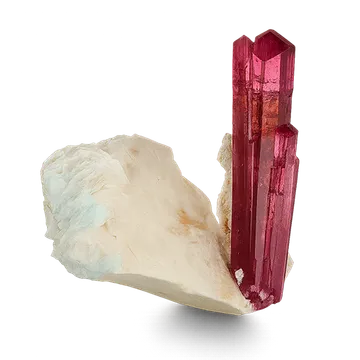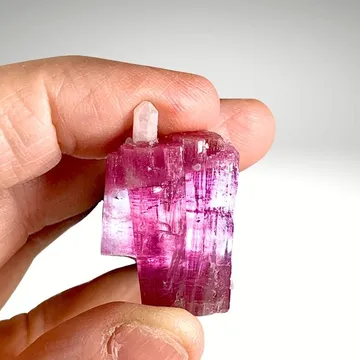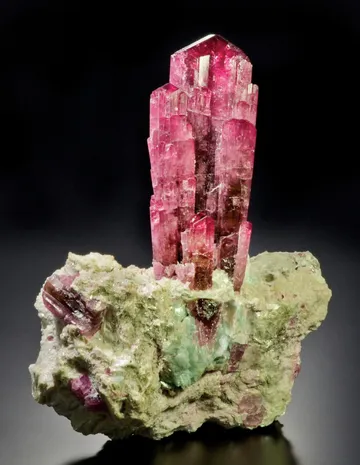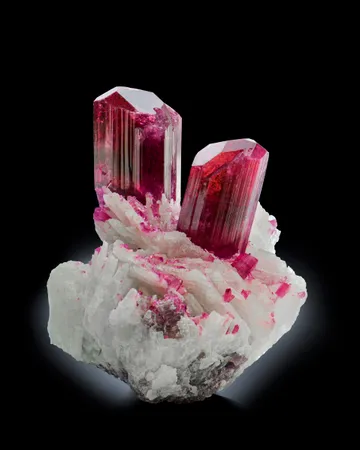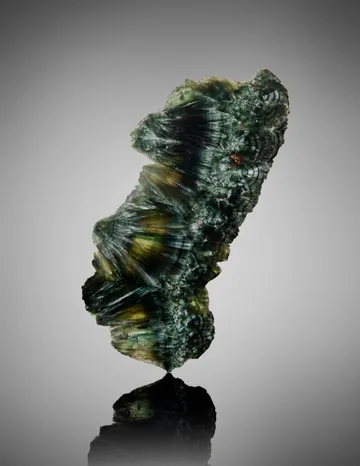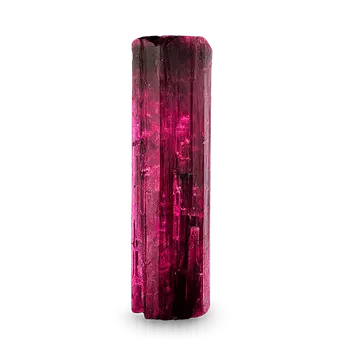
Rubellite from the Malkhan Pegmatite Field, Russia - deep wine-red to purple-red tourmaline crystals with prisms; prized for color and pocket aesthetics.
Key facts
Malkhan rubellite is one of the modern classics of gem tourmaline collecting: Russian, Siberian, pocket-grown, and instantly recognizable when it is good. The best pieces show saturated cranberry, wine-red, raspberry-red, and purple-red color in lustrous prismatic crystals, often with strong internal transparency and a darker “Siberian” tone that separates them from the brighter pinks of many Brazilian, Afghan, or Malagasy examples. Collectors prize Malkhan not merely for color, but for the whole pocket aesthetic: rubellite with snowy cleavelandite, smoky quartz, lepidolite, feldspar, and, on rare pieces, elegant matrix compositions rather than loose single crystals.

Photo: Wikimedia Commons
The locality belongs to the Malkhan pegmatite field near Krasnyi Chikoy in Zabaykalsky Krai, in the Transbaikalia region southeast of Lake Baikal. It is a field of complex, miarolitic granitic pegmatites related to the Malkhan granite-pegmatite system. In collector language, that means cavities: natural pocket spaces where volatile-rich residual melts and fluids allowed tourmaline, quartz, feldspar, mica, and borosilicate minerals to grow with crystal faces instead of forming only massive pegmatite rock.
The best rubellite is not uniform from pocket to pocket. Malkhan tourmalines may be deep wine-red, cranberry-red, purple-red, pink, orange-pink, yellowish, greenish, or polychrome, and many crystals record several growth episodes. Some crystals show a dark base, lighter internal zones, or subtle color transitions when backlit. The classic Malkhan “look” often combines a lustrous, steeply terminated prism with a deep red to purple body, sometimes with white albite or cleavelandite clinging to the side or base.

Photo: Wikimedia Commons
Historically, Malkhan revived Russia’s reputation for red tourmaline. Older Russian “siberite” from the Urals and Transbaikalia was famous in the 18th and 19th centuries, but by the early 20th century many of the classic sources were largely exhausted. The modern Malkhan field, discovered in the late Soviet period and mined seriously from the 1980s onward, brought Russian rubellite back into the international specimen market. Important veins such as Mokhovaya, Sosedka, Oktyabrskaya, and Oreshnaya became names worth preserving on labels.
Fine Malkhan specimens occupy a demanding collector niche. Loose single crystals are more common than balanced matrix pieces, and rubellite on quartz or cleavelandite with attractive composition is distinctly scarcer. The highest-value pieces combine deep but not opaque color, good luster, complete termination, visible translucency, minimal pocket damage, and honest provenance to a specific vein when possible.
Search for specimens: View all rubellite specimens from Malkhan Pegmatite Field, Russia
The Malkhan pegmatite field lies in the Chikoy Highland near Krasnyi Chikoy, in central Transbaikalia, Zabaykalsky Krai. The district sits in a mountain-taiga setting of pine forest, shallow relief, cold climate, and patchy to widespread permafrost, with the productive pegmatites situated high on the Malkhan Ridge. The area is often described in specimen literature as southeast of Lake Baikal and roughly southeast of Ulan-Ude; older labels may use “Chitinskaya Oblast,” “Transbaikalia,” “Malchan,” “Malkhansk,” or the erroneous “Malechansk.”
Geologically, Malkhan is a complex granitic pegmatite field with miarolitic, gem-bearing bodies. The pegmatites are associated with Mesozoic granites, especially the Bolsherechensky and Oreshnyi massifs, and are hosted largely by metamorphosed rocks of the Malkhan complex. Published work gives Early Cretaceous ages for the granite-pegmatite system, around 127.6–123.8 Ma. The gem-bearing pegmatites are classically LCT-affiliated in collector and petrologic usage, with lithium, cesium, tantalum, boron, fluorine, beryllium, and related rare-element signatures expressed in tourmaline, lepidolite, pollucite, beryl, topaz, danburite, hambergite, borocookeite, microlite-group minerals, and other accessory phases.
The field contains many pegmatite bodies, but only a fraction were rich enough in pockets and gem minerals to matter commercially. The most important named producers for rubellite and gem tourmaline include Mokhovaya, Sosedka, Oktyabrskaya, and Oreshnaya. Other names encountered in the literature and on specimen labels include Krutaya, Solnechnaya, Svetlaya, Zapadnaya, Skakunia, and related satellite veins. Sosedka became especially important in the modern specimen market because of its large size, later production, and spectacular pocket finds.
The pegmatites are typically zoned. Border zones may be aplitic or granitic; graphic, subgraphic, and blocky quartz-feldspar zones dominate the bodies; and the mineralized pockets are commonly spatially tied to metasomatic zones rich in quartz, cleavelandite, lepidolite, tourmaline, and late minerals. Miarolitic cavities range from small vugs to large rooms measured in meters. Some pockets were lined with smoky quartz, K-feldspar, cleavelandite, lepidolite, and colored tourmaline, with late zeolites such as laumontite and stilbite locally cementing or coating earlier crystals.
Mining history is layered. Black tourmaline-bearing pegmatites were known in the broader Malkhan Ridge area earlier, but gemmy colored tourmalines of the elbaite-liddicoatite series were discovered in 1980 by V. Ya. Bukharov. Exploration between 1980 and 1987 identified important bodies including Skakunia 1, Skakunia 2, Krutaya, Mokhovaya, and Zapadnaya. The Baikal Quartz-Gemstone Expedition and later official and unofficial mining groups worked hundreds of pegmatites in the 1980s and 1990s, initially with industrial quartz, feldspar, gem material, and exploration interests all intertwined.
Sosedka was originally found by drilling rather than by obvious outcrop. It is a subhorizontal pegmatite described in the literature as approximately 400 × 200 × 40 meters. Mining opened it in two quarries around 2000 after smaller bodies became exhausted. A first quarry was worked until 2011, when the pegmatite reached the host-rock contact at about 40 meters depth; a second quarry was opened nearby. Sosedka produced both huge cavities and smaller pocket zones, but much of the tourmaline was treated by miners as cutting rough rather than as collectible specimens.
Collecting access should be regarded as closed to casual field collecting. This is a mined district in a remote Russian locality, not a fee-collecting site. Material reaches collectors through miners, dealers, old collections, and specimen-market rediscovery. Label accuracy matters because some pieces are sold broadly as “Malkhan” when the exact vein is unknown; more precise labels such as Sosedka, Mokhovaya, or Oktyabrskaya carry extra scientific and collector value when credible.
Notable finds include meter-scale Sosedka cavities, large gem tourmaline crystals, and important matrix pieces with smoky quartz, cleavelandite, lepidolite, and late zeolite coatings. Published accounts mention tourmaline crystals reaching tens of centimeters in length, very large pocket cavities, and large portions of production lost to cabochon rough or damaged by extraction. This is part of Malkhan’s mystique: the district produced extraordinary crystals, but relatively few survived as undamaged, aesthetic mineral specimens.
Malkhan rubellite most commonly appears as prismatic tourmaline crystals with the striated prism faces typical of the group and relatively sharp terminations when pocket conditions and extraction were favorable. Cross sections may be triangular to rounded-triangular. Some crystals are single, stout prisms; others are parallel-growth clusters, composite bundles, or partial crystal groups. Smaller loose singles in the 2–6 cm range are encountered in the market, while important specimens may reach cabinet size, and published pocket reports describe much larger crystals and aggregates.
Color is the collector’s first sorting criterion. The most desired Malkhan rubellite tends toward cranberry-red, wine-red, purplish red, raspberry-red, or deep burgundy. The term “siberite” is often used historically for lilac-red to violet-red Russian tourmaline, and some Malkhan pieces revive that visual association. Many crystals are dark in the hand but open to red, pink, purple, or golden internal tones under strong transmitted light. The best crystals balance saturation with life: too dark and they become blackish; too pale and they lose the imposing Russian character.
Zoning is a signature feature. Published descriptions of Malkhan tourmaline crystallization include black schorl-dravite zones, green and orange stages, purple elbaite-liddicoatite zones, and younger pale purple or liddicoatite rims. On specimens, this may present as a darker base, a pink to red body, a purplish cap, yellowish or greenish internal areas, or subtle polychrome effects visible only with backlighting. A clean, deep red rubellite prism is desirable, but a well-zoned Malkhan crystal can be just as important if the color architecture is visible and natural.
Associated minerals are a major part of the locality’s identity. The classic suite includes albite, especially cleavelandite; quartz, including smoky quartz and morion; lepidolite; K-feldspar; danburite; hambergite; beryl, including pink beryl or morganite; topaz; spessartine; cassiterite; pollucite; petalite; zeolites such as laumontite and stilbite; and rarer boron-, lithium-, cesium-, tantalum-, niobium-, and bismuth-bearing species. For display specimens, white cleavelandite and smoky quartz provide the most dramatic contrast to wine-red tourmaline.

Photo: Wikimedia Commons
Matrix specimens are less common than loose singles and are especially prized when they look composed rather than simply bulky. Rubellite rising from cleavelandite, crossing smoky quartz, or partially embedded in quartz can be excellent, but the collector should inspect for contacts and repairs. Many Malkhan crystals grew in tight, complicated pockets; late zeolites and pocket collapse commonly left broken terminations, repaired crystals, etched surfaces, or areas where a crystal was forcibly removed from a wall.
Typical quality factors include:
Mineralogically, many collector rubellites from Malkhan are best treated as tourmaline-supergroup specimens in the elbaite-liddicoatite-rossmanite compositional neighborhood unless analyzed. “Rubellite” is a color-variety term, not an IMA species name. In a serious collection label, “tourmaline var. rubellite” or “elbaite var. rubellite” may be used when appropriate, but analytical proof is needed for exact species assignments in this chemically complex district.
The most important authenticity issue with Malkhan rubellite is not usually whether the tourmaline is real; it is whether the specimen is exactly what the label says and whether condition has been fully disclosed. “Malkhan” has become a market name, and older or simplified labels may omit the vein. A specimen labeled simply “Malkhan pegmatite field” may be perfectly legitimate, but a more precise label such as Sosedka or Mokhovaya should be supported by credible provenance.
Repairs are common enough to be expected on significant pieces, especially matrix specimens and large crystals. Published field accounts describe crystals broken during mining, specimens pried out of zeolite-cemented pockets, pocket ceilings damaged by blasting, and important crystals later repaired. This does not make a specimen undesirable; many world-class pegmatite specimens are repaired. It does mean the price must reflect the work. Ask specifically about repaired terminations, reattached crystals, restored edges, filled gaps, and whether matrix-tourmaline contacts are natural.
Malkhan rubellite crystals are often contacted at the base or backside, where they grew against pocket walls or were removed from feldspar and mica debris. A contacted base is normal. Damage on a main termination, crushed side faces, glued-on matrix, or unexplained white filler along contacts is more serious. Use magnification and angled light to inspect glue lines, color-matched restoration, matte patches, or discontinuities in striations.
Treatment issues are somewhat different for specimens and cut gems. For mineral specimens, the principal concerns are repair, restoration, and possible oiling or resin on fractures; for faceted rubellite, irradiation and heating may be relevant, and fracture filling with oils or resins is documented in the broader tourmaline trade. Pink tourmaline can be irradiated to increase saturation, and heat-treatment effects can be difficult or impossible to detect in many cases. For a high-value faceted stone represented as Malkhan, a reputable laboratory report is prudent.
Cleaning should be conservative. Tourmaline has good hardness but only fair toughness, and pocket specimens often include feldspar, mica, quartz, zeolites, repaired areas, and hidden fractures. Avoid ultrasonic and steam cleaning. Use warm water, mild soap, a soft brush, and patience; do not subject rubellite to sudden temperature changes. Zeolite-coated Malkhan pieces, especially those with laumontite or fragile late minerals, should be treated as delicate assemblages rather than as single tourmaline crystals.
In current market terms, Malkhan remains available but selective. Loose crystals and small thumbnails appear regularly, including newer and old-stock pieces. Fine matrix specimens, deep cranberry crystals with full terminations, strongly gemmy examples, and large unrepaired cabinet pieces are much scarcer. The very best Malkhan rubellites now compete with classic tourmalines from Brazil, California, and the Himalaya Mine in collector prestige, especially when the piece has size, luster, color, matrix, and provenance all aligned.
In the fall of 2011, Malkhan seemed to be nearing the end. The company’s mining licenses were expiring, the pegmatites looked nearly exhausted, and the miners were trying to recover whatever could still be saved. When the visiting collectors and authors reached the district after arriving in Irkutsk in early September, the Mokhovaya dike was almost mined out and the northeast Sosedka quarry had been deepened nearly to country rock. Two years of large-scale work had shown no sign of a major cavity.
After two nearly fruitless days, the tally was almost comically small: a single liddicoatite crystal measuring 23 × 22 × 16 mm. Then Saša Sotnik, the main geologist, came with news from Sosedka. A pocket had opened in the quarry floor.
The cavity was about 1 meter across and vertical. Its entrance was lined with blocks of gray quartz, pale blue cleavelandite, purple elbaite, and lepidolite. Inside was the classic chaos of a great pegmatite pocket: rock fragments, single crystals, smaller matrix specimens, and large druses of K-feldspar, cleavelandite, lepidolite, quartz, and tourmaline. The tourmalines included dark purple gem-quality crystals to 12 × 3.5 cm, loose or attached to quartz, cleavelandite, and lepidolite, plus clusters to 20 × 15 × 15 cm. Lepidolite occurred in two generations, first as purple crystals to 5 cm across and then as transparent yellowish crystals to 1 cm. Quartz formed unusually lustrous brown crystals to 15 cm, some covered by a thin younger milky quartz layer no more than about 1 mm thick.
The pocket was worked out the next day. In its lower part came the larger tourmalines: crystals to 25 × 8 cm, built from many smaller parallel intergrown crystals. Hambergite crystals to 4 cm were also present. The largest tourmaline from the miarole measured 36 × 15.5 × 9 cm, but it came out in three pieces and was later repaired. It was still important enough to be described as possibly one of the best Malkhan specimens in existence.
Malkhan’s beauty often came with its own trap. Late zeolites increased toward the bottom of the cavity, cementing earlier crystals in laumontite. Instead of freeing specimens grain by grain, miners used pry bars to break crystals from the zeolite cement. More pieces were damaged when the son of the owner, carrying one of the four best lots of specimens, fell.
Soon after, a second cavity was found, much larger at 3.5 × 3.2 × 2.4 meters. It contained a similar mineral suite, with tourmalines to 15 cm. Yet despite the size of the pocket, only a handful of specimens survived, most with damaged terminations because blasting destroyed the upper part of the cavity. A 13.5 cm tourmaline-and-quartz specimen was singled out as the best piece to survive the blasting and extraction untouched.
Then came another cavity in the same area, measuring 7 × 5 × 2 meters and lying about half a meter from the country-rock contact. It repeated the familiar Malkhan assemblage but added gemmy, etched petalite crystals loose on smoky quartz. The largest druse from this find was over 1 meter long and included an 80 cm K-feldspar crystal with lepidolite, tourmaline, and smoky quartz. That specimen was donated to the mineralogical museum of the Polytechnical Institute in Irkutsk. Dark purple tourmalines, some with mirror luster, reached 25 × 8 cm, but many were broken into two or more pieces during extraction. Some smaller single crystals were gem quality; almost none survived as specimens because they went directly into the gem-rough stream.
That sequence of discoveries explains why fine Malkhan rubellite specimens feel rarer than the district’s production numbers might suggest. The pegmatites produced remarkable crystals, but the mining style, the value of cutting rough, zeolite cement, blasting, pocket collapse, and rough handling all worked against preservation. A clean, well-composed Malkhan specimen is not just a crystal from a famous locality; it is a survivor.
Jindřich Kynický and Štěpán Krejsek, “Discovery of New Gem Tourmaline Pockets in the Sosedka Pegmatite, Malkhan, Russia,” Rocks & Minerals, 88(4), 308–315, 2013 — Essential field account of the 2011–2012 Sosedka pocket discoveries, with production figures, pocket dimensions, and extraction history.
Jindřich Kynický, Jan Kynický, Bryan Lees, Wenlei Song, Michaela Kotlanova, Gerhard Wagner, and Philip Persson, “The Malkhan Pegmatite District,” The Mineralogical Record, 50(3), May–June 2019 — The major modern collector reference on Malkhan, including geology, history, specimens, and the district’s importance for Russian gem tourmaline.
Igor S. Peretyazhko, Victor Ye. Zagorsky, Sergey Z. Smirnov, and Mikhail Y. Mikhailov, “Conditions of pocket formation in the Oktyabrskaya tourmaline-rich gem pegmatite (the Malkhan field, Central Transbaikalia, Russia),” Chemical Geology, 210, 91–111, 2004 — Technical study of melt, fluid-melt, and fluid inclusions in quartz from Oktyabrskaya, central to understanding Malkhan pocket formation and boron-rich fluids.
Rainer Thomas, Paul Davidson, and Elena Badanina, “Water- and Boron-Rich Melt Inclusions in Quartz from the Malkhan Pegmatite, Transbaikalia, Russia,” Minerals, 2(4), 435–458, 2012 — Open-access paper on water- and boron-rich melt inclusions, immiscibility, and pegmatite genesis in the Malkhan system.
Anatoly V. Kasatkin et al., “Fluor-rossmanite, □(Al2Li)Al6(Si6O18)(BO3)3(OH)3F, a new tourmaline supergroup mineral from Malkhan pegmatite field, Western Siberia, Russia,” Mineralogical Magazine, 88, 668–676, 2024 — Describes fluor-rossmanite from Krutaya, demonstrating the chemical complexity of Malkhan tourmaline.
Mindat locality page: Malkhan pegmatite field, Krasnyi Chikoy, Krasnochikoysky District, Zabaykalsky Krai, Russia — Mineral list, locality hierarchy, photos, and sublocality links for the Malkhan field.
Mindat occurrence page: Rubellite from Malkhan pegmatite field — Focused occurrence record for rubellite in the Malkhan pegmatite field.
Wikimedia Commons: Tourmaline-Albite-130374.jpg — Rob Lavinsky photograph of a 4.8 cm Malkhan rubellite crystal with albite.
Wikimedia Commons: Tourmaline-280362.jpg — Rob Lavinsky photograph of a 6.6 cm Sosedka rubellite crystal.
Wikimedia Commons: Tourmaline-Quartz-226180.jpg — Rob Lavinsky photograph of a Mokhovaya rubellite with quartz matrix.
“Elbaite variety Rubellite (Tourmaline group). Malkhan pegmatite field...” — MChMinerals, fine minerals — Short specimen video of rubellite from the Malkhan pegmatite field.
“Rubellite with Feldspar” — Wilensky Minerals — Video of an 8 cm Malkhan rubellite specimen on feldspar, emphasizing color, transparency, and matrix contrast.
“BFH3657 TOURMALINE, Malkhan Pegmatite Field Russia” — Crystal Classics — Dealer video of a Malkhan tourmaline specimen.
Wilensky Exquisite Minerals: Rubellite Tourmaline on Cleavelandite — Exhibition page for a major 19 × 23 cm Malkhan rubellite on cleavelandite, including a specimen video and notes on repair/restoration.
Mindat: Malkhan pegmatite field — Best starting point for locality hierarchy, mineral list, sublocalities, and photo database.
Mindat: Rubellite from Malkhan pegmatite field — Focused occurrence entry for rubellite at the locality.
Mindat: Mokhovaya pegmatite vein — Important sublocality page for one of the classic Malkhan rubellite-producing veins.
Mindat: Krutaya pegmatite vein — Useful for the district’s broader tourmaline mineralogy, including the fluor-rossmanite type occurrence.
Rocks & Minerals: Discovery of New Gem Tourmaline Pockets in the Sosedka Pegmatite, Malkhan, Russia — The key field narrative for the famous 2011–2012 Sosedka pocket finds.
The Mineralogical Record: The Malkhan Pegmatite District — The major collector-oriented district monograph.
Chemical Geology: Conditions of pocket formation in the Oktyabrskaya tourmaline-rich gem pegmatite — Technical petrologic reference for pocket-forming fluids and residual melts.
Minerals: Water- and Boron-Rich Melt Inclusions in Quartz from the Malkhan Pegmatite — Open-access geochemical study explaining the boron- and water-rich character of the system.
Mineralogical Magazine: Fluor-rossmanite from Malkhan — Current tourmaline-supergroup research from the field.
GIA: Micro-Features of Tourmaline — Gemological reference for inclusions, treatments, fracture filling, and irradiation in tourmaline.
GIA: Tourmaline Care and Cleaning Guide — Practical care guidance for tourmaline, including heat sensitivity and cleaning recommendations.
GIA: Clarity-Enhanced Tourmaline — Useful reference on fracture filling of tourmaline, including rubellite.