Lubin, Poland - copper-silver Kupferschiefer deposit; yields pale green cubic halite, green gypsum, and malachite, highly sought by collectors.
Key facts
Lubin is one of the great names of the Polish Copper Belt: a Lower Silesian mining city whose identity was remade by the discovery and development of the Lubin–Sieroszowice copper-silver ore field. For collectors, the name “Lubin” carries two overlapping meanings. In the strict mining sense it refers to the KGHM Lubin underground mine and the Lubin-Małomice deposit north of the city; in the specimen trade it is also used more broadly for the Lubin district and nearby KGHM workings that have yielded the familiar green halite, green to brown gypsum, and secondary copper minerals seen on European and American mineral tables.
Geologically, the attraction is the Kupferschiefer system: a sediment-hosted, stratiform copper-silver deposit in Permian rocks of the Fore-Sudetic Monocline. The ore-bearing package is thin but exceptionally metal-rich, with mineralization concentrated across the Weissliegend sandstone, the boundary dolomite, the black Kupferschiefer shale, and overlying Zechstein carbonate rocks. Its main ore minerals are chalcocite, bornite and chalcopyrite, but the district’s mineralogical importance is far wider: silver minerals, copper chlorides, uranium minerals, platinum-group and gold-bearing phases, native metals, arsenides, selenides and tellurides have all been recorded in the Lubin–Sieroszowice system.
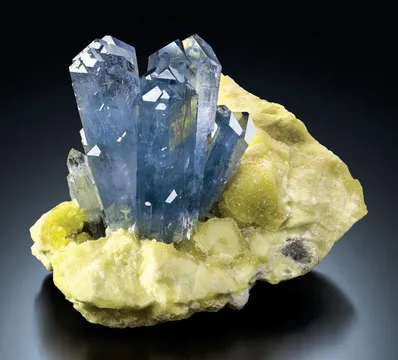
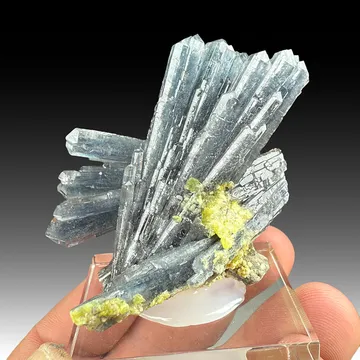
The specimens that collectors most readily recognize are not massive ore samples but late, delicate products of the mining environment: pale green to bluish green cubic halite, often skeletal or stacked, colored by microscopic copper chlorides; gypsum in transparent pale green blades, brown elongated crystals, and selenite plates; and malachite as secondary green copper mineralization in oxidized zones and on broken ore. The best halites have a strangely “fluorite-like” appearance—transparent cubes with apple-green color and, in some lots, orange shortwave fluorescence—while the best gypsums are treasured for color, openness of growth, and the survival of fragile blades from an active industrial mine.
Regional View
Country View
The historical significance is difficult to overstate. The Lubin-Sieroszowice discovery of March 1957 became the foundation of modern KGHM Polska Miedź and turned the Lubin-Głogów area into one of Europe’s principal copper-silver mining districts. Mineralogically, the same rocks have served as a laboratory for low-temperature ore formation, redox-front mineralization, organic-matter control of noble metals, and the unusual chemistry of chloride-rich brines moving through copper-bearing strata.

Photo: Flos Ferri Minerals
Search for specimens: View all specimens from Lubin, Poland
Lubin lies in Lower Silesia on the southeastern side of the Lubin-Głogów copper belt, a roughly northwest-southeast ore district extending from the Lubin area toward Bytom Odrzański. The KGHM Lubin mine works the Lubin-Małomice deposit and is described by the operator as the oldest mine in the Polish Copper Belt. It is an underground copper-silver operation in a sediment-hosted stratiform, Kupferschiefer-type ore system related to Zechstein and underlying Permian strata of the Fore-Sudetic Monocline.
The ore-bearing section is a compact but internally varied sedimentary package. From bottom to top the important units are the white Weissliegend sandstone, boundary dolomite, the black Kupferschiefer shale, and Zechstein dolomitic limestone. In the broader Lubin–Sieroszowice district, the Kupferschiefer shale is a black, microlaminated, organic-rich sediment containing illite, mixed-layer clays, dolomite, calcite, sulfides, gypsum, anhydrite, quartz, feldspar and minor phosphates. Although the shale is thin, it is commonly the richest part of the ore system; the sandstone and carbonate ores can also be economically important, and in the Lubin mine the operator notes that sandstone rock is the dominant lithological type in the resources.
The primary ore assemblage is dominated by copper sulfides, especially chalcocite, bornite and chalcopyrite, with digenite, covellite, djurleite and related low-temperature copper sulfides documented in detailed mineralogical work. The ore is not a simple copper deposit: silver is economically important, and published studies of the Lubin–Sieroszowice orebody record native silver, stromeyerite, mckinstryite, chlorargyrite, eugenite and other Ag-bearing phases. Lead, zinc, cobalt, nickel, arsenic, uranium, molybdenum, mercury, selenium, tellurium, gold and platinum-group elements occur in a long list of accessory and rare minerals. This richness reflects the deposit’s redox architecture: reduced, organic-bearing Kupferschiefer strata, oxidized Rote Fäule facies, secondary oxidation zones, and chloride-rich fluids all interacted at low temperatures.
The mining history begins with the 1957 discovery by Jan Wyżykowski’s team from the Polish Geological Institute. Construction of the Lubin mining plant began in 1960, KGHM was formally established in 1961, and the Lubin mine entered operation in 1968. KGHM records that the mine reached 4.5 million tonnes of ore per year in 1972, increased to 7.6 million tonnes after expansion in 1973, and celebrated its fiftieth anniversary in 2018. Modern Lubin mining is by room-and-pillar methods, with natural roof deflection and hydraulic backfill; KGHM describes seven shafts, one production shaft and others for personnel, material transport and ventilation.
Collecting access today should be regarded as industrial, not recreational. Lubin is an active underground KGHM operation, and casual underground collecting is not available to visiting mineral collectors. Specimens reach the market through mine-related recovery, old collections, Polish and European dealers, and material from the broader Lubin district labelled by mine, shaft, or simply “Lubin, Poland.” This is particularly important for halite and gypsum labels: some green halites and green gypsums on the market are described from Lubin, some from Lubin Główny shafts, some from Rudna, and some from Polkowice-Sieroszowice or Sieroszowice in the Lubin district.
The notable specimen-producing events are tied to late brines and mine openings rather than to conventional ore pockets. A documented 2016 brine outflow in the northern part of the Polkowice-Sieroszowice mine produced spectacular halite dripstone forms—stalactites, stalagmites, stalagnates and flowstone—built from arrays of skeletal halite crystals. Other market lots from the Rudna and Lubin district workings produced transparent green cubic halite stacks with individual crystals reaching about 2 cm and specimen groups in the thumbnail to small-cabinet range. Lubin and nearby workings also produced pale aqua-green gypsum blades and brown gypsum aggregates from crevices and recent growth surfaces. These are fragile, mine-environment specimens, and their survival is often as remarkable as their color.
Lubin-area halite is the locality’s most recognizable modern collector mineral: sharp cubic to skeletal crystals, commonly transparent to translucent and colored pale green, bluish green, white or brownish by included and overgrown copper chloride minerals. Published work on green halite from the Polkowice-Sieroszowice mine documented halite formed during a 2016 sodium-chloride brine inflow, producing stalactitic, stalagmitic, stalagnate and flowstone forms in mine drifts; analyses identified green coloration mainly from atacamite-group copper chlorides, along with Cu-Zn chlorides and other chloride phases. Dealer and Mineralogical Record reports describe Lubin-district halite in 5.5–10.5 cm specimens, small-cabinet stacked groups, individual cubes to about 2 cm, and orange shortwave fluorescence in some pieces. The finest examples are not just green salt: they have crisp cubic architecture, transparency, balanced stacking or hopper growth, visible copper-chloride color without muddy crusting, and enough stability to have survived handling from a brine-formed underground occurrence.
Malachite from Lubin is a secondary copper mineral of the oxidized parts of a copper-silver ore system, not a major showpiece species in the sense of classic African stalactitic malachite. It is documented from the Lubin–Sieroszowice mineral assemblage together with other secondary and oxidized-zone minerals such as azurite, cerussite, smithsonite, annabergite, erythrite, chlorargyrite and plattnerite. Collector specimens are best understood as small green coatings, crusts, stains, microcrystalline aggregates and occasional richer patches on ore or carbonate-sulfate matrix, reflecting local oxidation of copper sulfides in a system otherwise dominated by chalcocite, bornite, chalcopyrite and related low-temperature copper minerals. Good Lubin malachite is judged by saturation of color, clear association with genuine Lubin ore or gypsum/halite assemblages, attractive contrast against pale carbonate, sulfate or salt matrix, and credible labeling, because loose green copper staining alone is not enough to make a strong locality specimen.
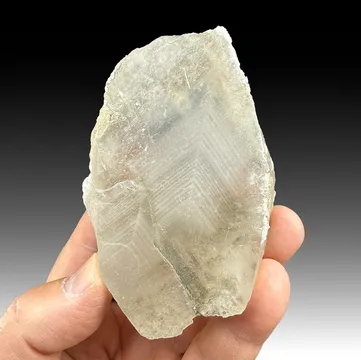
Lubin gypsum is prized for its unusual mine-grown forms: pale aqua-green to green selenite blades, brown elongated crystals, and delicate aggregates formed in crevices and along late sulfate-rich surfaces. Dealer descriptions record Lubin gypsum specimens from small hand size to larger cabinet pieces, including transparent pale green prismatic blades with flattened cross sections and slanted terminations, brown recently grown crystal aggregates, and a reported large selenite plate from the Lubin Główny shafts. The green material has attracted particular attention because it has been variously attributed in the trade to paratacamite, atacamite, botallackite, herbertsmithite, libethenite, malachite and other phases; the safer collector’s reading is that the gypsum itself is colored or coated by microscopic copper chloride minerals in a copper-mine brine environment. The best pieces combine open, undamaged blades, fresh luster, genuine green or brown color, and an honest surface—without oiling, dye, glued repairs or over-cleaning that rounds the soft gypsum edges.
Beyond these collector staples, Lubin is a mineralogical heavyweight because of its rare ore assemblage. The Lubin–Sieroszowice literature records more than 140 minerals and phases, including chalcocite, digenite, bornite, djurleite, covellite, anilite, geerite, spionkopite, yarrowite, tennantite, tetrahedrite, galena, sphalerite, skutterudite, carrollite, lautite, native copper, native silver, stromeyerite, mckinstryite, chlorargyrite, eugenite, native lead, clausthalite, uraninite, coffinite, brannerite, thucholite, molybdenite, jordisite, native palladium, sobolevskite, tetraauricupride, vincentite, native bismuth and bismuthinite. Eugenite, Ag11Hg2, is the most important type-locality mineral tied to the Lubin–Sieroszowice district, described from the Zechstein copper deposits in Poland; anilite from the Lubin mine was also the subject of a dedicated study by Henryk Kucha. Morozeviczite and polkovicite are associated with the broader Fore-Sudetic Monocline copper ores and are reported from Lubin, though their strict type locality is linked to Polkowice rather than the Lubin city locality.
Lubin labels deserve careful reading. In the specimen trade, “Lubin, Poland” may mean the Lubin mine, Lubin Główny shafts, Lubin County, the Lubin district, Rudna mine, or the Polkowice-Sieroszowice/Sieroszowice workings. None of those labels is automatically wrong, but for serious collections the exact wording matters. A specimen labelled simply “Lubin” should be evaluated against its style: green cubic halite and green gypsum are often district labels, while true ore suites may carry mine, shaft or level information.
The main authenticity issue is not a large known fake industry but misidentification and over-specific naming. Green halite has been mistaken for fluorite by casual sellers because the cubes can look deceptively fluorite-like. Green gypsum has circulated with different attributions for its color—paratacamite, atacamite, botallackite, herbertsmithite, malachite and others—when visual identification alone is usually inadequate. If the accessory chloride mineral matters to the price, analysis is warranted; otherwise it is better to describe the piece conservatively as green halite or green gypsum from Lubin, colored by copper-chloride inclusions or coatings.
Condition is critical. Halite is water soluble and can suffer from humidity, sweating, bruised corners, dissolved faces and recrystallized-looking dull patches. It should be kept dry, away from condensation, and never washed. Gypsum is very soft, easily cleaved, and prone to rubbed terminations, edge bruising and broken blades; even good Lubin gypsum often shows contact surfaces because crystals grew in narrow crevices. Malachite is more physically durable than halite or gypsum, but thin crusts on friable ore can flake if aggressively cleaned.
Fluorescence can be a useful bonus rather than a primary identification tool. Some green Lubin-district halites have been reported with zoned orange fluorescence under shortwave ultraviolet light, but not every specimen will respond the same way. Any UV examination should be brief and gentle, and specimens containing unknown copper, arsenic, lead, uranium or mercury-bearing accessory phases should be handled with ordinary mineral hygiene: wash hands after handling, keep dust out of the air, and avoid cutting or grinding.
Market availability is intermittent. Green halite from the Lubin district appeared in recognizable small lots in the 2010s, and additional examples still circulate through dealers, auctions and old collections. Gypsum from Lubin is easier to encounter than the rarer ore minerals but hard to find in excellent condition. Malachite is available mainly as small locality pieces or as part of mixed secondary copper associations. The microscopic ore rarities—eugenite, native palladium phases, uranium minerals, rare copper sulfides, arsenides and sulfosalts—are essentially research and micromount material rather than cabinet-specimen species.
On 23 March 1957, the future of Lubin arrived in the form of drill core. Jan Wyżykowski and his Polish Geological Institute team had been following the Permian rocks of the Fore-Sudetic Monocline through difficult, unproven ground when the Sieroszowice borehole intersected copper ore of industrial significance at roughly 655–658 m depth, with copper content recorded at 1.40%. Later accounts from the Polish Geological Institute emphasize the almost cinematic simplicity of the turning point: four drill cores containing chalcocite settled the fate of the Lubin region. What had been a geological prospect became the foundation of a national copper industry.
The years after the discovery were not a quiet transition from map to mine. KGHM’s own historical account describes the early builders of the Copper Belt confronting strongly water-bearing ground at a scale Poland had not previously faced for shaft sinking. The solution was freezing the rock mass—a technically demanding method in the early 1960s—which allowed the first shafts of Lubin and Polkowice to be driven into the deep ore field. By 15 February 1968, Lubin’s ore-processing plant produced its first concentrate; in May of that same year it processed the 100,000th tonne of copper ore and produced 1,000 tonnes of metal in concentrate. For collectors holding a delicate green halite cube from the district, it is worth remembering that it comes from a mining landscape built through engineering as much as geology.
The green halite story has its own brief, brilliant chapter. A 2016 sodium-chloride brine outflow in the northern workings of Polkowice-Sieroszowice produced a short-lived underground salt garden: halite dripstones growing on the roof, walls and floor of a mining drift as stalactites, stalagmites, stalagnates and flowstone. The forms were built of skeletal salt crystals, colored white, greenish and brownish by mineral inclusions. One Mineralogical Record report described a 320 m-long tunnel abandoned in July 2016 where the crystals seemed to have grown “in only a few months’ time,” with renewed mining expected to destroy the occurrence. It was a classic modern-mining specimen episode: spectacular growth, narrow access window, rapid disappearance.
A smaller but telling detective story followed the green gypsum. Collectors and dealers saw attractive green selenite from Lubin and nearby mines, but the source of the color was not consistently named. One specimen might be sold as colored by paratacamite, another by atacamite, another by botallackite or herbertsmithite, and another simply as malachite-stained gypsum. The analytical work that followed—SEM-EDS in collector discussion and later SEM, Raman and XRD work on related green halites—showed why the confusion was understandable: in a copper mine invaded by chloride-rich brines, a family of visually similar green copper chloride minerals can occur as tiny inclusions and coatings. To the eye the result is a luminous green crystal; to the analyst it is a miniature chemical record of brine, copper sulfides and an underground oxidation environment.
Kucha, H. “Mineralogia kruszcowa i geochemia ciała rudnego złoża Lubin-Sieroszowice.” Biuletyn Państwowego Instytutu Geologicznego, Vol. 423, 2007. A key mineralogical and geochemical summary of the Lubin–Sieroszowice orebody, listing major copper minerals, silver minerals, rare Cu-Ni-Co minerals, uranium minerals, noble-metal phases and the newly noted minerals morozeviczite, polkovicite and eugenite.
Piestrzyński, A. & Pieczonka, J. “Low temperature ore minerals associations in the Kupferschiefer type deposit, Lubin–Sieroszowice mining district, SW Poland.” Mineralogical Review, No. 62, 2012, pp. 59–66. A concise but important paper on the low-temperature ore assemblages, redox setting, lithologic units and long mineral list of the district.
Kucha, H. & Pocheć, J. “Organogenic ankeritic limestone with glauconite and native Au, Pt, Pd and Pb alloys in the region of Lubin.” Annales Societatis Geologorum Poloniae, Vol. 53, 1983. Describes organogenic ankeritic limestone in the Lubin mine with glauconite, cavern coatings, phosphate overgrowths and native/alloy phases of Au, Pt, Pd and Pb.
Kucha, H. “Eugenite, Ag11Hg2—a new mineral from Zechstein copper deposits in Poland.” Mineralogia Polonica, Vol. 17, No. 2, 1986, pp. 3–12. Listed in the references of Piestrzyński & Pieczonka’s Lubin–Sieroszowice paper; the original new-mineral description for eugenite, the silver-mercury mineral associated with the Zechstein copper deposits.
Piestrzyński, A. & Tylka, W. “Silver amalgams from the Sieroszowice copper mine, Lubin–Sieroszowice district, SW Poland.” Mineralogia Polonica, Vol. 23, No. 1, 1992, pp. 17–27. A district-level reference for Ag-Hg phases connected to the same copper-silver system.
Nowińska-Jarzębińska, J. & Walczak-Torba, N. “Mineralogical study of green halite from the Polkowice-Sieroszowice mine” conference abstract in Quo Vadis Sal 2021 materials. Documents the 2016 brine-related halite occurrence and identifies atacamite-group and other chloride minerals responsible for green coloration.
Kościński, M. “Diversity of the sulfur isotopic composition in the individual sulfide minerals from the copper Lubin Mine, SW Poland.” Mineralogical Society of Poland – Special Papers, Vol. 23, 2003. Reports sulfur-isotope work on 104 sulfide samples from the Lubin mine and notes sulfide associations with gypsum, barite, anhydrite, calcite and dolomite.
Mindat: Lubin, Lubin County, Lower Silesian Voivodeship, Poland. The principal locality database entry for the Lubin locality and its recorded mineral species and sublocalities.
“Jak wydobywa się miedź, srebro i złoto? [VIDEO]” — Fabryki w Polsce A Polish industrial video feature visiting KGHM miners underground at Lubin and explaining copper, silver and gold production, including drilling, milling and flotation.
“Selenite” — Ian Odgers, Vimeo A short specimen video showing green gypsum var. selenite from the Lubin copper mine, described as colored by inclusions of botallackite, atacamite and paratacamite.
“Przemysł i gospodarka – Ludzie podziemnych szlaków” — Telewizja Polska / TVP archive Archival Polish reportage on the history of the Copper Belt and people involved in building the copper-mine enterprise in Lubin.
KGHM: Lubin mine — Official operator page with current mine description, resources, history, production method, shafts and deposit data.
KGHM: History — Company chronology covering the 1957 discovery, founding of KGHM, first Lubin concentrate and development of the Polish Copper Belt.
Polish Geological Institute: How copper and silver deposits were discovered in Poland — Useful historical account of Jan Wyżykowski’s discovery and its significance for Polish copper and silver mining.
Polish Geological Institute: Copper and silver ores — Geological overview of Polish Kupferschiefer-type copper-silver deposits, including the Fore-Sudetic Monocline, ore-bearing lithologies and principal copper minerals.
Wyższy Urząd Górniczy: Copper and silver ores — Brief mining-authority summary of the Lubin-to-Bytom Odrzański copper ore area and its operating mines.
Mindat: Lubin, Lubin County, Lower Silesian Voivodeship, Poland — Locality database entry for Lubin, its mineral list, sublocalities and specimen photo records.
Mindat: Halite from Lubin — Occurrence page documenting halite from Lubin and associated minerals recorded from photo data.
Kucha, 2007: Mineralogy and geochemistry of the Lubin-Sieroszowice orebody — Essential scientific abstract for the complex ore and rare-mineral assemblage.
Piestrzyński & Pieczonka, 2012: Low temperature ore minerals associations — Open PDF with geology, mineral list, redox discussion and references for the Lubin–Sieroszowice district.
Kucha & Pocheć, 1983: Organogenic ankeritic limestone with native metals near Lubin — Specific paper on glauconitic limestone and native Au, Pt, Pd and Pb alloy mineralization in the Lubin mine.
Quo Vadis Sal 2021 conference materials — Includes an abstract on green halite from the Polkowice-Sieroszowice mine, its 2016 brine setting and copper-chloride coloring minerals.
Mineralogical Record: Tom’s Online Report 47 — Market-oriented report describing green halite specimens from the Sieroszowice and Rudna mines in the Lubin district.
Flos Ferri Minerals: Gypsum from Lubin — Dealer specimen page illustrating brown gypsum from the Lubin mine with dimensions and specimen description.
Amethyst Galleries: Gypsum specimen gyp-67 from Lubin — Archived dealer-style specimen description of pale aqua-green gypsum blades from Lubin, Poland.
Fabryki w Polsce: KGHM copper, silver and gold production video — Accessible media piece showing underground mining and processing context at Lubin.
Vimeo: Ian Odgers, “Selenite” — Short visual reference for green Lubin gypsum var. selenite.