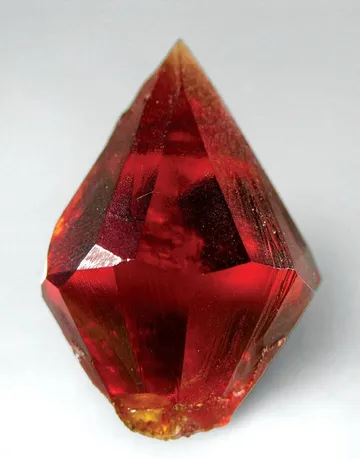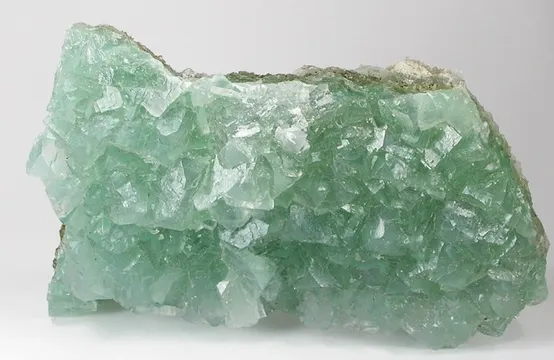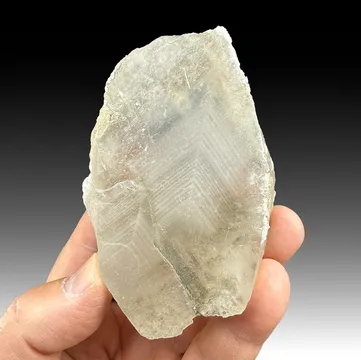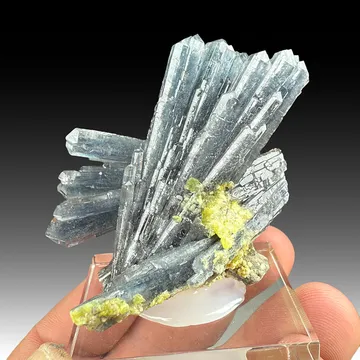
Tarnobrzeg, Poland — historic sulfur locality famed for cavernous limestones bearing native sulfur, celestine, barite, and calcite, prized by collectors.
Key facts
Tarnobrzeg is one of Europe’s great native-sulfur names, not because the mineral list is long, but because a small suite of low-temperature minerals grew there with exceptional abundance, variety, and beauty. The classic specimens come chiefly from the former Machów open pit, part of the Tarnobrzeg sulfur district of southeastern Poland, where Miocene evaporites of the northern Carpathian Foredeep were transformed into sulfur-bearing, cavernous post-gypsum limestones. In those cavities and fractures, native sulfur, calcite, gypsum, celestine, and barite developed in multiple generations; the finest pieces preserve that sequence as bright yellow sulfur perched on earlier celestine sprays, gray-white barite roses, honey calcite, or darker massive sulfur.
The district’s importance is historical as well as mineralogical. Sulfur-bearing limestone was discovered in the Tarnobrzeg area in the 1950s, and the region quickly became the center of Poland’s modern sulfur industry. Piaseczno was mined first by open pit, Machów followed as the great specimen-producing open pit, and Jeziórko became famous as a borehole underground-melting, Frasch-type operation. At its height, the Polish sulfur industry made the country one of the world’s major sulfur producers, while the exposed walls and cavities of Machów supplied museums and private collections with a flood of specimens that were new, distinctive, and immediately recognizable on the European market.
Regional View
Country View
Good Tarnobrzeg specimens have a different feel from Sicilian sulfur. They are often less architectural in the grand Sicilian manner, but more intimate and textural: sparkling druses of sharp sulfur crystals on cavernous limestone; sulfur crystals scattered like drops of yellow varnish on white or gray barite; and, at their most desirable, blue-tinged to honey celestine crystals punctuated by sulfur. The best cabinet pieces are not merely yellow—they show contrast, transparency, and paragenesis: a readable mineral story in a single cavity.
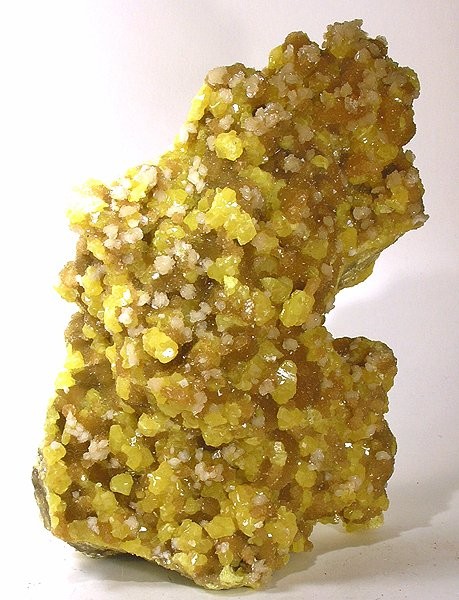
Photo: Wikimedia Commons
Search for specimens: View all specimens from Tarnobrzeg, Poland
The Tarnobrzeg sulfur deposits belong to the northern margin of the Carpathian Foredeep, where Badenian–Tortonian Miocene evaporitic rocks were altered into sulfur-bearing limestones. In the standard interpretation, the original gypsum and anhydrite were reduced with the participation of hydrocarbons and bacteria; sulfur and calcite replaced the sulfate rocks, while the surviving texture of the evaporite body remained legible in the altered limestone. The ore was not a simple vein system. It was a bedded to irregular replacement body in porous, fractured, cavernous carbonate, with sulfur filling fissures, small cavities, nests, and larger open spaces in the post-gypsum limestone.
The district is best understood as a cluster of related deposits and workings rather than as a single specimen locality. The name “Tarnobrzeg” on a mineral label may refer broadly to the sulfur district; the classic collector label “Machów Mine” is usually more specific and more desirable. Piaseczno, on the left bank of the Vistula, was the earlier open-pit operation and is important historically; Machów, on the right bank, was the great open pit that exposed large areas of sulfur-bearing limestone and produced the bulk of the famous display specimens; Jeziórko was mined by the borehole underground-melting method and is best known to collectors for rarer material recovered from drill cores and associated clays rather than for abundant hand specimens from open cavities. Osiek remains the modern operating native-sulfur mine in the wider region, but its Frasch-type extraction is an industrial method and does not provide ordinary collecting access to open cavities.
At Machów, the ore body was opened on a scale that gave mineralogists an unusually clear view of the deposit’s internal architecture. The exposure of the limestone by mining created precisely the conditions that made collecting possible: fresh cavities could be seen, broken, and selected before the material passed into the industrial stream. Native sulfur occurred as massive impregnations, waxy aggregates, dusty coatings, and well-formed crystals; celestine and barite formed earlier and later cavity generations; gypsum occurred both as relic primary evaporite and as younger secondary material tied to alteration and post-exposure degradation. The specimen suite is therefore a direct product of both geology and mining—without the open pit, most of the best pieces would never have been visible.
Mining history matters for labels. The Tarnobrzeg deposit was discovered in the early 1950s in the Mokrzyszów area, now part of Tarnobrzeg. Piaseczno was worked by open pit from the late 1950s into the early 1970s. Machów was developed later and operated as the celebrated open-pit mine until the early 1990s. Jeziórko was exploited from the late 1960s until 2001 by underground melting through boreholes. The collapse of the native-sulfur market in the early 1990s—driven by cheaper sulfur recovered from oil and gas desulfurization—ended the economic basis for open-pit sulfur ore mining in the district.
The former Machów excavation is no longer a mine face. It was reclaimed as Lake Tarnobrzeg, a large recreational reservoir created in the mined-out pit. The reclamation fundamentally changed access: the classic walls, working benches, and specimen-producing zones are gone or inaccessible, and present-day collecting should be regarded as closed for practical collector purposes. Modern Tarnobrzeg specimens on the market are overwhelmingly old-stock material, museum deaccessions, estate pieces, or specimens dispersed from collections built during the active-mining years.
The notable finds were not single named pockets in the style of an Alpine cleft; rather, they were generations of mineralized cavities and zones encountered during progressive exposure of the sulfur-bearing limestone. The best specimen cavities yielded sulfur crystals on the walls of voids, commonly after calcite, celestine, or barite had already formed. Particularly prized are combination specimens where the sequence is visible: white to honey or blue-tinged celestine under bright sulfur; gray or white barite plates and roses carrying later yellow sulfur; or cavernous limestone lined with sparkling, fresh sulfur crystals that retain their luster and sharpness.
Sulfur is the signature mineral of Tarnobrzeg and the reason Machów entered the mineralogical canon: the deposit produced waxy yellow masses in limestone, powdery pale-yellow coatings and inclusions, and, most importantly for collectors, coarse-crystalline sulfur lining cavities as one of the youngest generations. The finest crystals are sharp, lustrous orthorhombic forms, commonly a few millimeters to 1–2 cm and only rarely reaching several centimeters; published work records individual crystals up to about 7 cm, though larger examples are often internally cracked. Color ranges from bright lemon and greenish yellow through amber to brownish tones, and the best pieces show glassy to adamantine luster, clean crystal faces, and strong contrast against darker massive sulfur, gray limestone, white barite, or pale celestine. Ordinary Tarnobrzeg sulfur is massive, dusty, or dulled; good pieces are fresh, undamaged, well isolated on matrix, and ideally show sulfur as a final sparkling generation over celestine, barite, or calcite.
Celestine is the most distinctive companion mineral from Machów and, in many specimens, the real collector’s prize. It occurs in several generations: microscopic early crystals disseminated in sulfur-bearing limestone; dense vein and nest fillings composed of white, tightly intergrown crystals; and later cavity crystals forming druses, brushes, sprays, radiating aggregates, and blocky fan-like clusters. Clear prismatic crystals are commonly small, from a few millimeters to 1–2 cm, while larger crystals and aggregates can reach 10 cm or more but are often cloudy toward the base, with clearer terminations. Colors include colorless, milky white, yellowish, honey, brownish, and locally pale blue; yellow to brown tones are tied to hydrocarbon inclusions, while some blue coloration is structurally caused and may fade with heating. Top Tarnobrzeg celestine has luster, openness, and association—especially blue-tinged or honey prisms with native sulfur, or radiating groups that show the “split” growth habit characteristic of Machów material.
Barite from Tarnobrzeg is less famous than sulfur and celestine but is one of the locality’s essential collectors’ minerals, and in some parts of the deposit it was nearly as common as celestine. Machów barite occurs chiefly in two habits: prismatic to needle-like crystals and tabular crystals. The prismatic form is typically honey to brown when affected by bituminous material, with clearer pale crystals being more transparent; individual crystals range from a few millimeters to a few centimeters and occur singly or in showy cavity aggregates. Tabular barite is usually white to grayish, mostly opaque, and forms steep fan-like groups, rose-like clusters, dense spherulitic to kidney-shaped aggregates, and striking stalactitic forms. The best barite pieces from Tarnobrzeg are those with clean geometry and strong associations—bright sulfur crystals on white or gray barite, honey barite with sharp form, or unusual stalactitic aggregates whose surfaces are built from small tabular crystals.
Baryte is the same mineral as barite, but the spelling is common on European labels and in older collection records, so Tarnobrzeg specimens may appear under either name. On Machów labels, “baryte” usually refers to the classic BaSO4 from the sulfur cavities: white to gray tabular blades arranged as fans and roses, honey-brown prismatic crystals colored by bituminous inclusions, or grayish stalactitic and spherulitic aggregates later dusted or studded with yellow sulfur. Cabinet specimens with sulfur on baryte are especially attractive because the color contrast is strong and the paragenesis is easy to read: earlier sulfate growth followed by late native sulfur on exposed cavity surfaces. Desirable pieces have intact barite blades, minimal bruising on the sulfur, and enough matrix or three-dimensional relief to avoid the flat, industrial look common in lower-grade fragments.
Other documented Tarnobrzeg minerals are few but important. Calcite is a major rock-forming and cavity mineral in the deposit, including massive post-gypsum limestone, crystalline cavity growths, and stalactitic forms. Gypsum occurs as relic primary evaporite masses—locally as large, curved crystals colored by bituminous matter—and as younger secondary gypsum formed during alteration of exposed sulfur-bearing limestone. Strontianite is a true rarity at Machów, reported as compact masses of yellowish acicular crystals in small veins and as inclusions near the bases of some bluish celestine crystals; well-formed acicular strontianite is also known from Jeziórko drill-core material. Aragonite is rare and unstable in this environment, with small cream-colored, hexagonal-looking twinned crystals and calcite pseudomorphs after aragonite documented from Machów. Hauerite, MnS2, is the most sought-after rarity of the wider Tarnobrzeg sulfur district, occurring chiefly as dark brown octahedral to cubo-octahedral crystals in overburden marls and clays, especially from Jeziórko; it is fragile in the mineralogical sense as well as rare, because it weathers readily in contact with water and atmospheric alteration.
Tarnobrzeg specimens are classic old-stock material. A fresh claim of recent collecting from the former Machów open pit should be treated skeptically: the mine has been reclaimed as Lake Tarnobrzeg, and the specimen-producing exposure no longer functions as an accessible collecting locality. Legitimate pieces usually carry older labels reading “Machów,” “Machow,” “Machów Mine,” “Tarnobrzeg,” “Podkarpackie,” “Rzeszów Voivodeship,” or older Polish administrative variants. “Tarnobrzeg” alone is not necessarily wrong, but a more specific Machów label is preferable for specimen value.
The most common mislabelling issue is not deliberate fakery but geographic flattening. Specimens from Machów, Piaseczno, Jeziórko, and the broader Tarnobrzeg sulfur district may all be collapsed into “Tarnobrzeg,” while some older European labels use spelling variants or Germanized mineral names. Sulfur with celestine and barite from Machów is visually distinctive, but collectors should be cautious with loose sulfur crystals lacking matrix, with pieces labelled only “Poland,” and with specimens whose matrix and associated minerals do not fit the Tarnobrzeg suite.
Condition is the central issue. Native sulfur is soft, brittle, heat-sensitive, and a poor conductor of heat; even hand warmth can create internal stress in larger crystals, and old Tarnobrzeg sulfur crystals commonly show internal cracking. Avoid hot display lights, sunny windows, ultrasonic cleaning, and aggressive washing. Dust should be removed with a soft brush or very gentle air, not solvents or water immersion. Celestine and barite are more robust but still cleave and chip readily; sulfur perched on their edges is especially vulnerable.
Color stability is worth noting for celestine. Blue coloration in Machów celestine has been described as structurally controlled and capable of fading with heating, so avoid any treatment, hot water, or intense lighting intended to “improve” appearance. Honey and brown tones tied to bituminous inclusions are part of the locality character and should not be regarded as staining damage. Some barite and celestine may retain included fluids or hydrogen-sulfide-bearing components, but collectible specimens are normally handled as display minerals rather than as chemically active ore.
Market availability is steady but finite. During the active mine years, large numbers of specimens entered European and international collections, so ordinary sulfur-on-matrix pieces and small celestine-sulfur combinations are still obtainable. Fine pieces are a different matter: sharp sulfur crystals with high luster and minimal bruising, attractive blue celestine, large balanced sulfur-celestine plates, sulfur on baryte roses, and documented hauerite specimens are increasingly collector-held and less often replaced by new finds. Provenance, an old label, and intact, undulled sulfur make a meaningful difference in value.
The Tarnobrzeg story begins with a drill hole. On 23 September 1953, borehole A-1 at Mokrzyszów, now part of Tarnobrzeg, cut sulfur-bearing limestone at shallow depth. The find was the spark for a vast geological campaign led by Professor Stanisław Pawłowski and his team, including Katarzyna Pawłowska and Bolesław Kubica. The pace was astonishing: after the Mokrzyszów drilling, documentation for the deposit was prepared in only months and approved in days. Poland, still rebuilding its postwar economy, suddenly had not a curiosity but the foundation for a new mineral industry.
The early planning had the ambition of a national project. The new enterprise was expected to include not only a mine, but flotation and refining plants, sulfuric-acid production, repair shops, warehouses, power infrastructure, and housing for the workforce. In 1957, construction began in the Machów area. By the end of the 1950s, a railway bridge across the Vistula connected Piaseczno ore to the processing plant at Machów, and Tarnobrzeg began changing from a provincial town into the capital of a sulfur basin.
There is a wonderful irony in the survival of many Machów specimens. For official production, the crystals were irrelevant: the mine existed to feed ore to the crusher and refinery. Geologists and invited visitors were generally able to collect specimens from the pit, but ordinary mine workers collecting during shifts were viewed less kindly, because searching cavities took time away from ore production. Yet those unofficially rescued specimens are exactly why so many world-class pieces survive. Had every bright cavity gone straight into the industrial flow, many of the sulfur, celestine, and barite specimens now in museums and collections would have been pulverized.
By the late 1980s and early 1990s, as Poland opened more fully to outside markets and the domestic economy strained under transition, Machów specimens began moving west in quantity. Collectors in Western Europe suddenly saw abundant, affordable, bright Polish sulfur and celestine material from a locality that had been largely behind the economic curtain. The material was fresh, distinctive, and cheap enough to travel. Today, that route of dispersal explains why old Machów specimens turn up in German, Austrian, French, British, Dutch, and American collections as often as they do in Poland.
Even the mine’s engineering problems could be mineralogical. Barite did not merely grow in ancient cavities; it also precipitated in the drainage system of the operating mine. Mine waters carried strontium and barium, but because barite is so much less soluble than celestine, barium sulfate deposited readily—enough to create troublesome scale inside pipes. For collectors, it is a reminder that the deposit was not a dead museum case while it was being mined. Its fluids still had chemical memory, and the act of draining the open pit triggered new mineral growth.
After closure, Machów underwent one of the more dramatic transformations in European mining landscapes. The open pit, once a huge sulfur excavation, was profiled, sealed, reclaimed, and flooded to become Lake Tarnobrzeg. For mineral collectors the conversion is bittersweet: the classic locality is gone as a collecting ground, but the same excavation that opened the cavities now survives as a landscape feature rather than an industrial scar.
Jan Parafiniuk, “Minerały tarnobrzeskiego złoża siarki rodzimej / Minerals of the Tarnobrzeg native sulphur deposit,” Przegląd Geologiczny, 71, 605–613, 2023 — The essential modern mineralogical review of the Tarnobrzeg/Machów specimen suite, with mineral inventory, habits, paragenesis, and collector context.
Jan Parafiniuk, Arkadiusz Gąsiński, and Andrzej Kozłowski, “Fluid inclusions in celestine and their significance in the study of the formation of the native sulphur deposits in the Carpathian Foredeep,” Acta Geologica Polonica, 75(2), e42, 2025 — A focused study of Machów and Tarnobrzeg-area celestine, useful for understanding formation conditions and the role of celestine as a genetic indicator.
Marek Nieć and Edyta Sermet, “Odkrycie, badania, eksploatacja i przyszłość złóż siarki w Polsce / Discovery, geological investigation, mining and future of sulphur deposits in Poland,” Przegląd Geologiczny, 71, 631–638, 2023 — A historical and geological overview of Polish sulfur exploration, including the Tarnobrzeg discovery, resource development, and mining chronology.
Zbigniew Buczek, “Utworzenie i rozwój kombinatu siarkowego w rejonie Tarnobrzega / The foundation and development of the sulphur combine in Tarnobrzeg,” Przegląd Geologiczny, 71, 639–644, 2023 — A mine-history account by a former Machów mine director, valuable for understanding the industrial setting behind the specimens.
Maksymilian Cieśla, Renata Gruca-Rokosz, Lilianna Bartoszek, and Omonov Sokhibnazar Omonov, “Rekultywacja terenów pogórniczych – studium przypadku Jeziora Tarnobrzeskiego / Recultivation of post-mining areas – a case study of Tarnobrzeg Lake,” Przegląd Geologiczny, 71, 614–619, 2023 — Documents the post-mining transformation of the Machów pit into Lake Tarnobrzeg.
Simone Huber and Peter Huber, “Polen / Die Mineralien der Schwefellagerstätte Machów,” Lapis, 5(11), 15–18, 40, 1980 — A classic early collector-oriented publication that helped introduce Machów minerals to the German-speaking mineral community.
Witold Kowalski, T. Osmólski, and E. Pilichowska, “Stroncjanit w złożu siarki kopalni Machów,” Archiwum Mineralogiczne, 36(2), 29–46, 1980 — Cited in Parafiniuk’s review as the key work on rare strontianite from Machów.
E. Pilichowska, “Krystalografia celestynu ze złoża siarki w Machowie koło Tarnobrzega,” Archiwum Mineralogiczne, 40(1), 23–37, 1989 — Cited in the modern review as the crystallographic study of Machów celestine.
Mindat: Machów Mine, Tarnobrzeg, Subcarpathian Voivodeship, Poland — Core locality page for the classic specimen-producing mine, with species list, photographs, and references.
Wikimedia Commons: Category: Machow Mine — Useful open image set of sulfur, celestine, and barite specimens from the classic locality.
Polish Geological Institute: Sulfur resources page — Current official overview of Polish native-sulfur deposits, resources, and production context.
Polish Geological Institute: Przegląd Geologiczny 2023/12 issue — Full issue marking 70 years since the Polish sulfur discoveries, including several Tarnobrzeg-focused articles.
Museum-Zamek Tarnowskich: Muzeum Polskiego Przemysłu Siarkowego — The Polish Sulfur Industry Museum in Tarnobrzeg, useful for industrial and regional context.
Museum-Zamek Tarnowskich: Polski Przemysł Siarkowy exhibition — Describes the museum exhibition, including ore, crystallized sulfur, machinery models, and open-pit and borehole mining displays.
University of Poznań Earth Museum: “Siarka — tarnobrzeskie złoto” — Notes a mineralogical exhibition of valuable specimens from the former Machów sulfur mine.