Larkin's Quarry, Ireland — renowned fluorite locality with vivid purple-to-blue cubes, zoned interiors and Celtic-cross habits, prized by serious collectors.
Key facts
Larkin's Quarry, more properly Joe Larkin's Quarry at Shannapheasteen in Connemara, is one of the rare modern Irish localities that serious international collectors speak of as a specimen locality rather than merely a geological occurrence. Its fame rests on fluorite: not old mine-run material from a classic ore district, but vivid, late hydrothermal fluorite encountered intermittently during the working of a family granite quarry in the Galway Granite Complex. For Ireland, whose collectible mineral output has historically been modest compared with Britain or continental Europe, the 2015 discovery at Shannapheasteen was startling: lustrous purple to blue-purple cubes, zoned interiors, octahedral phantoms, green and cyan accents, and modified forms good enough to be figured in The Mineralogical Record.
Geologically, the quarry sits in the Shannapheasteen Granite, a fine-grained, aphyric granite body within the central block of the Galway Granite Batholith. The granite belongs to the late Caledonian plutonic suite of western Ireland, but the fluorite mineralization is younger: a hydrothermal vein system linked in the regional literature to Mesozoic, Atlantic-margin rifting fluids moving through the older granite basement. In specimen terms, that origin matters because the fluorite is not just a purple coating on granite joints; the best pieces are true pocket and vein-cavity specimens, with freestanding crystals, sharp zoning, and associations with quartz and the lead-zinc suite.
Regional View
Country View
The finest Larkin fluorites have a look that is now recognizable: lavender to deep violet cubes with darker edge zoning, blue-violet cores, occasional green sectors, satin to glassy luster, and internal octahedral phantoms that can read like a crystal suspended inside a crystal. Some show dodecahedral bevels, and a particularly distinctive “Celtic cross” habit has been described where later cubic growth developed preferentially on the apices of an earlier octahedral generation. Plates are much scarcer than small individual crystals, and large, clean cabinet pieces are exceptional.
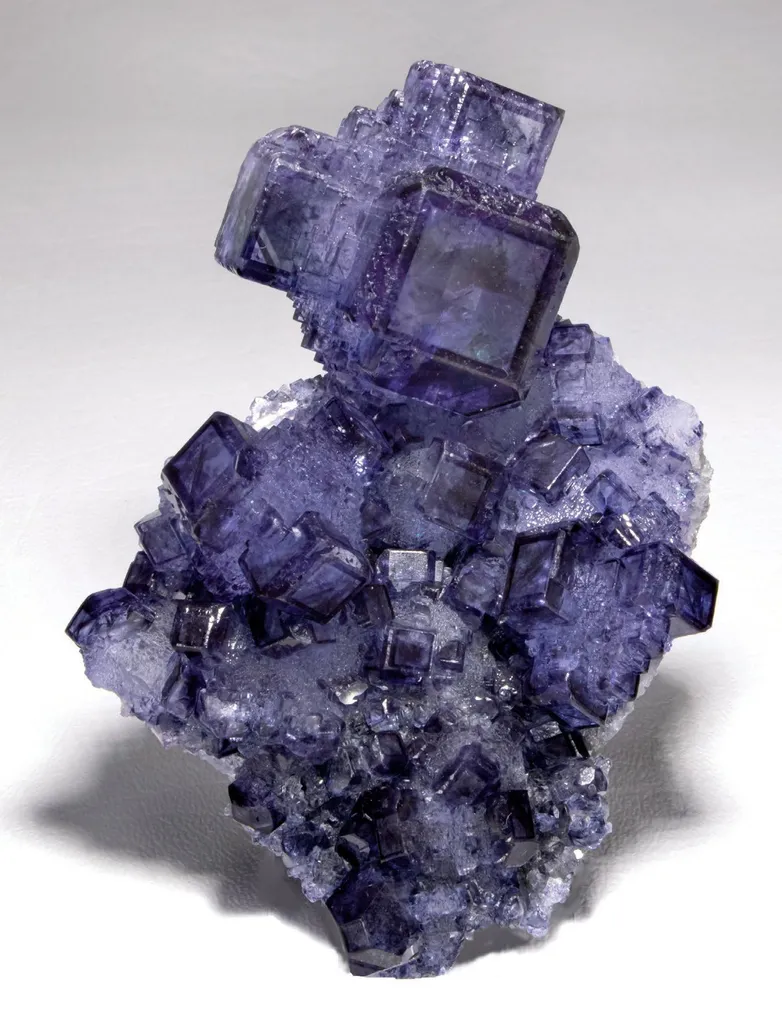
Photo: EarthWonders / Green Mountain Minerals
Search for specimens: View all specimens from Larkin's Quarry, Ireland
Larkin's Quarry is a working granite quarry in the townland of Shannapheasteen, near Costelloe, Connemara, County Galway. The quarry is associated with Connemara Granite Teoranta and is also encountered on labels as Joe Larkin's Quarry, Larkin's Granite Quarry, or Shannapheasteen Quarry. In geological locality usage, it is distinct from nearby Connemara fluorite occurrences such as Lettermuckoo Quarry, Walsh's Quarry, Bovroughaun, and other small Galway Granite vein localities.
The host rock is the Shannapheasteen Granite, described in Geological Survey Ireland and related Galway Bay mapping as a fine-grained, aphyric granite within the central block of the Galway Granite Batholith. Regional descriptions of the Galway Granite Complex place the batholith in the late Silurian to Devonian Caledonian intrusive history of western Ireland, with multiple plutons and blocks emplaced over a long interval. The Shannapheasteen body is part of that complex granite architecture: a comparatively fine-grained unit, closely jointed, cut by later veins and dykes, and exposed today through quarrying for building stone.
The specimen-forming mineralization is not an orebody in the economic mining sense. It is a late hydrothermal vein assemblage exposed sporadically as granite is quarried. The best-known veins carry fluorite with quartz and a lead-zinc suite that includes galena, sphalerite and cerussite; calcite, pyrite and other minor species are also documented. Regional fluid-inclusion and geochronological work on Galway Granite fluorite mineralization interprets these fluorite veins as late Triassic hydrothermal systems, much younger than the granite, and related to broader North Atlantic-European Triassic-Jurassic rift-related hydrothermal activity. In collector language, that means the fluorite is a fracture- and vein-cavity mineral, not a primary granite accessory.
The quarry's collecting history is modern and unusual. The Larkin family has quarried granite and sand at Shannapheasteen since the 1930s, with the quarry later associated with Joe Larkin and then the next generation of the family. Commercial use of the stone intensified during twentieth-century local road and construction work, and the modern company supplies indigenous Connemara granite as building stone, chippings, drainage stone, and bespoke dimension-stone products. The mineral specimens emerged as a by-product of this stone business.
The breakthrough specimen event came in 2015, when an exceptional fluorite occurrence was encountered during quarry work. That find immediately changed the collecting reputation of the site. Earlier Connemara fluorite localities had produced interesting material, especially Lettermuckoo with its small purple octahedra, but Larkin's Quarry yielded larger, more aesthetic and more varied crystals. The first important material was handled through Thames Valley Minerals in the United Kingdom and later through Moorland Minerals, with additional pieces moving through specialist dealers and auctions.
Specimens documented from the locality range from tiny lavender-blue cubes only a few millimetres across to cabinet plates. Mindat photo records include a very large fluorite and quartz plate measuring 36 cm with crystals to 7 cm, while The Mineralogical Record figured purple fluorite crystals to 4.5 cm and a 1.8 cm modified cube with an octahedral phantom and blue “checkerboard” sector zoning. Auction records show both modest miniatures and higher-end pieces: a 3.3 cm fluorite with quartz sold in 2022, a 14.7 cm cabinet plate sold in 2024, and a 4.3 cm Jack Halpern miniature sold in 2025.
There is no public collecting access. The quarry is private, active or intermittently active as a commercial stone operation, and collecting is prohibited without permission. The specimen supply is controlled by the owners, who recover material themselves when mineralized veins are exposed and distribute it through private dealer arrangements. Collectors should treat any invitation to enter the quarry independently as suspect unless it comes directly from the operators; the locality is not a casual field-collecting destination.
Fluorite is the defining mineral of Larkin's Quarry: CaF2 in sharp cubic crystals, typically lavender, blue-purple, dark violet, or silvery purple depending on light and zoning, with darker edge phantoms and occasional green or cyan sectors. The common collectible pieces are thumbnails to small cabinets with cubes from a few millimetres to roughly 1–3 cm; exceptional crystals to 4.5 cm and larger cabinet plates with crystals reported to 7 cm are documented. The best examples show transparency, crisp cubic form, dodecahedral bevels, octahedral phantoms, “checkerboard” sector zoning, and the locality's celebrated “Celtic cross” growth pattern; ordinary pieces are usually more etched, broken, massive, or crowded. Quartz is the most familiar display association, and some specimens carry or imply the broader vein assemblage of galena, sphalerite, cerussite, pyrite, calcite, chlorite-group material, and altered granite matrix.
Clinochlore at Larkin's Quarry is a subordinate but important part of the chloritic alteration and inclusion story around the fluorite veins rather than a showy standalone species. It is documented from the locality in the 2021 Mineralogical Record treatment and appears to represent green chlorite material associated with the vein pockets: coatings, inclusions, and fine chloritic patches on or within the fluorite-bearing assemblage. In aesthetic terms its value is usually contextual, not sculptural; the best Larkin clinochlore-bearing specimens are those where green chloritic material enhances blue, purple, or colorless fluorite zoning without muddying the crystal faces. Because chamosite is also documented from the quarry, well-labeled chlorite specimens should be treated carefully unless the species identification is supported by a reliable source or analysis.
Other documented minerals from Larkin's Quarry include albite, anatase, anglesite, calcite, cerussite, chalcopyrite, chamosite, epidote, fluorapatite, galena, hematite, K-feldspar including adularia, linarite, malachite, molybdenite, muscovite, pyrite, quartz, sphalerite, titanite and wulfenite. The quarry is not known as a type locality; its mineralogical importance lies instead in the unusually aesthetic fluorite and in the way a small Galway Granite vein system concentrates a Pb-Zn-Cu-Mo secondary and primary assemblage. Of the rarer species for the locality, linarite, wulfenite, fluorapatite, anatase, titanite and molybdenite are of most interest to systematic collectors, while galena, sphalerite, cerussite and quartz are the most relevant associates when assessing fluorite specimens.
Larkin's Quarry fluorite is still scarce enough that labels matter. The locality is often written in abbreviated forms — Joe Larkin's Quarry, Larkin Quarry, Larkin's Granite Quarry, Shannapheasteen, Costelloe, Connemara, or simply “Galway, Ireland” — and all can refer to the same source. However, Connemara has several other fluorite localities, and older labels from Lettermuckoo, Walsh's Quarry, Bovroughaun, or Shannapheasteen-area workings should not be casually merged. Larkin's material is usually cubic and zoned; Lettermuckoo is better known for smaller, dark purple octahedral crystals with baryte, calcite, quartz and sulphides.
No documented fake or systematic treatment problem has become attached to Larkin's Quarry material. The more realistic authenticity issue is mislabelling: purple fluorite cubes from China, Mexico, Illinois, Pakistan, or elsewhere should not be accepted as Larkin's Quarry without provenance. Genuine Larkin pieces often show a recognizable combination of purple edge zoning, blue to lavender centers, octahedral phantoms, satin-etched faces, green or cyan sectors, and granite or quartz association, but visual style alone is not proof. A credible dealer history, early UK-dealer provenance, collection labels, or published-figure linkage is worth a premium.
Condition is the main buying challenge. Fluorite has perfect octahedral cleavage, and quarry recovery adds an extra layer of risk: crystals can be bruised, cleaved, or edge-worn before they ever reach a dealer tray. Look closely at cube corners, bevels, and the high points of crowded plates. Many pieces have naturally etched or satin faces, which should not be confused with damage; the key is whether the corners are intact and whether the zoning is visible under ordinary light and backlighting. On matrix plates, peripheral attrition is common and acceptable if the display face remains sharp.
The strongest specimens combine locality character with preservation: sharp translucent cubes, dark violet edge phantoms, an internal octahedral phantom, blue or green zoning, and little or no contact damage. Single crystals with strong zoning can be better than busy plates if the geometry is clean. Conversely, a large plate with dozens of small cubes may be desirable if it preserves a coherent display face and shows the locality's color zoning across multiple crystals.
Fluorescence is not the principal reason collectors pursue Larkin's Quarry fluorite, but fluorite from many localities may respond to ultraviolet light, and individual Larkin pieces should be tested rather than assumed. Avoid prolonged direct sun for display, not because a specific fading problem is well documented here, but because purple fluorite in general is best treated conservatively. Do not clean specimens aggressively: the matrix and associated chlorite, sulphides, cerussite or delicate quartz can be more vulnerable than the fluorite itself, and acid treatment should be left to experienced preparators.
Market availability is intermittent. The quarry is private, production is tied to commercial granite extraction, and specimen recovery depends on whether a mineralized vein is exposed during ordinary work. Since the 2015 discovery, material has appeared through specialist dealers, online auctions and collections, including examples from the Alex Venzke, Jim Boteler and Jack Halpern collecting circles. Modest miniatures still surface, but large, damage-free, strongly zoned Larkin fluorites are genuinely scarce and tend to be absorbed quickly by fluorite and Irish-locality specialists.
The Larkin story begins as a stone story before it becomes a mineral story. At Shannapheasteen, the family quarry was not opened for collectors and not driven by ore. It was a practical Connemara granite operation, with quarrying and sand work in the area traced to the 1930s. During the oil crises of the 1970s, local road-building into the Fionnaun turf-cutting area drew on stone from the quarry. Joe Larkin, father of the later owners, took over quarrying in the 1980s, supplying crushed rock for regional sites, and the next generation carried the work forward in the 1990s. The specimens that collectors now prize came from this working landscape of road stone, building stone, yard stockpiles and family enterprise, not from a romantic abandoned mine.
That context helps explain why the 2015 fluorite find landed with such force. Connemara already had fluorite localities, but most had produced thin veneers, shattered crystalization, small octahedra or material of chiefly local interest. Then Shannapheasteen produced purple cubes large and sharp enough to redraw the Irish specimen map. Dealers and collectors began speaking of Ireland in a new tone: not just as the country of Connemara marble, Glengowla lead mine specimens, and scattered quarry curiosities, but as a source of internationally competitive fluorite.
The best Larkin fluorites also gave collectors a new visual vocabulary. One Mineralogical Record figure described two groups of purple crystals to 4.5 cm, with color concentrated along the edges and with dodecahedral bevels. The same caption singled out the “Celtic cross” habit — a phrase that stuck because it felt made for an Irish locality and because the habit really is distinctive: later cubic fluorite growing preferentially on points of an earlier octahedral generation, producing a cross-like architecture inside the crystal geometry.
Another described crystal, only 1.8 cm, carried an entire story in miniature: a dark purple modified cube, an internal octahedral phantom, and blue rectangular “checkerboard” zones. That is the kind of Larkin specimen that rewards a loupe. From across a room it is a purple cube; in the hand it becomes a diagram of changing growth conditions, with color sectors marking successive episodes of fluorite deposition.
Dealers soon developed their own language for the material. A viaMineralia description of a 41 x 36 x 31 mm sold crystal called the discovery “a sensation” and, after describing dark violet framing, sky-blue areas, a dark purple octahedral phantom, a thin colorless cross and a dark green layer in one quadrant, ended with the memorable nickname “Irish Alien.” That phrase is dealer poetry, but it captures why the locality caught on: the best Larkin cubes are not merely purple; they look internally constructed.
The auction record adds another chapter. A miniature fluorite with quartz, mined in 2017 and measuring 3.3 x 3.0 x 0.9 cm, sold through MineralAuctions in November 2022 for $195. A larger 14.7 x 12.3 x 2.6 cm cabinet plate closed in March 2024 at $831, with dozens of gemmy purple cubes on matrix. Then in March 2025 a 4.3 x 4.2 x 2.7 cm Jack Halpern collection miniature, with sharp gemmy purple cubes and dodecahedral modifications, brought $1,550. The prices are not just market trivia; they trace the locality's movement from fresh discovery to recognized modern classic.
Mike Sweeny and Richard Unitt, “Larkin's quarry, Connemara, Ireland,” The Mineralogical Record, 52(2), 129–156, 2021 — The key dedicated publication on the locality, its fluorite morphology, color zoning and associated minerals.
ResearchGate record for Sweeny and Unitt, “Larkin's Quarry, Connemara, Ireland,” The Mineralogical Record, 2021 — Public abstract noting the recent discovery, the rarity of notable Irish mineral occurrences, and Larkin's wide variety of fluorite forms and color zonations.
Martin Feely, Alessandra Costanzo, Sean P. Gaynor, David Selby and Emma McNulty, “A review of molybdenite, and fluorite mineralization in Caledonian granite basement, western Ireland,” Lithos, 354–355, 105267, 2020 — Regional geological framework for Galway Granite molybdenite and late Triassic fluorite mineralization.
P. J. O'Connor, H. Hogelsberger, M. Feely and D. C. Rex, “Fluid inclusion studies, rare-earth element chemistry and age of hydrothermal fluorite mineralization in western Ireland,” 1993 — Earlier fluid-inclusion, REE and age work tying western Irish fluorite mineralization to Triassic rifting.
Stephen Moreton and Robert Lawson, “Fluorite and associated minerals from Lettermuckoo Quarry, Connemara, Co. Galway,” Journal of the Russell Society, 22, 38–42, 2019 — Important Connemara fluorite context, including comparison with the 2015 Shannapheasteen/Larkin discovery.
Geological Survey Ireland, “Shannapheasteen Quarry” County Geological Site Report — Official geological heritage summary identifying the quarry's igneous and mineralogical interest.
Geological Survey of Ireland / ResearchGate record, Geology of Galway Bay: A Geological Description to Accompany the Bedrock Geology 1:100,000 Scale Map Series, Sheet 14 — Geological background on the Galway Granite Batholith and Shannapheasteen Granite.
Mindat locality page: Larkin's Quarry, Shannapheasteen, Costelloe, Connemara, Galway County, Ireland — Best single online locality page for coordinates, mineral list, synonyms, access notes and photo links.
Mindat fluorite occurrence page for Larkin's Quarry — Fluorite-specific occurrence page with gallery counts and associated minerals from photo data.
Connemara Granite: About — Background on the family quarry, Connemara granite products and the commercial stone context of Joe Larkin's Quarry.
Connemara Granite: Contact — Current quarry contact page and location information for Connemara Granite Teoranta.
An Bord Pleanála planning record for quarry development at Shannapheasteen — Planning documentation for the Shannapheasteen quarry operation and environmental consent history.
Applicant response documentation for Connemara Granite Teoranta, 2014 — Useful historical notes on Larkin family quarrying at Shannapheasteen.
MineralAuctions: Fluorite with Quartz, Larkin's Quarry, sold 2022 — Auction record documenting 2017-mined blue-purple fluorite with quartz and octahedral phantom zoning.
MineralAuctions: Fluorite, Larkin's Quarry, sold 2024 — Auction record for a 14.7 cm cabinet specimen, useful for market comparison and condition language.
MineralAuctions: Jack Halpern collection Larkin's Quarry fluorite, sold 2025 — High-end miniature record illustrating the premium for gemmy, sharp, zoned examples.
viaMineralia: Fluorite from Larkin's Quarry — Dealer description of a strongly zoned single crystal, notable for its detailed color and phantom observations.