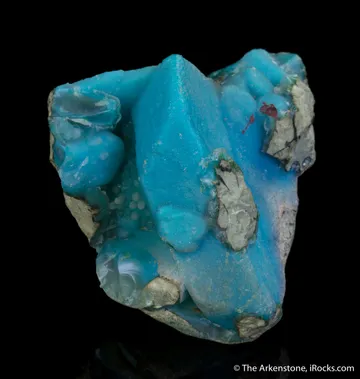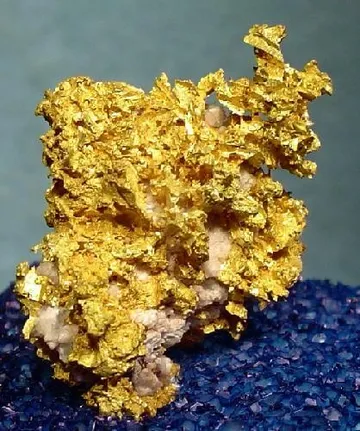
Flux Mine, USA: classic cerussite locality known for needle-like crystals in jackstraw bundles perched on dark matrix, recognizable to collectors.
Key facts
Flux Mine is one of the classic American cerussite localities: a southern Arizona zinc-lead-copper-silver-gold-manganese mine whose specimen fame rests not on broad, glassy twins like Tsumeb or Mibladen, but on something far stranger and more locality-specific — white to champagne, pearly, needle- and pencil-like cerussite in tangled “jackstraw” bundles. The mine lies high in the Patagonia Mountains of Santa Cruz County, in Flux Gulch off Alum Gulch, within the Harshaw Mining District south of the town of Patagonia. Its ore formed along a complex faulted and brecciated zone involving older limestone, shale and conglomerate, intrusive quartz monzonite and aplite, and altered rhyolitic volcanic rocks. In the oxidized zone, lead sulfides were transformed into abundant lead carbonates and sulfates; in the deeper sulfide zone the economic suite was galena, sphalerite, pyrite and chalcopyrite.
The locality matters to collectors because the best Flux Mine pieces are instantly recognizable. Fine examples show sheaves, sprays, and intergrown mats of slender cerussite crystals, commonly perched on dark brown to black limonitic or manganese-stained gossan. The aesthetic contrast is severe and memorable: pale, silky lead-carbonate “icicles” against a dark, porous oxidized matrix. Older writers singled out cerussite hanging from the roof of the south, or 260-foot, tunnel and adjacent crosscuts, and modern specimen descriptions still echo that underground image: brittle, pearly jackstraws that look as though they were frozen in mid-collapse.
Regional View
Country View
Economically, the Flux was an old mine by Arizona standards. It was reportedly worked by Mexican miners in the early 1850s, relocated in the late nineteenth century, and produced intermittently into the twentieth century. Operators and lessees included R. R. Richardson and partners, Arizona Gold & Copper Co., Patagonia Mining Co., Sterling Development Co., Flux Mining Co., Benjamin Heney, ASARCO and others. Its workings ultimately included adits, shafts, drifts, crosscuts, stopes and open cuts; early descriptions record more than 5,000 feet of work on the main levels, while later historical accounts describe still deeper and more extensive development.

Photo: Wikimedia Commons
Search for specimens: View all specimens from Flux Mine, USA
Flux Mine, historically also called the Goshen Mine, is in the SE¼SW¼ of section 30, T.22S., R.16E., at the head of Flux Gulch, about four miles south of Patagonia and roughly half a mile southwest of the Blue Eagle Mine. The locality is on National Forest land in the Patagonia Mountains, at about 4,800 to 4,900 feet elevation depending on the record consulted. The setting is the Harshaw district, a heavily mineralized portion of southern Arizona’s Basin and Range country, where Laramide magmatic and hydrothermal events produced porphyry, replacement, vein and breccia-style base-metal mineralization.
The deposit is best understood as a fault-controlled polymetallic lode and replacement system. Several veins or ledges converge near the mine, especially from easterly directions, and mineralization is concentrated along the main north-south Flux lode, which broadly coincides with the axis of Flux Ridge. The lode was reported over a linear extent of about 1½ miles. South of the mine it is associated with a reef-like body of limestone; north of the mine it lies mainly in rhyolite. At the mine itself the lode dips westward, about 45 degrees in early descriptions, and narrows downward from broad oxidized material at the surface to a much narrower vein in the lower workings.
The host rocks and structural setting are unusually instructive for a specimen mine. A small nucleus of Paleozoic limestone, with associated conglomerate and shale, is intruded and disturbed by quartz monzonite and granitic aplite, then surrounded, overlain or cut by rhyolitic volcanic rocks. The limestone is exposed on the southeast slope at the mine and is present on all levels, especially the lower workings, where it is crystalline, crushed, brecciated and altered. The rhyolite is brecciated and somewhat tuffaceous, and by replacement became one of the principal repositories for ore. The aplite occurs in the large open cut on the west side and is associated there with ore and much milky quartz. Nearby, a major fault contact separates the rhyolite of the Flux area from the granite porphyry of Three R Mountain; the broader structural picture includes the Alum Gulch fault block and fault systems related to the Harshaw Creek fault.
In the oxidized zone, which early reports placed to depths of roughly 250 feet, the ore was reddish brown and yellow from hematite, limonite and lead carbonate. The texture was commonly porous, cellular or honeycombed, reflecting replacement and leaching of feldspar from the rhyolitic gangue. Some ore consisted largely of friable gray and whitish crystalline cerussite and other lead carbonates with iron oxides and little quartz. Acanthite was reported with the secondary silver minerals. At depth, the mine entered sulfide ore with galena, sphalerite, pyrite and chalcopyrite; zinc became a major commodity in the twentieth-century history of the property.
The early workings centered on a large deposit in the south shoulder of Flux Ridge, where several veins or lodes came together. Historic development included an open cut, tunnels, drifts, shafts, crosscuts and stopes on 70-, 100-, 125- and 260-foot levels, with a 260-foot main shaft, an 800-foot west tunnel and extensive crosscutting. Later accounts describe more than 6,000 feet of underground work and a 750-foot level. The mine’s productive life was intermittent but long: reported early work in the 1850s, relocation in 1878, ore shipments in the 1880s and 1890s, major periods of early twentieth-century work, and production under ASARCO and other operators into the 1960s.
Ore from Flux was treated at several smelting centers. In 1858, ore was reportedly smelted in an adobe furnace in Alum Gulch. In the 1880s, several thousand tons were shipped to the Benson smelter. Around 1897 the mine produced close to a thousand tons of ore, and in 1904 about ten carloads of high-grade galena ore were shipped to El Paso. Early analyses of shipments showed lead and silver values high enough to make the mine a serious lead-silver producer, and some ore was valuable enough as iron-rich flux to be packed to the Mowry smelter for use in treating more refractory ores from other mines — a practical explanation for the mine’s memorable name. A later summary of the property gives total estimated and recorded production of roughly 850,000 tons averaging about 8% zinc, 5% lead, 2.5% copper, 5 ounces silver per ton, minor gold, and about 2.5% manganese.
The most important specimen-producing zones were in the oxidized lead-rich workings, particularly the south tunnel and adjoining crosscuts where the famous jackstraw cerussite occurred on and near roof surfaces and in cavities. The best specimen pockets produced clustered, matted or sheaflike cerussite crystals rather than isolated sharp display singles. Much of the material was fragile from the start: cerussite needles, blades and pencil-like prisms grew in close-packed aggregates, commonly on friable gossan or porous oxidized ore. That fragility is why undamaged, well-trimmed Flux Mine pieces with open, three-dimensional jackstraw structure are far scarcer than small broken fragments or compressed mats.
Collecting access today should be treated as closed unless current legal permission is obtained. The mine is on National Forest land but has had active claims, reclamation history, and hazardous underground workings. ASARCO-related reclamation and Forest Service closure work removed or blocked underground access; reported measures included gates and foam or puff closures of adits, shafts and concrete storage rooms. Serious collectors should regard modern self-collecting as a permissions, safety and land-status issue, not as an open rockhounding locality.
Flux Mine cerussite is the locality’s calling card: white, off-white, champagne or pale pearly PbCO3 in jackstrawed sheaves of acicular, filiform, bladed or pencil-like crystals, most characteristically on dark limonitic and manganese-oxide matrix. Historic descriptions mention silky white cerussite masses about a foot long hanging from the roof of the inner south, or 260-foot, tunnel and adjacent crosscuts, while surviving collection pieces more commonly range from thumbnails and miniatures to small-cabinet specimens; large matrix pieces with dense but undamaged crystal bundles are genuinely scarce. Associated minerals include limonite, hematite, psilomelane-type manganese oxides, minium, anglesite, quartz and residual galena-sulfide material. The ordinary Flux piece is a chalky or bruised mass of pale needles; a fine one has open architecture, intact crystal terminations, pearly luster, strong contrast against dark matrix, and enough three-dimensional relief to read as a tangled spray rather than a flattened crust.
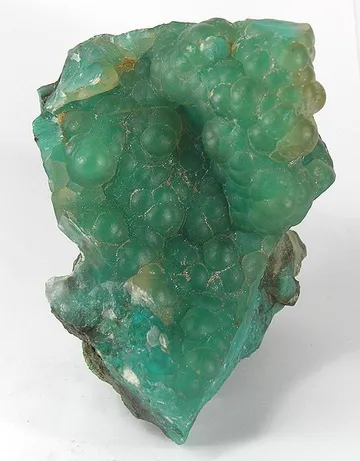
Beyond cerussite, Flux Mine has a compact but interesting oxidized lead-zinc-copper suite. Documented species include acanthite, anglesite, aurichalcite, chrysocolla, goethite, hematite, hemimorphite, jarosite, linarite, massicot, minium, pyromorphite, quartz, serpierite, siderite and vanadinite, with primary sulfides including galena, sphalerite, chalcopyrite and pyrite. Anglesite is recorded as clear to yellow crystals to about 1 cm in goethite vugs, and the locality is also noted for pseudomorphic relationships between anglesite and cerussite. Minium and massicot are historically recorded with the lead-carbonate assemblage, and aurichalcite specimens from the mine are much less common than cerussite but highly desirable to locality specialists. No well-established mineral species has the Flux Mine itself as its type locality; the nearby Harshaw district, however, is part of a mineralogically rich Patagonia Mountains neighborhood that includes type-locality material such as luetheite from the Humboldt Mine area, a few kilometers away.
Flux Mine cerussite is not a locality that usually causes identification trouble at the species level; the classic jackstraw habit on dark gossan is one of the more recognizable American cerussite styles. The greater concern is locality discipline. Similar pale jackstraw cerussite has been sold from other localities, and Flux Mine material can be confused in casual labeling with robust Irish Tynagh cerussite, Iranian Nakhlak reticulated cerussite, or other white acicular lead-carbonate specimens. True Flux pieces tend to be more gracile, brittle and pearly, commonly with an oxidized Arizona gossan matrix rather than the different matrices seen in many foreign examples. Old labels, especially those from established Arizona, American or institutional collections, add real value.
No well-documented treatment tradition or systematic fake problem is associated with Flux Mine cerussite. The practical authenticity issues are repair, consolidation and relabeling. Because the crystals are brittle and the matrix may be porous, specimens may have detached crystal sprays, glued breaks, stabilized friable matrix, or hidden losses along the edges. Repairs are not automatically disqualifying on a rare large matrix piece, but they should be disclosed. A collector should inspect jackstraw groups under magnification for unnatural glue sheen at contact points, modern adhesive in matrix recesses, or sprays that appear awkwardly perched rather than naturally rooted.
Condition is the central grading factor. Cerussite has high density and modest hardness, and the Flux habit is mechanically unforgiving: long needles and blades chip, snap and shed easily. Even fine specimens may have a few broken tips, but widespread truncation turns a display piece into a study specimen. Loose crystals in the box are common warning signs. When shipping, these pieces deserve the same caution as fine acicular stibnite or delicate natrolite: immobilization matters more than padding alone. Some sellers have even recommended hand delivery for large, fragile cabinet pieces.
Flux cerussite is reported as weakly whitish under shortwave ultraviolet light, but fluorescence is a secondary curiosity rather than a major collecting criterion. Handling considerations are those of a lead mineral from an old mine: do not generate dust, do not lick or wet-test, wash hands after handling, and keep friable fragments away from children and food areas. Dark manganese-oxide and iron-oxide matrix can shed powder; mount or store unstable pieces so they are not repeatedly abraded.
Market availability is intermittent. Small and miniature examples appear regularly from old stock, dealer inventories and collection dispersals, while excellent cabinet specimens are scarce and often traceable to mid-twentieth-century or older collections. Prices vary sharply with size, openness, luster and damage: modest miniatures can remain accessible, but large, rich, aesthetic, low-damage matrix pieces have sold in the low thousands of dollars. The best Flux Mine cerussites are American classics, not merely Arizona curiosities, and they compete for attention with better-known U.S. lead localities because the habit is so distinctive.
The old history of the Flux reads like a compressed history of the Patagonia Mountains themselves. Before Arizona was a state — and, according to early accounts, when the area was still remembered as Mexican mining ground — ore was already being taken from the mountain. In 1858 it was reportedly smelted in an adobe furnace in Alum Gulch near Sonoita Creek. Later tradition held that the mine supplied lead used for ammunition during the Civil War. Whether one approaches that story as mining lore or frontier logistics, it captures the character of the place: a lead-rich oxidized orebody known early, worked hard, and revisited whenever metal prices and transportation made it worthwhile.
The mine’s name was not poetic; it was practical. Early government geologists noted that the ore contained much iron and for that reason made a good flux. Some of it was packed six miles to the Mowry smelter, where it helped smelt more refractory ore from other mines. For a collector holding a brittle spray of white cerussite on dark iron-stained gossan, that detail is worth remembering. The same iron-rich, porous, oxidized rock that makes the specimens visually dramatic was also part of the old metallurgical economy of the district.
The shipping records give the locality a hard numerical backbone. From February 23 to August 27, 1897, a partial record showed 942.8 tons of ore averaging about 17% lead and 20.5 ounces of silver per ton. Later shipments totaling about 450 tons, from August 16, 1900, to January 23, 1905, assayed roughly 30% lead, 8% iron, 1½% manganese, 4% sulfur and 30 ounces silver per ton. In 1904 about ten carloads of high-grade galena ore, worth $60 to $100 per ton in period values, were shipped to El Paso. These figures explain why the property kept attracting operators even though the district was rugged, the ore shoots irregular, and the mine’s fortunes uneven.
One of the most vivid episodes came in 1919, when the Flux Syndicate financed a 6,200-foot aerial rope tramway from the mine to a gravity-flotation concentrating mill rated at 100 tons per day. The mill could treat lead carbonates — exactly the kind of oxidized ore that made the Flux both a mine and a specimen locality. The operation lasted only several years because operating costs were high, but in that period roughly 4,000 tons of ore and tailings were milled, producing 14 carloads of lead and silver concentrates worth about $16,000 in contemporary markets. The image is wonderfully specific: delicate lead-carbonate crystals underground, tram buckets overhead, and a mill built to turn the same oxidized lead minerals into concentrate.
The specimen story has its own underground picture. Early descriptions place the famous cerussite in the inner part of the south or 260-foot tunnel and adjacent crosscuts, where masses of silky white needles hung from the roof. Later collector language made the image more visual still: “jackstraw” crystals like icicles on a dark roof. That is why the finest surviving pieces have a slightly architectural quality. They are not just clusters; they are fragments of a roof-and-cavity environment, trimmed down to portable scale.