






A collector's guide to Christmas Mine, USA: its geology, mining history and notable minerals, illustrated with the 45 specimens documented from this locality on EarthWonders.
Key facts
Christmas Mine is one of the great “small-but-deep” Arizona copper localities: not a giant on the scale of Morenci or Bisbee, but a locality whose collector importance far exceeds its tonnage because of its rare calcium-copper and calcium-zinc silicate assemblage. The mine sits in the Banner Mining District of southern Gila County, on the southeastern flank of the Dripping Spring Mountains, near Winkelman and Hayden. Geologically it is a porphyry copper system with conspicuous skarn development, where Laramide intrusive rocks cut Paleozoic carbonate units and Cretaceous volcanic rocks. That combination—copper-bearing fluids, reactive limestones, intense contact metamorphism, and later oxidation and retrograde alteration—created the uncommon mineral chemistry for which Christmas is famous.
For specimen collectors, Christmas means kinoite first. The mine did not give kinoite its type-locality status, but it made the species collectible: rich, electric to royal-blue microcrystals and sheaves on pale tactite, commonly sparkling under clear apophyllite-group crystals. Around that classic blue-on-clear association are some of Arizona’s most coveted micromount and small-cabinet rarities: junitoite, ruizite, gilalite, apachite, stringhamite, xonotlite, whelanite, native silver, cuprite, and dioptase. The best Christmas Mine specimens have a distinctive look—blue kinoite bands or patches in wollastonite-rich matrix, bright “sugar” of colorless apophyllite, pale to emerald dioptase in small prismatic groups, and occasional green gilalite balls or orange-brown ruizite tucked into the same miniature landscape.
Regional View
Country View
The mine also matters historically. Copper ore was recognized in the district in the 1880s, but serious mining waited through land-status complications, remote logistics, poor roads, smelting difficulties, company reorganizations, and the familiar rise-and-fall rhythm of the copper market. Christmas eventually produced copper, gold, and silver through underground and later open-pit operations, with mining suspended in January 1982. The specimen legacy is therefore finite: nearly all good pieces now circulate from old stock, former mine employees, Arizona collections, and the handful of dealers who handled material when collecting access was possible.

Photo: Rob Lavinsky, iRocks.com via Wikimedia Commons
Search for specimens: View all specimens from Christmas Mine, USA
Christmas Mine is best understood as a skarn-rich porphyry copper deposit. The ore system is centered on the Christmas intrusive complex, commonly described in the modern Arizona Geological Survey literature as the Christmas Granodiorite Porphyry, emplaced into older carbonate and volcanic rocks. Metallic ore was hosted in the intrusive rocks, the Cretaceous Williamson Canyon Volcanics, and Paleozoic limestone units including the Martin, Escabrosa, and Naco limestones. Fluid movement and ore localization were strongly influenced by structures such as the Christmas, Joker, and No. 4 shaft faults.
The skarn mineralogy records the reaction between hot copper-bearing hydrothermal fluids and carbonate wall rocks. Prograde assemblages include garnet, wollastonite, diopside, vesuvianite, tremolite, forsterite, and related calc-silicate minerals, with sulfides such as chalcopyrite, bornite, pyrite, pyrrhotite, sphalerite, galena, chalcocite, covellite, and cubanite documented from the system. Later retrograde alteration and oxidation produced the collector assemblage: kinoite, apophyllite-group minerals, junitoite, ruizite, gilalite, apachite, stringhamite, xonotlite, tobermorite, whelanite, chrysocolla, malachite, azurite, cuprite, tenorite, brochantite, chalcanthite, dioptase, calcite, and native copper and silver.
The collecting minerals were not distributed evenly through the mine. The most desirable silicate specimens came from retrogressively altered tactites, fractures, vugs, and carbonate-breccia zones rather than from ordinary sulfide ore. Kinoite commonly fills fractures or forms tabular blue microcrystals on altered calc-silicate rock; apophyllite forms clear to colorless crystals over and around the kinoite; junitoite appears as thin colorless plates; ruizite as orange-brown crystals; and gilalite as green coatings, balls, or fracture fillings. Dioptase, by contrast, is more closely associated with oxidized copper zones and open-pit material, where it occurs with calcite, chrysocolla, malachite, cuprite, and related secondary copper species.
The mining story began with copper-bearing outcrops noticed around 1880 by Dennis O’Brien and William Tweed. Phelps Dodge acquired the early claims, built a long wagon road, and investigated the property, but the discovery that the claims lay within the San Carlos Indian Reservation halted development. After the land was restored to the public domain in 1902, the Saddle Mountain Mining Company staked the property and named it Christmas for the timing of the event. Mining began in August 1905, but early operations were hampered by remoteness, high transport costs, and smelter fuel problems. A smelter with a rated capacity of 150 tons per day was built in 1905, but the operation shut down in 1907 during a weak copper market.
The Gila Copper Sulphide Company took over in 1909. The Arizona Eastern Railroad completed a 7.6-mile branch from Winkelman to Copper Canyon in 1911, and ASARCO’s Hayden smelting arrangements helped restart more serious production in 1916. A 7,300-foot Bleichert aerial tram connected the mine to a railroad terminal along the Gila River. Later operators and ownership changes followed, with underground mining continuing into the mid-1960s. By 1966 unstable underground workings pushed the mine toward open-pit operation. The open pit ultimately swallowed the old townsite, and copper mining was suspended in January 1982.
Reported 1905–1981 production was about 25.8 million tons of ore, yielding approximately 362.9 million pounds of copper, 55,000 ounces of gold, and 2.15 million ounces of silver. Copper grades ranged widely, from low-grade disseminated material to much richer zones. The property is now associated with Freeport-McMoRan interests and should be regarded by collectors as closed private mine property unless specific permission has been granted. Organized professional or society visits have occurred in the past, but Christmas is not a casual collecting locality today. The market supply is consequently old material: mine-era specimens, pieces collected under past permission, dealer stock from the 1970s and 1980s, and specimens dispersed from older Arizona and micromount collections.
Kinoite from Christmas Mine is the locality’s signature collector mineral, occurring as electric-blue to deep royal-blue tabular or platy microcrystals, bladed sheaves, fan-like sprays, and rich crystalline coatings in fractures and vugs in retrograded tactite and wollastonite-bearing matrix. Individual crystals are usually tiny—commonly sub-millimeter to about 2 mm on the better pieces—but the best specimens compensate with intensity of color, dense coverage, and contrast against gemmy colorless apophyllite-group crystals. Classic associations include hydroxyapophyllite-(K) or fluorapophyllite-(K), gilalite, ruizite, junitoite, xonotlite, calcite, native silver, cuprite, and occasional dioptase. Good Christmas kinoite is not merely “blue dust”: it shows visible crystal form, lively sparkle, clean apophyllite contrast, and enough coverage to read as a strong blue specimen from arm’s length, while ordinary pieces are sparse, dull, dirty, or dominated by pale matrix with only scattered blue points.
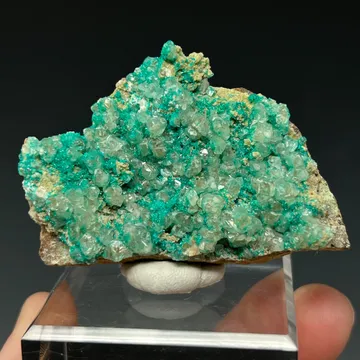
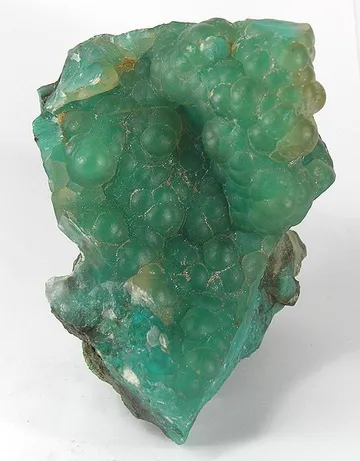
Dioptase from Christmas Mine is a scarce Arizona expression of the species, best known as small emerald-green prismatic crystals, microcrystalline coatings, and locally radiating or hemispherical aggregates in oxidized copper ore. Christmas dioptase is typically much smaller than Tsumeb or Kazakhstan material; documented examples include fibrous blue-green crystals under 1 mm on clear apophyllite with kinoite, and more typical vuggy pieces with roughly 1 mm scintillating crystals intergrown with white to colorless calcite. Its associations—calcite, chrysocolla, malachite, cuprite, chalcotrichite, native copper, kinoite, apophyllite-group minerals, and occasional wulfenite—give the locality pieces a distinctly Arizona character. The best examples have abundant sharply sparkling green coverage, identifiable crystal form or “bow-tie” groupings, and attractive contrast on calcite or colorful copper matrix; most pieces are micromount-scale and visually modest unless examined under magnification.
Apophyllite-group minerals at Christmas Mine are less famous as a standalone prize than as the clear, sparkling stage on which the rare silicates perform. The material historically labeled simply “apophyllite” includes potassium apophyllite-group species, with RRUFF and locality records indicating hydroxyapophyllite-(K) and fluorapophyllite-(K) identifications among Christmas specimens. It occurs as colorless, transparent to translucent euhedral crystals and druses in vugs and fractures of altered tactite, commonly encrusting or partly covering blue kinoite and occurring with gilalite, ruizite, junitoite, xonotlite, native silver, and dioptase. The finest apophyllite-bearing Christmas pieces are not large Indian-style apophyllite specimens; their value lies in bright, undamaged, glassy crystals that frame kinoite without smothering it, producing the classic blue-and-clear Christmas Mine contrast.
Calcite at Christmas Mine is a supporting but important specimen mineral, appearing in the altered carbonate-skarn environment and in the later oxidized assemblage. It is documented with junitoite, kinoite, apophyllite-group minerals, smectite, xonotlite, dioptase, chrysocolla, malachite, and cuprite, and collector pieces most often show white to colorless calcite crystals or drusy calcite providing contrast for green dioptase or blue copper silicates. Fine calcite-only specimens are not what made Christmas famous; desirable calcite specimens from this mine are combination pieces where clean, bright calcite sharpens the visual presentation of dioptase or rare silicates. Ordinary examples are small, pale, or etched-looking, while better pieces show fresh luster, clear separation from the copper minerals, and minimal bruising.
Christmas Mine is also a major locality for type and near-type rarity collecting. Junitoite, CaZn2Si2O7 · H2O, was described from Christmas as a new hydrated calcium zinc silicate and occurs as thin colorless rectangular plates, commonly with kinoite, apophyllite, smectite, calcite, and xonotlite. Ruizite, Ca2Mn3+2Si4O11(OH)22 · 2H2O, was described from the mine as an orange-brown manganese-bearing silicate from the mesogene calc-silicate assemblage and named for Arizona collector Joe Ana Ruiz. Apachite and gilalite were described from Christmas tactites as new retrograde or mesogene copper silicates; gilalite gives green balls or coatings in association with kinoite, while apachite is a blue copper silicate that can be visually treacherous in a mine already full of blue species. Stringhamite, xonotlite, tobermorite, clinohedrite, whelanite, native silver, native copper, cuprite, chalcotrichite, malachite, chrysocolla, brochantite, chalcanthite, garnet, diopside, wollastonite, vesuvianite, and related skarn minerals round out one of Arizona’s most specialized rare-silicate assemblages.
Christmas Mine specimens reward magnification. Many of the locality’s most important minerals are micromount species, and even cabinet-size specimens may carry their real mineralogical value in crystals only a millimeter or two across. A hand lens is adequate for attractive kinoite and dioptase, but junitoite, ruizite, gilalite, apachite, stringhamite, whelanite, and xonotlite are best appreciated—and in some cases responsibly identified—under a binocular microscope.
Mislabeling is common enough to matter. Older labels may say only “Christmas Mine, Hayden, Arizona,” “Christmas Mine, Winkelman,” or even “Pinal County,” although the accepted locality is in Gila County. “Apophyllite” labels are also usually older group-name usage rather than modern species-level determinations; without analysis, it is often safer to describe such material as apophyllite group or as apophyllite-(K) group rather than to insist on fluorapophyllite-(K) or hydroxyapophyllite-(K). Kinoite may be confused with azurite, stringhamite, gilalite, chrysocolla, or apachite on casual inspection. Striated blue tabular crystals and the classic association with clear apophyllite strongly favor kinoite, but analytical confirmation is warranted for rare-species labels, especially on high-value micromounts.
No widely documented large-scale fakery tradition is attached to Christmas Mine material, but the locality’s rarity creates incentive for optimistic labeling. Be wary of generic blue copper-silicate specimens being sold as kinoite from Christmas without old labels, collection history, or crystal evidence. Conversely, some older, modest-looking pieces in micromount flats may carry genuine rare species that were under-recognized when collected. Provenance—ex Joe Ruiz-type Arizona micromount circles, old Phelps Dodge/Inspiration-era labels, former mine-employee material, or established dealer stock from the 1970s–1980s—adds real confidence.
Condition issues are typical of altered tactite specimens. The matrix can be crumbly, granular, or porous; apophyllite crystals bruise and cleave easily; kinoite and gilalite coatings may be thin; and many pieces have iron staining, dusty seams, or sawed bases from trimming dense ore blocks. Avoid aggressive cleaning. Water, acids, ultrasonic cleaning, and strong mechanical brushing can damage soft copper silicates, loosen drusy coatings, or dissolve delicate secondary sulfates such as chalcanthite if present. Store delicate micromounts boxed and dry, and handle cabinet specimens from the matrix rather than from sparkling apophyllite-covered faces.
Rarity varies sharply by species. Apophyllite-on-kinoite combinations are obtainable, though fine rich examples are much less common than small scattered ones. Christmas dioptase is significantly scarcer than kinoite on the market and is especially hard to find as an attractive display specimen. Junitoite and ruizite are specialized micromount rarities; apachite, whelanite, and confirmed stringhamite are still more analytical-collector material than casual display minerals. Since the mine is closed to ordinary collecting, new supply is essentially recycled old material, and the best pieces tend to move through specialist dealers, micromount collections, and Arizona-focused collection dispersals.
Christmas Mine earned its name in a way only an Arizona mining camp could: through timing, law, telegraph, horses, and a little opportunism. Dennis O’Brien and William Tweed found the copper outcrops around 1880, and Phelps Dodge moved quickly enough to acquire the claims, build a long wagon road, and test the ore. Then the government survey placed the ground inside the San Carlos Indian Reservation. For nearly two decades the property sat in limbo while Phelps Dodge waited for the land to reopen and kept a watchman there to discourage rival locators.
The opening came in December 1902, when President Theodore Roosevelt signed the order returning the ground to the public domain. The managers of the Saddle Mountain Mining Company had prepared for exactly that moment. Word was sent by telegraph, then relayed across the desert by horses to George Chittenden at Dudleyville. The message reached him on Christmas Eve. Chittenden and his men went directly to the old Phelps Dodge ground and found that the watchman had left to celebrate the holiday. They staked the claims, and the mine became “Christmas.” Phelps Dodge sued, but the dispute ended within months when Saddle Mountain bought 40 contested claims for $160,000. The episode has often been remembered as a kind of seasonal claim-jumping drama, but it was also a precise exploitation of public-land timing.
The early mine was a logistical ordeal. By 1905 the underground workings had already gone beyond 300 feet, and Saddle Mountain built a 150-ton-per-day smelter. Hundreds of men were on the payroll, and photographs from the period show a raw camp of wooden buildings and canvas structures. But the roads were long, the haulage expensive, and the copper market unforgiving. The 1907 shutdown came only two years after mining began in earnest.
Christmas did not truly come into its own until rail and smelter logistics improved. The Arizona Eastern Railroad built a 7.6-mile branch from Winkelman to the mouth of Copper Canyon in 1911, and the later ASARCO arrangement at Hayden helped stabilize operations. One of the great pieces of mine infrastructure was the 7,300-foot Bleichert aerial tramway, built to connect the mine with the Gila River rail terminal. For a collector looking at a 5 cm kinoite today, it is easy to forget that the specimen came from a place where every ton of ore once had to be solved as a transportation problem.
The town called Christmas had its own brief life. It had company housing, a store, a meat market, a club-house, and recreational rooms; by about 1930 the population was roughly 1,000. The post office operated intermittently from 1905 to 1935 and became a seasonal curiosity because people around the country mailed parcels there to receive the “Christmas” postmark before forwarding. The mining camp is gone now: the expansion of the open pit erased the townsite that had grown beside the workings.
For mineral collectors, one of the most important late episodes came not from copper production but from specimen recovery. In 1980, the John Mediz rock shop in Globe reportedly secured a contract with Inspiration Consolidated Copper Company, then the property owner, allowing collection of specimens including apophyllite, dioptase, kinoite, and silver. That detail helps explain why Christmas Mine material appears in older Arizona collections with good locality data: some of it was not random dump picking but legally recovered during the mine’s final active years, just before copper mining was suspended in January 1982.
The rare-mineral story has its own cast of Arizona micromounters and mineralogists. Joe Ana Ruiz of Mammoth, Arizona, appears repeatedly in the Christmas narrative. The first junitoite specimen came from his collection, and during investigation of junitoite material, Ruiz and Robert Jenkins noticed another unknown brown mineral—later described as ruizite and named for Ruiz. In a mine already producing bright blue kinoite and clear apophyllite, the discovery of tiny colorless plates and orange-brown crystals might seem modest to a casual visitor, but to a micromounter it was the real treasure: an entire suite of new minerals emerging from small fractures in altered skarn.
-207486.jpg)