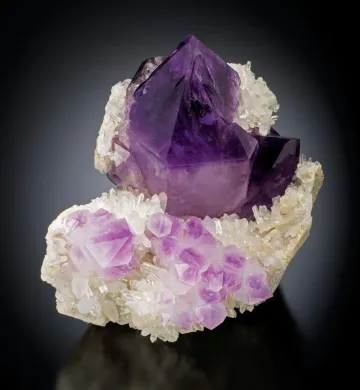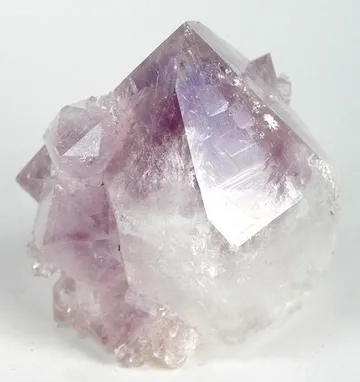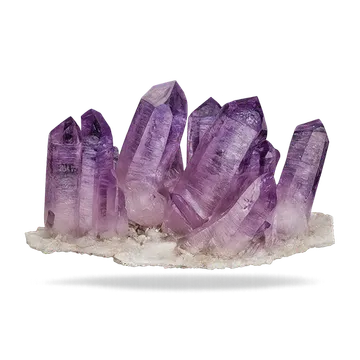
メキシコ・ゲレロ州産アメジスト - しっかりとしたガラス状の結晶で、核はワインレッドパープル、外側は淡色ゾーン;内側の色のファントムと彫刻的な結晶形状で特長を示します。
Key facts
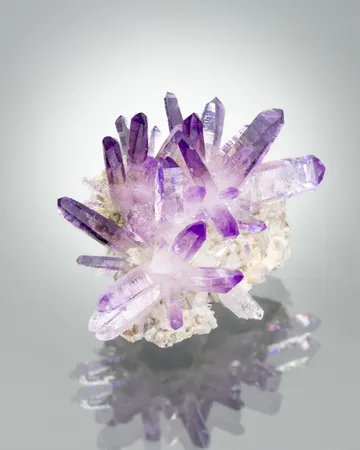
ゲレロ産アメジストは、メキシコのクォーツの定番として最も recognizable なものの一つです。ヴェラクルスの風に吹かれた空気感のある淡紫色の針状アメジストではなく、がっしりとしたガラスのように光沢のある円錐状の結晶で、内部は濃いワイン紫から赤紫、外側は淡く、乳白色、烟色、または無色の区域を持ちます。最良の例では、紫色が結晶内部に浮かぶように鮮烈な幻影として見え、終端部は霜白または水晶のように透明です。優れたゲレロ群は実際のキャビネット・プレゼンスを持ち、肩幅のある結晶、分岐する構造、深い内部色、そして紫が単に表面をコーティングしているのではなく内側から輝いているという確固たる感覚を備えています。
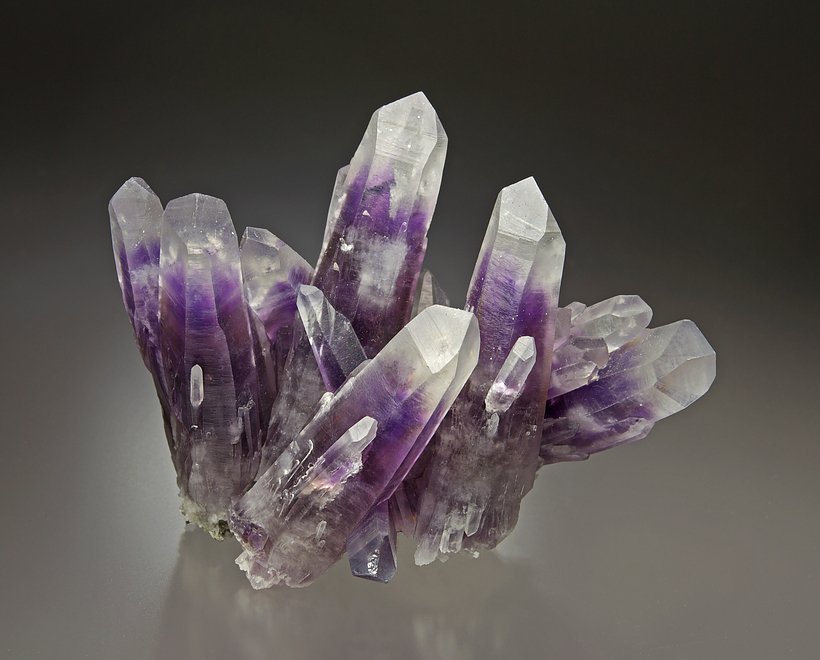
写真: Mindat.org
クラシックな産地は、北中央ゲレロ州教育ノリエ市のアマティトラン地区で、バルサス川の南の山地に位置します。ラベルはしばしば産地を「ゲレロ」「アマティトラン」「イガラ」「リオ・バルサス地区」などと単純化しますが、収集材料はアマティトラン周辺の険しい地域の小さな裂け目やポケット帯に点在する多くの脈や帯状地帯から来ています。特定の鉱山名としては、マルガリタ、パロ・ベルデ、ラヤス、バレンシアーナ、サンタ・リタ、アマティトラン、アルタミラノ、ラ・ソルプレサ鉱山または採掘地が挙げられますが、多くの小さな坑穴や溝は安定した産地名の下に保存されることはありませんでした。
地質学的には、これらのアメジスト脈はゲレロ・ゴールド・ベルトの鉱物化環境に属し、モレロスおよびメスカラ層の後期白亜紀炭酸塩性・カルシウム沈積岩が初期第三紀の花崗閃緑岩体によって侵入されています。関連する金-鉄スカルン系にはガーネット-輝石の集合体、磁鉄鉱、鏡状赤鉄鉱、以及関連する変成作用が含まれます。アメジスト自体はこのスカルン地帯の周辺の脈やポッドに現れ、ブラジルやウルグアイで知られる巨大な玄武岩系ジオードとしてではなく、むしろこの地域のスカルン地帯の周囲に発生します。この差異が、収集家性を説明するのに役立ちます。ゲレロは彫刻的な結晶標本と宝石用粗材を生み出し、工業規模のアメジスト・ジオード材料ではありません。
歴史的に、ゲレロ産アメジストは宝石色と標本形状を組み合わせたことで20世紀に有名になりました。初期の鉱山労働者やラピドリはこの材料を切断用 rough として高く評価し、いくつかの優れた結晶はファセット加工のために破砕されましたが、 intact な群の収集価値が十分に評価される前のことです。後の世代の収集家は、 locality を診断する特徴—厚く円錐状のプリズム、無色のキャップ、紫色の芯、強いファントム、そして時折のマンガン酸化物のコーティング—を高く評価するようになりました。上品な古い例は現在、二重の魅力を持っています。部分的にはメキシコのクラシック、部分的には世界クラスのアメジストです。コレクターは color distribution とアーキテクチャをまず重視します。望ましいゲレロ産の標本は単に「濃い紫色」ではありません。最高品質の個体は、飽和したぶどう色から赤紫色の核、はっきりとした内部ファントム、優れた光沢、損なわれていない端部、そして寄せ集めではなく魅力的な結晶分布を示します。単結晶はクラシックな先細り形と強いファントムを示すときに重要となることがあります;結晶がよく分離・均整・光沢・完全であると、群晶は価値を急上昇させます。## Featured Specimens
Search for specimens: View all amethyst specimens from Guerrero, Mexico
The essential Guerrero amethyst locality is Amatitlán, a small settlement in Eduardo Neri Municipality. Mindat places the Amatitlán diggings at approximately 17.86514, -99.76164, with the village itself only a short distance from the mineralized ground. The productive amethyst area is best understood not as a single mine but as a swarm of veins over roughly a 20 × 20 km region north of Amatitlán and south of the Balsas River. Serious labels should use “Amatitlán, Eduardo Neri Municipality, Guerrero, Mexico” unless a specimen has credible older documentation tying it to a named claim such as Margarita, Palo Verde, Rayas, Valenciana, Santa Rita, Amatitlán Mine, Altamirano, or La Sorpresa.
The deposit style is small-scale vein and pocket mining associated with gold-iron skarn systems of the Guerrero Gold Belt. The regional skarns formed where Cretaceous dolomitic limestones and calcareous shales were intruded by granodiorite stocks. The skarns are described as andradite-grossular garnet and diopsidic to johannsenitic pyroxene systems, with specular hematite, magnetite, and massive magnetite pods along contacts. The amethyst veins and pods are related to this broader contact-metasomatic district, but the collectible crystals occur in localized open spaces rather than in a continuous orebody.
Mining was never the orderly bench-and-stope specimen production one associates with some modern commercial localities. The classic workings were shallow trenches, adits, and cuts dug along vein exposures. Miners followed a vein until the productive pocket zone was exhausted, sometimes only to depths of 8 or 10 meters, then abandoned that working and searched for another. This is why so many Guerrero pieces are safely labeled to Amatitlán rather than to a precise mine: the collectors’ market preserved the regional name better than the names of every temporary cut.
Extensive working began around 1930–1933. The earliest discovery story centers on Donato Retana, a farmer near Tenantla and Amatitlán, who found purple and white quartz crystals while preparing cornfields. The lapidary trade in Querétaro soon became involved because the crystals yielded attractive gem rough. At first, much of the finest material was valued as cutting stock; large crystals were broken apart for clean pieces to facet. Only later did the market fully recognize the value of intact specimen groups.名付けられた Margarita 欄は、標本グループにとって特に重要になることが多かった。 Manuel Ontiveros は、山間の高地を測量していた技術者が結晶を含む石灰質の帯を指摘した後、姉 Margarita の名を取ってそれを命名したと回想している。約3メートルの深さまで掘ると、砂で満たされたポケットが現れ、数多くのアメジスト結晶が露出した。 Margarita Mine は、長い断層の端の近くに位置しており、その断層は Amatitlán のアメジストの大部分を産出していた。
Palo Verde の発生も、初期の大規模な幸運の一つであった。 Ontiveros は、他の多くの権利権益と異なり、非常に大きなポケットが、通常の脈状産出ではなく、約20メートル深で崩壊した花崗岩の中の塊(ポッド)として見つかったと報告されている点を挙げて Palo Verde を特に区別した。彼はまた、La Cuna と Palo Verde が Donato Retana の元々の発見を超えた二つの偉大な初期の幸運地であったことを思い出しており、最高の標本グループは一般に Margarita 由来であったことも述べている。
La Sorpresa は現代の収集家の記録に1997–1998年に初めて登場した。Mike New、Wayne Thompson、Ruben Avila と関係する従業員がこの鉱区を採掘した。現地は Rio Balsas の支流を見下ろす丘陵にわたる、半マイルの長さの脈状露出として記述された。脈の多くは以前に掘られ、その後埋め戻されていたと考えられ、以前の名称の下で重要なポケットがすでに取り除かれていたことを示唆している。それでも、オペレーションは見事な標本を回収し、The Mineralogical Record の表紙にも登場した有名な Guerrero アメジストを含んでいた。
today の収集アクセスは、カジュアルな野外採集ではなく、専門的な問題として臨むべきである。地元の地籍は権利権益を持つ私有地または特別許認可を受けた鉱物地帯であり、治安、土地状態、採掘権が重大な検討要素となる地域である。土地所有者および鉱物権利者の許可が不可欠である。ほとんどの収集家にとって、責任あるルートは信頼できるディーラー、旧コレクション、または dokumented auction material を通じて取得することであり、現地を訪問しようとすることではない。## グアレレラ州(メキシコ)産アメジストの特徴
グアレレラ産アメジストは結晶の結晶形で最も有名です。結晶は長く伸びますが Veracruz 式の細長さにはなく、下部および中部を通して厚くなり、通常の石英の終端部へと細くなる傾向があります。多くは Tessin のようなテーパーや樽状の膨らみを示し、強い水平の縞模様、階段状の断面、そしてガラス光沢からすりガラス状の光沢まで様々です。良好な結晶群は自然の扇形や花のような配置で、共通の基部から結晶が広がる形でしばしば分岐します。
色は結晶全体に均一に分布するよりも、結晶内部に濃縮されるのが特徴です。古典的な結晶は下部または中央部に深い赤紫からブドウ紫の芯を持ち、外側へ向かって淡い煙色、乳白色、灰色がかった色、または無色の石英へとフェードします。先端は一般に白色または無色です。これは Veracruz アメジストとの重要な視覚的差異の一つで、 Veracruz 産は色が終端部へ強くなる傾向があり、結晶は通常より細長く、あまりテーパーではありません。
ファントムはこの産地の魅力の中心です。多くの結晶は紫色の内部成長帯をはっきりと境界付きで示し、下部コアにはしばしばくさび形や煙紫の帯状があります。珍しい結晶には同心円状の帯状があり、外部のマットな殻の内側にははるかに豊かな紫色の内部が隠れていることがあります。背景照明は特に明らかで、反射光では控えめに見える標本が、背後から照明すると飽和した紫色の核と複雑なファントム幾何を示すことがあります。
一般的なコレクタブル結晶は5–10 cm程度で、このサイズはこの産地では珍しくありません。10 cmを超えるキャビネット標本は、完全で美観である場合に非常に望まれます。はるかに大きい優れた個体も報告されており、60 cm超え、体重45 kg 超えの結晶も含まれますが、そのような巨人はそのままの状態で完品としてコレクター市場でめったに出会えません。スペイン語の産地要約には Amatitlán 結晶が約30 cmに達することがあると記されていますが、非常に大きい個体は例外であり、典型的とは言えません。
基質(マトリックス)は様々です。多くの標本は実質的に結晶群であり、マトリックスがほとんどないように見えます。特に脈やポケットが柔らかく分解した物質から群体または単結晶が放出される可能性があるためです。存在する場合、マトリックスは珪質化した炭酸塩、結晶性石英、または風化した母岩であることがあります。アマティトラン採掘地では方解石が報告されており、石英は当然ながら主要な関連鉱物です。マンガン酸化物は結晶のコーティングとして一般的で、黒い膜や染みとして現れることがあります。グアテマラ全体として、アメジストは Taxco 周辺の鉱床からはロドクロサイトと共存することも記録されていますが、それらはラベルと標本がそれを支持しない限り、典型的な Amatitlán の結晶習性と混同すべきではありません。
品質は複数の要因の組み合わせで判断されます:- Color intensity: 濃い赤紫色またはぶどう紫の内部色が好まれます。特に強い背光なしで見える場合に重要です。
古典的なゲレンテラの「look」は、鮮やかな紫心を持つ淡い水晶結晶です。一度見れば、普通のブラジル産ジオードアメジスト、ベラクルスのスプレー、商業的に染色された材料とは区別が難しくなります。## Collector Notes
Guerrero amethyst has become a true collector’s locality rather than a steady modern production source. Small examples and lesser clusters still appear, but fine, undamaged, well-composed pieces with rich phantoms are not common. Market availability in 2026 ranges from modest, imperfect or less saturated pieces in the low hundreds of dollars to exceptional cabinet specimens priced in the tens of thousands. A 2024 auction miniature from Amatitlán, 4.3 × 4.2 × 2.3 cm, closed at $265; a 15.5 × 10.2 × 5.5 cm dealer specimen was offered at $245; and a large world-class 17 × 9 × 4 cm Arkenstone-listed piece was indexed at $55,000. Those figures illustrate the spread: locality name alone does not make a specimen elite, but top architecture, color, scale, and condition can move Guerrero amethyst into the highest tier of quartz collecting.
The most common condition issues are broken or bruised terminations, edge wear on the pale caps, missing companion crystals, and contacts where crystals detached from the pocket wall or from each other. Because many Guerrero crystals have clear or white tips, small chips may be more visible than they would be on a uniformly dark crystal. Check terminations under magnification, especially where a white cap meets a purple core. Also inspect the base of clusters for glue lines, modern fills, or reattached crystals. Repairs are not automatically disqualifying in classic mineral specimens, but they should be disclosed and priced accordingly.
Locality attribution deserves scrutiny. “Guerrero” on an old label may be accurate but imprecise; “Amatitlán” is often the safest refined locality for classic material when no mine name is documented. Be cautious with labels that over-specify a named mine without provenance. The names Margarita, Palo Verde, Rayas, Valenciana, Santa Rita, Amatitlán Mine, Altamirano, and La Sorpresa are all real in the Amatitlán district, but not every specimen sold with a named-mine label has enough evidence to support that precision.
There is one especially instructive documented treatment issue: a Mindat-listed amethyst specimen attributed uncertainly to Guerrero was subjected to hydrothermal “re-healing” in an autoclave. The broken terminations were regrown as clear quartz over approximately five months in alkaline solution at about 345 °C and 10,000 psi. That example was presented as an experiment rather than as a deceptive commercial fake, but it is an important warning. Artificial quartz overgrowth can create new clear terminations on a natural amethyst base. On suspect specimens, look for changes in surface texture, continuity of striations, unnatural clear caps, odd secondary faces, or terminations that seem too perfect compared with the rest of the crystal.Routine dyeing or heat treatment is not the chief issue for classic Guerrero specimen material. Heating amethyst can alter color toward yellow, orange, brown, green, or colorless tones in quartz generally, and synthetic amethyst exists in the gem trade, but the collector value of Guerrero pieces lies in intact natural crystal groups with diagnostic internal purple phantoms. The greater practical risks are mislocality, undisclosed repair, assembled clusters, synthetic overgrowth on damaged crystals, and ordinary condition problems.
When buying, ask for the following:
A fine Guerrero amethyst should not look like a purple geode fragment, nor like a Veracruz spray. It should have substance: thick tapered crystals, pale outer growth, deep inner color, and the particular Mexican elegance that made Amatitlán one of the great amethyst localities of the twentieth century.## Stories & Field Notes
発見の物語は麦畑から始まります。1930年ごろ、アマティトラン村に住む農家ドナト・レタナは、テンアンタラ近郊の山岳高地で土地を耕していると、白色と紫色の水晶を次々と掘り出しました。彼は宝石材料の田舎の多くの発見者と同じことをしました:結晶を価値がわかる人がいる町へ運ぶのです。この場合の目的地はイグアラで、助けを求めた人は甥のマーガリート・レタナでした。
ドナトは書くことができなかったので、鉱山の権利申請を提出する助力が必要でした。マヌエル・オンティベロスによれば、甥が自分の名義で申請を提出したとのことです。その後に起きたのは、所有権をめぐる丁寧な論争ではなく、シエラ山脈での激しい家族間の対立でした。オンティベロスは、この対立が家族全体に拡大し、男性・女性・子どもを巻き込み、双方をほぼ破滅させかけたと記憶しています。コレクターが静かな陳列ケースで称賛するアメジストは、読み書き能力の欠如や権利の跳ね上がり、誇り、そして血の色を含む非常に人間的な物語を通じて市場へ入っていきました。
その頃、クエレタロはラピドリの中心地であり、ドナトは購入者を求めてそこへ出かけました。オンティベロス家は切削用のアメジストを必要としていたため、グエレロ山脈へ頻繁に出向くようになりました。そのルート自体が frontier の鉱物年代記のように読めます。ひとつの経路はバルサス駅から入り、ラバと徒歩でアグアカティージョ山へと向かい、およそ5時間の登攀でした。別の経路はバルサス川のイズトラ橋から始まり、アマティトランへは6時間の登攀を要しました。その第二の道沿いには、土の中に浮遊する青銅鉱の水晶が見られる古い銅山がありました。彼らはそれらを賞賛しましたが、その時点では宝石粗晶を狙っており、鉱物標本は探していませんでした。後の著者は、古い銅鉱床は現在のヌカイ鉱山の近くにあった可能性があると示唆しました。
マヌエルの父、ホアキン・オンティベロスはアマティトランの近くに権利を申請し、それをラ・クーナと名付けました。高く、樹木が生い茂り、見えにくい場所でした。マヌエルは家族の最良の男たちとともにそれを作業するよう頼まれました。権利は優れた結晶を生み出しました—彼は、いくつかはコーク瓶ほどの大きさ、他はさらに大きく、ほとんどが深いアメジスト色でした。その段階では、家族は完品の結晶標本の価値をまだ理解していませんでした。大きな結晶を割って、ファセット加工用の清浄な宝石粗晶を取り出していました。
それからマグダリタが現れました。ホアキン・オンティベロスは、山岳地帯の高い場所に別の権利を申請し、植物に覆われた区域の中に結晶ポケットの系统が隠れている場所を選びました。マヌエルは公式の権利調査のために技術者を雇い、それを長姉の名をとって「マグダリタ」と名づけました。調査中、技術者は石灰質の層に結晶が埋め込まれているのを発見しました。マヌエルはそこを掘りました。約3メートル下で、アメジストで満たされた砂のポケットにシャベルが入りました。その権利は長い断層系の端の近くに位置することが後に証明され、アマティトランの生産の多くを生み出す要因となりました。La Cuna did not last. Within two months, the Ontiveros party learned that dangerous rivals planned to attack them on a Sunday. A friend warned them the threat was serious. The miners worked day and night to erase signs of the operation, scattering rubble and vegetation to disguise the site. Heavy rain helped wash away traces. They left by a pathless route over the mountains rather than risk either of the known trails. The locality was never found again. Ontiveros later said, “I am the last man who still knows where it is.”
Their escape became a month-long prospecting march through the wild mountains toward the Pacific side. They found floater amethyst at one place near Chilpancingo but did not like the crystals enough to stay. At Campo Morado they obtained food, and the villagers helped them with knowledge of edible roots and forest plants. Later, at Corral de Piedra, they found a chalky formation with good-colored amethyst crystals. The soft soil allowed them to dig about 15 kg, which they divided into three loads because more would have been impossible to carry through the mountains.
The most vivid moment in Ontiveros’s account came when the party was starving. They reached a stream where a small dam had formed a pool full of fish. Manuel joked that it was a shame they had no hooks. The guide disappeared into the woods and returned with branches from an unfamiliar plant. He crushed them with a rock and let the sap run into the water. Soon fish floated to the surface, stunned for about 15 minutes. The men gathered and cooked them quickly. Afterward they pushed through forest so dense that machetes were needed to cut through interwoven fern leaves and branches. The guides navigated by sun and stars. Eventually the party emerged at Atoyac on the coast. Manuel was only 17.
Other Guerrero occurrences entered the Ontiveros story in the same practical, opportunistic way. The family used to buy lapidary-grade amethyst at Taxco. One day, while they were eating in the Taxco market and examining their purchases, a man told them he knew where there were many such crystals. They met him in Huitzuco, and he led them to the Barranca del Ocote area, about 5 km east of town. There they recovered about 5 tons of massive amethyst suitable for cabochons and shipped it to Querétaro. Farther up the barranca they found two sites with purple and white crystals that looked like Amatitlán material. They worked the pocket zone for about six months, sold the crystals as Amatitláns, never filed a formal claim, and stopped only when the digging reached hard, unaltered bedrock beyond their hand tools.最後のゲレロ産アメジストの探検は、ピコ・デ・ Oro near Caballosで結晶が見えると誰かが報告した後に始まりました。マヌエルと弟のアルフォンソは山を一か月探し、Filo Mayor山脈の峰のひとつで鉱床を見つけました。彼らは食料と道具を運ぶのに馬ではなくラバを使い、毎週末に補給を持ち込みました。ある日曜日、さらに探検を計画していたところ、二人の武装した男が現れて spies だと非難しました。兄弟は田園地帯の奥深く、見知らぬ指導者の元へ連れて行かれました。道中、彼らはポピー畑の中で働く人々を見ましたが、当時マヌエルは自分たちが何を見ていたのか理解できませんでした。外国人は彼らを殺そうと考えましたが、鉱山作業員であることを認識している人物が介入しました。彼らは結晶を採取し、ラバを積み込み、警護の下で去ることを許されました。道端で警護は二度と戻らないよう警告しました。オントイベロスはその後、ゲレロでアメジストの探鉱を再び行きませんでした。
これらの話が、ゲレロ産アメジストが多くの古典的産地と異なると感じさせる理由です。標本は単なる鉱物学的対象ではなく、山腹の道、隠れた権利主張、ラバ道、宝石加工家の家族、危険な紛争、そしてバルサス山地の高地で手で開かれたポケットの遺物だからです。## 鉱物学的記録と刊行物- Wilson, Wendell E.; Ontiveros, Manuel; Megaw, Peter K. M. (2004). “Famous Mineral Localities: The Guerrero Amethyst Deposits, Mexico.” The Mineralogical Record, 35(6), 29–37. 現代の主要な局所性記事であり、地質学、局所性の歴史、鉱床の記述、そして Manuel Ontiveros の最初の現地発見の語りを結びつけている。
Full text mirror of “Famous Mineral Localities: The Guerrero Amethyst Deposits, Mexico.” 2004年の Mineralogical Record 記事のアクセス可能な全文で、参考文献と現場史の詳細を含む。
Mindat reference record for Wilson, Ontiveros & Megaw (2004). Guerrero アメジストに関する主要論文の書誌的検証。
Panczner, William D. (1987). Minerals of Mexico. Van Nostrand Reinhold, 459 pp. Mindat による Amatitlán 局所と Margarita 鉱山の引用文献;メキシコの鉱物局所にとって重要な広範な参考文献。
Sinkankas, John (1959). Gemstones of North America, Vol. 1. Van Nostrand Reinhold, p. 403. 2004年 Guerrero アメジストの文献において、材料の初期宝石学的扱いの引用。
Sinkankas, John (1997). Gemstones of North America, Vol. 3. Geoscience Press, p. 404. 2004年の記事で引用; Guerrero アメジスト宝石のカット済み標本が200カラットまで、ポケットは宝石粗体で50万ドル相当と報告。
Pough, Frederick H. (1968). “Mexico’s new wine-red amethyst.” Jewelers’ Circular Keystone, February 1968, pp. 86, 88. Guerrero 標本を有名にした独特の色に関する初期の商業紙記事。
White, John S. (1970). Q/A column. The Mineralogical Record, 1, 124. 2004年の文献目録に掲載され、局所性の初期コレクター文献の流れの一部。
Desautels, Paul E. (1968). The Mineral Kingdom. Grosset & Dunlap, pp. 82–83, 237. 2004年の記事で、主要な Smithsonian Guerrero アメジスト標本に関連して引用。
Smithsonian National Museum of Natural History, Quartz var. amethyst, Catalog Number NMNH 125254. Guerrero, メキシコ産アメジスト標本の国立鉱物コレクション記録。公有領域メディアと収蔵データを含む。
Fine Minerals International, “Amethyst,” El Rodeo Mine, Amatitlán, Guerrero, Mexico, specimen 13262. 高級 Guerrero アメジストのディーラー記録。1990年代初頭の調査で発見、12.2 × 9.8 × 8 cm、重量456 g。
Mindat specimen KAG-921, Quartz var. Amethyst, Amatitlán, Guerrero, Mexico. 色のない終端部を持つ単結晶、紫の鞍状ファントム、2 mm の珍しい気泡を特徴とする、Kay Robertson コレクション出典の記録。
Mindat photo 614942, Quartz var. Amethyst, Guerrero, Mexico, locality questioned. 水熱自動クレーブによる壊れたアメジストの終端部の再結晶化の重要な文書化例、治療の認識に有用。## Videos & Media
“Amethyst variety quartz, Guerrero, Mexico” — Minerals-and-Crystals / Les Minéraux — Sold-specimen page with an embedded video of an 8.7 × 6.5 × 5 cm Guerrero amethyst crystal on limestone matrix, useful for seeing luster and three-dimensional form.