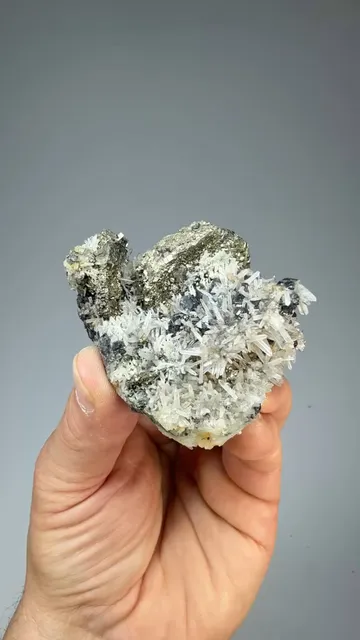
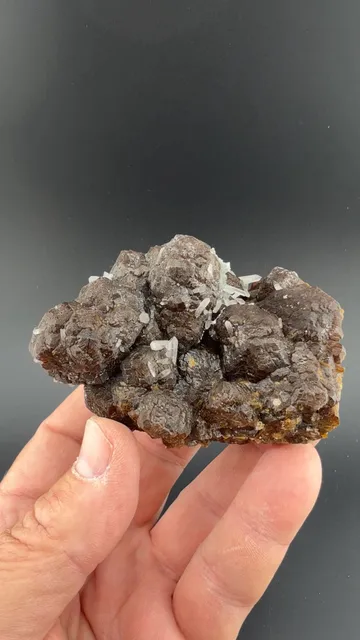
Large pseudo-hexagonal crystals of what were once pyrrhotite to 4.5 cm in size, these now replaced by crystalline marcasite, across the top of a crystallized siderite and quartz matrix. In great condition all around.The Turt Mine, located in the Oas Mountains of Satu Mare County in northwestern Romania, is situated within a prolific metallogenic region associated with Neogene volcanism along the Inner Carpathians. The local geology is characterized by volcanic and subvolcanic structures where hydrothermal activity deposited complex polymetallic ore veins containing lead, zinc, and copper sulfides. Mining operations in the area date back generations to extract these base metals. The underground workings became well known among mineral collectors for producing fine specimens of galena, often associated with siderite, pyrite, and other sulfide minerals, before industrial extraction eventually ceased.Pseudomorphs occur when one mineral replaces another while preserving the original crystal form of the precursor mineral. In the specific case of marcasite replacing pyrrhotite, a chemical and structural alteration takes place where the iron sulfide mineral pyrrhotite, which forms in high-temperature igneous or metamorphic environments, is chemically changed or dissolved under lower-temperature, acidic conditions. As the pyrrhotite unstable in those changing conditions breaks down, iron and sulfur react to precipitate marcasite, which shares the same chemical composition of iron sulfide but possesses a different crystal structure. This replacement allows the resulting marcasite crystals to retain the distinct hexagonal or tabular shape characteristic of the original pyrrhotite, creating a mineralogical record of changing geological conditions over time.



 Ships from USA
Comments