Yuma Mine — a classic Arizona locality in the Tucson Mountains, prized for vivid vanadinite and wulfenite in oxidized ore, with notable cerussite and calcite.
Key facts
The collector locality meant by “Yuma Mine” is the Old Yuma Mine in the Tucson Mountains of Pima County, Arizona, not a Yuma County occurrence and not a mine near the city of Yuma. Older labels may read “Yuma Mine,” “Old Yuma,” “near Tucson,” or “Saguaro National Monument”; all should be understood, when correctly applied, as referring to this compact but storied lead-copper-zinc-molybdenum-silver-gold deposit in what is now the Tucson Mountain District of Saguaro National Park.
For mineral collectors, Old Yuma’s importance is far larger than its tonnage. It is one of the classic Arizona localities for red-orange vanadinite and orange to yellow-orange wulfenite, with cerussite, calcite, quartz, anglesite, minium, descloizite, mottramite, fornacite, plattnerite, and other oxidation-zone minerals filling out the suite. The mine’s best specimens have a distinctly old Arizona look: small but dazzling vanadinite barrels on calcite or oxidized ore; glassy, delicate wulfenite tablets with beveled edges; and combination pieces where white cerussite or pale calcite gives the lead vanadate and lead molybdate a bright desert contrast.
Geologically, the deposit belongs to the mineralized Cretaceous volcanic terrain of the Tucson Mountains. The ore was concentrated along a steep, fault-controlled fissure and dike system cutting Cretaceous andesite, with Laramide intrusive activity and later oxidation supplying the chemistry that made the mine famous. Silver-rich galena altered to anglesite and cerussite, releasing lead into the oxidized zone; vanadium and molybdenum then produced the collector minerals that made the locality a fixture in Arizona cabinets.
Regional View
Country View
The mine’s specimen reputation was built less on continuous commercial production than on pockets, seams, and later collector work. Its vanadinite is prized for luster and color rather than sheer size, although exceptional crystals have been reported at very large sizes for the locality. Its wulfenite is similarly classic: individual tablets and groups may be modest by Red Cloud standards, but the finest Old Yuma crystals have the clean orange fire, transparency, and delicacy that serious Arizona wulfenite collectors know instantly.

Photo: Wikimedia Commons

Photo: Wikimedia Commons

Photo: Wikimedia Commons
Search for specimens: View all specimens from Yuma Mine, USA
Old Yuma is in the Amole Mining District of the Tucson Mountains, northwest of Tucson, Pima County, Arizona. The locality is now within the Tucson Mountain District of Saguaro National Park, in the Sonoran Desert landscape between Picture Rocks Road, Golden Gate Road, and the western edge of metropolitan Tucson. The mine area lies close enough to Tucson that early and mid-20th-century collectors could treat it almost as a backyard classic, yet its present-day status inside a national park makes it a closed historic locality rather than an active collecting ground.
The deposit is a small, structurally controlled oxidized base-metal system. USGS and later summaries describe the ore as a steeply dipping, lensing, faulted body along a fracture zone cutting Cretaceous volcanic rocks. At the mine, a porphyritic andesite or latite dike occupies a dip-slip fault dipping about 43 degrees; the dike averages about 8–10 feet wide and widens to about 20 feet on the 65-foot level. The surrounding geologic section includes Cretaceous andesite, rhyolite, and dacite flows in the Tucson Mountains volcanic terrane, a complex caldera-related setting later affected by intrusive and hydrothermal events.
Mineralization was not uniform through the workings. Scattered pods of silver-rich galena altered to anglesite and cerussite, furnishing lead for later vanadinite and wulfenite. The vanadinite and wulfenite zones were sufficiently distinct that they were reportedly milled in separate bins: wulfenite mainly on the western side of the fissure and vanadinite on the eastern side. That zonation matters to collectors because the classic labels and the visual character of specimens often reflect different parts of the orebody—dense red vanadinite crusts and calcite-associated vanadinite from one side, and more delicate wulfenite tablets or groups, often with cerussite, from the other.
Workings included surface cuts, pits, shafts, adits, underground levels, a main inclined shaft, a headframe, mill foundations, tailings, and a later leach-pad area. The inclined shaft was about 300 feet deep and dipped at roughly 43 degrees, with horizontal workings off the main incline at approximately the 65-, 100-, 200-, and 300-foot levels. The 200-foot level carries particular weight in specimen lore, and labels referring to the second level or 200-foot level deserve careful attention.
The first claim at Old Yuma was filed in 1885, though the locality is sometimes described in collector literature as having been discovered around 1872. Commercial production was sporadic. Between 1916 and 1947 the mine produced about 5,700 tons of ore grading approximately 4% lead, 1% copper, 0.6% zinc, 0.3% molybdenum, 1 ounce silver per ton, and 0.1 ounce gold per ton. A 100-ton-per-day mill was built on site in 1916 to concentrate gold, molybdenum, and vanadium, but the mill operated only briefly; a smelter continued at the site into the 1920s. The mine changed ownership in 1930 and later produced dump ore and surface material intermittently, but the specimen side of its history became increasingly important.
After 1947 the property was largely inactive as a mine, though not as a mineral locality. Collectors worked the dumps and accessible portions of the mine, and old-time Arizona mineral people recovered many of the pieces that now circulate through collections. Around 1969, a cave-in in the main incline dropped large slabs from the roof, a reminder that this was never a casual collecting locality even before legal access changed. In the 1980s, Richard A. Bideaux and Consolidated Mining & Milling attempted renewed work, including plans involving cyanide leaching of gold from remnant material; the site’s proximity to Saguaro National Monument, nearby residences, and conservation interests led to prolonged conflict and ultimately to federal acquisition.
Collecting access today should be treated as closed. The mine is within Saguaro National Park, where casual removal of rocks and minerals is not permitted, off-trail travel below 4,500 feet is restricted to designated roads and trails unless part of an approved activity, and abandoned mine features are hazardous cultural and environmental resources. Modern Old Yuma specimens on the market should therefore be understood as old collection pieces, estate material, historical dealer stock, or specimens collected before closure and federal management—not as new-production field material.

Photo: Wikimedia Commons
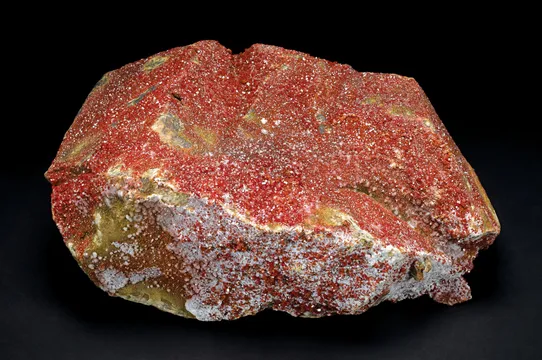
Old Yuma vanadinite is the mine’s signature species: typically red-orange to brick-red, highly lustrous hexagonal barrels, short prisms, and sometimes hoppery or tapered crystals on oxidized lead ore, quartz-calcite gangue, or lustrous calcite rhombs. Most specimens seen today show millimeter-scale crystals, commonly around 1–5 mm; attractive pieces with crystals in the 5–8 mm range are already strong for the locality, while old accounts and notable specimens record exceptional crystals around 2.5 cm and, in rare cases, near an inch. The vanadinite-rich zone lay chiefly on the eastern part of the fissure, separate from the main wulfenite zone, and classic associations include calcite, wulfenite, plattnerite, opal, quartz, descloizite, and occasional cerussite. Good Old Yuma vanadinite is judged by saturation, sparkle, completeness, and provenance: a fine miniature with sharp, undamaged, glassy red-orange barrels over contrasting calcite can outrank a larger but dull or bruised specimen.
Old Yuma wulfenite occurs as tabular crystals and crystal groups, commonly yellow-orange, orange, or deep orange-red, with the best examples showing glassy luster, beveled edges, transparency, and a delicacy that places them among the most desirable Arizona wulfenites after the great Red Cloud classics. The wulfenite zone was reported primarily on the western side of the fissure, distinct from the vanadinite-rich eastern side, and associations include cerussite, calcite, vanadinite, opal or hyalite, and locally willemite; old accounts also note rare black wulfenite with specks of gold. Individual crystals may be small loose tablets, thumbnails, or matrix pieces, with documented and photographed examples around 1–3 cm; the best Old Yuma wulfenites are clean, sharp, unrepaired, and transparent enough to glow, while ordinary pieces are often small, edge-bruised, or merely representative.
Cerussite from Old Yuma is not the locality’s main trophy species, but it is central to the paragenesis and to several of the best combination pieces. It formed as an oxidation product of silver-rich galena pods in the fissure-dike system, and it supplied part of the lead budget for later vanadinite and wulfenite. Collector specimens show white to snow-white or creamy translucent cerussite, including small twinned clusters and matrixless groups, as well as cerussite associated with orange wulfenite and old vanadinite combinations; photo-documented examples include a neat twinned cluster around 1.8 cm and old specimens with millimeter-scale vanadinite on colorless cerussite. The finest Old Yuma cerussite pieces are those that provide crisp contrast or paragenetic interest—especially with wulfenite or vanadinite—rather than merely massive white lead carbonate on ore.
Beyond the three primary collector species, Old Yuma has a compact but rich oxidized lead-base-metal suite: anglesite, calcite, chrysocolla, descloizite, fornacite, galena, hematite, malachite, minium, mottramite, muscovite as sericite, opal including opal-AN, plattnerite, quartz, the tetrahedrite subgroup, and willemite have all been documented. No type-locality mineral is the basis of Old Yuma’s reputation; its rarity interest lies instead in uncommon oxidation products and associations, especially minium after cerussite, fornacite and mottramite in the lead-copper-vanadium assemblage, and the collector-significant occurrence of vanadinite pseudomorphs after wulfenite.
Old Yuma specimens require locality discipline. A label reading only “Yuma Mine” or “Yuma, Arizona” is not enough by itself, because collectors can confuse Old Yuma in Pima County with Yuma County, La Paz County, Red Cloud-area material, Apache Mine vanadinite, North Geronimo or Pure Potential vanadinite, and other Arizona lead-vanadate or wulfenite localities. A sound Old Yuma label usually mentions Tucson, the Tucson Mountains, the Amole District, Pima County, Saguaro National Monument, Saguaro National Park, or the Old Yuma Mine specifically.
There are no widely documented, locality-specific treatment scandals for Old Yuma material, but the normal cautions for classic Arizona vanadinite and wulfenite apply. Wulfenite is fragile, thin tablets chip easily, and loose crystals from pocket seams are vulnerable to edge damage, reattachment, and trimming. Vanadinite crystals are tougher in appearance than in handling: barrel terminations bruise, edges chip, and dense drusy carpets can conceal missing crystals until viewed under magnification. A specimen that looks superb from a distance should still be checked with a loupe for flattened contacts, freshly exposed broken bases, glue, or crystal loss, especially if an old photograph or publication record exists for comparison.
Condition is especially important because many Old Yuma pieces are small. On vanadinite, look for saturated red-orange color, high luster, sharp basal faces, and lively coverage across the matrix. Calcite-associated pieces should have clean, bright carbonate rather than heavy iron staining that dulls the contrast. On wulfenite, the value is in complete edges, transparency, undulled faces, and honest mounting or matrix contact; a single glassy thumbnail crystal can be more desirable than a larger group with damaged corners.
Rarity is tiered. Small vanadinite miniatures and representative wulfenite thumbnails still appear from old stock and estate collections, but strong cabinet-size pieces, specimens with old labels, and examples linked to known Arizona collectors such as Dick Jones, George Godas, Gene Schlepp, Scott Adams, Jaime Bird, Kay Robertson, Bill Pinch, or the Arizona-Sonora Desert Museum carry a different level of desirability. The locality is closed, so availability depends on collection turnover rather than new pockets. That closed-locality status gives even modest, well-labeled pieces a historical value that modern abundant Moroccan vanadinite or more available Arizona wulfenite cannot duplicate.
Fluorescence is not a defining feature of the classic vanadinite and wulfenite specimens. Willemite is reported from the mine and may fluoresce in some Arizona occurrences, but any Old Yuma willemite or fluorescent association should be verified specimen by specimen. Handling concerns are more practical than optical: avoid cleaning with acids unless professionally advised, keep wulfenite away from pressure and vibration, and store friable minium-bearing or cerussite-bearing specimens so that powdery alteration products are not rubbed or inhaled. As with all lead minerals, wash hands after handling and keep specimens away from children and food preparation areas.
The Old Yuma Mine sits close enough to Tucson that its history often feels half frontier, half neighborhood. In the early 20th century it was a working mine with a 100-ton-per-day mill and a smelter; by the late 20th century it was a mineral-collector legend on the edge of a growing city and a protected desert landscape. The same hill that produced brilliant vanadinite and wulfenite also drew lawmen, investors, conservationists, and some of Arizona’s best-known mineral people.
One of the stranger episodes came on February 4, 1932, when Cliff Adkins kidnapped Tucson banker Gordon Sawyer. The next day, Adkins and accomplices demanded $60,000 from Southern Arizona Bank and Trust Co. in exchange for Sawyer’s life. Deputies found unusual tire tracks at the abduction scene, followed them to a ranch, and found Sawyer alive in an abandoned well. The abductors escaped at first, and Tucson’s hills filled with armed townsmen chasing the bank’s $5,000 reward. Caretakers at Old Yuma then reported that Adkins had been hiding at the mine and forcing its owner, “One-Eyed” Joe Baker, to feed him. Tucson police and Border Patrol officers arrested Adkins; he later received a 40-year sentence, though he was eventually paroled early.
The collector stories are just as vivid. Arizona specimen accounts credit Dick Jones with opening a vanadinite pocket more than two feet across that yielded hundreds of rock fragments covered with half-inch crystals. That image—the pocket broken into many glittering, red-orange fragments—is the essence of Old Yuma vanadinite: not a single cavernous Moroccan-style geode, but a hard Arizona fissure where compact pieces could emerge blazing with small, lustrous barrels.
Jones also had one of the great wulfenite moments. He opened a seam that sent loose orange wulfenite crystals cascading into his outstretched shirt. The seam proved to be part of a larger pocket of choice wulfenite with snow-white cerussite, the kind of color contrast that makes Old Yuma pieces instantly understandable even to a collector who has never been underground in Arizona.
Bob Jones recorded an even more theatrical Old Yuma discovery involving Dick Jones, lunch, and a revolver. Sitting by the open pit, Jones noticed a bright yellow spot on the opposite wall. As an ex-policeman, he carried a revolver for snakes and similar hazards; he fired at the yellow spot, and the bullet cracked open a small wulfenite pocket. Bob Jones summed up the absurd perfection of the moment with the line that it was “using lead to find lead minerals.”
George Godas also belongs in the Old Yuma story. Later collector literature describes him doing well at the mine on both vanadinite and wulfenite. The orebody carried wulfenite down one side and vanadinite down the other, and Godas opened a wulfenite pocket on the west side, in a room near the top and just west of the incline. Several specimens from that pocket were good enough to be illustrated in Dick Jones’s 1983 Mineralogical Record article. Godas also found several vanadinite pockets, one containing numerous small specimens and a single superb crystal about 2.5 cm across—large enough and fine enough to be compared with top-tier Arizona vanadinite from other great localities.