Wadi El-Natrun Depression, Egypt: a premier evaporite locality yielding trona, halite, thenardite and related salts; prized for delicate, architectural crystal…
Key facts
Wadi El-Natrun is one of the great evaporite localities of the collector’s world: not a hard-rock mine, but a chain of alkaline saline lakes and sabkha flats set in a closed desert depression northwest of Cairo, where brines have repeatedly concentrated, dried, redissolved, and recrystallized sodium salts. For collectors it matters because it produced a suite of attractive, highly soluble evaporite specimens—trona, halite, thenardite, burkeite, gaylussite, pirssonite, northupite and related species—in combinations that look more like miniature frozen brine chemistry than conventional matrix minerals. The historic importance is even larger: “natron” from this valley was a working material of ancient Egypt, used in mummification and in vitreous industries, and later tied to Roman glassmaking along the lake margins. The best Wadi El-Natrun pieces are delicate, pale, saline sculptures: cream to pale orange trona prisms and radial aggregates, transparent to pink or reddish hoppered halite cubes, and thenardite crystals and bundles with reddish or gray inclusions, sometimes on substantial small-cabinet to cabinet-size plates from the Zug Lake area.
Regional View
Country View
Geologically, the locality is a brine-lake and sabkha system rather than a single mine. The depression trends northwest-southeast and contains a line of lakes including El-Beida, El-Fazda, El-Gaâr, El-Hamra, Zug, Ruzounia, Umm Risha and others. The mineralization is controlled by shallow saline waters, evaporative concentration, lake-floor crusts, marsh-margin salt cementation, older buried evaporite layers, and the chemistry of waters moving through Neogene and Quaternary sediments. That is why specimens from the locality can look so fresh and architectural while remaining inherently fragile: they are products of active surface and near-surface salt systems, not deep, stable mineral veins.
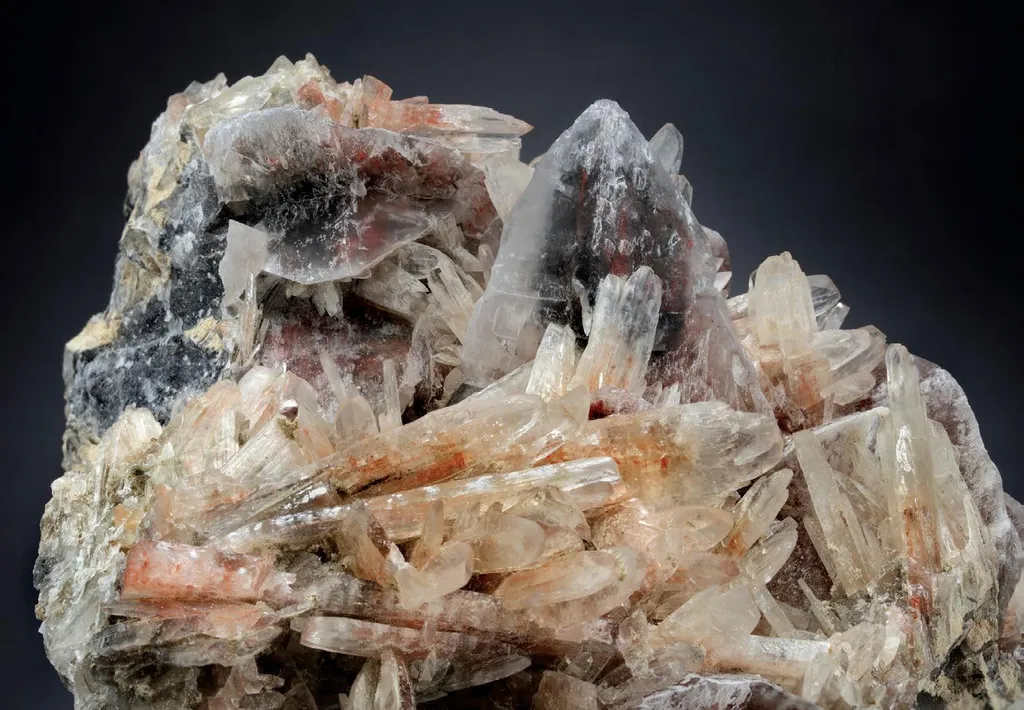
Photo: EarthWonders specimen 2304
The locality’s finest modern collector specimens entered the mineral market in small, memorable waves rather than through a long-running specimen-mining industry. Around the mid-2000s, European collectors and dealers began seeing lustrous trona, hoppered halite, orange-pink thenardite and rare burkeite from the Natrun Depression; subsequent analytical work and field campaigns by Marco Marchesini and Antonello Barresi placed those finds on a firmer mineralogical footing and documented Wadi Natrun as a serious locality for display-quality sodium evaporites.
Search for specimens: View all specimens from Wadi El-Natrun Depression, Egypt
Wadi El-Natrun lies in Egypt’s Western Desert northwest of Cairo, commonly described as an elongated depression about 50–60 km long and roughly 10 km wide, with its floor around 23 m below sea level. Its collector minerals formed in a classic continental evaporite setting: alkaline saline lakes and adjacent sabkhas occupying topographic lows, fed by groundwater and affected by strong evaporation, seasonal water-level changes, and long-term changes in salinity. The surface system includes lake-bottom salts, salt flats, marshland, aeolian quartz sand cemented by salts, and clay-rich siliciclastic sediments with organic matter; older Miocene evaporitic rocks are exposed toward the western end of the depression and disappear eastward into the basin.
The mineralization is not an orebody in the vein or replacement sense. It is a set of brine-derived salt crusts and layers, with halite, sodium sulfate minerals, sodium carbonate and bicarbonate minerals, and mixed sulfate-carbonate species developed in and around individual lakes. Modern mapping and geochemical work has divided the lakes into saline water, marshland and salt zones, and has shown that halite is widespread across the system, while thenardite-rich and carbonate-bearing assemblages vary by lake and by stratigraphic position within the crusts. The most important collector pieces came from the more stable or older evaporite layers rather than from loose, powdery efflorescences: buried or semi-buried crusts around Zug Lake and the Zug–El-Hamra system are especially important for trona-and-thenardite specimens.
The best-documented lakes have distinct personalities. El-Beida is a pale, almost white salt area and has been exploited for halite and thenardite; published work describes it as nearly dry in places, with limited water in lower areas and varicolored salt precipitates across broad surfaces. Zug and El-Hamra are connected and together form a longitudinal lake system in which shallow water overlies evaporite deposits of halite and trona; sabkha deposits and salt precipitates include halite and sodium sulfates, with natron-bearing “korchef” deposits around the margins. El-Gaâr is one of the larger, more persistent water bodies and is dominated by halite with accessory trona and burkeite. Umm Risha has a hard halite crust over brine and crystalline material and is known for pinkish to reddish-pink coloration. El-Fazda is particularly important archaeologically and chemically, with halite, burkeite and sodium carbonate-rich upper material recorded from the lake system.
Mining history here is ancient in the literal sense. Sodium salts from Wadi El-Natrun were exploited by Egyptians for natron long before mineral collecting existed, and archaeological literature ties the deposits to mummification, faience, glass and other technologies over several millennia. Modern production has been more utilitarian: the lakes and salt flats have been worked for halite, sodium sulfate and carbonate-bearing salts, but the published collector literature does not frame the locality as a named commercial mine run by a single long-lived specimen operator. Instead, individual lakes have been economically important at different times, while collector specimens have come from field collecting, small-scale extraction areas, and carefully removed plates from old evaporite layers.
The modern collector should treat Wadi El-Natrun as a chemically active, locally worked, culturally sensitive desert locality rather than as open public collecting ground. Active salt extraction, private or state-managed land interests, soft lake crusts, brines, monasteries, roads, agricultural development and protected archaeological or religious sites all make casual collecting inappropriate. Legitimate specimens should have a credible collection chain, ideally naming the lake or zone—Zug Lake area, El-Hamra, El-Beida, El-Fazda, El-Gaâr, Umm Risha—rather than only “Egypt.” The most desirable older pieces are not simply labeled “natron”; they are species-specific, analytically supported trona, halite, thenardite, burkeite or associated assemblages from the Wadi El-Natrun Depression.
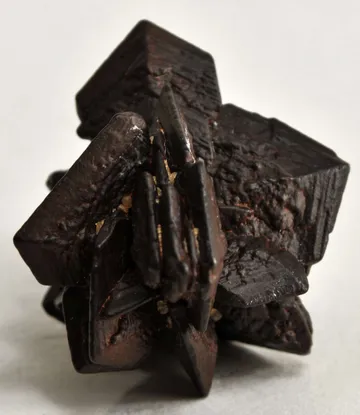
The notable specimen finds are concentrated around the early-2000s to 2010s collector material and the specimens illustrated in the 2019 Mineralogical Record study. Documented display specimens include reddish twinned thenardite crystals to 4 cm with white prismatic trona on a 12 cm specimen from the Zug Lake area; thenardite crystals to 3 cm with red and gray inclusions surrounded by cream-colored trona on a 13 cm specimen from the neighborhood of Zug Lake; and orange trona crystals with white thenardite on an 11 cm specimen from old, buried evaporite layers near Zug Lake. These are the benchmark pieces against which ordinary crust fragments and massive salt lumps should be judged.
Trona from Wadi El-Natrun is the signature collector mineral of the depression, prized where it forms lustrous cream, white, colorless to pale orange prismatic crystals, sheaves, sprays and rounded aggregates rather than dull crust. The most important specimens are from the Zug Lake and Zug–El-Hamra neighborhood, including old buried evaporite layers where trona occurs with thenardite and halite; illustrated specimens reach cabinet size, with individual thenardite crystals to several centimeters surrounded by trona prisms, and separate trona-rich pieces show orange crystals with white thenardite. Good pieces here have sharp, intact terminations, translucency, warm color, and readable three-dimensional association with thenardite or hoppered halite; ordinary pieces are friable crusts or granular “natron” mixtures that lack distinct trona crystal form and should not be valued as display trona without confirmation.
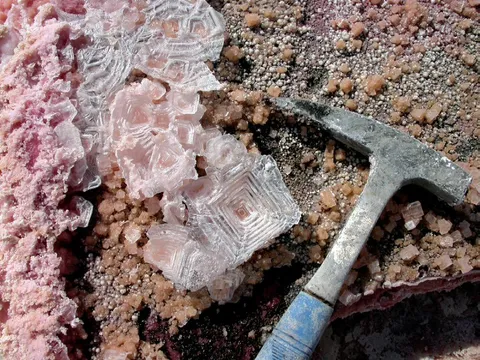
Halite is the dominant salt mineral across much of Wadi El-Natrun, but collector-grade halite is a narrower category: sharp, transparent to translucent cubes, commonly hoppered, and in the best examples tinted pale pink, orange-pink or red by inclusions and brine-related impurities. Fine specimens were noted from the Natrun Depression as small-cabinet clusters that resemble classic California playa halites, often intergrown with cream to orange trona, thenardite and locally burkeite. El-Beida, El-Fazda, El-Gaâr, Ruzounia, Umm Risha, Zug and El-Hamra are all relevant halite-bearing lake systems, but the best collector pieces are those in which halite cubes remain glassy and undissolved, with crisp hopper architecture and attractive pink-red coloration; common pieces are opaque, edge-rounded crusts or massive salt plates from production areas.
Thenardite from Wadi El-Natrun is especially valued when it appears as sparkling white, orange-pink, reddish or inclusion-rich crystals and bundles rather than as powdery sodium sulfate crust. The Zug Lake area produced some of the locality’s most memorable display specimens, including reddish twinned thenardite crystals to 4 cm associated with white prismatic trona, and gray- to red-included thenardite crystals to 3 cm surrounded by cream-colored trona. El-Beida is also a major sodium sulfate lake, and the Zug–El-Hamra system is described as containing thick sodium sulfate deposits. Superior thenardite specimens from Wadi El-Natrun combine recognizable crystal form, color, intact luster and association with trona or halite; the weak point is stability, because thenardite is anhydrous Na2SO4 and can suffer hydration, dulling or surface alteration under humid storage.
Beyond the three principal EarthWonders species, Wadi El-Natrun has a remarkably broad sodium-evaporite assemblage. Documented minerals include burkeite, mirabilite, nahcolite, thermonatrite, natron, gaylussite, pirssonite and northupite, plus more common or accessory evaporite and sediment minerals such as gypsum, bassanite, anhydrite, calcite, dolomite, aragonite, baryte, celestine, quartz, chalcedony, goethite and pyrite; searlesite has also been reported with caution. Burkeite is the standout rarity for collectors, occurring as white to weakly pink spherical aggregates and coatings, commonly associated with halite and trona. Pirssonite, gaylussite and northupite are important micromount and systematic species from the locality. Wadi El-Natrun is historically tied to the name and use of natron, but the modern mineralogical picture is more complex: the valley’s present-day and subrecent deposits commonly contain abundant halite, trona, thenardite and burkeite, while true mineral natron is only part of a changing, seasonally and historically variable salt assemblage.
Wadi El-Natrun specimens are first and foremost conservation specimens. Halite, trona, thenardite, natron-group minerals and related sodium salts are water-soluble, humidity-sensitive and mechanically fragile. A specimen that looks crisp in a dry desert or in a dealer’s case can soften, whiten, recrystallize, sweat or crumble if stored in a damp cabinet. Keep pieces in a stable, dry environment, ideally in a sealed acrylic box with fresh desiccant, away from bathrooms, kitchens, basements, open windows and rapid temperature swings. Never wash these specimens. Even a brief rinse can erase crystal faces, dissolve halite edges, mobilize inclusions and create secondary crusts.
Condition is the central grading factor. For trona, look for lustrous, translucent, well-separated prisms or sprays with minimal bruising. For halite, insist on sharp cube edges and clean hopper geometry; cloudy surfaces, rounded corners and dull skins are signs of moisture exposure. For thenardite, check for powdery alteration, white bloom, softened luster and loosened aggregates. Because some Wadi El-Natrun specimens are associations of several highly soluble salts with different hydration behavior, a seemingly minor humidity event can selectively alter one mineral while leaving another apparently intact.
Authenticity problems are mostly practical rather than spectacular. The locality is not known for a famous fake scandal, but halite and sodium salts are among the easiest minerals to misrepresent by vague locality, artificial recrystallization, dyed or stained color, or broad labels such as “natron” used as a cultural term rather than a species identification. Good labels should distinguish trona, halite, thenardite, burkeite, natron and related minerals rather than lumping them together. The best labels name Wadi El-Natrun Depression and, when possible, the lake or zone. “Zug Lake area,” “El-Hamra,” “El-Beida,” “El-Fazda,” “El-Gaâr” and “Umm Risha” add real value because the assemblages vary across the depression.
Fluorescence should not be the main reason to buy Wadi El-Natrun specimens. Some evaporite minerals and included organic material can respond under ultraviolet light, but documented collector value here rests on crystal form, color, association and locality history. If testing with UV, avoid heating the specimen with the lamp and do not handle it with damp fingers. Use gloves or clean, dry hands; salts can absorb skin moisture and oils, and the most delicate trona and thenardite sprays can be damaged by light pressure.
Market availability is limited and episodic. Common massive salt material from the region is not rare, but well-crystallized Wadi El-Natrun display specimens with trona, pink-red hoppered halite, good thenardite or burkeite are much scarcer. The best pieces are usually ex-European collections, material connected to the early-2000s dealer finds, or specimens traceable to the Marchesini-Barresi collecting and publication period. Cabinet-size, aesthetically balanced trona-thenardite-halide associations from the Zug Lake neighborhood should be considered locality classics, especially when the crystals remain sharp and the label is precise.
For most mineral localities, the human story begins with a prospector. At Wadi El-Natrun it begins with salt, bodies, heat and time. Long before collectors admired trona prisms under fiber-optic lamps, Egyptians were gathering the valley’s alkaline salts from lake margins and dry crusts. “Natron” was not just a mineralogical word then; it was a material of transformation. Its carbonate-rich salts dried flesh, suppressed decay and entered the rituals and industries that helped define Egyptian material culture. The same basic landscape that now yields cream trona and pink halite once supplied the practical chemistry behind mummification, cleansing, medicine, faience and early glass.
The valley’s chemistry never stood still. Archaeometric work on Wadi Natrun evaporites shows that the precipitation of sodium carbonate minerals is seasonal and likely changed over longer climatic intervals. That matters because ancient industries depended on the lake chemistry of their own time, not necessarily on the exact salt mixture visible to a modern visitor. A lake that today gives sulfate-rich, glass-unfriendly crusts may have supplied a more carbonate-rich flux in the past—or required processing before use. That uncertainty is part of the locality’s fascination: Wadi El-Natrun is not a static deposit, but a living evaporite laboratory where climate, groundwater, microbial mats and human extraction keep rewriting the salt column.
One of the best archaeological puzzles sits at Lake Fazda. A large Roman glass-making factory at Beni Salama lies on the shore of the lake, yet modern analyses found the current evaporites too sulfate-rich to be immediately useful for glass. The contradiction is deliciously concrete: the factory is where it should be if the lake supplied glass flux, but the lake’s present salt is not quite the flux the furnaces wanted. Researchers proposed two solutions. Either the lake chemistry changed through natural and human causes, or ancient workers processed the sulfate-rich deposits to convert them into a more useful carbonate flux. Experimental work even tested a Leblanc-type conversion of burkeite-rich material, suggesting that the practical answer may have been ancient chemical processing rather than simple scooping of perfect natron from the shore.
Collectors had their own small awakening in the 2000s. When suites of Wadi El-Natrun evaporites reached the mineral market through Italian channels, seasoned observers were struck by how unlike ordinary salt-flat specimens they were. The halite came as sharp, transparent, deeply hoppered cubic clusters with pale pink to red coloration. Trona was not just powder or crust but lustrous cream to pale orange translucent crystals in rounded aggregates. Thenardite appeared as sparkling orange-pink bundles with halite, trona and burkeite. The surprise was not that Egypt had natron—everyone knew the name—but that Wadi El-Natrun could produce serious display minerals.
The most vivid modern specimen story is centered on Zug Lake. Published specimens from the area show Wadi El-Natrun at its best: a 12 cm plate with reddish twinned thenardite crystals to 4 cm and white prismatic trona; a 13 cm specimen with thenardite crystals to 3 cm, their interiors clouded by red and gray inclusions, encircled by cream-colored trona; and an 11 cm specimen of orange trona with white thenardite from old, buried evaporite layers near the lake. These are not anonymous salt crusts. They are the products of a particular microenvironment—a buried, protected evaporite layer in a historically famous depression—opened at just the right moment before the desert, brine or humid air could reclaim them.