A collector's guide to Egypt: its geology, mining history and notable minerals, illustrated with the 47 specimens documented from this locality on EarthWonders.
Key facts
Egypt matters to mineral collectors in a way few countries do: it is both an ancient source of named gems and a modern archive of unusual desert mineralization. The headline locality is Zabargad Island, also known as St. John’s Island, in the Egyptian Red Sea. There, gem peridot—mineralogically forsterite-rich olivine—occurs in and around mantle-derived peridotite and associated deep-crustal rocks uplifted during the tectonic evolution of the Red Sea. Its best specimens are sharply formed, glassy, yellow-green to rich green crystals, generally modest by modern cabinet standards but carrying the weight of one of the oldest gem-mining traditions on Earth.
Regional View
Country View
Collectors also know Egypt for the White Desert near Farafra, where iron oxyhydroxide pseudomorphs preserve the bladed, cockscomb, stellate, spherical, tabular, and tubular forms of original marcasite and pyrite grown in the Cretaceous Khoman Chalk. In the trade these are often sold as “hematite after marcasite,” “limonite after marcasite,” or by the metaphysical name “prophecy stones,” but careful work has shown that goethite is commonly the dominant replacement mineral. The finest pieces are not merely odd desert concretions; they are sculptural mineral specimens, dark brown to black, lustrous, complete all around, and strikingly architectural against the pale chalk landscape that released them.

Photo: Wikimedia Commons
Beyond those two collector staples, Egypt’s mineral story is unusually broad. The Eastern Desert and Sinai belong to the northern Arabian-Nubian Shield, with Neoproterozoic basement rocks cut by quartz veins, pegmatites, greisens, shear zones, and ancient mining districts for gold, copper, turquoise, and emerald. Wadi Sikait and nearby Zubara form the famous Roman emerald province of Mons Smaragdus; Serabit el-Khadim and Wadi Maghareh are among the most historically resonant turquoise and copper districts in Sinai; Wadi El-Natrun is a classic evaporite basin for sodium-carbonate minerals; and Bahariya Oasis is Egypt’s best-known iron-manganese ore district, with hematite, goethite, siderite, pyrolusite, cryptomelane, and the controversial type-locality mineral bahariyaite.

Photo: Wikimedia Commons
The country’s best mineral specimens tend to have a desert directness about them: transparent green peridot crystals from an island of peridotite; black, starry pseudomorphs weathered out of white chalk; earthy red-brown iron ores from Bahariya; pale evaporite crystals from Wadi El-Natrun; and rare microscopic species from highly evolved granites of the Red Sea mountains. Egypt is not a country of abundant modern collector production in the Alpine-cleft or pegmatite-pocket sense, but it is a country where provenance, geological setting, and historical depth add exceptional importance to even small specimens.
Search for specimens: View all specimens from Egypt
Egypt is best treated by collectors as a country of several distinct specimen provinces rather than a single mineral deposit. The Red Sea locality of Zabargad Island is a mantle and lower-crustal exposure: peridotite bodies, gneisses, pyroxenites, and related rocks record uplift of deep lithosphere in the Red Sea region. The gem peridot is forsterite-rich olivine and is thought to have formed in late-stage, fluid-influenced veins and altered ultramafic rocks rather than as ordinary granular rock-forming olivine. The resulting specimens are transparent to translucent green crystals and fragments, commonly small, but historically reported crystals reached far larger sizes than the ordinary loose thumbnails and miniatures now seen in collections.
Mining on Zabargad is famous because of its antiquity, but the exact beginning is tangled with classical references to Topazos, Ophiodes, and the “island of serpents.” Greco-Roman authors described a Red Sea island source of a green gem that modern scholarship identifies with peridot. Later mining history includes renewed interest before World War I, when the Khedive held the mining rights and Zabargad became known in European gem circles as a source of unusually fine peridot crystals. By the late twentieth century, the locality was no longer a normal commercial source, and today Zabargad specimens with convincing old provenance are prized as historical objects as much as mineral specimens.
The White Desert near Farafra is completely different. Here the collector minerals are not primary metallic crystals from a lode but pseudomorphed aggregates in Upper Cretaceous Khoman Chalk. Original marcasite and pyrite formed during early diagenesis in open-marine carbonate sediment under low-temperature pore-water conditions. Later oxidation and replacement produced goethite-dominant iron oxyhydroxide forms, with subordinate or associated barite, calcite, and gypsum trapped among blades and cavities. The best specimens preserve radiating sprays, compound rosettes, cockscomb blades, and spherical-to-stellate forms, commonly in the hand-size range; sharp, aesthetic pieces are less common than rounded or indistinct nodules.
Bahariya Oasis, in the Western Desert, is Egypt’s major iron-ore specimen district in geological rather than aesthetic terms. The deposits include El Gedida, Ghorabi, El Harra, Nasser, and related areas, and the ores are hosted largely by Lower–Middle Eocene carbonate units affected by iron and manganese mineralization. Hematite and goethite are the principal iron minerals in many ore types, with siderite, pyrite, quartz, barite, halite, gypsum, manganese oxides and hydroxides, and clay minerals occurring in various facies. This is an industrial field first and a collector field second; specimen-quality material is more likely to be massive, botryoidal, earthy, oolitic, or pseudomorphic than finely crystallized.
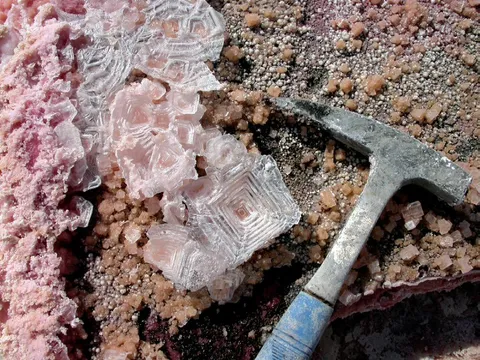
Wadi El-Natrun, northwest of Cairo, is a classic closed-basin evaporite locality. It is a chain of brine lakes and saline flats where sodium carbonate minerals and sulfates occur with halite, gypsum, natron, trona, thermonatrite, thénardite, mirabilite, gaylussite, pirssonite, burkeite, nahcolite, and related species. These are delicate collector minerals, often small, friable, soluble, and vulnerable to humidity changes, but they matter because Wadi El-Natrun is tied to the long history of Egyptian natron extraction and to mineral species whose names entered chemistry, archaeology, and everyday language.
The Eastern Desert is Egypt’s great hard-rock mineral belt. In the central and southern Eastern Desert, Neoproterozoic basement rocks of the Arabian-Nubian Shield host gold-bearing quartz veins, shear-zone mineralization, granites, pegmatites, greisens, copper occurrences, tungsten and molybdenum minerals, and rare-element assemblages. Um Safi, in the Marsa Alam district, is especially important to modern mineralogy because the greisenized F-rich granite there yielded marsaalamite-(Y), a new yttrium molybdate mineral approved by the IMA in 2024 and published in 2025. Most such Eastern Desert rarities are microscopic or analytical species rather than display specimens, but they greatly enrich Egypt’s mineralogical record.
Collecting access today varies sharply by locality. Zabargad is not a casual collecting island and is not a current commercial peridot source. The White Desert is a protected and heavily visited natural landscape, so responsible collectors should assume that surface collecting requires permission and that export or removal of geological material may be restricted. Ancient mine sites such as Wadi Sikait, Serabit el-Khadim, Wadi Maghareh, and Wadi Hammamat are archaeological landscapes, not collecting grounds. Material on the market should therefore be judged by old labels, reliable acquisition history, and a realistic understanding of what each Egyptian locality actually produces.
Egyptian “marcasite” specimens in the collector market are best understood through the White Desert pseudomorphs north of Farafra Oasis: the original FeS2 grew as bladed, cockscomb, stellate, spherical, tabular, and tubular aggregates in the Cretaceous Khoman Chalk, then was replaced largely by goethite and other iron oxides or oxyhydroxides while retaining marcasite morphology. Good pieces are dark brown to black, lustrous, three-dimensional floaters with crisp blades or radiating starbursts, often with tiny white barite, calcite, or gypsum grains lodged between the blades; ordinary pieces are duller, rounded, broken, or so altered that the original marcasite habit is only vaguely suggested. Specimens range from small thumbnails to cabinet-size clusters of several centimeters, and sharp White Desert examples stand apart because they preserve the architectural marcasite form far better than the common rounded “prophecy stone” nodules sold in tourist and metaphysical trade.
Egyptian peridot is the classic gem material of Zabargad Island in the Red Sea, where forsterite-rich olivine occurs in peridotite and associated deep-crustal rocks as transparent yellow-green to rich green crystals and fragments. The most desirable specimens show distinct crystal faces, glassy luster, strong green color without muddy brown tones, and minimal internal fracturing; many surviving old pieces are thumbnails or small miniatures, while historic reports describe crystals commonly in the 2–4 cm range and exceptional crystals reaching much larger sizes. Associations are chiefly the altered ultramafic setting itself—serpentinized peridotite, pyroxene-bearing rocks, chromian spinel or dark inclusions, and later vein material—so a convincing Zabargad peridot specimen is valued not just for size and clarity but for the rare combination of locality, gem character, and documented old provenance.
Forsterite from Egypt is inseparable from Zabargad, because the island’s peridot is mineralogically forsterite-rich olivine with a subordinate fayalite component, Mg2SiO4 dominant in the olivine solid-solution series. As mineral specimens, Egyptian forsterite crystals tend to be evaluated more strictly than cut peridot: collectors want recognizable orthorhombic crystal form, bright vitreous surfaces, clean green body color, and a label tying the piece to St. John’s Island rather than merely “Red Sea” or “Egypt.” Matrix pieces are scarce and especially desirable when the green crystal remains seated in altered ultramafic rock; loose fragments are commoner, and their value rises sharply when they are transparent, undamaged, sharply terminated, and accompanied by an old collection pedigree.
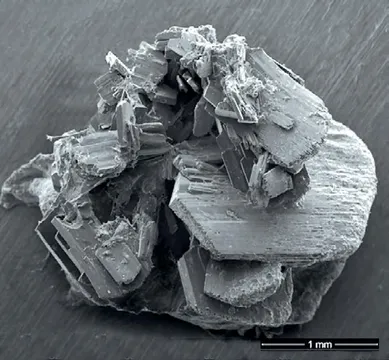
Egyptian hematite appears in two collector contexts. In the White Desert, many pseudomorphs after marcasite or pyrite have historically been labeled hematite, although analytical work on representative material shows goethite commonly dominates, so careful labels should read “goethite, hematite, or iron oxyhydroxide pseudomorph after marcasite/pyrite” unless tested. At Bahariya Oasis, hematite is a genuine major ore mineral with goethite, siderite, pyrite, quartz, barite, halite, gypsum, and manganese oxides in the El Gedida, Ghorabi, El Harra, Nasser, and related iron deposits. Display-quality hematite from Egypt is usually massive, earthy, oolitic, botryoidal, or pseudomorphic rather than brilliant platy “iron rose” material; better specimens show rich red-brown to steel-black color, interesting ore textures, or a clear Bahariya or White Desert provenance.
Other Egyptian minerals of collector and mineralogical importance include emerald-green beryl from the ancient Wadi Sikait–Zubara district, turquoise and copper minerals from Serabit el-Khadim and Wadi Maghareh in Sinai, native gold and sulfides from Eastern Desert quartz-vein systems, trona, natron, thermonatrite, thénardite, mirabilite, gaylussite, pirssonite, and halite from Wadi El-Natrun, manganese oxides and iron minerals from Bahariya, and rare-element species from Eastern Desert granites and greisens. Type-locality and historically important species include chalconatronite, first described as a blue-green corrosion mineral on ancient Egyptian bronze objects; bahariyaite, reported from Bahariya Oasis but considered by some authors problematic and possibly anthropogenic; and marsaalamite-(Y), a recently approved yttrium molybdate from the greisenized Um Safi F-rich granite near Marsa Alam.
The main authenticity issue with Egyptian specimens is not laboratory synthesis but locality and species labeling. White Desert pseudomorphs are routinely sold under loose or outdated names: “hematite after marcasite,” “limonite after marcasite,” “marcasite,” “pyrite,” “Egyptian black diamond,” and “prophecy stone.” The best scientifically cautious label is usually goethite-dominant iron oxyhydroxide pseudomorph after marcasite and/or pyrite, with hematite listed only when supported by analysis or reliable provenance. The morphology is real and natural, but the trade names often obscure the mineralogy.
Zabargad peridot demands provenance discipline. The island is not a modern commercial producer, and small loose green olivine crystals from Pakistan, Myanmar, China, Arizona, or other sources can be misrepresented as Egyptian if the buyer relies only on appearance. Old handwritten labels, documented museum or dealer histories, and a realistic size-and-quality comparison are important. A confirmed Zabargad crystal may be smaller or less perfect than a modern Pakistani peridot, yet it can be more desirable because of historical locality value. Faceted stones require even more caution: peridot origin is not reliably established by color alone.
Condition is also locality-specific. Zabargad peridot can be chipped, abraded, internally fractured, or partly etched; sharp terminations and lustrous faces are worth paying for. White Desert pseudomorphs are more robust than fresh marcasite because they are largely oxidized, but thin blades can snap and repaired points are not unusual on dramatic clusters. If any original sulfide remains, keep the specimen dry and isolated from carbonate labels or mounts, because marcasite and pyrite oxidation can produce acidic alteration products. Evaporites from Wadi El-Natrun are far more delicate: many are soluble, humidity-sensitive, and best kept in stable, dry microclimates.
Mislabelling by country is common in tourist material. Egyptian desert ironstone nodules, fossiliferous concretions, chert, and gypsum roses may be sold as meteorites, tektites, artifacts, “black diamonds,” or vaguely “pharaonic” stones. Ancient mine localities in Sinai and the Eastern Desert are archaeological sites; specimens claimed to have been collected recently from such places should be approached carefully from both legal and ethical angles. For serious collections, Egypt rewards labels that name the actual locality—Zabargad Island, White Desert near Farafra, Bahariya Oasis, Wadi El-Natrun, Wadi Sikait, Serabit el-Khadim, Um Safi—rather than only the country.
Market availability is uneven. White Desert pseudomorphs are the most commonly encountered Egyptian mineral specimens today, especially as small to hand-size clusters. Zabargad peridot crystals appear far less often and command premiums when accompanied by credible old labels. Bahariya hematite and manganese-iron ore specimens are available occasionally but seldom as fine crystallized display pieces. Wadi El-Natrun evaporites and Eastern Desert rare-element minerals are specialized collector material, usually small, fragile, or analytical rather than showy.
The most enduring Egyptian mineral story begins on a small, barren Red Sea island that ancient writers called Topazos or Ophiodes. Sailors knew it as a difficult place, a serpent island, lying off the route between the Egyptian coast and the port of Berenike. The green stones reportedly could not be seen well in the glare of day but were searched for in darkness, when they were said to shine or reveal themselves by night. The mineral behind the story was not topaz in the modern sense, but peridot: forsterite-rich olivine from Zabargad.
The island’s mineral magic is geological rather than mythical. Zabargad is made of rocks that belong deep below the surface: peridotites, gneisses, and associated crustal and mantle materials lifted into view during the history of the Red Sea. A collector holding a centimeter-scale green crystal from St. John’s Island is holding a gem from a setting that also became a reference point in debates about uplifted mantle, Red Sea rifting, older Pan-African lithosphere, and metasomatic fluids. Few mineral localities connect hand-specimen beauty so directly to plate-scale geology.
The ancient mine itself was not a romantic paradise. Archaeological work identified roughly 150 open surface pits on the southeastern shore of Zabargad, with nearby ruins of stone dwellings suggesting perhaps 10 to 20 miners living and working there. There was no fresh water on the island. That fact alone changes the way one looks at a Zabargad crystal: every recovered gem required not only extraction but provisioning, transport, and survival on a dry offshore rock. The mine appears to have been abandoned around the middle of the sixth century AD, near the time when Berenike, the mainland Red Sea port tied to the trade, also declined.
Modern rediscovery added its own cast of characters. Edward Gübelin visited Zabargad in March 1980 and wrote one of the classic twentieth-century accounts of the locality. Earlier, in the period before World War I, mining rights were held under the authority of the Khedive, and the island again entered European mineral and gem literature. One celebrated crystal passed through the hands of Ismalum Bey, managing director of the mining company, who sold it to Cairo businessman Max Ismalun. It measured 6.6 by 5.1 by 2.5 cm and was described as well formed, nearly flawless, and a fine deep green—exactly the sort of specimen that explains why collectors still speak of Zabargad with a special tone.
Egypt’s oldest geological story on paper belongs to the Turin Papyrus Map, prepared around 1150 BC for an expedition of Ramesses IV to Wadi Hammamat in the Eastern Desert. It is not merely a route sketch. It shows topography, quarrying, gold workings, the gold-working settlement at Bir Umm Fawakhir, gold-bearing quartz veins, the famous bekhen-stone quarry, and differently colored rock and gravel units. In modern terms, it is a mining map and a geological map at once—the work of people who understood that rock type, vein position, and terrain mattered.
Wadi Sikait, the ancient emerald district of the Eastern Desert, tells a different story of beauty extracted from uncomfortable geology. The emeralds occur in contact zones where quartz and pegmatite veins cut phlogopite schist. Ancient miners followed those zones underground. A mid-twentieth-century Egyptian Geological Survey report described some workings as so narrow and tortuous “that one has to creep all the time,” while other tunnels were cleanly cut, systematically dug, and high enough to walk through comfortably. Some inclined tunnels even had steps cut into the floor, and pillars of country rock were left in place to support the roof. For a collector, those details make Egyptian emerald less a generic green beryl and more a specimen of Roman and Byzantine mining engineering.
The White Desert pseudomorphs have a quieter story, but one every field collector understands: the landscape itself sorted the specimens. The Khoman Chalk is pale, soft, and wind-carved into cliffs, cones, mushrooms, and ridges; the dark iron pseudomorphs are tougher and weather out as resistant objects against the white ground. For years they circulated as curiosities, commonly called marcasite or hematite pseudomorphs, before detailed work clarified the mixture of original marcasite and pyrite forms and the goethite-rich replacement. The best pieces look almost intentional—black stars and bladed rosettes released from chalk that once lay beneath a southern Tethyan sea.
Gübelin, Edward. “Zabargad: The Ancient Peridot Island in The Red Sea.” Gems & Gemology, Vol. 17, No. 1, 1981, pp. 2–8. Classic first-person modern account of Zabargad peridot, including geology, mining, gem characteristics, and historical context.
Shigley, James E. “Historical Reading List: Peridot from Egypt.” Gemological Institute of America, 2026. A curated bibliography of Zabargad peridot literature from classical sources through modern geology and gemology.
Wilson, Wendell E. “Famous Mineral Localities: Saint John’s Island, Egypt.” The Mineralogical Record, Vol. 7, No. 6, 1976, pp. 310–314. A classic collector-oriented account of Zabargad, cited in GIA’s historical bibliography.
Bonatti, E., Hamlyn, P., and Ottonello, G. “Upper Mantle beneath a Young Oceanic Rift: Peridotites from the Island of Zabargad (Red Sea).” Geology, Vol. 9, No. 10, 1981, pp. 474–479. Important paper interpreting Zabargad peridotites as uplifted mantle material tied to the Red Sea rift system.
Bonatti, E., Clocchiatti, R., Colantoni, P., Gelmini, R., Marinelli, G., Ottonello, G., Santacroce, R., Taviani, M., Abdel-Meguid, A.A., Assaf, H.S., and El Tahir, M.A. “Zabargad (St. John’s) Island: An Uplifted Fragment of Sub-Red Sea Lithosphere.” Quarterly Journal of the Geological Society of London, Vol. 140, No. 4, 1983, pp. 677–690. A foundational geological study of the island’s mantle and crustal rocks.
Allen, Hannah M., Bailey, David G., and Tewksbury, Barbara. “Pseudomorphed Mineral Aggregates of the Khoman Chalk, Western Desert, Egypt.” Geological Society of America Abstracts with Programs, Vol. 46, No. 2, p. 66, 2014. Analytical study of the White Desert pseudomorphs, documenting goethite-dominant replacement after marcasite and pyrite.
Marchesini, Marco, and Barresi, Antonello. “The Wadi Natrun Evaporite Deposits, Western Desert, Buhayra Governorate, Egypt.” The Mineralogical Record, Vol. 50, No. 6, 2019, pp. 723–748. Collector-relevant treatment of the Wadi El-Natrun evaporite mineral assemblage.
Harrell, James A. “Archaeological Geology of the World’s First Emerald Mine.” Geoscience Canada, Vol. 31, No. 2, 2004. Key paper on Wadi Sikait emerald geology, mining methods, and archaeological setting.
Mindat: Egypt — Country-level mineral locality database for Egypt, with sublocalities, species lists, photographs, and references.
Mindat: St. John’s Island / Zabargad Island, Red Sea, Egypt — Core locality page for Egyptian peridot and forsterite specimens.
GIA: Peridot Gemstone Guide — Useful gemological overview with Egypt’s Zabargad Island placed in peridot history.
GIA: Historical Reading List: Peridot from Egypt — Best single bibliography for Zabargad peridot history, geology, and gemology.
GIA: Zabargad: The Ancient Peridot Island in The Red Sea — Edward Gübelin’s classic 1981 Gems & Gemology article.
Smithsonian National Museum of Natural History: Forsterite var. Peridot from Zabargad Island — Museum specimen record for a Zabargad peridot in the Smithsonian collection.
AMNH Digital Collections: Peridot crystal and cut stone from Zabargad Island — American Museum of Natural History record showing a 4.1 cm peridot crystal and a 10.92 ct cut stone from Zabargad.
Mindat: White Desert, Farafra Oasis, New Valley Governorate, Egypt — Locality context for White Desert pseudomorphs after marcasite and pyrite.
GSA Abstract: Pseudomorphed Mineral Aggregates of the Khoman Chalk, Western Desert, Egypt — Concise scientific source for the mineralogy and formation of the White Desert pseudomorphs.
Mindat: Hematite from White Desert, Farafra Oasis — Useful entry showing how White Desert material has been recorded and labelled.
Mindat: Wadi El-Natrun depression, Beheira Governorate, Egypt — Evaporite locality page for trona, natron, thermonatrite, thénardite, halite, gypsum, and associated species.
Klemm, Rosemarie, Klemm, Dietrich, and Murr, Andreas. “Gold of the Pharaohs – 6000 Years of Gold Mining in Egypt and Nubia.” Journal of African Earth Sciences, Vol. 33, No. 3–4, 2001, pp. 643–659. Major synthesis of ancient Egyptian and Nubian gold mining, with emphasis on auriferous quartz veins and shear-zone deposits.
Harrell, James A., and Brown, V. Max. “The World’s Oldest Surviving Geological Map: The 1150 B.C. Turin Papyrus from Egypt.” The Journal of Geology, Vol. 100, No. 1, 1992, pp. 3–18. Essential publication on the Turin Papyrus Map and its depiction of Wadi Hammamat geology and mining.
Frondel, Clifford, and Gettens, Rutherford J. “Chalconatronite, a New Mineral from Egypt.” Science, Vol. 122, 1955, pp. 75–76. Original description of chalconatronite, a sodium copper carbonate hydrate first found as an alteration product on Egyptian bronze artifacts.
Mahdy, Nasser Mourad, Ondrejka, Martin, Bačík, Peter, Biagioni, Cristian, Sejkora, Jiří, Uher, Pavel, Števko, Martin, Förster, Hans-Jürgen, and Mikuš, Tomáš. “Marsaalamite-(Y), Y(MoO4)OH, a New Molybdate Mineral from the Um Safi Area, Marsa Alam District, Central Eastern Desert, Egypt.” Mineralogical Magazine, Vol. 89, No. 3, 2025, pp. 443–453. Formal description of a new Egyptian type-locality mineral from greisenized F-rich granite.
Mindat: Marsaalamite-(Y). Mineral database entry with formula, properties, type locality, IMA status, and references.
Mindat: Bahariya Oasis, Giza Governorate, Egypt. Locality page for the major iron-manganese district, including bahariyaite and the documented ore-mineral assemblage.
Baioumy, Hassan, et al. “A Mixed Hydrogenous and Hydrothermal Origin of the Bahariya Iron Ores, Egypt: Evidences from the Trace and Rare Earth Element Geochemistry.” Journal of Geochemical Exploration, 2014. Study of Bahariya iron ores documenting hematite and goethite as principal constituents.
GIA: Historical Reading List: The Ancient Emerald Mines of Egypt — Bibliographic gateway to Wadi Sikait, Zubara, and the Mons Smaragdus emerald district.
University of Liverpool: Sikait-Zubara Emerald Mine Project — Current academic project page on the Roman and Byzantine emerald mines of Egypt’s Eastern Desert.
Geoscience Canada: Archaeological Geology of the World’s First Emerald Mine — Detailed open-access paper on Wadi Sikait emerald geology and ancient mining.
UCL Digital Egypt: Sinai — Clear archaeological overview of Sinai copper, malachite, turquoise, and the Hathor temple at Serabit el-Khadim.
Library of Congress: Turquoise Mine at Sinai — Historical photograph record with useful contextual notes on Sinai mining districts.
Journal of Geology: The World’s Oldest Surviving Geological Map — Publication on the Turin Papyrus Map and its depiction of Wadi Hammamat geology and mining.
USGS: Egypt Mineral Information — Current national mineral-industry overview, useful for separating collector localities from active industrial commodities.
Mindat: Marsaalamite-(Y) — Database entry for Egypt’s recently approved molybdate type-locality mineral.
Cambridge Core: Marsaalamite-(Y), Y(MoO4)OH, a New Molybdate Mineral — Formal Mineralogical Magazine publication on the Um Safi type material.